

Updated: August 2026
Flying with a dog or cat can be much easier when you choose the right airline.
But “pet-friendly” does not simply mean that an airline allows pets in the cabin.
Before booking, you may need to compare:
- Whether pets can fly in the cabin
- Which animals are accepted
- Pet fees
- Carrier requirements
- Number of pets allowed
- Aircraft restrictions
- Seat restrictions
- Destination limitations
- International-entry requirements
- Whether pets can travel in the baggage compartment
- Rules for service animals
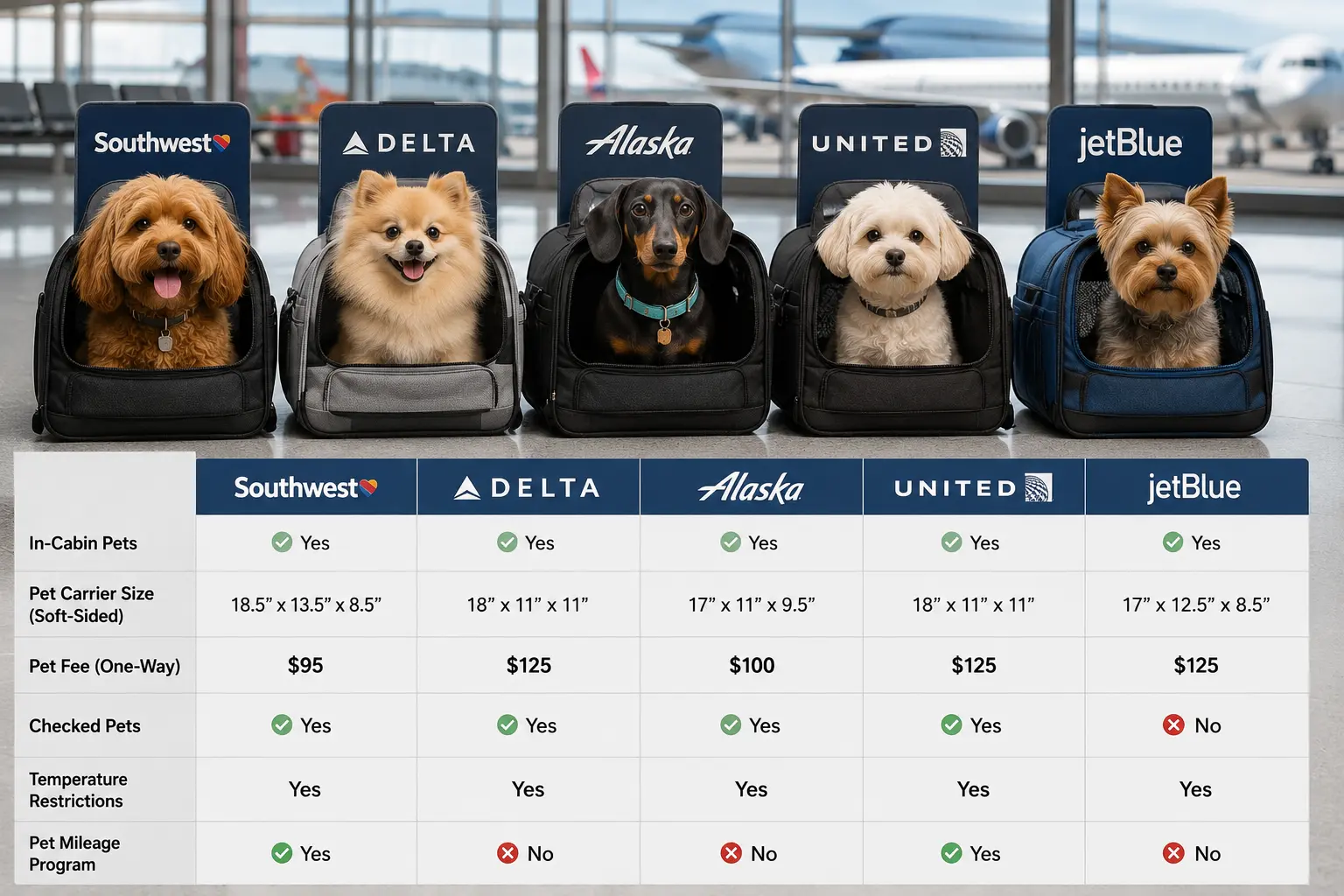
For example, American Airlines currently allows eligible small cats and dogs to travel in the cabin, with a $150 carry-on pet fee per kennel on qualifying routes. Alaska Airlines offers cabin and baggage-compartment options, with pet travel fees ranging from $100 to $200 each way, depending on the type of travel and route. Delta currently lists a $150 one-way in-cabin fee for U.S./Canada/Puerto Rico/U.S. Virgin Islands travel for tickets issued on or after April 8, 2025.
That means the “best” airline depends on your pet, route, and travel needs—not simply on the lowest fee.
Important: Airline policies, fees, aircraft restrictions, and destination requirements can change. Always check the airline’s current pet-travel page and your destination’s government requirements before booking.
Quick Comparison: Pet-Friendly Airlines
| Airline | Cabin pets | Current published pet fee* | Best for |
|---|---|---|---|
| Alaska Airlines | Yes, eligible pets | From $100 each way | Travelers wanting multiple transport options |
| American Airlines | Yes, eligible cats/dogs | $150 per kennel | Many U.S./nearby international routes |
| Delta Air Lines | Yes, eligible small pets | $150 each way on qualifying domestic-region tickets | Straightforward cabin travel |
| JetBlue | Yes, small dogs/cats | Fee applies | Cabin-only travelers |
| United Airlines | Yes, eligible pets | Check current itinerary | Travelers who want to add a pet during booking |
*Fees and eligibility depend on route, destination, aircraft, ticket date, and other restrictions. Do not treat the table as a guarantee of availability.
For example, Alaska says pet space is subject to availability and that international and Hawaii travel can have additional requirements. Delta similarly states that aircraft configuration can affect whether a pet can travel in a particular cabin.
What Makes an Airline “Pet-Friendly”?
A useful airline comparison should look at more than price.
I recommend evaluating six factors:
1. Cabin availability
Can your pet stay with you under the seat?
2. Total cost
How much will you pay each way?
3. Carrier requirements
Will your existing carrier fit under the seat?
4. Route flexibility
Are pets accepted on your specific route?
5. Aircraft restrictions
Does the aircraft have enough under-seat space?
6. Booking process
Can you reserve the pet easily and confirm availability before travel?
An airline that charges $25 less but has fewer eligible routes may not actually be the better choice.
1. Alaska Airlines
Alaska Airlines is worth considering if you want more than one pet-transport option.
Alaska currently offers:
- Pets in the cabin
- Pets in the baggage compartment
- Cargo transportation through Alaska Air Cargo
- Additional options for certain destinations
Its current pet-travel page says fees range from $100 to $200 each way, depending on the type of travel and route. Trained service animals travel free.
Cabin travel
Pets that fit in an under-seat carrier can travel in the cabin, subject to the airline’s rules and available pet space.
Why Alaska stands out
Alaska can be attractive for travelers whose pets don’t fit the airline’s cabin requirements because it provides additional transport options.
However, baggage-compartment travel has its own:
- Breed restrictions
- Fleet restrictions
- Date embargoes
- Destination requirements
So don’t assume that a pet accepted in the cabin will automatically qualify for baggage-compartment travel.
Best for
Travelers who want multiple pet-transport options.
2. American Airlines
American Airlines currently allows eligible cats and dogs to travel in the cabin on qualifying routes.
American’s current policy lists a $150 carry-on pet fee per kennel for qualifying travel.
Cabin carrier requirements
American recommends soft-sided carriers and currently lists:
Soft-sided:
18 × 11 × 11 inches
For some aircraft, hard-sided carrier dimensions differ.
The carrier must fit under the seat, and the pet must remain inside the carrier during the flight.
Seat restrictions
Pets are not permitted in certain seats, including:
- Bulkhead seats
- Exit rows
- Certain premium-cabin seats
- Seats without suitable under-seat storage
Aircraft type matters.
Checked pets
American’s current policy is much more restrictive than many older articles suggest.
Checked pets are currently accepted only for active-duty U.S. military and U.S. State Department Foreign Service personnel traveling on official orders, subject to additional requirements.
This is important because older online articles may incorrectly suggest that ordinary passengers can simply check their dog or cat as baggage.
Best for
Travelers whose small dogs or cats can comfortably travel in the cabin.
3. Delta Air Lines
Delta Air Lines allows eligible small dogs, cats, and certain household birds to travel in the cabin, subject to route and aircraft restrictions.
Current in-cabin fee
For U.S., Canada, Puerto Rico, and U.S. Virgin Islands travel, Delta lists:
$150 each way
for tickets issued on or after April 8, 2025.
International fees can be higher.
Carrier requirements
Delta recommends a soft-sided carrier with maximum dimensions of:
18 × 11 × 11 inches
because that size fits most aircraft, although actual under-seat dimensions can vary.
Cabin restrictions
Delta’s current policy indicates that pet availability can depend on cabin and aircraft configuration.
For example, pets are not permitted in certain premium cabins, while Delta Main/Comfort may have limited pet capacity.
International restrictions
Some destinations do not permit pets in the cabin, including destinations such as:
- Australia
- Barbados
- Hawaii
- Hong Kong
- Iceland
- Jamaica
- New Zealand
- South Africa
- United Kingdom
- United Arab Emirates
The exact restrictions depend on the route and destination.
Best for
Travelers looking for a major U.S. airline with established cabin-pet procedures.
4. JetBlue
JetBlue is another option for travelers flying with a small dog or cat.
Its current contract of carriage permits small dogs and cats in the cabin, subject to the airline’s rules. Pets are not permitted in Mint, and JetBlue’s current contract allows a maximum of six pets in the cabin on a flight.
The airline requires pets to travel in an approved kennel.
Important limitation
JetBlue does not accept ordinary pets as checked baggage under its current contract of carriage.
That makes JetBlue primarily a cabin-pet option.
Best for
Small dogs and cats that can comfortably travel in an approved cabin carrier.
5. United Airlines
United Airlines currently supports in-cabin pet bookings on eligible flights.
United’s booking system currently states that it allows one pet per adult or senior in a reservation, subject to additional restrictions.
This is useful because travelers can see pet availability as part of the booking process.
Why this matters
Pet capacity can be limited.
A flight that has seats available may not necessarily have space available for another cabin pet.
So don’t wait until airport check-in to discover that pet capacity has been reached.
Best for
Travelers who want to check pet availability while arranging their flight.
Which Airline Is the Cheapest?
There isn’t one universal winner.
Based on the current published fees discussed above:
- Alaska: from $100 each way
- American: $150 per kennel on qualifying carry-on routes
- Delta: $150 each way for qualifying U.S./Canada/Puerto Rico/U.S. Virgin Islands travel
- JetBlue: fee applies; check the current itinerary/booking terms
- United: check the current booking flow and itinerary
Alaska has the lowest advertised starting price among these examples, but that does not mean Alaska will always be cheapest for your trip.
The Real Cost of Flying With a Pet
Don’t calculate only the pet fee.
Your actual cost may include:
Pet fee
Carrier
Health certificate, if required
Vaccination or veterinary requirements
Destination-entry costs
Airport transportation
Additional baggage
For example:
Example trip
Pet fee: $150 each way
Round trip:
$150 × 2 = $300
Add:
Carrier: $60
Veterinary documentation: $75
Total estimated pet-related cost:
$435
This is only an example, not an average cost.
Cabin vs. Cargo vs. Baggage Compartment
These options are not interchangeable.
Cabin
Your pet travels with you in an approved carrier under the seat.
Advantages
- You can see your pet
- No separate cargo handling
- Often simpler for small pets
Limitations
- Pet must fit in carrier
- Under-seat space is limited
- Pet capacity may be restricted
Baggage Compartment
Some airlines offer temperature-controlled baggage-compartment transportation on eligible routes.
But this option can have:
- Breed restrictions
- Temperature restrictions
- Aircraft restrictions
- Seasonal embargoes
- Route limitations
Alaska currently describes baggage-compartment travel as subject to breed, date, and fleet restrictions.
Cargo
Cargo is a separate transportation service.
It may be necessary for pets that cannot travel in the cabin and don’t qualify for baggage-compartment travel.
American, for example, directs pets that do not qualify for cabin or eligible checked travel toward its cargo service.
Is It Better to Fly With Your Pet in the Cabin?
For many owners of small dogs and cats, cabin travel is attractive because the animal remains physically close to the passenger.
But cabin travel isn’t automatically comfortable for every pet.
Consider:
- Pet temperament
- Carrier size
- Flight duration
- Layovers
- Airport noise
- Temperature
- Destination requirements
A nervous animal may find a long airport journey stressful even if it stays in the cabin.
What Size Dog Can Fly in the Cabin?
There is no single universal weight limit across all airlines.
The practical limitation is usually whether the pet can:
fit comfortably inside the approved carrier and the carrier can fit underneath the seat.
Delta, for example, says the pet must be small enough to fit comfortably in the kennel and that the kennel must fit completely underneath the seat.
American similarly requires carry-on pets to remain in an appropriately sized carrier under the seat.
So instead of asking:
“What is the maximum dog weight?”
ask:
“Will my dog and carrier meet the exact requirements of my aircraft and route?”
Does the Pet Carrier Count as a Carry-On?
It depends on the airline.
American’s current rules, for example, limit passengers traveling with a carry-on pet to one additional item: either a personal item or a qualifying carry-on bag.
That can affect how much luggage you can bring.
Always read the airline’s specific pet policy instead of assuming the carrier is treated the same everywhere.
Can My Pet Sit on My Lap?
Generally, ordinary pets traveling as cabin pets must remain inside their approved carrier.
Do not assume that paying a pet fee gives you permission to take your dog or cat out during the flight.
The carrier usually needs to remain properly stowed.
Can I Buy a Seat for My Pet?
Buying an extra passenger seat does not automatically mean your pet can occupy that seat.
Airline pet rules typically require ordinary cabin pets to remain in an approved carrier under the seat.
Service-animal rules are different.
Always follow the airline’s specific policy.
Can I Take My Pet Into the Airport?
Airport rules can vary.
After security screening, airlines may require pets to remain inside their carrier except in designated relief areas.
Delta, for example, states that pets must remain in their kennel in the airport, including during check-in, boarding, and deplaning, except when using designated relief areas.
What About Service Animals?
A trained service animal should not simply be treated as an ordinary pet.
Under U.S. Department of Transportation rules, airlines have separate requirements for service animals.
For example, American states that fully trained service dogs can travel in the cabin without a pet fee if they meet the airline’s requirements.
This is different from an ordinary pet or an emotional support animal.
What About Emotional Support Animals?
Do not assume that an emotional support animal automatically receives the same airline treatment as a service dog.
Airlines now distinguish between:
- Pets
- Service animals
- Emotional support animals
American’s current policy explicitly states that emotional support and comfort animals may travel as pets rather than service animals, with applicable pet requirements and fees.
This distinction is important when booking.
What Documents Does My Pet Need?
The answer depends on the destination.
Possible requirements include:
- Rabies vaccination
- Health certificate
- Microchip
- Import permit
- Government forms
- Quarantine documentation
The airline is not necessarily the only authority you need to satisfy.
You may also have to meet:
- USDA requirements
- CDC requirements
- State requirements
- Destination-country requirements
International Pet Travel Is More Complicated
A flight can be “pet-friendly” while the destination is difficult for animals to enter.
Before booking an international trip, check:
Airline requirements
What does the airline require?
Government requirements
What does the destination government require?
Transit requirements
Does the connecting country have separate rules?
Return requirements
What will you need when bringing your pet home?
Don’t Assume a Direct Flight Is Always Better
A nonstop flight usually reduces:
- Handling
- Connections
- Airport transfers
- Waiting time
But it may not always be available.
If you need a connection, check the pet policy of every operating airline.
A codeshare flight can be especially important.
Codeshare Flights Need Extra Attention
Suppose you purchase a ticket from Airline A.
But one segment is operated by Airline B.
The marketing airline’s pet policy may not be the only policy that matters.
American explicitly notes that passengers must check each operating airline’s requirements and that it does not collect pet fees for other operating airlines on a trip.
Therefore:
Always check the airline listed under “Operated by.”
Temperature Restrictions Matter
Some airlines restrict pet travel when temperatures are too high or too low.
American, for example, currently lists temperature restrictions for pets traveling outside the cabin and has specific heat and cold rules.
This can be especially important for:
- Summer travel
- Winter travel
- Hot airports
- Cold-weather destinations
If your pet cannot safely travel under the airline’s conditions, the airline may refuse transportation.
Should You Sedate Your Pet?
Do not make this decision casually.
American currently states that it does not accept pets that have been sedated or tranquilized and cites concerns about the risks of sedation at altitude.
If you’re worried about your pet’s anxiety, discuss travel preparation with your veterinarian before the trip.
Don’t give medication simply because another traveler recommended it.
Which Airline Is Best for Small Dogs?
For a small dog that can comfortably fit under the seat, several airlines may work.
Your decision should depend on:
- Route
- Nonstop availability
- Pet availability
- Fee
- Carrier dimensions
- Aircraft
- Destination restrictions
For example, American, Delta, Alaska, JetBlue, and United all have current cabin-pet options, but their restrictions differ.
Which Airline Is Best for Cats?
Cats are often easier to accommodate in airline cabins because many can fit comfortably in approved under-seat carriers.
American, Delta, JetBlue, and Alaska all publish cabin-pet options that include cats, subject to route and carrier requirements.
But your cat still needs to tolerate:
- Carrier confinement
- Airport security
- Noise
- Aircraft sounds
- Travel duration
Which Airline Is Best for Larger Dogs?
This is much more complicated.
If your dog cannot fit safely in an approved under-seat carrier, ordinary cabin travel may not be possible.
Your options may include:
- An airline offering eligible baggage-compartment travel
- Cargo transportation
- Ground transportation
- A pet-specific transport service
Alaska currently offers both cabin and baggage-compartment options, while JetBlue’s current contract limits ordinary pets to cabin travel.
What Is the Most Pet-Friendly Airline?
There is no objective winner for every traveler.
A better way to rank airlines is by use case.
Best for lower advertised starting fee
Alaska Airlines
Its pet travel program starts at $100, although actual fees vary by travel type and route.
Best for extensive cabin-pet information
American Airlines
American provides detailed carrier, aircraft, seat, destination, and temperature information.
Best for straightforward major-airline cabin travel
Delta
Delta publishes detailed cabin requirements and destination restrictions.
Best for cabin-only small-pet travelers
JetBlue
Its current rules focus ordinary pet travel on small dogs and cats in the cabin.
Best for booking with pet availability in the reservation flow
United
United’s booking interface currently allows travelers to select pets in cabin and states that one pet per adult or senior can be included in a reservation, subject to restrictions.
Airline Pet Policy Checklist
Before buying the ticket, check:
Pet eligibility
- Dog or cat?
- Minimum age?
- Breed restrictions?
- Health requirements?
Cabin
- Can my pet fit under the seat?
- Is the flight aircraft-compatible?
- Is pet space available?
- Are there seat restrictions?
Cost
- Pet fee
- Carrier
- Health certificate
- Destination documents
- Additional baggage
Route
- Domestic or international?
- Direct or connecting?
- Codeshare?
- Hawaii?
- International destination restrictions?
Before departure
- Pet reservation confirmed
- Carrier measured
- Documents prepared
- Vaccinations current
- Airport relief area located
How to Choose the Right Airline: A Simple Method
Instead of searching:
“What is the most pet-friendly airline?”
use this process.
Step 1: Identify your pet
Dog or cat?
Step 2: Measure the carrier
Length × width × height.
Step 3: Identify the route
Domestic or international?
Step 4: Check nonstop options
Fewer connections can simplify pet travel.
Step 5: Compare total cost
Don’t compare only the pet fee.
Step 6: Confirm pet space
A seat may be available even when pet capacity is full.
Step 7: Check the operating carrier
Especially for codeshare itineraries.
Step 8: Recheck the policy before departure
Airline rules can change.
A Practical Example
Suppose you are traveling with a 12-pound cat from New York to Los Angeles.
You have three possible airlines.
Airline A
Pet fee: $150 each way
Round trip: $300
Airline B
Pet fee: $100 each way
Round trip: $200
Airline C
Pet fee: $150 each way
Round trip: $300
At first glance, Airline B looks cheapest.
But suppose:
- Airline B requires a connection
- Airline A offers a nonstop flight
- Airline C’s pet capacity is unavailable
The cheapest pet fee isn’t necessarily the cheapest or easiest trip.
How to Prepare Your Pet for the Flight
A few days before travel:
- Confirm the reservation
- Check the carrier
- Review documents
- Confirm flight times
- Check weather
- Plan airport transportation
- Locate pet relief areas
For longer trips, discuss feeding, hydration, motion sickness, and anxiety with your veterinarian.
What to Put in Your Pet Travel Kit
Consider carrying:
- Leash
- Harness
- Identification
- Vaccination records
- Required documents
- Food
- Water
- Absorbent pads
- Waste bags
- Medications prescribed by your veterinarian
- Cleaning supplies
- Familiar bedding
Keep important documents accessible rather than packed in checked luggage.
Common Mistakes to Avoid
Mistake 1: Booking the flight before checking pet availability
A flight can have seats but no remaining pet capacity.
Mistake 2: Measuring only the pet
The carrier must meet the airline’s requirements.
Mistake 3: Assuming all airlines allow checked pets
They don’t.
American’s current checked-pet program is limited to certain military and State Department travelers, while JetBlue does not accept ordinary pets as checked baggage.
Mistake 4: Ignoring the operating airline
Codeshare policies can differ.
Mistake 5: Using an outdated fee
Pet fees change.
Mistake 6: Ignoring destination rules
The airline may accept your pet while the destination does not permit entry under your current documentation.
Mistake 7: Assuming a service-animal policy applies to pets
Service animals are subject to different rules.
Frequently Asked Questions
What is the most pet-friendly airline in 2026?
There is no single best airline for every pet traveler. Alaska, American, Delta, JetBlue, and United all offer different pet-travel options, so the best choice depends on your route, pet size, aircraft, and travel needs.
Which airline has the cheapest pet fee?
Alaska currently advertises pet travel from $100, depending on the type of travel and route. Other airlines may have similar or different fees depending on the itinerary.
Can my dog fly in the cabin?
Possibly, if your dog is small enough to fit comfortably in an approved carrier under the seat and the specific flight accepts cabin pets.
Can large dogs fly in the cabin?
Usually, an ordinary pet must fit inside the airline’s approved under-seat carrier. Larger dogs may need another transportation option.
Can I check my dog as baggage?
It depends on the airline and your circumstances. American currently limits checked-pet travel to active-duty U.S. military and State Department Foreign Service personnel traveling on official orders, while other airlines have their own restrictions.
Can I fly with a cat?
Yes, several major airlines allow eligible cats in the cabin.
How much does it cost to fly with a pet?
Fees vary by airline, route, and travel method. Current published examples range from about $100 upward each way, but international or special transportation can cost more.
Does my pet need a health certificate?
It depends on the destination and airline. International travel often involves government documentation in addition to airline requirements.
Can I bring my pet on an international flight?
Sometimes. Destination-country rules can be stricter than the airline’s own policy.
Can emotional support animals fly for free?
Don’t assume so. Airlines generally distinguish emotional support animals from trained service animals. American, for example, treats emotional support animals as pets rather than service animals.
Are service animals charged pet fees?
Generally, qualifying service animals are handled separately from ordinary pets. American currently states that fully trained service dogs travel in the cabin without a fee if they meet its requirements.
Can I take my pet out of the carrier during the flight?
Ordinary cabin pets generally need to remain in the approved carrier. Follow the specific airline’s instructions.
Final Verdict: Which Airline Should You Choose?
There is no single airline that wins every pet-travel situation.
Instead, choose the airline that best matches your pet + route + carrier + budget.
Choose Alaska if:
You value multiple pet-transport options and want a program with cabin and baggage-compartment possibilities.
Choose American if:
You want detailed cabin-pet rules and your small dog or cat can travel in an approved under-seat carrier.
Choose Delta if:
You want a major airline with clearly published cabin-pet requirements and your itinerary is eligible.
Choose JetBlue if:
Your small dog or cat can travel in the cabin and you don’t need checked-pet transportation.
Consider United if:
Its route and pet availability work well for your trip and you want to check pet availability through the booking process.
The most important rule is simple:
Don’t choose an airline solely because an article calls it “pet-friendly.” Check the exact flight, aircraft, route, pet availability, carrier requirements, fee, and destination rules before paying for your ticket.
Related Pet Travel Guides
If you’re planning a trip with your pet, these guides can help:
Pet Cargo vs. Cabin Travel: Which Is Safer? — Compare cabin and cargo transportation.
Pet Travel Checklist — Prepare documents, carriers, food, and other essentials.
Pet Ownership Cost Calculator — Estimate your overall annual pet expenses.
ESA vs. Service Animal in Rental Housing — Understand the difference between assistance animals and service animals in housing.
Editorial Methodology
This comparison focuses on practical airline pet-travel factors:
- Cabin availability
- Published pet fees
- Carrier requirements
- Aircraft restrictions
- Checked/baggage options
- Destination restrictions
- Service-animal distinctions
- Booking considerations
Current airline information was checked against airline-published sources, including American Airlines, Alaska Airlines, Delta Air Lines, JetBlue, and United Airlines.
Because airlines can change fees, aircraft restrictions, and route eligibility, this article does not treat the comparison table as a permanent guarantee.
Fees shown are based on currently published airline information available at the time of review. Actual charges may differ by itinerary, ticket date, destination, currency, or applicable airline rules.
Legal & Travel Disclaimer
PetPolicyFinance.com is an independent informational website. We are not an airline, veterinarian, government agency, travel agent, or legal service.
Airline policies, fees, health requirements, animal-entry rules, and restrictions can change without notice.
Before traveling, verify the current rules directly with the airline and the government authority responsible for your destination.
This article is intended for general informational purposes and should not be treated as a guarantee that a particular airline will accept a particular animal on a specific flight.
Author: Harry Mills
Last Reviewed: August 2026
