

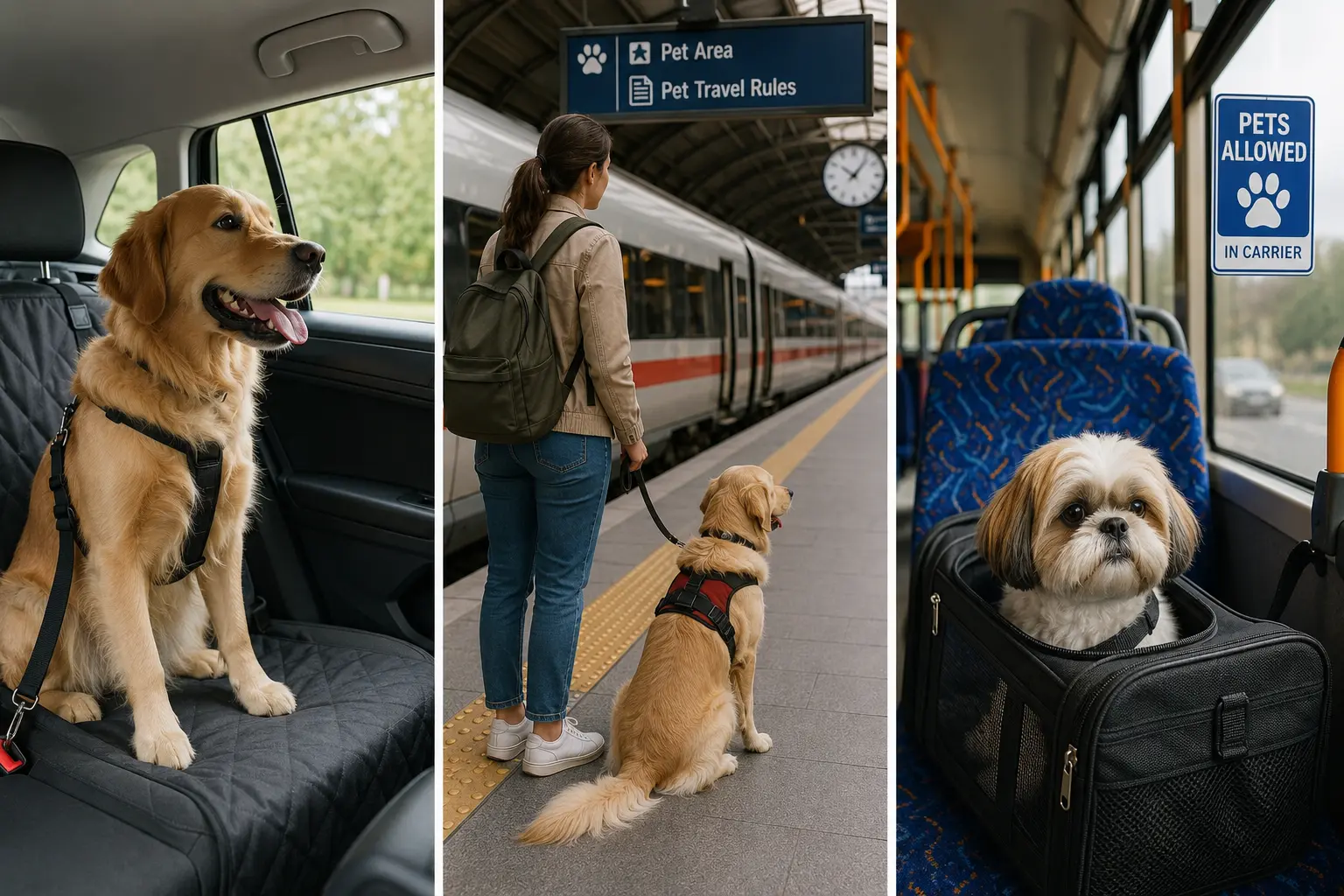
Not every trip with your pet involves an airport. Road trips, train journeys, and even long-distance bus travel are common ways pet owners get from point A to point B — but each mode of transportation comes with its own rules, costs, and practical challenges. What works perfectly for a car trip can be completely off-limits on a bus, and what’s simple on one train line may be restricted on another.
This guide walks through exactly what to expect when traveling with a pet by car, train, or bus, including real fees, documentation requirements, and the preparation that makes each option go smoothly.
Traveling With a Pet by Car
Car travel is by far the most flexible and pet-friendly option, since you control the schedule, the stops, and the environment. That flexibility, however, doesn’t mean there’s nothing to plan for.
Safety Comes First
The single most important rule of car travel with a pet is restraint. An unsecured pet in a moving vehicle is a safety risk both to the animal and to everyone else in the car — in a sudden stop, an unrestrained pet becomes a projectile.
Best practices include:
- Dogs: Use a crash-tested harness attached to a seatbelt, or a secured crate anchored in the back seat or cargo area.
- Cats: Keep cats in a secured, well-ventilated carrier at all times. Cats are far more likely than dogs to panic and interfere with driving if left loose in the car.
- Never let pets ride in truck beds unsecured, and never let them ride with their head out the window, since debris can cause eye, ear, or respiratory injuries. The American Veterinary Medical Association’s pet travel guidance covers these safety practices in more depth.
Planning Stops and Comfort
For trips longer than a couple of hours, plan stops roughly every two to three hours so your pet can relieve themselves, drink water, and stretch. Feed pets a light meal a few hours before departure rather than immediately before driving, since a full stomach combined with motion can trigger nausea.
Pack a dedicated pet travel kit including:
- Leash, collar or harness with ID tags, and a recent photo in case your pet gets loose
- Water, a collapsible bowl, and enough food for the entire trip plus extra
- Waste bags and a portable litter box for cats
- Any medications, plus your veterinarian’s contact information
- A basic pet first-aid kit
The Real Cost of Car Travel
Car travel is the cheapest way to travel with a pet by far. Beyond normal trip expenses like fuel and lodging, the main costs are:
- A quality crash-tested harness or carrier ($30–$150, depending on size and brand)
- Pet-friendly hotel fees along the route, which commonly range from $25 to $75 per stay
- Fuel and time for additional stops
If you’d rather not drive yourself, professional ground pet transport services also exist. These are typically priced by distance and can run anywhere from about $75 for a short local trip to several thousand dollars for a cross-country relocation, depending on the route and level of service.
Traveling With a Pet by Train
Train travel with a pet in the U.S. is more restrictive than car travel, but Amtrak — the primary long-distance passenger rail carrier — does allow small pets on many routes under specific conditions.
Amtrak’s Pet Policy
Amtrak allows small dogs and cats on most routes, but with firm restrictions:
- Pets, including their carrier, must weigh no more than 20 pounds combined
- Trips are limited to a maximum of 7 hours
- A pet reservation is required in advance, since only a limited number of pet spots are available per train — often as few as five
- Pets must remain in an approved, leak-proof, ventilated carrier that fits under the seat for the entire trip
- Pets are not allowed in food service cars or sleeping accommodations, and can only travel in coach class
Pet fees on Amtrak generally range from about $29 to $39 per travel segment depending on the route, and this fee is paid at the time of reservation and is non-refundable — meaning if your pet is denied boarding for any reason, including an oversized carrier, you lose that fee. For the complete, official rules, see Amtrak’s official pet policy page.
Not all Amtrak routes accept pets at all. Popular services that exclude pets include the Auto Train, Amtrak Cascades service to and from Canada, and several other cross-border or specialty routes, so it’s essential to confirm pet eligibility for your specific route before booking.
Documentation and Age Requirements
Amtrak requires pets to be at least 8 weeks old and fully weaned. You’ll also need to sign a pet release and indemnification agreement accepting responsibility for your pet’s behavior, and you should carry proof of current vaccinations, particularly rabies, since station agents may ask to see it during check-in.
Service Animals Travel Differently
Trained service animals are allowed on all Amtrak trains at no additional charge and are not subject to the size or weight limits that apply to pets. Emotional support animals, however, are treated the same as regular pets under Amtrak’s policy and are subject to the standard fees and restrictions.
Traveling With a Pet by Bus
Long-distance bus travel is the most restrictive option of the three, and it’s important to set expectations accordingly before planning a trip around it.
Greyhound’s Strict No-Pets Policy
Despite its name, Greyhound does not allow pets of any kind — dogs, cats, or otherwise — in the passenger cabin or in the luggage compartment beneath the bus. The only exception is for legitimate service animals trained to perform tasks for a person with a disability, as defined under the Americans with Disabilities Act. Emotional support animals, comfort animals, and therapy animals do not qualify for this exception and are not permitted on board under any circumstances.
This means if you’re planning bus travel with a pet that isn’t a trained service animal, Greyhound simply isn’t an option — and this rule is applied consistently regardless of the pet’s size, breed, or how well-behaved it is.
Other Bus Carriers Vary
Policies differ meaningfully by company, so it’s worth checking each carrier individually rather than assuming they all follow the same rule:
- Megabus generally restricts travel to service animals only, similar to Greyhound.
- Smaller regional carriers sometimes allow small pets in carriers for an additional fee, with weight limits often around 25 pounds combined with the carrier.
Because policies vary so widely between bus companies — and can differ even between routes operated by the same company — always confirm directly with the specific carrier before purchasing a ticket if you plan to travel with anything other than a certified service animal.
Why Buses Are More Restrictive Than Trains
The stricter approach on buses largely comes down to space and ventilation. Buses have far less room for pet carriers, no dedicated storage separate from passenger luggage, and less consistent climate control throughout the vehicle compared to trains, making it harder for carriers to guarantee a safe environment for a traveling pet.
Comparing Your Options at a Glance
If you’re deciding which mode of transportation makes sense for your trip, consider:
- Car travel offers the most flexibility, the lowest cost, and the fewest restrictions — ideal for most pet owners, provided your pet travels reasonably well by vehicle.
- Train travel works well for small dogs and cats on trips under 7 hours, provided you book early and confirm your route allows pets.
- Bus travel is realistically only an option if your pet is a trained service animal, or if you’re using a smaller regional carrier with a different policy than Greyhound or Megabus.
Questions to Ask Before You Book
Regardless of which mode you choose, confirm the following in advance:
- Is there a weight or size limit, and does it include the carrier?
- Is a reservation required, and is availability limited?
- Is the fee refundable if my pet is denied boarding?
- Are there restrictions on which routes or services allow pets?
- What documentation, such as vaccination records, will I need to show?
Final Thoughts
Traveling with a pet by car remains the simplest and most affordable option, while train travel offers a workable middle ground for small pets on shorter trips. Bus travel, by contrast, is the most limited of the three, with major carriers like Greyhound reserving space almost exclusively for trained service animals. Whichever mode you choose, booking early, confirming route-specific policies, and preparing the right documentation will save you from the most common — and most frustrating — travel-day surprises.
