

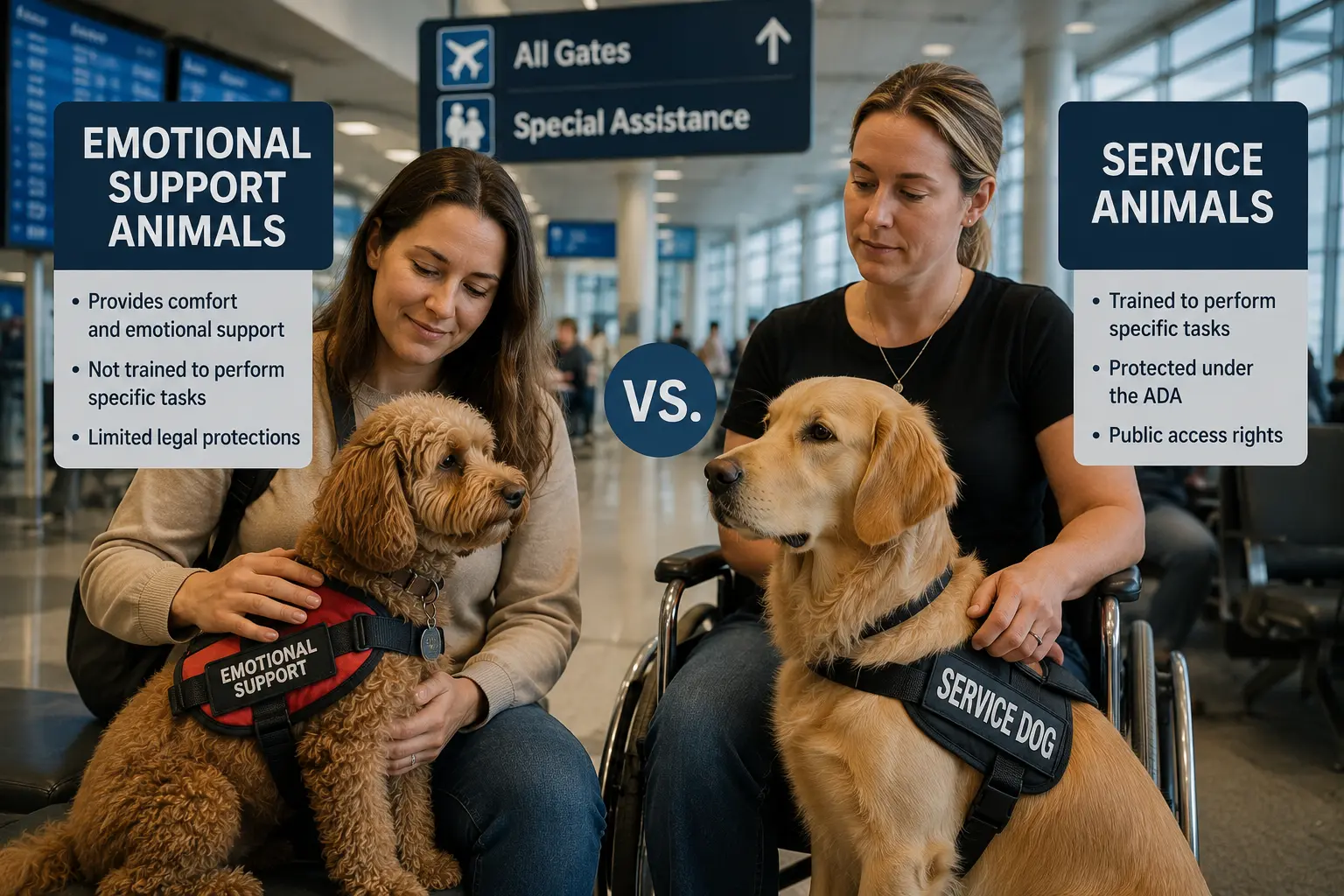
Few pet-related topics generate as much confusion as the difference between service animals and emotional support animals. The two terms get used interchangeably in everyday conversation, but legally, they occupy entirely different categories — with different rights, different protections, and, as of 2026, an increasingly wide gap between how each is treated across housing, air travel, public spaces, and the workplace.
This guide breaks down exactly what the law says about each category, where their protections actually apply, and what’s changed recently in a way that affects millions of pet owners and disabled individuals alike.
The Core Legal Distinction
At the heart of nearly every law touching this issue is a single dividing line: training to perform a specific task versus providing comfort simply by being present.
Service Animals
Under the Americans with Disabilities Act (ADA), a service animal is defined as a dog that has been individually trained to do work or perform tasks for a person with a disability. In limited circumstances, miniature horses receive similar protection. The task performed must be directly related to the individual’s disability — guiding someone who is blind, alerting someone who is deaf, retrieving items for a person with a mobility impairment, interrupting a dissociative episode, or reminding someone to take medication.
Critically, a doctor’s note or diagnosis alone does not make an animal a service animal. The animal must be individually trained to perform a specific task — the training requirement is what separates a service animal from a pet in the eyes of federal law, not the handler’s disability status alone. The ADA National Network’s guide on service animals and emotional support animals offers a detailed side-by-side breakdown of this distinction.
Emotional Support Animals
An emotional support animal (ESA) provides comfort through companionship and presence, but is not trained to perform a specific task tied to a disability. ESAs are not limited to dogs — virtually any domesticated animal can theoretically qualify as an ESA, since the “job” the animal performs is simply being present and offering emotional comfort.
This distinction matters enormously, because it determines which laws apply. Service animals receive broad protection under the ADA in nearly every public setting. Emotional support animals receive no ADA protection at all — their legal status depends entirely on which other, narrower law might apply in a given context.
Where Service Animals Are Protected: Public Access Under the ADA
Under Title II and Title III of the ADA, service animals must generally be allowed to accompany their handler into any place open to the public — restaurants, stores, hotels, government buildings, and more — regardless of a business’s general “no pets” policy.
Businesses have limited ability to question a service animal’s legitimacy. Staff are generally permitted to ask only two questions: whether the animal is required because of a disability, and what task the animal has been trained to perform. They cannot demand documentation, ask about the specific nature of the disability, or require the animal to demonstrate its task on command.
A service animal can be excluded only in narrow circumstances — specifically, if the animal is out of control and the handler doesn’t take effective action, or if the animal poses a direct threat to health or safety. Even then, the business must generally offer the person the opportunity to receive service without the animal present. Notably, other customers’ fear of dogs or allergies are not valid legal grounds for exclusion.
Emotional support animals receive none of these public access protections under the ADA. A restaurant, retail store, or other public business can lawfully deny entry to an ESA, since ESAs fall entirely outside the ADA’s definition of a service animal.
Where the Law Gets More Complicated: Housing
Housing is where the ESA vs. service animal distinction has historically been the most different from public access law — and where the biggest recent change has occurred.
For years, the Fair Housing Act (FHA) protected a broader category of “assistance animals,” which included both trained service animals and untrained emotional support animals. Under this older framework, landlords generally had to grant reasonable accommodation requests for ESAs even in buildings with a strict no-pets policy, without charging a pet fee, based on federal guidance from HUD dating back to 2008, expanded in 2013 and 2020.
That changed significantly in 2026. On May 22, 2026, HUD’s Office of Fair Housing and Equal Opportunity permanently rescinded its longstanding ESA guidance and issued a new enforcement standard that realigns federal housing policy much more closely with the ADA’s task-based definition. Under the new framework, HUD’s enforcement priority generally follows this practical distinction: if an animal is trained to sense an oncoming crisis and respond with a specific trained action, it qualifies; if the animal simply provides comfort by being present, it generally does not receive the same federal enforcement priority it once did.
It’s worth understanding precisely what this change does and doesn’t mean:
- The Fair Housing Act statute itself remains in place. Tenants retain the right to bring private legal claims, and this is a shift in HUD’s enforcement guidance, not a repeal of the underlying law.
- State and local fair housing laws may still independently protect ESAs, since many states have broader statutes than federal law.
- The new guidance is also broader than the ADA in one respect: it isn’t limited to dogs and miniature horses, and can extend to other species, provided the animal is trained to perform a disability-related task.
Given how recent and significant this shift is, renters currently relying on an ESA for a housing accommodation should check their specific state’s law and consider consulting an attorney, since practical outcomes may now vary far more by location than before.
Air Travel: ESAs Lost Their Special Status Years Ago
Air travel actually got to this “training-based” standard well before housing did. The Air Carrier Access Act (ACAA) previously defined “service animal” broadly enough to include animals that assisted passengers with disabilities “by providing emotional support” — meaning ESAs once flew for free in the cabin alongside trained service animals.
That changed under a Department of Transportation final rule that took effect in January 2021. The DOT redefined a service animal under the ACAA as a dog individually trained to do work or perform tasks for a person with a disability, explicitly removing emotional support animals from that definition. The rule change followed years of complaints from airlines and other passengers about untrained animals causing disturbances in aircraft cabins, including incidents of biting, aggressive behavior, and animals failing to remain under their handler’s control. The full reasoning and text of the rule are available in the Federal Register’s final rule on traveling by air with service animals.
Under current airline policy, trained psychiatric service dogs continue to receive the same protections as other service animals, including the ability to fly at no charge, subject to documentation requirements airlines are permitted to request in advance. Emotional support animals, by contrast, are now treated the same as ordinary pets — subject to standard pet fees, carrier or size requirements, and each airline’s individual pet policy, exactly like traveling with a family dog or cat that has no legal status at all.
The Workplace: A Different Framework Entirely
Employment operates under yet another standard. Title I of the ADA, which covers workplace accommodations, doesn’t actually define or limit the type of animal an employee can request as an accommodation the way Title II and III do for public access. Instead, an employee’s request to bring a service animal or an emotional support animal to work is treated as a reasonable accommodation request, triggering the employer’s duty to engage in a good-faith interactive process to determine whether the accommodation is reasonable and doesn’t create undue hardship.
This means an ESA could, in principle, be a permitted workplace accommodation — but there’s no automatic right to bring one, and the outcome depends heavily on the specific employer, position, and circumstances, unlike the ADA’s clear public-access mandate for trained service animals.
Documentation: What’s Actually Required (and What Isn’t)
A common point of confusion involves documentation and certification, which the law treats very differently depending on the animal’s category:
- Service animals: No certification, registration, or ID card is legally required under the ADA, despite the existence of many online “registries” that sell such documents. A business may only ask the two permitted questions described earlier.
- Emotional support animals: Under the pre-2026 housing framework, a letter from a licensed healthcare provider was generally sufficient to support an ESA accommodation request. Under the new HUD enforcement approach, and under airline and public-access rules, a doctor’s letter alone no longer establishes the kind of task-based qualification these frameworks now generally look for.
Regardless of context, no legitimate federal law requires a service animal to wear a vest, carry a special ID, or be professionally trained by a certified organization — owner training is legally sufficient under the ADA, as long as the animal reliably performs the required task.
A Quick Reference Comparison
| Context | Service Animals | Emotional Support Animals |
|---|---|---|
| Public access (ADA) | Broadly protected | Not protected |
| Air travel (ACAA, since 2021) | Fly free, minimal restrictions | Treated as pets, subject to fees |
| Housing (FHA, post-2026 HUD guidance) | Protected | Enforcement priority narrowed; state law may still apply |
| Workplace (ADA Title I) | Reasonable accommodation process | Reasonable accommodation process |
| Documentation required | None legally required | Varies significantly by context |
Final Thoughts
The legal line between service animals and emotional support animals comes down to one core question: is the animal trained to perform a specific task related to a disability, or does it simply provide comfort through its presence? That distinction has always determined ESA outcomes in public access and air travel, and as of HUD’s May 2026 guidance, it now shapes federal housing enforcement as well — closing a gap that had persisted for well over a decade. For pet owners and disabled individuals navigating these overlapping frameworks, understanding exactly which law applies in which setting, and staying current on rapidly evolving guidance like HUD’s 2026 shift, has become more important than ever.
This article is intended for general informational purposes and does not constitute legal advice. Disability accommodation law varies by state and continues to evolve, so consult a licensed attorney for guidance specific to your situation.
