

Updated: August 2026
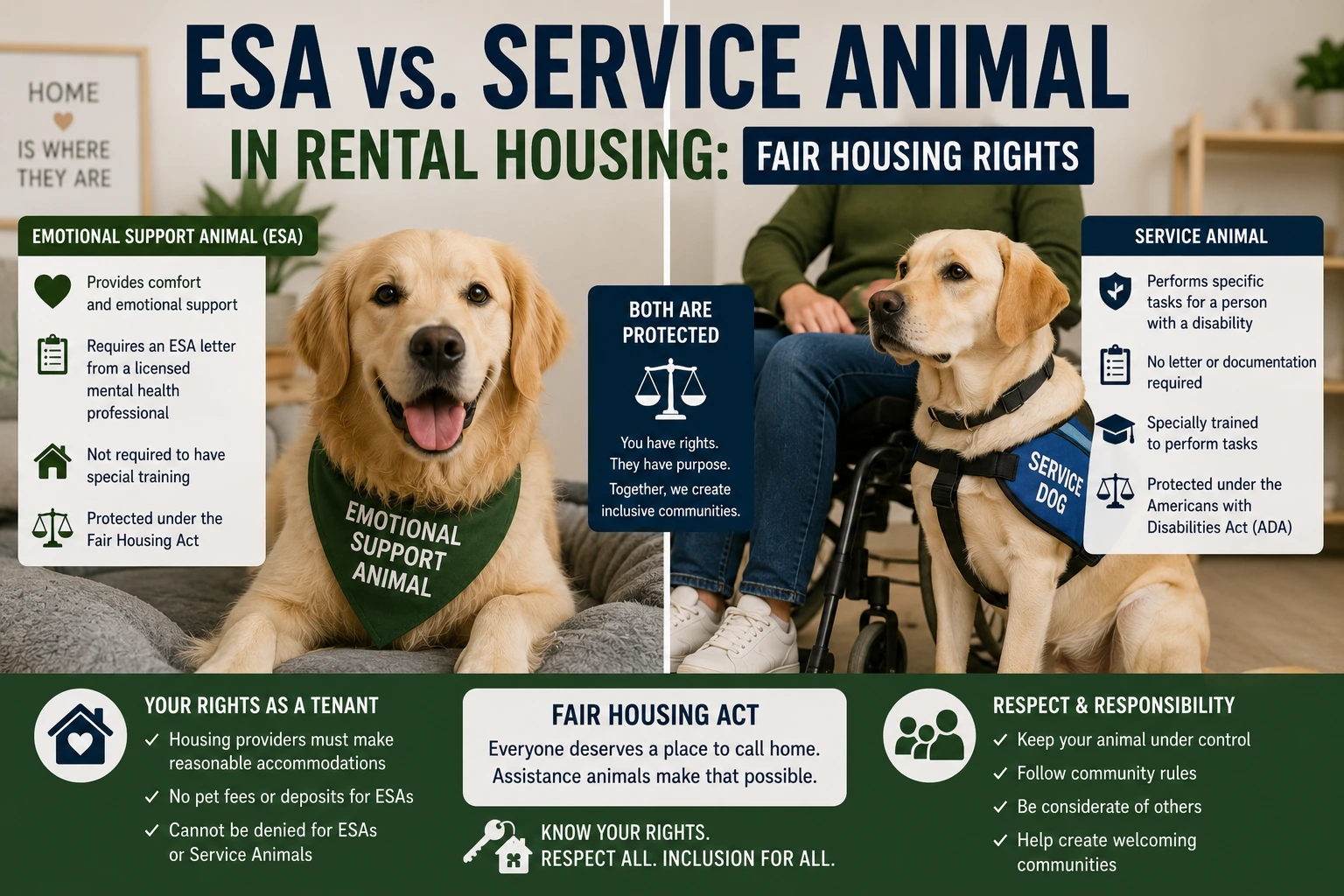
If you rent a house, apartment, condominium, or other residential property and need an animal because of a disability, you may have questions about the difference between an emotional support animal (ESA) and a service animal.
People often use these terms interchangeably. Legally, however, they can mean different things depending on where the animal is being used and which law applies.
The most important point for renters is this:
The rules for service animals in public places under the Americans with Disabilities Act (ADA) are not identical to the rules for assistance animals in housing under the Fair Housing Act (FHA).
Under the ADA, a service animal is generally a dog individually trained to perform work or tasks directly related to a person’s disability. An animal whose sole role is providing comfort or emotional support is not a service animal under the ADA.
Housing can be different. DOJ explains that the Fair Housing Act applies to many public and privately owned housing situations and can require reasonable accommodations for animals that provide assistance, perform tasks, or provide emotional support related to a disability.
This guide explains the difference specifically from a renter’s housing perspective, including pet fees, breed restrictions, documentation, reasonable accommodation requests, and what to do if a landlord says no.
Important: This is general educational information, not legal advice. Housing laws and exemptions can vary depending on the property, state, locality, and circumstances. If you are facing eviction, denial of housing, or a disputed accommodation request, consider getting advice from a qualified housing attorney or fair-housing organization.
Quick Answer: ESA vs. Service Animal
| Question | Service Animal | ESA / Support Animal |
|---|---|---|
| Primary purpose | Performs disability-related tasks or work | Provides disability-related emotional support |
| ADA public-access definition | Generally qualifies if requirements are met | Generally does not qualify |
| Housing protection | May qualify | May qualify |
| Must perform a trained task? | Under ADA, yes | Not necessarily for FHA housing accommodation |
| Certification required? | No federal ADA certification | No universal federal certification |
| Pet fee in qualifying housing accommodation | Generally not permitted as a pet charge | Generally not permitted as a pet charge |
| Breed/size pet restriction | Housing rules differ from ADA public-access rules | Housing rules differ from ordinary pet rules |
| Main federal housing law | Fair Housing Act may apply | Fair Housing Act may apply |
The critical takeaway is that “not an ADA service animal” does not automatically mean “no housing protection.” DOJ specifically explains that animals that do not meet the ADA service-animal definition may still qualify as reasonable accommodations in housing under the Fair Housing Act.
What Is a Service Animal?
Under the ADA, a service animal is generally a dog that has been individually trained to perform work or tasks for a person with a disability.
Examples include a dog trained to:
- Guide a person who is blind
- Alert a person who is deaf
- Retrieve objects
- Assist with mobility
- Alert someone to a medical condition
- Remind a person to take medication
- Interrupt certain psychiatric symptoms
The task must be directly related to the person’s disability.
What Is an Emotional Support Animal?
An emotional support animal is an animal that provides disability-related emotional support, comfort, or assistance.
The important distinction under the ADA is that comfort from the animal’s presence alone does not make the animal a service animal.
For example:
Emotional support
A person’s dog helps reduce symptoms simply by being present and providing comfort.
Psychiatric service animal
A dog has been trained to recognize an impending psychiatric episode and perform a specific action to help the person.
The second example can meet the ADA’s service-animal definition because the dog performs a trained task related to the disability.
Why the Difference Matters in Rental Housing
This is where many online articles become confusing.
The ADA primarily governs accessibility in areas such as:
- Businesses
- Restaurants
- Stores
- Government services
- Certain educational and public facilities
Housing is also governed by other laws, especially the Fair Housing Act.
DOJ specifically explains that the Fair Housing Act applies to many public and private housing situations and may provide protection for animals that provide emotional support even when those animals do not meet the ADA’s service-animal definition.
So if you are renting an apartment, don’t stop your research after reading the ADA definition of a service animal.
ADA vs. Fair Housing Act
A simple way to remember the distinction is:
ADA
Think:
Public access
Fair Housing Act
Think:
Equal opportunity to use and enjoy housing
The laws overlap in some situations, but they do not use identical definitions or rules.
For example, under the ADA, an emotional support animal is generally not a service animal. In housing, however, an assistance animal that provides emotional support related to a disability may qualify for a reasonable accommodation.
Does an ESA Have Housing Rights?
A qualifying assistance animal may receive protection under the Fair Housing Act.
The question is not simply:
“Is this animal an ESA?”
The more useful question is:
“Is the animal necessary because of a disability, and is the requested accommodation reasonable under the applicable housing law?”
HUD’s housing framework recognizes assistance animals beyond the narrower ADA service-animal definition.
Is an ESA a Pet?
For ordinary rental purposes, a landlord may classify an animal as a pet unless the tenant establishes that an assistance-animal accommodation applies.
Once an animal qualifies for a reasonable accommodation under applicable fair-housing law, however, it is not treated like an ordinary pet for purposes of pet restrictions and charges.
That distinction can affect:
- Pet deposits
- Pet fees
- Pet rent
- No-pet policies
- Breed restrictions
- Weight restrictions
Can a Landlord Charge Pet Rent for an Assistance Animal?
Generally, a qualifying assistance animal is not subject to ordinary pet fees, deposits, or surcharges.
HUD guidance identifies waiver of pet deposits and pet fees as examples of reasonable accommodations for assistance animals.
This means a renter should distinguish between:
Ordinary pet
The property’s lawful pet charges may apply.
Qualifying assistance animal
Ordinary pet charges may need to be waived as part of the reasonable accommodation.
What About a Pet Deposit?
Suppose your apartment requires:
$400 pet deposit
If you are keeping an ordinary pet, the deposit may apply subject to applicable law.
If you are requesting a reasonable accommodation for a qualifying assistance animal, the landlord generally cannot simply charge the same pet deposit because the animal is classified as a pet.
HUD’s guidance specifically addresses waiver of pet deposits and fees for qualifying assistance animals.
Can a Landlord Charge for Actual Damage?
This is an important distinction.
No pet fee does not mean:
“The tenant can never be responsible for damage.”
A landlord may generally retain the ability to charge for actual property damage when the applicable law permits it.
So:
Pet charge
Different rules may apply to an assistance animal.
Actual damage
The tenant may still have responsibility.
This distinction is important when reading your lease.
Can an Apartment Have a No-Pet Policy?
Yes, a property can generally have a no-pet policy for ordinary pets where permitted by applicable law.
But a qualifying assistance-animal request can require an exception.
The Fair Housing Act’s reasonable-accommodation framework can require a housing provider to modify a no-pet policy when necessary to give a person with a disability an equal opportunity to use and enjoy the home. DOJ explains this distinction in its housing-related service-animal guidance.
What About “No Dogs” Buildings?
The same principle applies.
A landlord may prohibit ordinary dogs if the property is legally allowed to do so.
But a qualifying assistance animal is a separate question.
Don’t assume:
“No dogs means no assistance animals.”
The accommodation analysis must be considered separately.
What About Breed Restrictions?
Breed restrictions are another area where renters can become confused.
For an ordinary pet, a landlord may have a breed restriction if permitted by applicable law.
For a qualifying assistance animal, HUD guidance has stated that housing providers should not apply ordinary breed or size restrictions simply because of the animal’s breed or size.
The analysis can instead focus on the specific animal and whether there is reliable evidence of a legally recognized direct threat or substantial property damage that cannot reasonably be reduced.
Example: Pit Bull Restriction
Imagine a rental property has this rule:
“Pit Bulls are not permitted.”
Scenario 1: Ordinary pet
The landlord may be able to enforce the restriction depending on applicable law and the lease.
Scenario 2: Qualifying assistance animal
The landlord cannot simply end the analysis by saying:
“The breed is prohibited.”
The housing provider may need to consider the reasonable-accommodation request and the specific animal’s circumstances.
What If the Landlord Says the Dog Is Dangerous?
A landlord’s concern about safety should not automatically be treated as proof that an animal is dangerous.
For an assistance animal, the analysis can involve the specific animal’s actual behavior or history, rather than general assumptions about a breed.
DOJ’s ADA guidance similarly explains that decisions involving a service animal’s potential direct threat must be based on the particular animal’s actual behavior or history rather than fears or generalizations about a breed.
What If the Animal Has a History of Aggression?
This can change the analysis.
If a landlord has credible evidence that a specific animal presents a direct threat, the housing provider may have a stronger basis for denying an accommodation, depending on the applicable legal standard and whether the risk can be reduced through reasonable measures.
This is different from saying:
“We don’t like this breed.”
A documented history involving the specific animal is much more relevant than a generalized breed stereotype.
Can a Landlord Ask for ESA Documentation?
The answer depends on the circumstances.
If the disability or disability-related need for the animal is not obvious, a housing provider may generally be able to request reliable information that is reasonably necessary to evaluate the accommodation request.
But that does not mean a landlord can demand unlimited medical information.
The proper documentation question is:
What information is reasonably necessary to establish the disability-related need for the accommodation?
Not:
“Give me your entire medical history.”
Is an ESA Certificate Required?
There is no universal federal ESA certification system that automatically creates a housing right.
Be careful with websites selling:
- ESA certificates
- Registration numbers
- Identification cards
- Official-looking certificates
- “Guaranteed ESA approval”
Buying a certificate does not automatically establish that a housing provider must approve an accommodation.
The legal question is whether the person qualifies and whether the requested accommodation is necessary and reasonable under applicable law.
What About ESA Registration?
An online registration is not the same thing as a federal legal determination.
If a website says:
“Register your ESA and your landlord must accept it everywhere,”
be skeptical.
Housing rights depend on applicable law and the actual circumstances.
Does an ESA Need Special Training?
Unlike an ADA service animal, an emotional support animal does not necessarily need to perform a trained disability-related task simply to provide the emotional support that forms the basis of a housing accommodation.
That is one of the central differences between the ADA’s service-animal definition and the broader housing framework. DOJ expressly notes that animals providing emotional support may have housing protection even though they do not meet the ADA service-animal definition.
Does a Service Animal Need Professional Training?
No.
The ADA does not require a service dog to be trained by a professional program.
A person with a disability may train their own service dog.
This is different from saying that an untrained pet automatically becomes a service animal.
The dog still needs to be individually trained to perform disability-related work or tasks under the ADA definition.
Does a Service Animal Need a Certificate?
No federal ADA certification is required.
The ADA does not require:
- Special certification
- Official registration
- A service-animal ID card
- A special vest
- Professional training documentation
The ADA states that service animals do not need to be certified or professionally trained.
Housing situations can involve a separate reasonable-accommodation process under the Fair Housing Act.
Does a Service Dog Need a Vest?
No.
There is no federal ADA requirement that a service animal wear a special vest or carry an identification card.
A vest may be useful for practical reasons, but it does not create the legal status of a service animal.
Can Any Dog Breed Be a Service Dog?
Under the ADA, service animals are not restricted by breed.
ADA guidance explains that service animals can be any breed and any size of dog.
For housing, however, the applicable Fair Housing Act analysis should be considered separately from the ADA’s public-access rules.
Can an Emotional Support Animal Be a Cat?
Potentially, yes, in housing.
This is another important distinction.
The ADA’s service-animal definition generally recognizes dogs.
The Fair Housing Act’s assistance-animal framework can be broader and is not limited to the ADA’s service-dog definition. DOJ explains that animals other than ADA service animals may qualify as housing accommodations.
Therefore, a cat may potentially qualify as an assistance animal in a housing situation even though it is not an ADA service animal.
Can an Assistance Animal Be a Bird or Another Animal?
Potentially, depending on the housing circumstances and applicable law.
Do not automatically assume:
“Not a dog = no housing protection.”
The Fair Housing Act’s accommodation analysis is broader than the ADA service-animal definition.
However, unusual or exotic animals can raise additional legal questions, and the specific facts matter.
Can a Landlord Require the Animal to Be Housebroken?
A housing provider can have legitimate concerns about an animal’s behavior and property damage.
An animal that repeatedly causes serious problems may create a different legal situation from a well-behaved assistance animal.
The fact that an animal is protected does not mean the tenant has no responsibility for controlling the animal or preventing unreasonable damage.
What If the Animal Disturbs Other Tenants?
An assistance animal is not a license to ignore reasonable housing rules.
For example, tenants generally remain responsible for controlling unreasonable noise and preventing property damage.
The important distinction is between:
reasonable conduct rules
and
rules that improperly exclude an assistance animal solely because it is an animal.
What If a Neighbor Is Allergic?
A landlord may need to consider both residents’ needs.
One person’s disability-related accommodation does not necessarily mean another resident’s needs are ignored.
The housing provider may need to explore reasonable ways to accommodate both residents rather than automatically choosing one person over the other.
The solution can depend on the property’s layout and the circumstances.
What If a Neighbor Is Afraid of Dogs?
Fear alone does not automatically establish that an assistance animal must be removed.
The landlord should evaluate the actual circumstances and applicable law.
A generalized fear of a particular breed is not necessarily the same as evidence that a specific animal presents a direct threat.
What If the Landlord Says “Our Insurance Won’t Allow It”?
Insurance-related objections can be complicated.
If a landlord says an assistance animal cannot be accepted because of insurance, ask for the explanation in writing.
You can ask:
- What insurance requirement applies?
- Does it apply to ordinary pets or assistance animals?
- Is there another insurance option?
- Is the decision based solely on breed or size?
- Has the specific animal been evaluated?
Don’t assume that an insurance statement automatically ends the reasonable-accommodation analysis.
How to Request an Accommodation
If you need an assistance animal in your rental home, a written request is often the clearest approach.
You can write:
Subject: Reasonable Accommodation Request
I am requesting a reasonable accommodation to the property’s animal policy because I have a disability-related need for an assistance animal.
Please confirm receipt of this request and let me know what information, if any, is reasonably necessary to evaluate the accommodation.
Thank you.
Keep a copy of the request.
Should You Mention Your Diagnosis?
Usually, focus on the need for the accommodation, rather than providing unnecessary medical details.
If the disability and need are not obvious, the landlord may be entitled to reliable supporting information under applicable law.
But an accommodation request should not automatically require disclosure of every detail of your medical history.
What If the Landlord Asks for a Doctor’s Note?
Whether documentation is appropriate depends on the circumstances.
If the disability-related need is not apparent, some supporting information may be permissible.
The key issue is whether the information is:
- Reliable
- Relevant
- Necessary
- Reasonably related to the accommodation request
If the request seems excessive, consider getting professional fair-housing advice before providing extensive medical information.
What If the Landlord Rejects the Request?
Ask for the reason in writing.
For example:
“Please provide the reason for denying my reasonable accommodation request and identify the policy or requirement on which the decision is based.”
Save the response.
Written documentation can be important if the dispute later needs to be reviewed by a housing agency, attorney, or court.
Keep a Housing Documentation File
Save:
- Lease
- Pet policy
- Pet addendum
- Accommodation request
- Supporting documentation
- Landlord responses
- Emails
- Text messages
- Payment records
- Photos
- Notices
A simple chronological record can make a complicated dispute much easier to understand.
What If the Landlord Charges a Pet Fee Anyway?
First, don’t immediately assume the charge is lawful or unlawful.
Ask:
“Is this charge being assessed as an ordinary pet charge, or is it being assessed despite my assistance-animal accommodation request?”
Then ask for the charge and its legal/lease basis in writing.
HUD’s housing guidance specifically recognizes waiver of pet deposits and fees as a reasonable accommodation for qualifying assistance animals.
What If You Already Paid the Pet Fee?
Keep the receipt.
If you later establish that the animal qualifies for an assistance-animal accommodation, the appropriate treatment of amounts already paid can depend on the circumstances and applicable law.
Don’t simply deduct the amount from your next rent payment without obtaining appropriate advice.
Can a Landlord Evict You Because of an Assistance Animal?
A landlord cannot necessarily treat a qualifying assistance animal as an ordinary lease violation simply because the animal would otherwise violate a no-pet rule.
However, assistance-animal protection does not eliminate all lease obligations.
Serious issues involving:
- Actual property damage
- Uncontrolled behavior
- Direct threats
- Other legitimate lease violations
may require separate analysis.
If you receive an eviction notice, get legal assistance promptly.
ESA vs. Service Animal: A Real-World Example
Imagine two renters.
Renter A
Has a dog trained to alert them before a seizure and perform a specific safety task.
This may qualify as a service animal under the ADA.
Renter B
Has a dog whose presence provides disability-related emotional support but the dog has not been trained to perform a specific task.
The dog may not qualify as an ADA service animal.
However, in housing, Renter B may still have a reasonable-accommodation claim under the Fair Housing Act if the applicable requirements are satisfied.
This example illustrates why housing law cannot be analyzed using the ADA service-animal definition alone.
ESA vs. Service Animal: Another Example
Suppose an apartment has:
- $300 pet deposit
- $35 monthly pet rent
- 40-pound dog limit
For an ordinary pet, those rules may apply if lawful.
For a qualifying assistance animal, the landlord may need to modify those pet rules as a reasonable accommodation.
HUD guidance specifically recognizes accommodation involving pet deposits, fees, breed, and size restrictions.
What Renters Should Not Do
Avoid these common mistakes.
Don’t buy a fake-looking certificate
An online certificate doesn’t automatically establish a federal housing right.
Don’t claim an animal is a service dog when it isn’t
The ADA service-animal definition requires disability-related trained work or tasks.
Don’t stop paying rent
A housing dispute does not automatically justify withholding rent.
Don’t rely on verbal promises
Get important decisions in writing.
Don’t assume every landlord rule is illegal
Check the actual law and circumstances.
Don’t assume every landlord rule is legal
A lease clause cannot necessarily override mandatory fair-housing protections.
How to Compare Your Housing Costs
If you have an ordinary pet, calculate:
Pet deposit + pet fee + (monthly pet rent × 12)
Example:
$300 deposit
+ $200 fee
- ($35 × 12)
= $920 initial/first-year cash outlay
But remember that a refundable deposit is different from a permanent expense.
For broader pet budgeting, use your Pet Ownership Cost Calculator.
What Should You Check in the Lease?
Before signing, look for:
- Pet policy
- Pet addendum
- Pet deposit
- Pet fee
- Monthly pet rent
- Breed restrictions
- Weight restrictions
- Number of animals
- Damage rules
- Cleaning requirements
- Noise rules
- Insurance requirements
- Assistance-animal accommodation procedure
For more detail, see your Pet Addendum to a Lease guide.
What If Your Landlord Says “ESA and Service Dogs Are the Same”?
Ask them to clarify which law and policy they are applying.
They are not identical concepts under federal law.
The ADA uses a specific definition for service animals in public accommodations. The Fair Housing Act can provide broader accommodation protection in housing, including for animals that provide emotional support related to a disability.
Where Can You Get Help?
If you believe your housing provider has improperly denied an accommodation, potential sources of assistance include:
- HUD
- Fair Housing and Equal Opportunity offices
- Local fair-housing organizations
- Legal-aid organizations
- Tenant-rights organizations
- Qualified housing attorneys
HUD provides information about assistance animals and fair-housing protections.
A Simple Renter Action Plan
If you need an assistance animal, use this sequence:
Step 1 — Identify the housing rule
Find the exact no-pet, breed, weight, or fee clause.
Step 2 — Determine whether an accommodation is needed
Ask whether the animal is needed because of a disability.
Step 3 — Make the request
Submit a clear reasonable-accommodation request.
Step 4 — Provide appropriate supporting information
If legally requested and necessary, provide reliable information addressing the disability-related need.
Step 5 — Get the response in writing
Keep the landlord’s decision.
Step 6 — Review the decision
If denied, compare the reason with applicable fair-housing requirements.
Step 7 — Seek professional help if necessary
Especially if eviction or significant financial loss is involved.
Frequently Asked Questions
Is an ESA the same as a service animal?
No. Under the ADA, an emotional support animal is generally not a service animal because the ADA service-animal definition requires a dog trained to perform disability-related work or tasks. In housing, however, an ESA may qualify as an assistance animal under the Fair Housing Act.
Does an ESA have housing rights?
A qualifying assistance animal may receive reasonable-accommodation protection under the Fair Housing Act. The specific circumstances and applicable housing rules matter.
Can an apartment charge pet rent for an ESA?
A qualifying assistance animal generally cannot be subjected to ordinary pet fees, deposits, or surcharges under the Fair Housing Act’s reasonable-accommodation framework.
Does a service dog need certification?
No. The ADA does not require federal certification, registration, or a special ID card.
Does an ESA need certification?
There is no universal federal certification that automatically creates an ESA housing right.
Can an ESA be a cat?
Potentially, in housing. The Fair Housing Act’s assistance-animal framework is broader than the ADA’s service-dog definition.
Can a landlord ban an assistance animal because of its breed?
A housing provider generally cannot apply an ordinary breed restriction to a qualifying assistance animal simply because of breed. The specific animal’s conduct and other legally relevant factors may still be considered.
Can a landlord charge for damage caused by an assistance animal?
Potentially yes. Assistance-animal protection does not generally eliminate responsibility for actual property damage.
Does a service dog have to wear a vest?
No. The ADA does not require a special vest or identification card.
Can a landlord ask for medical documentation?
If the disability-related need is not obvious, some reliable supporting information may be permissible. The request should be reasonably related to evaluating the accommodation.
Can an apartment have a no-pet policy?
Yes for ordinary pets where legally permitted. A qualifying assistance-animal accommodation can require an exception.
Can an assistance animal be removed?
Protection is not absolute. Serious issues involving the specific animal’s behavior, direct threat, or substantial property damage can require separate evaluation under applicable law.
Final Takeaway
The biggest mistake renters make is treating ESA and service animal as two names for exactly the same legal category.
They aren’t.
Under the ADA, a service animal is generally a dog individually trained to perform work or tasks directly related to a person’s disability. An animal whose role is simply providing comfort does not meet that ADA definition.
But rental housing is different.
The Fair Housing Act can require reasonable accommodations for qualifying assistance animals, including animals that provide emotional support related to a disability.
That distinction can affect whether a landlord may enforce:
- A no-pet policy
- A breed restriction
- A weight limit
- A pet deposit
- A pet fee
- Monthly pet rent
The safest approach is not to rely on a generic internet certificate or simply argue that your animal is a “service dog.”
Instead:
Identify the applicable law → make the appropriate accommodation request → provide necessary supporting information → keep everything in writing → seek professional help if the dispute escalates.
Related Resources
- Pet Addendum to a Lease: Every Clause to Check — Understand pet deposits, fees, breed restrictions, damage rules, and other lease clauses.
- Pet Deposit vs. Pet Rent vs. Pet Fee — Compare the financial impact of common pet-related rental charges.
- Breed Restrictions in Rental Housing — Understand ordinary pet breed restrictions and assistance-animal exceptions.
- Pet Ownership Cost Calculator — Estimate your broader annual pet expenses.
Editorial Methodology
This article separates public-access rules from housing-accommodation rules because the legal definitions are not identical.
For ADA-related information, the primary reference is the U.S. Department of Justice’s ADA guidance. DOJ defines a service animal generally as a dog individually trained to perform work or tasks directly related to a person’s disability.
For housing-related information, the article relies on federal Fair Housing Act guidance explaining that housing protections can extend to assistance animals that do not meet the narrower ADA service-animal definition.
Because housing exemptions and state/local laws can vary, this article intentionally avoids claiming that every rental property is subject to exactly the same rules.
Dollar amounts used in examples are hypothetical and are provided only to demonstrate budgeting calculations.
Legal Disclaimer
PetPolicyFinance.com is an independent educational website. We are not a law firm, attorney, landlord, property manager, government agency, or fair-housing organization.
This article provides general educational information and does not constitute legal advice or create an attorney-client relationship.
Federal, state, and local housing laws can change, and exemptions may apply to particular types of housing. Before signing a lease, disputing an accommodation request, withholding rent, or taking legal action, verify the current rules applicable to your specific property and consider consulting a qualified housing attorney or fair-housing organization.
Information about service animals and assistance animals is general educational information and does not determine whether a particular person or animal qualifies for protection.
Author: Harry Mills
Last Reviewed: August 2026
