

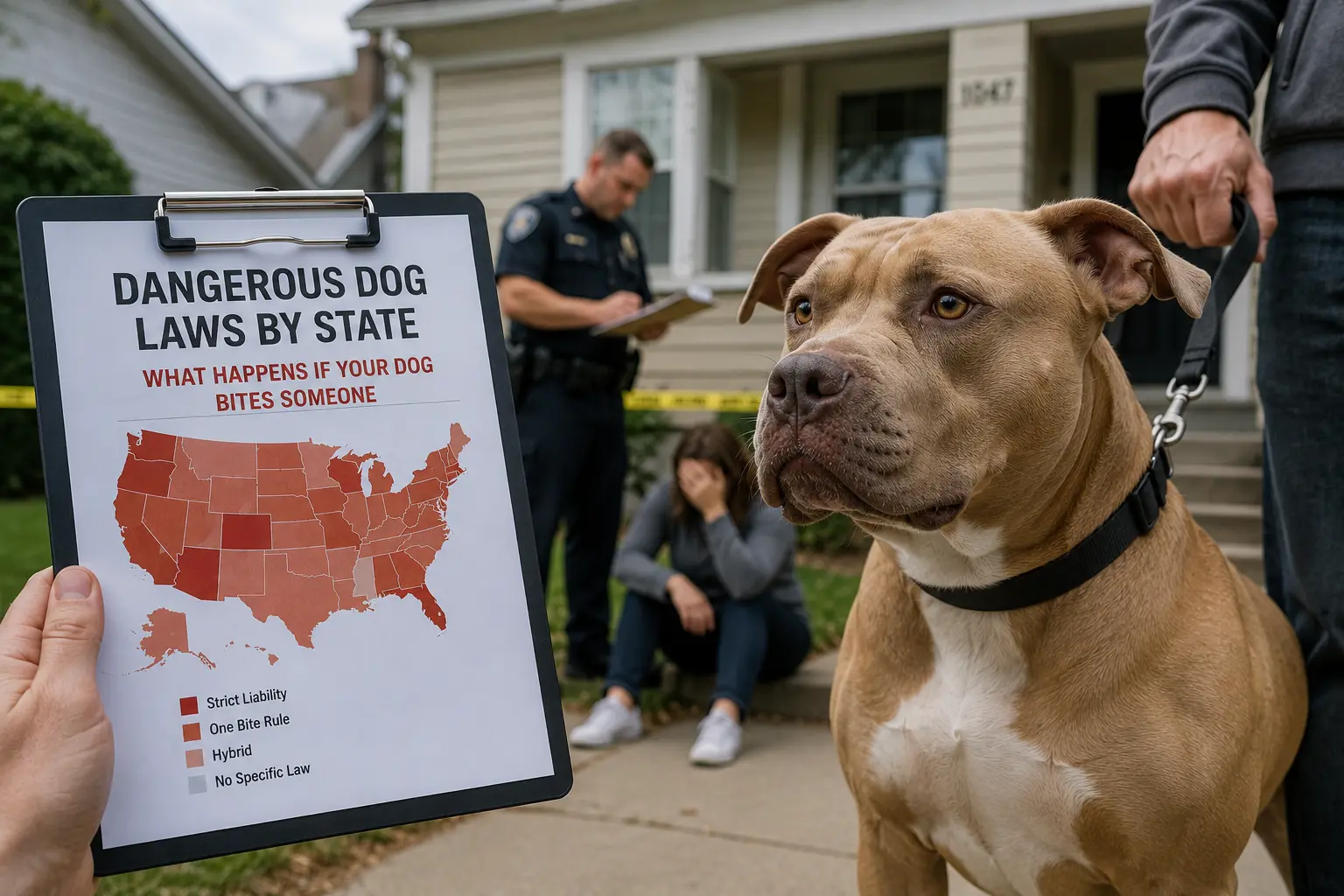
A dog bite can turn into one of the most stressful legal and financial experiences a pet owner ever faces. Depending on where you live, you could be held responsible even if your dog has never shown a hint of aggression before — or you might only face liability if you already knew your dog posed a risk. On top of civil liability, your dog could also be formally classified as “dangerous,” triggering a separate set of ongoing legal requirements that can follow the animal, and you, for years.
This guide breaks down how dog bite liability actually works across the U.S., what “dangerous dog” classification means in practice, and what to expect legally and financially if your dog bites someone.
The Two Legal Frameworks: Strict Liability vs. the One-Bite Rule
Every state has its own approach to dog bite liability, but nearly all of them fall into one of two broad frameworks, with a handful of states blending elements of both.
Strict Liability States
Under a strict liability framework, a dog owner can be held financially responsible for injuries their dog causes regardless of whether the owner did anything wrong or had any reason to believe the dog was dangerous. The typical strict liability dog-bite statute holds an owner liable for a bite as long as the injured person was lawfully present and wasn’t provoking the animal. There’s no “free pass” for a first-time incident — a puppy’s very first bite can trigger full liability in these states.
Florida is a clear example of this approach. Florida imposes strict liability on dog owners by statute, and the old common-law idea that every dog gets “one free bite” simply doesn’t apply there — a first-time bite from a dog with no prior history is enough to establish liability. Many other states, including California and Illinois, follow a similar strict liability model, though the specific statutory language and available defenses vary. The Animal Legal & Historical Center’s table of dog bite strict liability statutes provides a state-by-state breakdown of the exact statutory language.
One-Bite Rule States
Roughly 16 states still follow some version of the traditional “one-bite rule.” Under this framework, an owner is only liable for a bite if they knew, or reasonably should have known, that the dog had dangerous tendencies before the incident occurred. This doesn’t literally mean a dog gets one guaranteed free bite — prior growling, snapping, aggressive body language, or even breed-related knowledge can be enough to establish that an owner “should have known,” even before an actual bite occurs.
New York is a notable example of a one-bite rule state for civil liability purposes, though it layers a separate dangerous dog statute on top of that framework, creating additional consequences once a dog has been formally adjudicated as dangerous — regardless of whether the one-bite standard applies to the underlying injury claim.
Hybrid and Case-Law-Driven States
Several states combine elements of both systems, or rely heavily on court decisions rather than a single bright-line statute. Texas, for example, has developed its dog bite standards largely through case law, with courts considering factors beyond prior bites — including training methods, the dog’s general temperament, and the specific circumstances of the incident — rather than applying a single rigid rule.
What Damages Can a Bite Victim Recover?
Regardless of which framework applies, a successful dog bite claim can typically cover:
- Medical expenses, including emergency treatment, surgery, and follow-up care
- Lost wages if the injury prevented the victim from working
- Pain and suffering
- Scarring or disfigurement compensation, particularly relevant in bite cases
- Psychological impact, including trauma-related therapy in more severe cases
Common Defenses Owners Can Raise
Even in strict liability states, owners aren’t entirely without defenses. Common arguments that can reduce or eliminate liability include:
- Provocation: If the victim provoked the dog — hitting it, cornering it, or otherwise instigating the incident — liability can be reduced or eliminated entirely.
- Trespassing: Many statutes only protect victims who were lawfully present; a bite against a trespasser may not trigger the same liability.
- Comparative fault: Some states use a comparative fault system, where a court assigns a percentage of blame to each party, which can reduce a victim’s recovery if they’re found partially responsible — and in some states, bar recovery entirely if the victim is found more than 50% at fault.
Dangerous Dog Classification: A Separate Legal Track
Civil liability for an existing bite is only one part of the picture. Separately, most states and many municipalities maintain a “dangerous dog” or “vicious dog” classification system, which is fundamentally different from a liability lawsuit. This is a regulatory and often quasi-criminal process, not a claim for damages, and it can be triggered even without a lawsuit ever being filed.
How a Dog Gets Classified
A dog is typically classified as dangerous through an administrative or municipal process, often initiated after a bite report, an animal control investigation, or a witness complaint. States vary considerably in what triggers this classification — some require an actual bite or attack, while others allow classification based on aggressive behavior alone, even without physical contact.
What Happens Once a Dog Is Classified as Dangerous
Once a dog receives a formal dangerous dog designation, owners typically face a range of ongoing legal obligations, which can include:
- Mandatory microchipping and registration with local animal control
- Required liability insurance coverage, often with a specific minimum amount
- Mandatory secure enclosure requirements at the owner’s property
- Muzzle and leash requirements in public
- Warning signage requirements on the property
- Restrictions on the number of dangerous dogs a single owner may keep
- In more serious cases, a court order for euthanasia, particularly after a second incident or a severe attack
Minnesota’s dangerous dog framework illustrates this well: state law allows owners to petition for review of a dangerous dog designation, requires microchipping, sets minimum liability insurance requirements, and gives animal control authorities enforcement power, including the ability to seize a dog and, in defined circumstances, order its destruction.
Appealing a Dangerous Dog Designation
Most states provide some form of appeal process if you believe your dog was wrongly classified. This typically involves a hearing before a judge or administrative body where you can present evidence about the incident, your dog’s overall behavior, and any mitigating circumstances. Given how significant the consequences can be, consulting an attorney before or during this process is generally worthwhile.
Breed-Specific Legislation: A Related but Distinct Issue
Dangerous dog laws are sometimes confused with breed-specific legislation (BSL), but they’re conceptually different. BSL restricts or bans dogs based on breed alone, regardless of any individual dog’s behavior or history, while dangerous dog laws generally evaluate an individual animal’s conduct.
Major veterinary and animal welfare organizations, including the American Veterinary Medical Association and the ASPCA, oppose breed-specific legislation, arguing there’s no reliable evidence that it makes communities safer, and advocating instead for breed-neutral, behavior-based regulation. The ASPCA’s overview of breed-specific legislation explains this position in more detail. Several states now prohibit local governments from enacting breed bans or from using breed alone to support a dangerous dog designation, while other states leave this decision to individual cities and counties, resulting in a patchwork of local ordinances even within a single state.
This distinction matters practically: in a state that prohibits BSL, your dog’s breed cannot, by itself, be used as grounds for a dangerous dog classification — the classification still has to be based on the individual dog’s documented behavior.
What to Do If Your Dog Bites Someone
If your dog is involved in a biting incident, how you respond in the immediate aftermath can meaningfully affect both the civil liability outcome and any dangerous dog proceeding.
- Ensure the injured person receives medical attention and cooperate with any request for basic information.
- Document the incident as thoroughly as possible, including witness accounts, the circumstances leading up to the bite, and your dog’s prior behavior history.
- Report the incident promptly if legally required in your jurisdiction, since failing to report can sometimes worsen your legal position.
- Contact your homeowners or renters insurance provider, since many policies include liability coverage for dog bites, subject to any breed exclusions or policy limits.
- Consult an attorney if you’re facing a significant claim or a dangerous dog classification proceeding, particularly given how much the specific rules vary by state and even by municipality.
- Take corrective steps with your dog, such as professional behavioral training, since demonstrating responsible follow-up can matter both in a liability defense and in a dangerous dog appeal.
Final Thoughts
Dog bite law in the United States is genuinely a patchwork — strict liability in some states, the one-bite rule in others, and hybrid or case-law-driven approaches in between. Layered on top of civil liability is a separate dangerous dog classification system that can impose lasting requirements on owners regardless of how the underlying liability claim is resolved. Because the specific rules, defenses, and classification triggers vary so significantly by state and often by city, the single most useful thing any dog owner can do — before an incident ever happens — is understand exactly which framework applies where they live, and confirm that their homeowners or renters insurance actually covers dog-related liability.
This article is intended for general informational purposes and does not constitute legal advice. Dog bite and dangerous dog laws vary significantly by state and municipality, so consult a licensed attorney in your jurisdiction for guidance specific to your situation.
