

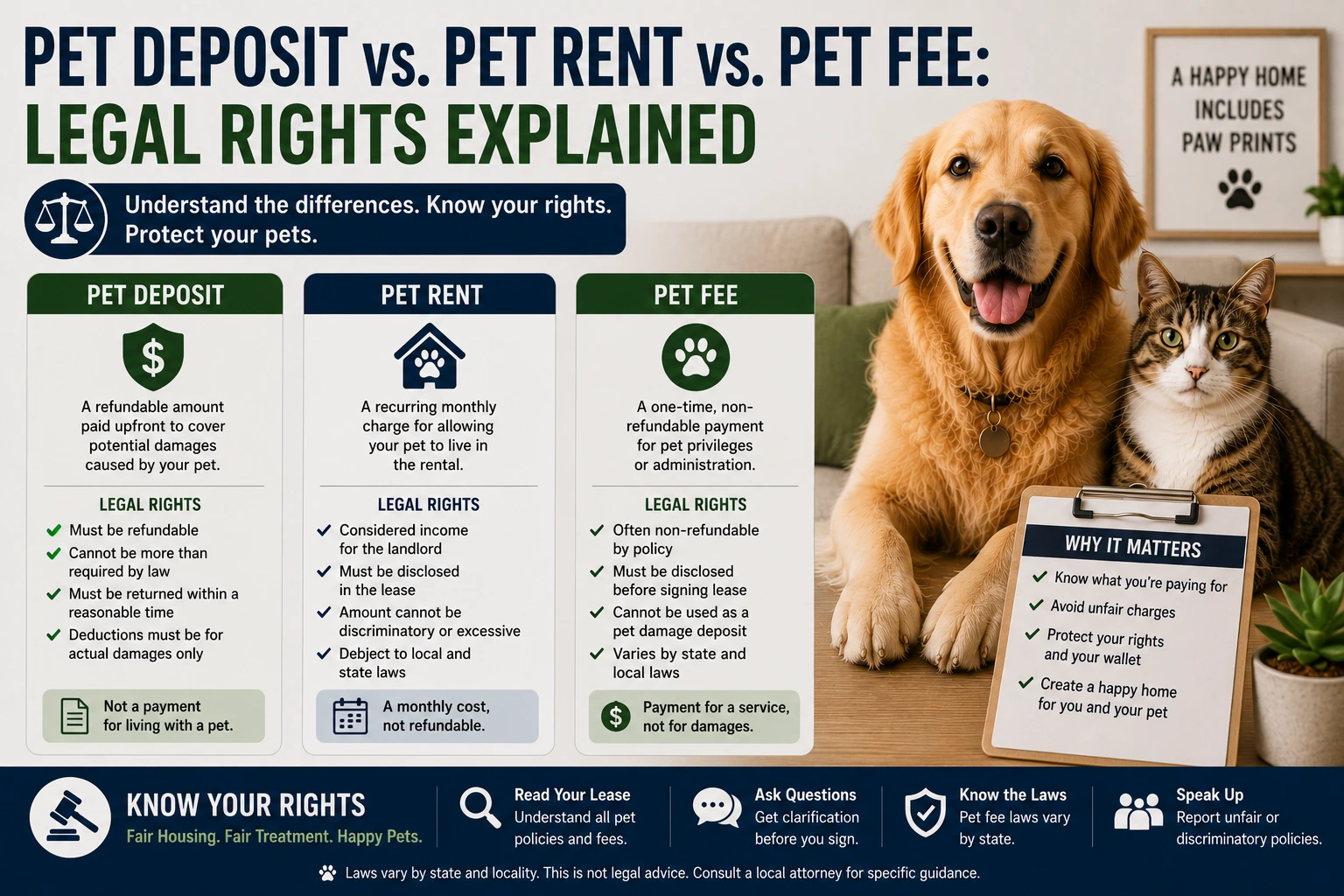
You’ve found the perfect apartment. Decent square footage, good natural light, manageable commute. There’s just one line in the lease that gives you pause: “Pet Policy: $300 non-refundable pet fee, $50 monthly pet rent, $500 refundable pet deposit.”
Three separate pet-related charges. Three different legal structures. And most renters — even experienced ones — have no idea what the differences mean, which ones are negotiable, what their legal rights are, or when a landlord is charging more than they’re legally allowed to.
If you’re a renter with a pet, understanding the legal distinction between a pet deposit, pet rent, and a pet fee isn’t just academically interesting — it’s money. Potentially hundreds or thousands of dollars that either stays in your pocket or leaves it, depending on how well you understand what you agreed to and what your state law actually permits.
This comprehensive guide explains each charge clearly, breaks down your legal rights as a pet-owning renter, covers the special rules that apply to assistance animals, and gives you the practical knowledge to review any pet-related lease clause with confidence.
The Three Pet Charges: Definitions That Matter
Before discussing your rights, it’s essential to understand exactly what each term means — because landlords don’t always use them correctly, and the distinction carries significant legal and financial weight.
Pet Deposit
A pet deposit is a refundable sum of money paid at the beginning of a tenancy, held by the landlord to cover potential pet-related damage to the rental unit. Like a standard security deposit, a pet deposit must be returned to the tenant — minus any documented, legitimate deductions for actual damage — at the end of the tenancy.
Key characteristics:
- Refundable (if no pet damage occurs)
- Held separately or alongside the security deposit depending on state law
- Subject to the same legal rules as security deposits in most states — including requirements about holding, itemized deduction notices, and return timelines
- Can only be used to cover actual, documented damage, not normal wear and tear
Typical range: $200–$600 per pet
The critical point: Because a pet deposit is refundable, you have legal rights to its return. Landlords who fail to return it within the legally required timeframe — or who deduct for normal wear and tear rather than actual damage — may be liable for penalties under state security deposit laws.
Pet Fee
A pet fee is a non-refundable, one-time payment made by the tenant in exchange for the landlord’s permission to have a pet on the premises. Unlike a pet deposit, a pet fee is explicitly not returned at the end of the tenancy — it is paid, it is gone, and the landlord has no obligation to account for how it was used.
Key characteristics:
- Non-refundable — explicitly disclosed as such in the lease
- One-time payment, typically due at lease signing or move-in
- Does not require itemized accounting or return at move-out
- Represents compensation for the landlord’s general risk of pet ownership rather than coverage for specific damage
Typical range: $100–$500 per pet
The critical point: Whether a charge is labeled a “pet deposit” or a “pet fee” matters enormously. If a landlord calls a charge a “pet deposit” but then refuses to return it at move-out, they may be violating your state’s security deposit law — even if they intended it to be non-refundable. Get the non-refundable nature of any pet fee documented explicitly in your lease.
Pet Rent
Pet rent is a recurring monthly charge added to the base rent in exchange for permission to have a pet on the premises. Unlike a deposit or fee, pet rent is not tied to damage — it is simply an ongoing premium for the privilege of having an animal in the unit.
Key characteristics:
- Monthly recurring charge, paid alongside base rent
- Non-refundable — treated as part of the monthly rent payment
- Does not require accounting or return at move-out
- Purely revenue for the landlord — not held in trust or designated for damage repair
Typical range: $25–$100 per pet per month
The financial reality of pet rent: Unlike a one-time deposit or fee, pet rent compounds over the duration of your tenancy. A $50/month pet rent charge on a two-year lease represents $1,200 in total additional housing cost — more than most pet deposits or fees, and entirely non-refundable. For long-term renters, pet rent is often the most financially significant of the three charges.
How These Three Charges Can Be Combined — and What’s Reasonable
Landlords are legally permitted to charge any combination of these three pet-related charges in most states — subject to specific caps and restrictions that vary by jurisdiction. A landlord can theoretically charge all three simultaneously:
- A non-refundable pet fee ($300)
- A refundable pet deposit ($500)
- Monthly pet rent ($50/month)
For a two-year lease, the total financial impact would be:
- Non-refundable pet fee: $300
- Pet rent over 24 months: $1,200
- Pet deposit (refundable if no damage): $500 held, returned at move-out
Total guaranteed non-refundable pet cost: $1,500 Total pet-related charges during tenancy: $2,000
This is a significant financial burden on top of standard rent and security deposits. Understanding whether these charges are reasonable — and legal — requires knowing what your specific state allows.
State-by-State Legal Landscape: What Your State Allows
Pet-related charge regulations are governed by state law, and the variation between states is significant. Here’s the general legal landscape:
States With Deposit Caps That Include Pet Deposits
Many states cap total security deposits (which may include pet deposits) at a specific multiple of monthly rent — commonly 1.5x to 2x monthly rent. In these states, a landlord cannot charge a $2,000 pet deposit on a $1,000/month apartment if the total of security + pet deposit would exceed the state cap.
States with security deposit caps that typically apply to pet deposits:
- California: 2x monthly rent for unfurnished units (security deposit including pet deposit combined)
- New York: 1x monthly rent (security deposit cap, pet deposits generally included)
- New Jersey: 1.5x monthly rent
- Washington: No statutory cap, but must be reasonable
- Florida: No statutory cap on deposits, but pet deposits are subject to security deposit return requirements
States With Separate Pet Deposit Rules
Some states specifically address pet deposits outside of the general security deposit framework:
- Michigan: Pet deposits are separate from security deposits and have their own handling requirements
- Oregon: Security deposit caps apply to all deposits including pet deposits
- Colorado: Pet deposits regulated under standard security deposit law with 30-day return requirement
States Where Non-Refundable Pet Fees Are Explicitly Regulated
Several states specifically address whether non-refundable pet fees are permissible:
- California: Non-refundable deposits of any kind are generally not allowed — a deposit must be refundable. Any non-refundable charge must be clearly labeled as a “fee” rather than a “deposit.”
- Tennessee: Non-refundable pet fees are explicitly permitted
- Georgia: Non-refundable fees are permitted with proper disclosure
Critical legal reminder: State laws change, and local ordinances can be more restrictive than state law. Always verify current rules with a local tenant’s rights organization or attorney for the most accurate guidance applicable to your specific situation.
Security Deposit Laws Applied to Pet Deposits
In most states, pet deposits are treated as a form of security deposit and are subject to the same legal protections. This means:
Holding Requirements
Many states require security deposits — including pet deposits — to be held in a separate escrow or trust account rather than commingled with the landlord’s personal funds. Landlords who fail to properly hold pet deposits may forfeit their right to make deductions.
Return Timelines
States mandate specific timelines for returning security deposits after move-out, typically ranging from 14 to 60 days. These timelines almost always apply to pet deposits as well. Common state return timelines include:
- California: 21 days
- Texas: 30 days
- New York: 14 days (for deposits under certain thresholds)
- Florida: 15–60 days depending on whether deductions are claimed
- Illinois: 30 days (45 days if itemizing deductions)
A landlord who fails to return your pet deposit within the legally required timeframe may owe you double or triple the deposit amount as a penalty under many state statutes.
Itemized Deduction Requirements
Before keeping any portion of a pet deposit for damage, landlords must typically provide:
- A written, itemized list of deductions
- Documentation or receipts supporting the claimed repair costs
- Delivery of this itemization within the legally required timeframe
Landlords who simply pocket a pet deposit without providing documentation — or who deduct for normal wear and tear rather than actual damage — are violating security deposit law in most jurisdictions.
Normal Wear and Tear vs. Actual Damage
The most common dispute in pet deposit cases is the distinction between normal wear and tear (not deductible) and actual pet damage (deductible).
Normal wear and tear (landlord CANNOT deduct):
- Small scuffs or minor scratches on wood floors from pet nails consistent with normal use
- Minor carpet wear in pet areas consistent with normal foot and pet traffic
- Light odor that dissipates with standard cleaning
Actual pet damage (landlord CAN deduct):
- Deep scratches or gouging in hardwood floors
- Carpet staining that requires replacement rather than cleaning
- Chewing damage to baseboards, door frames, or fixtures
- Persistent pet odor requiring professional remediation
- Urine damage that has penetrated subfloor materials
If your landlord attempts to charge for normal wear and tear disguised as pet damage, you have the right to dispute the deduction — in small claims court if necessary.
Assistance Animals: A Completely Different Legal Framework
One of the most important — and most frequently misunderstood — aspects of pet-related housing law is the special legal status of assistance animals. If you have a disability and your animal qualifies as a service animal or emotional support animal, the rules change dramatically.
Service Animals Under the ADA
The Americans with Disabilities Act (ADA) defines a service animal as a dog (or in limited cases, a miniature horse) that is individually trained to perform specific tasks directly related to a person’s disability. Service animals are not pets under the law — they are working animals with civil rights protections. The HUD official guidance on assistance animals provides the authoritative federal framework for how these protections apply in housing contexts.
Key legal protections for service animals in housing:
- Landlords cannot refuse housing to a person with a service animal, even in a no-pet building
- Landlords cannot charge a pet deposit, pet fee, or pet rent for a service animal
- Landlords can only request documentation of disability if the disability is not obvious
- Landlords can hold a tenant responsible for actual damage caused by a service animal
Emotional Support Animals Under the Fair Housing Act — A Rapidly Changing Legal Landscape
⚠️ Important 2026 Update: The legal framework for emotional support animals in housing underwent a significant federal-level change on May 22, 2026. HUD’s Office of Fair Housing and Equal Opportunity (FHEO) permanently rescinded its longstanding ESA guidance documents (FHEO-2013-01 and FHEO-2020-01) and issued a new enforcement standard that fundamentally realigns federal housing policy with the stricter Americans with Disabilities Act (ADA) trained-animal standard. This is one of the most significant shifts in housing-related ESA law in over a decade. For a detailed analysis of what changed and what it means for tenants and landlords, see the Duane Morris Animal Law Developments blog’s breakdown of HUD’s 2026 ESA guidance change.
What the pre-2026 framework said: Under HUD’s prior guidance, ESAs were classified as assistance animals — not pets — and landlords generally could not charge pet deposits, pet fees, or pet rent for them. A letter from a licensed healthcare provider confirming the disability-related need for the animal was typically sufficient for accommodation.
What changed in May 2026: HUD has now aligned its federal enforcement standard with the ADA’s trained-animal definition. Under the new enforcement posture:
- HUD will no longer pursue federal enforcement complaints for untrained ESAs
- Landlords may now treat untrained ESA requests as not presumptively requiring accommodation under federal enforcement
- Pet fees and deposits may be applied to untrained ESAs without triggering federal FHEO enforcement consequences
- The Fair Housing Act itself has not been amended — private lawsuits under the FHA remain possible within two years of an alleged violation
- State and local fair housing laws are unaffected — many states maintain independent ESA protections that are broader than the new federal enforcement standard
What has NOT changed:
- Trained service animals under the ADA retain full housing protections — landlords cannot charge pet fees or deposits for trained service animals
- Private civil litigation under the FHA for ESA-related discrimination remains available
- State laws in jurisdictions like California, New York, and others may still provide ESA protections independent of federal enforcement
- Landlords can still hold tenants responsible for actual damage caused by any animal
What landlords can legitimately ask (for trained service animals):
- Whether the animal is required because of a disability
- What specific task the animal has been trained to perform
What landlords cannot ask (for trained service animals):
- Specific details about the nature of your disability
- Access to medical records or documentation of the animal’s certification
The ESA Documentation Landscape Post-2026
Given the significant federal enforcement changes, ESA-owning tenants navigating housing situations should:
- Check their state’s specific fair housing laws — many states provide independent ESA protections unaffected by the federal change
- Consult a local tenant’s rights organization or fair housing attorney for jurisdiction-specific guidance
- Maintain documentation from licensed healthcare providers even if federal enforcement is reduced — this remains relevant for state-level claims and private litigation
- Be aware that online ESA registration certificates from commercial websites have never been recognized by HUD or any government agency as valid documentation
Practical Steps to Protect Your Financial Rights as a Pet-Owning Renter
Before Signing the Lease
Step 1: Clarify every pet charge in writing. If the lease mentions a “pet deposit,” confirm in writing whether it is refundable or non-refundable. Ask your landlord to add explicit language: “This $300 pet deposit is refundable subject to documented damage deductions” or “This $300 pet fee is non-refundable.”
Step 2: Research your state’s deposit laws. Look up your state’s specific rules on security deposit caps, return timelines, and non-refundable fee regulations before signing. Your state attorney general’s office and local tenant’s rights organizations typically publish plain-language guides.
Step 3: Calculate the total pet-related cost of the lease. Add up all pet-related charges across the full lease term: (Pet Fee) + (Pet Rent × Months) + (Pet Deposit held during tenancy). This total, not just the monthly rent, is your true housing cost with a pet.
Step 4: Negotiate where possible. Pet fees and pet rent are frequently negotiable — particularly in rental markets with higher vacancy rates. If you have a proven rental history, good credit, and a well-behaved pet, making the case for reduced pet charges is entirely reasonable.
During the Tenancy
Step 5: Document your pet’s impact (or lack thereof). Take comprehensive move-in photos and video of all surfaces — floors, baseboards, carpets, walls — before your pet enters the unit. Store these in cloud storage with dated timestamps. This documentation is your primary defense against illegitimate damage deductions at move-out.
Step 6: Address pet-related maintenance proactively. Minor scratches, pet hair in carpet, or light odor are far less expensive to address during the tenancy than to litigate at move-out. Professional carpet cleaning before move-out, for example, is typically far cheaper than the cost of disputing a landlord’s carpet replacement claim.
At Move-Out
Step 7: Conduct a thorough move-out walkthrough. Request a move-out walkthrough with your landlord present. Document the condition of the unit in writing and with photos at the time of the walkthrough. If the landlord identifies any pet-related damage, discuss it at that time rather than waiting for a deduction notice.
Step 8: Know your deposit return timeline. Mark your calendar for your state’s required return date from the day you vacate. If your pet deposit isn’t returned within that timeframe with a proper itemization, send a written demand letter. If still unresolved, small claims court is specifically designed for these disputes — filing fees are typically $30–$100, and the potential recovery includes the deposit plus statutory penalties.
Frequently Asked Questions
Can a landlord charge both a pet deposit AND a pet fee? In most states, yes — there is no law preventing landlords from charging both a refundable pet deposit and a non-refundable pet fee simultaneously, as long as total deposit amounts don’t exceed state caps and all terms are clearly disclosed in the lease.
Can a landlord increase pet rent during my lease term? No — during a fixed lease term, all financial terms including pet rent are locked. A landlord can only increase pet rent at lease renewal with proper notice as required by state law (typically 30–60 days).
What happens to my pet deposit if I move and my new unit is in better condition than at move-in? Your pet deposit must be fully returned if there is no pet damage. “Better than move-in condition” doesn’t entitle you to additional compensation — but it definitively eliminates any legitimate damage claim.
Can a landlord in a no-pets building refuse my service animal or ESA? For service animals and ESAs with proper documentation, generally no. The Fair Housing Act’s reasonable accommodation requirement applies to most housing providers regardless of their no-pets policy. Exceptions exist for certain small landlord situations and for animals that pose a documented direct threat.
Is a verbal agreement about my pet sufficient? Never rely on verbal agreements about pet policies. Any permission to have a pet, any agreement about pet charges, and any modifications to stated pet fees should be in writing — either in the lease itself or in a signed written addendum. Verbal agreements are nearly impossible to enforce.
What if my landlord adds pet charges after I’ve already moved in with a pet they verbally approved? This is a lease modification requiring your written consent. A landlord cannot unilaterally add pet charges mid-tenancy without your agreement. If they attempt to do so, consult a local tenant’s rights organization immediately.
Final Thoughts
Pet deposits, pet fees, and pet rent are three legally distinct financial instruments with very different implications for your rights as a renter. Understanding those distinctions — before you sign a lease rather than after a dispute arises — is one of the most practically valuable pieces of financial knowledge a pet-owning renter can have.
Know what each charge is. Know whether it’s refundable. Know your state’s specific rules about deposit caps and return timelines. Document everything at move-in and move-out. And if you have a disability and your animal qualifies for accommodation under the Fair Housing Act, know that pet deposits, pet fees, and pet rent simply don’t apply to you.
Your pet deserves a home. So does your security deposit.
Disclaimer: This article is intended for general informational and educational purposes only and does not constitute legal advice. Landlord-tenant laws vary significantly by state and locality and are subject to change. Always consult a licensed attorney or local tenant’s rights organization for guidance specific to your jurisdiction and situation. Information regarding assistance animals and the Fair Housing Act reflects general federal guidelines — implementation may vary by state and housing type.
