

Updated: August 2026
Finding a pet-friendly rental is only the first step.
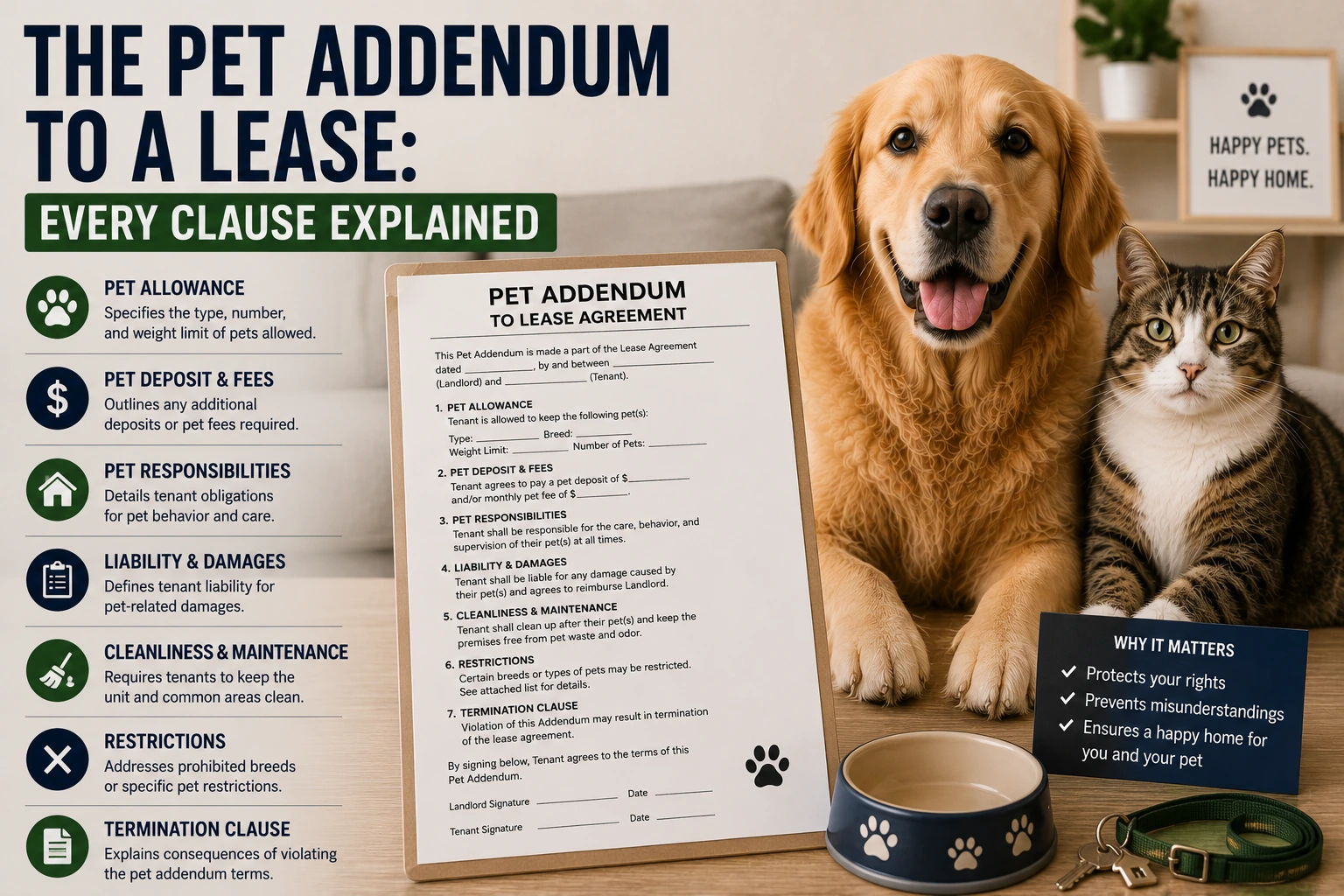
Before moving in with a dog, cat, or another household pet, your landlord may ask you to sign a pet addendum or pet agreement.
This document is usually attached to the main lease and establishes additional rules for keeping an animal in the rental property.
It may cover:
- Which animals are permitted
- Number of pets
- Breed or size restrictions
- Pet deposits
- Pet fees
- Monthly pet rent
- Vaccination requirements
- Cleaning responsibilities
- Damage
- Noise
- Common-area rules
- Lease violations
- Removal of the animal
A pet addendum can look like a simple form, but some clauses can create significant financial or contractual obligations.
This guide explains what renters should review before signing a pet addendum, how to calculate the real cost of the agreement, what questions to ask the landlord, and how the rules can differ for qualifying assistance animals.
Important: This article provides general educational information, not legal advice. Landlord-tenant and animal-control laws vary by state and locality. Always check the current rules applicable to your rental before disputing a lease term or taking legal action.
What Is a Pet Addendum?
A pet addendum is a document that supplements your residential lease.
Instead of putting every animal-related rule inside the main lease, a landlord may use a separate document that becomes part of the rental agreement.
For example, your main lease might say:
“Pets are permitted subject to the attached Pet Addendum.”
The pet addendum may then establish the detailed requirements.
HUD’s own housing materials recognize pet agreements/addenda as documents that can establish pet rules in certain housing contexts.
Is a Pet Addendum Legally Binding?
Generally, if you properly agree to a pet addendum that forms part of your lease, its terms can become contractual obligations.
However, a lease cannot necessarily override mandatory federal, state, or local law.
For example, a lease clause requiring a pet fee may not be enforceable if applicable law prohibits that charge.
Likewise, qualifying assistance animals are subject to different federal fair-housing rules than ordinary pets. HUD explains that assistance animals are not pets for purposes of the Fair Housing Act’s reasonable-accommodation framework.
So don’t assume:
“It’s in the lease, therefore it must be legal.”
Pet Addendum vs. Pet Policy
These terms are sometimes used interchangeably, but they can serve different purposes.
Pet Policy
A general set of rules describing what the property allows.
Pet Addendum
A document that is typically attached to the lease and creates specific contractual terms for your tenancy.
A property might publish a general pet policy online and then require you to sign a more detailed pet addendum when you move in.
The 12 Clauses You Should Check First
Before signing, look for these sections:
- Approved animal
- Number of pets
- Breed restrictions
- Weight or size limits
- Pet deposit
- Pet fee
- Monthly pet rent
- Vaccination and licensing
- Damage responsibility
- Cleaning requirements
- Noise and nuisance rules
- Removal or lease-violation provisions
Don’t sign until you understand what each one means financially and practically.
1. Approved Animal Clause
The addendum should identify what type of animal you’re permitted to keep.
For example:
- Dog
- Cat
- Fish
- Bird
- Small household animal
It may also identify the specific animal.
Example:
Dog: Max
Breed: Labrador mix
Weight: 42 lb
Age: 4 years
This information can become important later if the landlord claims that you brought in an unauthorized animal.
Why You Should List the Correct Animal
Suppose your addendum says:
“One cat, 10 pounds.”
Six months later, you bring home a second cat.
Even if both animals are normally allowed by the property’s general policy, your signed addendum may not automatically authorize the second animal.
Ask the landlord to update the agreement in writing.
2. Number of Pets
Look for language such as:
“Tenant may keep one pet.”
or:
“Maximum of two pets per unit.”
This is different from asking whether the building is generally pet-friendly.
A property may allow pets but limit the number.
Multiple-Pet Costs
If the landlord charges:
$25/month per pet
and you have two pets:
$25 × 2 = $50/month
Annual cost:
$50 × 12 = $600
But if the landlord charges $25 per household instead, the cost would be:
$25 × 12 = $300
Always ask whether the charge is:
Per pet
or
Per household.
3. Breed Restrictions
A pet addendum may list restricted breeds or categories of dogs.
For ordinary pets, breed restrictions may be permitted depending on applicable law and the lease.
But this issue becomes substantially different when the animal is a qualifying assistance animal.
HUD states that housing providers may not apply ordinary pet rules to qualifying assistance animals and may not limit an assistance dog solely because of its breed or size.
Therefore, don’t automatically apply an ordinary-pet breed clause to an assistance animal.
4. Weight and Size Limits
A pet addendum might say:
“Dogs must weigh less than 40 pounds.”
or:
“Dogs may not exceed 24 inches at the shoulder.”
For ordinary pets, such restrictions may apply where lawful.
For qualifying assistance animals, HUD guidance states that housing providers may not impose breed or size restrictions simply because of the animal’s breed or size.
However, a specific animal’s actual behavior can still be relevant.
5. Pet Deposit
The addendum may require a refundable deposit.
Example:
Pet deposit: $300
Don’t stop at the dollar amount.
Look for:
- Is it refundable?
- When is it returned?
- What deductions are allowed?
- Does it count toward the general security-deposit limit?
- Is it per pet?
- Is there a separate accounting requirement?
Pet-deposit rules vary by jurisdiction.
6. Pet Fee
A pet fee is generally a one-time charge.
Example:
One-time pet fee: $250
The addendum may describe it as non-refundable.
But whether a particular fee is legally permissible depends on applicable state/local law.
Don’t assume that changing the word from “deposit” to “fee” automatically removes legal restrictions.
7. Monthly Pet Rent
This is one of the most important financial clauses.
Example:
Pet rent: $35/month
Annual cost:
$35 × 12 = $420
Two-year cost:
$35 × 24 = $840
Unlike a refundable deposit, monthly pet rent is generally an ongoing housing expense.
Calculate the Real Cost Before Signing
Suppose your addendum requires:
- Pet deposit: $300
- Pet fee: $200
- Pet rent: $35/month
Initial pet-related payment
$300 + $200 = $500
First-year pet rent
$35 × 12 = $420
First-year cash outlay
$500 + $420 = $920
But if the $300 deposit is fully refundable, your eventual cost may be lower.
This is why renters should separate:
Cash required
from
Non-refundable/recurring cost.
8. Vaccination Requirements
A pet addendum may require current vaccinations.
It may ask for:
- Rabies vaccination
- Other applicable vaccinations
- Veterinary records
- Licensing
- Identification information
Requirements vary by jurisdiction and property.
Keep copies of whatever you submit.
Don’t Ignore Local Animal Laws
Your landlord’s pet addendum is not the only source of animal-related requirements.
Your city or county may separately regulate:
- Dog licensing
- Rabies vaccination
- Number of animals
- Leash requirements
- Dangerous-dog rules
- Waste disposal
The lease and local law can operate simultaneously.
9. Pet Identification Clause
The addendum may require:
- Pet name
- Species
- Breed
- Age
- Weight
- Color
- License number
- Microchip information
Provide accurate information.
If the animal changes significantly—for example, its weight exceeds the property’s stated limit—ask the landlord how the policy applies.
10. Damage Responsibility
This is one of the most important clauses.
The agreement may say that you are responsible for damage caused by your pet.
That can include damage to:
- Flooring
- Doors
- Carpet
- Walls
- Landscaping
- Fixtures
But the lease does not necessarily determine the full legal standard.
State law can govern security deposits, deductions, and normal wear and tear.
Normal Wear and Tear vs. Damage
A pet addendum may make you responsible for damage.
That doesn’t automatically mean you are responsible for every sign of aging.
For example:
Possible normal wear
Minor aging of flooring over several years.
Potential damage
Deep scratching that substantially damages flooring.
The exact legal standard varies by jurisdiction.
11. Cleaning Clause
Some addenda contain special cleaning requirements.
For example:
- Professional carpet cleaning
- Flea treatment
- Odor treatment
- Yard cleanup
- Deodorizing
Read these clauses carefully.
A requirement to pay for professional cleaning regardless of actual condition may be subject to applicable state law.
Don’t assume every cleaning charge is automatically enforceable.
12. Noise and Nuisance Rules
A pet addendum may prohibit:
- Excessive barking
- Repeated howling
- Aggressive behavior
- Odors
- Waste accumulation
- Disturbance of neighbors
These rules are generally designed to protect other residents.
A practical tip:
Read the wording carefully.
“Excessive barking” is different from:
“Any barking.”
The more specific the clause, the easier it may be to understand what conduct the landlord considers a violation.
13. Common-Area Rules
Your addendum may specify that pets must be:
- Leashed
- Carried
- Kept away from certain areas
- Removed from elevators during certain situations
- Cleaned up after immediately
The property may also prohibit animals from:
- Pools
- Gyms
- Certain lounges
- Food-service areas
- Landscaped areas
Follow both the lease and applicable local rules.
14. Pet Waste Rules
Some leases specifically require owners to remove pet waste immediately.
Possible consequences for violations include:
- Warning
- Cleaning charge
- Fine, where legally permitted
- Lease violation
Don’t assume a fee listed in the lease is automatically lawful in every jurisdiction.
15. Flea and Pest Control
A pet addendum may require tenants to address flea or pest infestations associated with their animal.
The clause may specify:
- Preventive treatment
- Professional treatment
- Cleaning
- Documentation
Before signing, determine who pays if pest treatment becomes necessary.
16. Pet Supervision Clause
Some addenda require pets to remain under the owner’s control.
That can mean:
- No roaming
- Leash in common areas
- No unsupervised outdoor access
- Proper containment
These requirements can become particularly important if the property has shared outdoor spaces.
17. Prohibited Animal Behavior
Look for terms such as:
- Aggressive
- Dangerous
- Vicious
- Threatening
- Nuisance
These terms can have legal significance depending on the context.
If the addendum simply says:
“Any aggressive behavior is grounds for immediate eviction,”
don’t assume the clause can override the legal eviction process.
A lease provision does not necessarily eliminate statutory tenant protections.
18. Pet Inspection Clause
Some agreements allow the landlord to inspect the unit if there is a complaint or suspected violation.
Read:
- When inspection is allowed
- How much notice is required
- Whether emergencies are treated differently
- What constitutes reasonable grounds
Landlord entry is often regulated by state law.
19. Pet Removal Clause
Some addenda say that the landlord can require removal of the animal if the tenant violates the pet agreement.
This is a serious clause.
Before signing, understand:
- What counts as a violation?
- Is there a warning?
- Is there a cure period?
- Can the tenant challenge the allegation?
- What happens to the lease?
- What does state law require?
A landlord generally cannot simply bypass legally required eviction procedures by writing “immediate removal” into a pet addendum.
20. Lease Termination Clause
Some agreements say that serious pet violations can result in lease termination.
Read this carefully.
There is a difference between:
Contractual violation
You violated a lease term.
and
Legal eviction
The landlord follows the applicable legal process to remove a tenant.
The second generally involves statutory procedures that a private addendum cannot simply erase.
21. Insurance Requirements
Some pet addenda require renters to maintain insurance.
The clause may specify:
- Liability coverage
- Proof of insurance
- Additional insured status
- Breed-related requirements
If your landlord says insurance prohibits your dog, ask for the requirement in writing.
For an assistance animal, ordinary pet-policy restrictions cannot simply be applied without considering fair-housing accommodation requirements. HUD guidance specifically addresses breed, size, and pet-fee restrictions for assistance animals.
22. What If Your Dog Is an Assistance Animal?
This section deserves special attention.
Under the Fair Housing Act, a qualifying assistance animal is not treated as a pet for reasonable-accommodation purposes.
HUD explains that a tenant may request an exception to a property’s pet restrictions when necessary because of a disability.
That can include exceptions to:
- No-pet policies
- Breed restrictions
- Size restrictions
- Pet deposits
- Pet fees
- Other pet rules
Can a Pet Addendum Apply to an Assistance Animal?
A landlord may still have reasonable rules concerning the animal’s conduct and the tenant’s responsibilities.
But the ordinary pet rules do not automatically apply.
HUD specifically states that housing providers may not charge a deposit, fee, or surcharge for a qualifying assistance animal.
A landlord may still charge for actual damage caused by the animal when the landlord ordinarily charges tenants for comparable damage.
Breed Restrictions and Assistance Animals
Suppose your pet addendum says:
“No Pit Bulls.”
If the animal is an ordinary pet, the restriction may apply if lawful.
If the animal qualifies as an assistance animal, HUD guidance says the housing provider cannot restrict it simply because of breed or size.
The housing provider may still evaluate the specific animal’s conduct if there is reliable evidence of a direct threat or substantial property damage that cannot reasonably be reduced.
Can a Landlord Charge a Pet Deposit for an Assistance Animal?
Generally, no.
HUD specifically lists waiver of a pet deposit or fee as an example of a reasonable accommodation.
This is different from ordinary pets.
If a landlord includes a standard $300 pet deposit in an addendum for an assistance animal, the tenant should request clarification and, where appropriate, reasonable accommodation rather than assuming the charge must be paid.
Can a Landlord Charge Monthly Pet Rent for an Assistance Animal?
A qualifying assistance animal is not subject to ordinary pet rent.
HUD guidance states that housing providers may not charge a fee, deposit, or surcharge for an assistance animal.
However, this does not eliminate responsibility for actual damage.
Does the Landlord Need a Doctor’s Note?
The answer depends on whether the disability and disability-related need for the animal are obvious.
HUD explains that when the disability-related need is not apparent, a housing provider may request reliable information needed to evaluate the accommodation request.
A landlord should not automatically demand unlimited medical records simply because an assistance-animal request was made.
Online ESA Certificates Are Not a Substitute for Legal Analysis
Be cautious about websites selling:
- ESA certificates
- Registration cards
- Official-looking IDs
- “Guaranteed approval”
A purchased certificate does not automatically establish a Fair Housing Act accommodation.
HUD’s guidance focuses on the disability-related need and reasonable accommodation process rather than a commercial registration product.
23. Pet Liability Clause
The addendum may state that you are responsible for:
- Injury
- Property damage
- Cleaning
- Pet-related claims
Read whether the clause is:
- Broad or specific
- Limited by applicable law
- Connected to actual losses
- Requiring insurance
Do not assume a broad indemnity clause is enforceable exactly as written in every state.
24. Guest and Visitor Rules
Some pet addenda address animals belonging to guests.
For example:
“Guests may not bring animals into the property.”
Others may allow temporary visits.
If you regularly care for someone else’s dog, clarify whether the landlord considers that animal to be your pet.
25. Pet Sitting
This can become surprisingly important.
Suppose you agree to:
“One pet maximum.”
Then your friend asks you to care for their dog for two weeks.
Does that violate the addendum?
Maybe.
Ask the landlord if you’re unsure.
26. New Pet Clause
Some agreements require written approval before adding another animal.
If your pet dies and you later adopt another one, don’t assume the old approval automatically transfers.
The safest approach is:
Get approval in writing.
27. Pet Replacement Clause
Some landlords require approval for any replacement animal.
This can matter if:
- Your current pet dies
- You rehome your pet
- You adopt another animal
- You change species
Read the exact wording.
28. Pet Identification Changes
Notify the landlord if relevant information changes.
For example:
- Pet changes weight significantly
- Pet’s name changes
- Additional animal is acquired
- Animal is permanently removed
Keep the addendum accurate.
29. Move-Out Requirements
The addendum may contain special move-out requirements.
Look for:
- Cleaning
- Odor removal
- Carpet treatment
- Yard restoration
- Damage repair
- Professional service requirements
Ask whether these requirements apply automatically or only when actual conditions require them.
30. Deposit Return Clause
If you paid a pet deposit, determine:
- Where it is held
- Whether it earns interest
- When it is returned
- What deductions are permitted
- Whether an itemized statement is provided
These issues are generally governed by applicable state law.
The addendum cannot necessarily override mandatory deposit rules.
A Simple Pet Addendum Cost Calculator
Suppose your agreement says:
Pet deposit: $300
Pet fee: $200
Pet rent: $30/month
Move-in pet cost
$300 + $200
= $500
First-year pet rent
$30 × 12
= $360
Total first-year cash outlay
$500 + $360
= $860
If the $300 deposit is fully refundable, then:
Potential non-refundable/recurring cost
$200 + $360
= $560
This is a much more useful way to evaluate the lease.
Compare Two Rental Properties
Property A
Pet deposit: $300
Pet fee: $0
Pet rent: $0
First-year pet-related cash requirement:
$300
Property B
Pet deposit: $0
Pet fee: $200
Pet rent: $30/month
First-year cost:
$200 + ($30 × 12)
= $560
Property A requires more cash upfront.
Property B costs more over the year.
That distinction matters when apartment hunting.
Pet Addendum Checklist Before Signing
Use this checklist:
Animal
- Correct pet listed
- Correct species
- Correct breed
- Correct weight
- Correct number of pets
Money
- Pet deposit
- Pet fee
- Monthly pet rent
- Refund conditions
- Deduction rules
Rules
- Breed restriction
- Weight restriction
- Number of pets
- Vaccination requirements
- Leash rules
- Waste rules
- Noise rules
- Cleaning rules
- Damage rules
Ending the lease
- Move-out cleaning
- Deposit return
- Damage assessment
- Pet removal rules
Assistance animal
- Accommodation process
- Pet-charge exemption
- Breed/size rules reviewed separately
Questions to Ask Your Landlord Before Signing
Ask these questions in writing:
- Is the pet deposit refundable?
- What deductions can be made?
- Is the pet fee refundable?
- Is pet rent charged per pet?
- Can pet rent increase at renewal?
- Are there breed restrictions?
- Are there weight limits?
- How many pets are allowed?
- Can I replace a pet without signing a new addendum?
- What happens if my pet causes damage?
- Are professional cleaning charges automatic?
- What happens if I need an assistance-animal accommodation?
Red Flags in a Pet Addendum
Be particularly careful with clauses that are:
Extremely vague
“Tenant is responsible for all pet-related costs.”
Ask what that actually includes.
Unlimited
“Tenant agrees to pay any amount requested by landlord.”
This deserves clarification.
Automatic
“Tenant must pay professional carpet cleaning regardless of condition.”
Check applicable state law.
Contradictory
The main lease says pets are allowed, but the addendum says no pets.
Ask which document controls.
Missing refund language
If you paid a deposit, determine the refund rules.
What If the Pet Addendum Conflicts With the Main Lease?
Don’t guess.
Ask the landlord to correct the documents before signing.
For example:
Lease: “One pet allowed.”
Addendum: “No pets permitted.”
That contradiction should be resolved in writing.
A corrected agreement is much safer than relying on a verbal promise.
What If the Landlord Changes the Addendum After You Sign?
Keep your original signed copy.
If the landlord sends a new version, compare:
- Pet rent
- Deposit
- Fees
- Breed rules
- Weight limits
- Damage rules
Do not assume a landlord can unilaterally change a fixed-term agreement.
The legal effect depends on the lease and applicable law.
What If You Never Signed the Pet Addendum?
This can become complicated.
Your rights may depend on:
- Main lease
- Written communications
- Whether the landlord accepted pet-related payments
- Whether the pet was disclosed
- State law
- Property rules
Don’t assume:
“I didn’t sign the addendum, so none of the pet rules apply.”
The complete contractual history matters.
What If You Signed the Addendum Under Pressure?
If you’re already in a dispute, preserve:
- Original document
- Revised document
- Emails
- Text messages
- Payment records
If a significant amount of money or housing security is involved, obtain legal advice before refusing to comply.
How to Organize Your Pet Lease Documents
Create one digital folder containing:
01 – Main Lease
02 – Pet Addendum
03 – Pet Payments
04 – Vaccination/License Records
05 – Landlord Communications
06 – Move-In Photos
07 – Move-Out Documents
This can save considerable time if a dispute occurs.
Pet Addendum and Your Overall Pet Budget
A pet addendum is only one part of your housing cost.
You may also pay for:
- Pet food
- Veterinary care
- Grooming
- Insurance
- Medication
- Training
- Boarding
For a broader estimate, use the Pet Ownership Cost Calculator.
For rental-specific charges, compare your pet addendum with your Pet Deposit vs. Pet Rent vs. Pet Fee guide.
For state-specific deposit research, see your Pet Deposit Laws by State guide.
These pages serve different purposes rather than repeating the same information.
What to Do If You Disagree With a Clause
Don’t immediately refuse to sign.
Use this process:
Step 1 — Identify the clause
Write down the exact language.
Step 2 — Ask what it means
Request clarification.
Step 3 — Check applicable law
Especially if the clause concerns deposits, fees, eviction, discrimination, or assistance animals.
Step 4 — Request a written change
If the landlord agrees, have the addendum corrected before signing.
Step 5 — Keep the final signed version
Don’t rely on verbal promises.
If the Issue Involves an Assistance Animal
Use a different process.
If you believe your animal qualifies for a reasonable accommodation:
- Make the accommodation request.
- Explain the disability-related need as appropriate.
- Provide reliable supporting information if legally requested and necessary.
- Keep the request in writing.
- Don’t automatically pay ordinary pet fees or deposits without understanding how the accommodation applies.
- If the request is denied, consider contacting HUD/FHEO or a qualified fair-housing professional.
HUD explains that housing providers must consider qualifying reasonable-accommodation requests and that an accommodation may include an exception to pet restrictions.
Can an Assistance Animal Be Removed?
An assistance animal is not automatically immune from all lease enforcement.
HUD explains that a housing provider may deny an accommodation when, after considering reasonable alternatives, the specific animal would pose a direct threat to health or safety or cause significant physical damage to the property.
The focus should be on the specific animal and evidence, not simply stereotypes about a breed.
Frequently Asked Questions
What is a pet addendum?
A pet addendum is a document attached to a residential lease that establishes additional terms and responsibilities for keeping a pet.
Is a pet addendum legally binding?
It can become part of the lease when properly agreed to and signed, but its terms remain subject to applicable law.
Can a landlord change the pet addendum?
The answer depends on the lease and applicable law. Don’t assume a landlord can unilaterally change a fixed-term agreement.
Is a pet deposit refundable?
Often, a deposit is intended to be refundable subject to lawful deductions. State laws vary.
Is a pet fee refundable?
A fee is often described as non-refundable, but whether a particular fee is legally permitted depends on applicable law.
Is pet rent refundable?
Pet rent is generally a recurring charge rather than a refundable deposit.
Can a pet addendum restrict dog breeds?
For ordinary pets, breed restrictions may be permitted depending on applicable law. Qualifying assistance animals receive different treatment under federal fair-housing law.
Can a landlord charge a pet deposit for an assistance animal?
Generally not when the animal qualifies as an assistance animal under applicable fair-housing rules. HUD identifies waiver of pet deposits and fees as an example of reasonable accommodation.
Can a landlord charge for damage caused by an assistance animal?
Potentially yes. HUD distinguishes prohibited pet charges from responsibility for actual damage caused by the animal.
Can a landlord require vaccinations for an ordinary pet?
The lease and applicable local/state rules may establish vaccination requirements. Check both.
Can a landlord require professional carpet cleaning?
The answer depends on the lease and applicable state law. A clause in a lease does not automatically override statutory tenant protections.
What happens if my pet violates the addendum?
Possible consequences can include notice, required correction, charges where lawful, or lease enforcement. The landlord still has to follow applicable legal procedures.
Should I sign a pet addendum without reading it?
No. Read the entire document and clarify any unclear financial or contractual terms before signing.
Final Takeaway
A pet addendum may look like a routine form, but it can affect your:
- Monthly housing cost
- Move-in cash requirement
- Security deposit
- Pet’s permitted behavior
- Responsibility for damage
- Lease compliance
- Ability to keep another pet later
Before signing, focus on five questions:
1. What am I paying?
Separate:
Deposit + fee + monthly pet rent
2. What am I agreeing to?
Check:
Breed + size + number + behavior + cleaning
3. What happens if something goes wrong?
Look for:
Damage + violations + removal + lease enforcement
4. What happens when I move out?
Check:
Cleaning + deductions + deposit return
5. Does my animal have special legal protection?
If you’re dealing with a qualifying assistance animal, ordinary pet rules may not apply. HUD specifically recognizes reasonable accommodation for assistance animals and states that housing providers may not charge pet deposits, fees, or surcharges for qualifying assistance animals.
The safest approach is simple:
Read the addendum before signing, calculate the total cost, get unclear terms clarified in writing, and keep a copy of the final signed document.
Related Pet Rental Resources
Pet Deposit vs. Pet Rent vs. Pet Fee
Understand the difference between refundable deposits, one-time fees, and recurring pet rent.
Pet Deposit Laws by State
Research how security deposits and pet-related charges can vary by state.
Pet Ownership Cost Calculator
Estimate your broader annual pet expenses.
Pet Emergency Fund Calculator
Plan for unexpected veterinary and pet-related expenses.
Editorial Methodology
PetPolicyFinance evaluates pet lease addenda from a renter-focused perspective.
The article separates:
- Contract terms
- One-time charges
- Recurring charges
- Refundable deposits
- Pet restrictions
- Damage responsibilities
- Move-out requirements
- Assistance-animal accommodations
Legal information relating to assistance animals is based primarily on HUD guidance and federal housing materials. HUD’s current guidance explains that qualifying assistance animals are not pets and that reasonable accommodation may require exceptions to ordinary pet policies.
State-specific landlord-tenant rules can differ substantially, so this article does not present a single nationwide rule for deposits, cleaning fees, eviction, or pet restrictions.
Example dollar amounts are hypothetical budgeting examples and are not claims about average rental charges.
Legal Disclaimer
PetPolicyFinance.com is an independent educational website. We are not a law firm, attorney, landlord, property manager, government agency, or fair-housing organization.
This article provides general educational information and does not constitute legal advice or create an attorney-client relationship.
Landlord-tenant laws, security-deposit rules, pet restrictions, and local housing regulations can change. Before disputing a lease clause, withholding payment, refusing to comply with a landlord’s request, or taking legal action, verify the current law applicable to your property and consider consulting a qualified attorney or tenant-rights organization.
Information about assistance animals is general educational information and is not a determination that a particular person or animal qualifies for a reasonable accommodation.
Author: Harry Mills
Last Reviewed: August 2026
