

Updated: August 2026
Choosing where to get a pet is an emotional decision, but it is also a financial one.
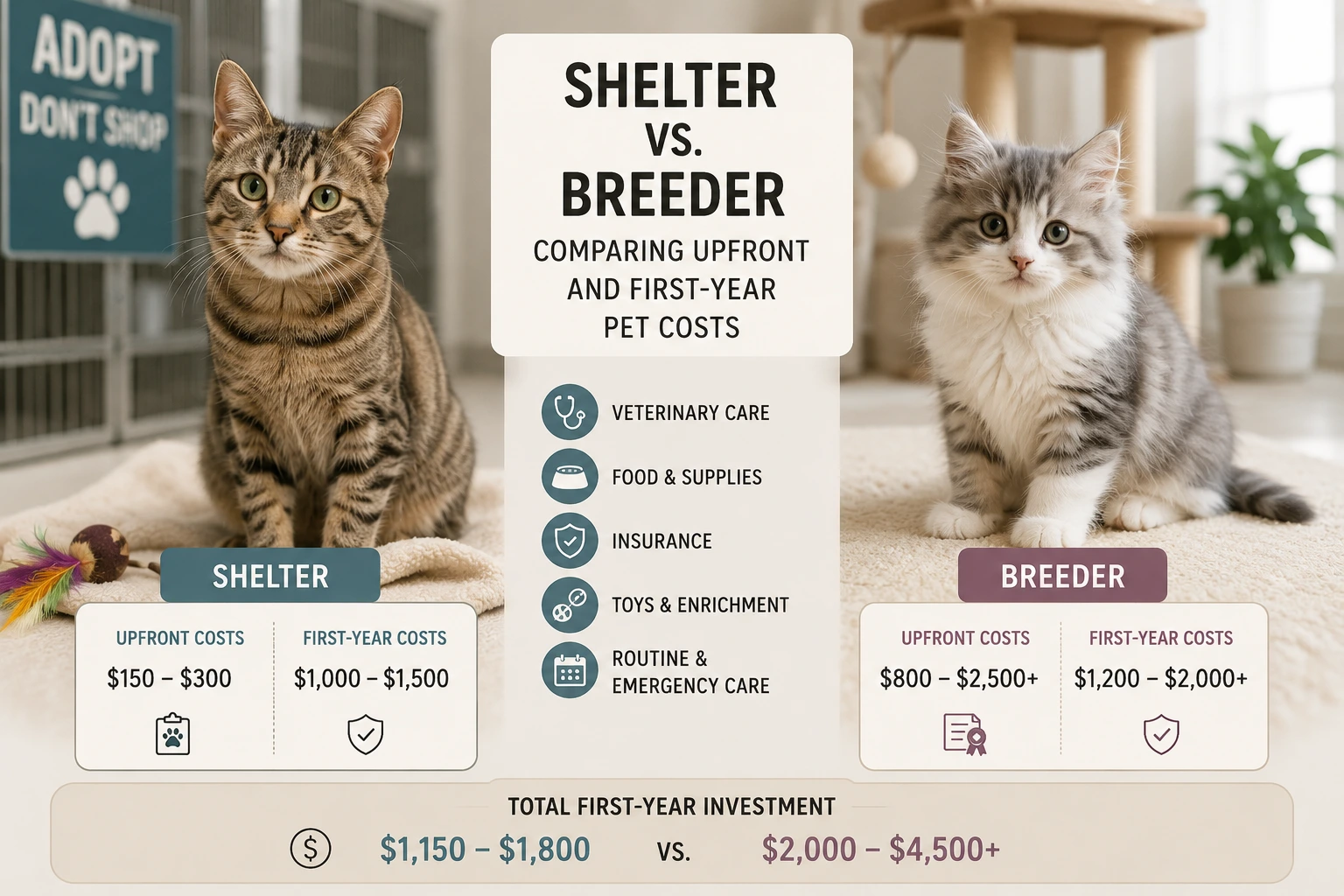
A shelter or rescue may have a different upfront fee than a breeder. However, the amount you pay on adoption or pickup day does not tell you the complete cost of the first year.
A breeder may include certain veterinary services, registration documents, early vaccinations, or other care in the purchase price. A shelter or rescue may also include services such as vaccinations, spay/neuter, microchipping, or parasite treatment in its adoption fee.
The right financial comparison is therefore not simply:
Shelter = cheap
Breeder = expensive
Instead, compare:
Upfront cost + included services + initial supplies + first-year routine expenses + potential medical costs
This guide explains how to make that comparison before bringing a dog or cat home.
Important: Prices vary considerably by species, breed, location, organization, breeder, age, health, and included services. The examples in this article are budgeting illustrations, not universal prices or quotes.
Shelter vs. Breeder: The Short Answer
There is no single price that applies to every shelter adoption or breeder purchase.
A shelter or rescue may have a relatively modest adoption fee, but the exact amount and included services vary by organization.
A responsible breeder may charge substantially more upfront, but the purchase price may include certain veterinary care, registration, health screening, or other services.
Therefore, the better question is:
What will I actually have to pay during the first 12 months under each option?
A useful comparison looks like this:
| Cost Category | Shelter/Rescue | Breeder |
|---|---|---|
| Initial fee | Adoption fee | Purchase price |
| Spay/neuter | May be included | May be future expense |
| Vaccinations | May be included | May be partly included |
| Microchip | May be included | May be included |
| Medical records | Usually provided when available | Usually provided |
| Initial supplies | Usually separate | Usually separate |
| Food | Ongoing | Ongoing |
| Routine vet care | Ongoing | Ongoing |
| Preventive care | Ongoing | Ongoing |
| Training | Depends on pet | Depends on pet |
| Insurance | Optional | Optional |
| Emergency fund | Recommended | Recommended |
The key word is “may.”
Always confirm exactly what is included.
What Does “Shelter” Mean?
A shelter can refer to an animal shelter, municipal shelter, humane organization, or another organization that houses animals needing homes.
A rescue organization may operate differently from a municipal shelter.
For financial planning, the important point is that each organization can have its own adoption fee, policies, included services, and requirements.
Before adoption, ask for an itemized explanation of what your fee covers.
What Does “Breeder” Mean?
A breeder is someone who intentionally produces litters of animals.
Breeders vary significantly in their practices, experience, screening processes, contracts, health testing, and pricing.
A higher purchase price does not automatically prove that a breeder is responsible.
Likewise, a lower price does not automatically mean that a breeder provides poor care.
If you are considering a breeder, evaluate the breeder’s practices as well as the price.
Why the Upfront Price Can Be Misleading
Suppose you compare two options:
Shelter
Adoption fee: $200
Breeder
Purchase price: $2,000
At first glance, the shelter appears to be $1,800 cheaper.
But you still need to determine:
- What medical care has already been completed?
- Is spay/neuter included?
- Are vaccinations included?
- Is the animal microchipped?
- Are there medical records?
- Are there required follow-up visits?
- What supplies do you need immediately?
- Does either option include registration or documentation?
- Does the breeder provide a health contract?
- Are there known medical issues?
Only after answering these questions can you make a meaningful first-year comparison.
What May Be Included in a Shelter Adoption Fee?
Shelter and rescue organizations differ, but an adoption fee may include some services that would otherwise create additional expenses.
Depending on the organization, this can include:
- Spay/neuter
- Vaccinations
- Microchipping
- Veterinary examination
- Parasite treatment
- Identification
- Other initial medical services
For example, the ASPCA explains that adoption fees help organizations cover the costs of caring for animals, including veterinary care, spay/neuter, vaccinations, and food.
However, never assume these services are included everywhere.
Ask the specific shelter or rescue before making your budget.
What May Be Included in a Breeder Purchase?
A breeder may provide some initial services or documentation as part of the purchase.
Depending on the breeder and animal, this could include:
- Initial vaccinations
- Veterinary examination
- Deworming
- Microchip
- Registration documentation
- Pedigree information
- Health records
- Genetic testing information
- Spay/neuter arrangements or requirements
- Health guarantee or contract
The exact terms vary.
A responsible buyer should ask for the details in writing rather than assuming that a high purchase price includes every future veterinary expense.
The First-Year Cost Comparison
The most useful comparison is to divide expenses into three groups.
Group 1: Upfront Costs
These are paid around the time you bring the pet home.
Examples:
- Adoption fee or purchase price
- Carrier
- Crate
- Initial food
- Bowls
- Bedding
- Litter equipment for cats
- Leash and harness for dogs
- Initial toys
Group 2: Planned First-Year Costs
These are expenses you can reasonably anticipate.
Examples:
- Routine veterinary visits
- Preventive care
- Food
- Grooming
- Training
- Litter
- Medication
- Insurance
- Boarding
Group 3: Unexpected Costs
These are harder to predict.
Examples:
- Emergency veterinary care
- Diagnostic testing
- Surgery
- Unexpected medication
- Treatment for illness or injury
Your financial plan should account for this third category even though you cannot predict the exact amount.
Example: Shelter First-Year Budget
Consider this hypothetical example for an adopted adult cat:
| Expense | Example |
|---|---|
| Adoption fee | $150 |
| Initial supplies | $250 |
| Food | $480 |
| Litter | $240 |
| Routine care reserve | $300 |
| Emergency savings | $360 |
| First-year planned budget | $1,780 |
The adoption fee is only $150.
But the total planned first-year budget is $1,780.
That is why focusing exclusively on the adoption fee can produce an unrealistic financial picture.
Example: Breeder First-Year Budget
Now consider a hypothetical kitten purchased from a breeder:
| Expense | Example |
|---|---|
| Purchase price | $1,500 |
| Initial supplies | $300 |
| Food | $480 |
| Litter | $240 |
| Routine care reserve | $300 |
| Emergency savings | $360 |
| First-year planned budget | $3,180 |
This example is not intended to represent an average breeder price.
It simply demonstrates how a higher initial purchase price can affect the first-year budget.
Why You Should Not Compare Only the Two Fees
The previous examples show:
Shelter
$150 initial fee
Breeder
$1,500 initial price
But that doesn’t tell the whole story.
If the shelter fee includes:
- Spay/neuter
- Vaccinations
- Microchip
- Medical examination
and the breeder price also includes several veterinary services, the difference in actual first-year expenses may be smaller than the headline prices suggest.
Conversely, if additional services are not included, your initial costs may increase.
Always compare what you receive for the money.
Spay and Neuter Costs
Spay/neuter is an important item to clarify before bringing a pet home.
Ask:
Shelter
- Has the pet already been altered?
- Is the procedure included in the adoption fee?
- If not, is there a required deadline?
- Is a voucher provided?
Breeder
- Has the animal already been altered?
- Is alteration prohibited until a certain age?
- Is there a contractual requirement?
- Will the breeder require proof of the procedure?
The financial difference can be significant.
Vaccination Costs
Ask for the animal’s complete vaccination record.
For a shelter animal:
Which vaccinations have already been administered?
For a breeder animal:
Which vaccinations have been administered, when were they given, and what remains?
Do not automatically budget for vaccinations that have already been completed.
At the same time, don’t assume the animal is fully caught up without reviewing the records.
Microchipping
Microchipping is another cost that may already be included.
If the animal is already microchipped:
- Get the microchip number.
- Confirm the registration process.
- Update the contact information after adoption or purchase.
A microchip is not useful for reunification if its registration information is outdated.
Veterinary Records Matter More Than the Headline Price
Before bringing the pet home, request the available medical records.
Look for:
- Vaccination history
- Parasite treatment
- Previous illnesses
- Medications
- Surgeries
- Diagnostic results
- Microchip information
- Spay/neuter documentation
For a breeder, also ask about health testing relevant to the breed or animal.
A cheap upfront price can become less attractive if you discover major immediate medical needs.
Breed Can Affect the First-Year Budget
Breed can influence expenses in several ways.
Potential differences include:
- Food requirements
- Grooming
- Training
- Breed-associated health risks
- Exercise requirements
- Equipment
- Insurance pricing
This does not mean a particular breed will definitely cost more.
It means breed should be included in your financial planning.
Age Can Change the Financial Picture
Age is another important factor.
Young Animal
Potential expenses:
- Vaccinations
- Spay/neuter
- Training
- Initial equipment
- More frequent early veterinary care
Adult Animal
Expenses may be more predictable if the animal is healthy.
Senior Animal
There may be greater uncertainty around:
- Medication
- Diagnostic testing
- Veterinary monitoring
- Chronic conditions
The animal’s actual medical history is more useful than age alone.
Shelter vs. Breeder: Which Is Cheaper?
There is no universal answer.
A shelter adoption often has a lower upfront fee.
But “cheaper” should be evaluated using:
Total first-year spending
not simply:
Adoption fee vs. purchase price
A better comparison is:
How much money will I actually need to provide appropriate care during the first year?
The Cost of Training
Training can be a meaningful first-year expense, especially with puppies.
Depending on your needs, you may pay for:
- Group classes
- Private training
- Behavioral consultation
- Specialized training
A shelter dog may need training to adjust to a new home.
A puppy from a breeder may also require substantial training.
Therefore, don’t assume one source automatically means lower training costs.
The individual animal and your experience as an owner matter.
Grooming Can Change the Comparison
Grooming is particularly important for certain dogs.
Consider:
- Coat type
- Hair length
- Grooming frequency
- Professional grooming prices
- Whether you can groom at home
A small dog with high grooming requirements can potentially cost more than a larger dog with a low-maintenance coat.
Again, pet characteristics matter more than the source alone.
Food Costs
Food should be calculated based on the individual pet.
Factors include:
- Species
- Size
- Age
- Activity
- Food type
- Brand
- Medical dietary requirements
For example, a large dog will generally consume more food than a small dog.
A cat with a veterinary-prescribed diet may also have a very different food budget.
For a more detailed food-specific calculation, see:
How Much Should You Really Spend on Pet Food?
That article focuses on food budgeting rather than the shelter-versus-breeder decision.
Pet Insurance: Shelter vs. Breeder
Insurance decisions should not automatically depend on where you obtained your pet.
The more relevant questions are:
- What coverage is available?
- What is the premium?
- What is the deductible?
- What reimbursement applies?
- What exclusions apply?
- Are pre-existing conditions excluded?
- What limits apply?
A pet from a breeder can need insurance.
A shelter pet can need insurance.
The source of the pet does not eliminate the need to evaluate financial risk.
Emergency Savings Should Be Separate
Don’t confuse your normal pet budget with emergency savings.
For example:
Routine monthly budget
$150/month
Emergency contribution
$40/month
Total monthly financial commitment:
$190
The $40 is not intended to be spent on ordinary food or toys.
It is building a reserve.
For a more detailed emergency-fund approach, see our Pet Emergency Fund Calculator.
A Useful First-Year Comparison Worksheet
Before choosing a shelter or breeder, fill this out.
| Expense | Shelter/Rescue | Breeder |
|---|---|---|
| Adoption/purchase fee | $___ | $___ |
| Spay/neuter | $___ | $___ |
| Vaccinations | $___ | $___ |
| Microchip | $___ | $___ |
| Initial veterinary visit | $___ | $___ |
| Initial supplies | $___ | $___ |
| Food | $___ | $___ |
| Litter / waste supplies | $___ | $___ |
| Grooming | $___ | $___ |
| Training | $___ | $___ |
| Insurance | $___ | $___ |
| Routine veterinary care | $___ | $___ |
| Medication | $___ | $___ |
| Emergency reserve | $___ | $___ |
| Estimated first-year total | $___ | $___ |
This is much more informative than comparing two headline prices.
How to Calculate the True First-Year Cost
Use this formula:
Step 1 — Initial cost
Adoption fee or purchase price
Step 2 — Add initial setup
Carrier/crate + food + bowls + bedding + litter + other equipment
Step 3 — Add planned healthcare
Routine vet + preventive care + medication
Step 4 — Add lifestyle expenses
Training + grooming + boarding + walking/daycare
Step 5 — Add financial protection
Insurance + emergency savings
Result
Estimated first-year financial commitment
This approach gives you a more realistic number.
Example: Two Pets With Different Upfront Prices
Imagine:
Shelter option
Upfront fee:
$200
Breeder option
Upfront price:
$1,800
Difference:
$1,600
Now imagine the shelter pet needs $500 of additional initial veterinary care, while the breeder’s price already includes several initial veterinary services.
The effective first-year difference becomes smaller.
This is why included services must be assigned a value before comparing options.
What Questions Should You Ask a Shelter?
Before adoption, ask:
- What exactly does the adoption fee include?
- Has the animal been examined by a veterinarian?
- Which vaccinations were given?
- Has the animal been spayed or neutered?
- Is the animal microchipped?
- Are medical records provided?
- Is the animal currently taking medication?
- Are there known medical conditions?
- Are there behavioral considerations?
- Are there post-adoption requirements?
- Are there additional fees?
- Is there adoption support after bringing the animal home?
The answers should be part of your financial decision.
What Questions Should You Ask a Breeder?
Before purchasing, ask:
- What is included in the purchase price?
- Which veterinary services have been completed?
- What vaccinations have been administered?
- What health testing has been performed?
- Are medical records provided?
- Is microchipping included?
- Is there a written contract?
- Is there a health guarantee?
- What happens if a serious health issue is discovered?
- What veterinary follow-up is expected?
- What food is the animal currently eating?
- What documentation is provided?
A responsible buyer should evaluate the breeder’s practices as well as the price.
Don’t Ignore the Contract
If you purchase from a breeder, read the contract carefully.
It may contain provisions concerning:
- Health guarantees
- Veterinary examinations
- Spay/neuter
- Registration
- Breeding rights
- Return policies
- Rehoming
- Required veterinary care
If you do not understand a contractual requirement, ask for clarification before paying.
Don’t Ignore the Shelter’s Adoption Agreement
Shelter and rescue adoption agreements may also include requirements.
These can concern:
- Veterinary care
- Identification
- Spay/neuter
- Return procedures
- Rehoming
- Housing restrictions
- Other responsibilities
Read the agreement before finalizing the adoption.
Hidden Costs to Watch For
“Hidden cost” does not necessarily mean someone is hiding the expense.
It often means a new owner simply forgot to include it in the budget.
Examples:
- Replacement equipment
- Travel
- Boarding
- Training
- Grooming
- Medication
- Emergency veterinary care
- Pet deposits or housing-related costs
- Damage caused by a young or untrained pet
Adding these categories to your planning worksheet can make your budget much more realistic.
Housing Costs Can Be Different
If you rent, pet-related housing expenses may affect the total cost of ownership.
Depending on your lease and location, you may encounter:
- Pet deposits
- Pet fees
- Pet rent
- Breed or size restrictions
These are not adoption costs, but they are part of the financial decision of bringing an animal home.
Check your lease before committing to a pet.
What If the Shelter Has a Very Low Adoption Fee?
A low or waived adoption fee can reduce your initial financial burden.
However, don’t assume the total cost of ownership will be low.
You still need to budget for:
- Food
- Supplies
- Veterinary care
- Preventive care
- Emergency savings
- Other ongoing expenses
The lower initial fee simply means you have more money available for those future costs.
What If the Breeder Has a High Purchase Price?
A high purchase price should not automatically be treated as a complete first-year budget.
You still need to plan for:
- Food
- Veterinary care
- Preventive care
- Training
- Grooming
- Insurance
- Emergency savings
A higher initial payment does not eliminate future expenses.
Which Option Is Better Financially?
The answer depends on your circumstances.
A shelter may be financially attractive because the adoption fee can include important initial services.
A breeder may provide specific documentation, health testing, or other characteristics that are important to a buyer.
But the financial decision should be based on:
Total cost
Included services
Expected ongoing expenses
Potential medical needs
Your available emergency savings
Your ability to maintain the budget long term
A Practical Decision Framework
Before choosing, score each option from 1–5.
| Factor | Shelter | Breeder |
|---|---|---|
| Upfront affordability | /5 | /5 |
| Included veterinary services | /5 | /5 |
| Medical information available | /5 | /5 |
| Ongoing cost fit | /5 | /5 |
| Lifestyle fit | /5 | /5 |
| Emergency-risk comfort | /5 | /5 |
| Documentation | /5 | /5 |
| Long-term affordability | /5 | /5 |
This prevents the purchase price from becoming the only factor.
Shelter vs. Breeder: The Financial Takeaway
There is no responsible way to say:
“Shelter pets always cost less.”
There are too many variables.
Likewise, it would be misleading to say:
“Buying from a breeder is always more expensive.”
The financial reality depends on what you pay upfront, what is included, the animal’s characteristics, and what happens during the first year.
The most useful comparison is:
Upfront cost
Included services
Initial setup
Routine first-year expenses
Expected lifestyle expenses
Emergency preparation
Frequently Asked Questions
Is adopting from a shelter cheaper than buying from a breeder?
The upfront adoption fee is often lower than a breeder’s purchase price, but the total first-year cost depends on what each option includes and the animal’s individual needs.
Do shelter adoption fees include veterinary care?
They may. Services can include vaccinations, spay/neuter, microchipping, and veterinary examination, but this varies by organization. Confirm with the specific shelter or rescue.
Why are breeder prices so different?
Breeder pricing can vary based on breed, location, lineage, health testing, demand, breeding practices, and other factors. Price alone does not establish quality.
Does a breeder price include vaccinations?
Some breeders include initial vaccinations, while others may provide only certain services. Ask for a written list of what has been completed.
Does adoption include spay or neuter?
It may. Many organizations provide or arrange the procedure, but policies differ.
Which option has lower first-year costs?
There is no universal answer. Compare the complete first-year budget rather than only the adoption or purchase price.
Should I budget for emergency veterinary care?
Yes. Emergency expenses are difficult to predict, so building an emergency reserve can help reduce financial stress.
Is pet insurance necessary?
Pet insurance is optional, but it can be one way to manage certain eligible veterinary expenses. Compare premiums, deductibles, reimbursement, exclusions, waiting periods, and limits before deciding.
Should I choose a shelter or breeder based only on cost?
No. Financial sustainability is important, but you should also consider the animal’s health, temperament, your lifestyle, the organization’s or breeder’s practices, and your ability to provide long-term care.
Final Checklist Before Bringing a Pet Home
Before you make your decision, confirm:
- I know the exact adoption/purchase price.
- I know what is included.
- I have reviewed medical records.
- I know vaccination status.
- I know spay/neuter status.
- I know microchip status.
- I know about current medications.
- I have estimated initial supplies.
- I have estimated food costs.
- I have estimated routine veterinary costs.
- I have considered grooming/training.
- I have considered boarding or daycare if needed.
- I have considered insurance if appropriate.
- I have emergency savings.
- I can afford the pet beyond the first year.
Related Pet Finance Resources
If you are comparing the financial impact of bringing a pet home, these resources may also help:
Pet Ownership Cost Calculator — Build an overall annual pet ownership estimate.
Pet Emergency Fund Calculator — Estimate a financial reserve for unexpected veterinary expenses.
How Much Should You Really Spend on Pet Food? — Focus specifically on food budgeting.
Average Vet Costs by Procedure — Explore veterinary costs by procedure rather than overall ownership costs.
These pages address different questions, while this guide focuses specifically on comparing shelter and breeder costs during the first year.
Editorial Methodology
PetPolicyFinance evaluates shelter-versus-breeder costs using a total-cost framework.
The comparison separates:
- Upfront acquisition cost
- Included veterinary services
- Initial equipment and supplies
- Routine first-year expenses
- Lifestyle expenses
- Emergency financial preparation
Example prices are illustrative and are not presented as universal national averages.
Because shelters, rescues, and breeders differ substantially in their fees and included services, readers should obtain current pricing and documentation directly from the organization or breeder they are considering.
Editorial Disclaimer
PetPolicyFinance.com is an independent educational website. We are not an animal shelter, rescue organization, breeder, veterinary clinic, insurance company, insurance broker, financial adviser, or law firm.
This article provides general educational information about pet budgeting. It does not constitute veterinary, financial, insurance, or legal advice.
Always verify current adoption or purchase terms, medical records, contracts, and prices before making a decision.
Veterinary questions should be discussed with a licensed veterinarian.
Author: Harry Mills
Last Reviewed: August 2026
