

Updated: August 2026
A pet emergency can happen without warning.
A dog may swallow something dangerous. A cat may suddenly need emergency treatment. An accident may require diagnostic tests, medication, hospitalization, or surgery.
The difficult part is that you usually don’t know when an emergency will happen or how much it will cost.
That’s why a dedicated pet emergency fund can be useful.
This guide helps you estimate an emergency savings target based on your pet’s circumstances, your insurance coverage, your regular veterinary costs, and how much you can realistically save each month.
Important: This calculator is a financial-planning tool, not a prediction of veterinary costs. Actual emergency expenses vary significantly by location, condition, treatment, veterinary hospital, and individual pet.
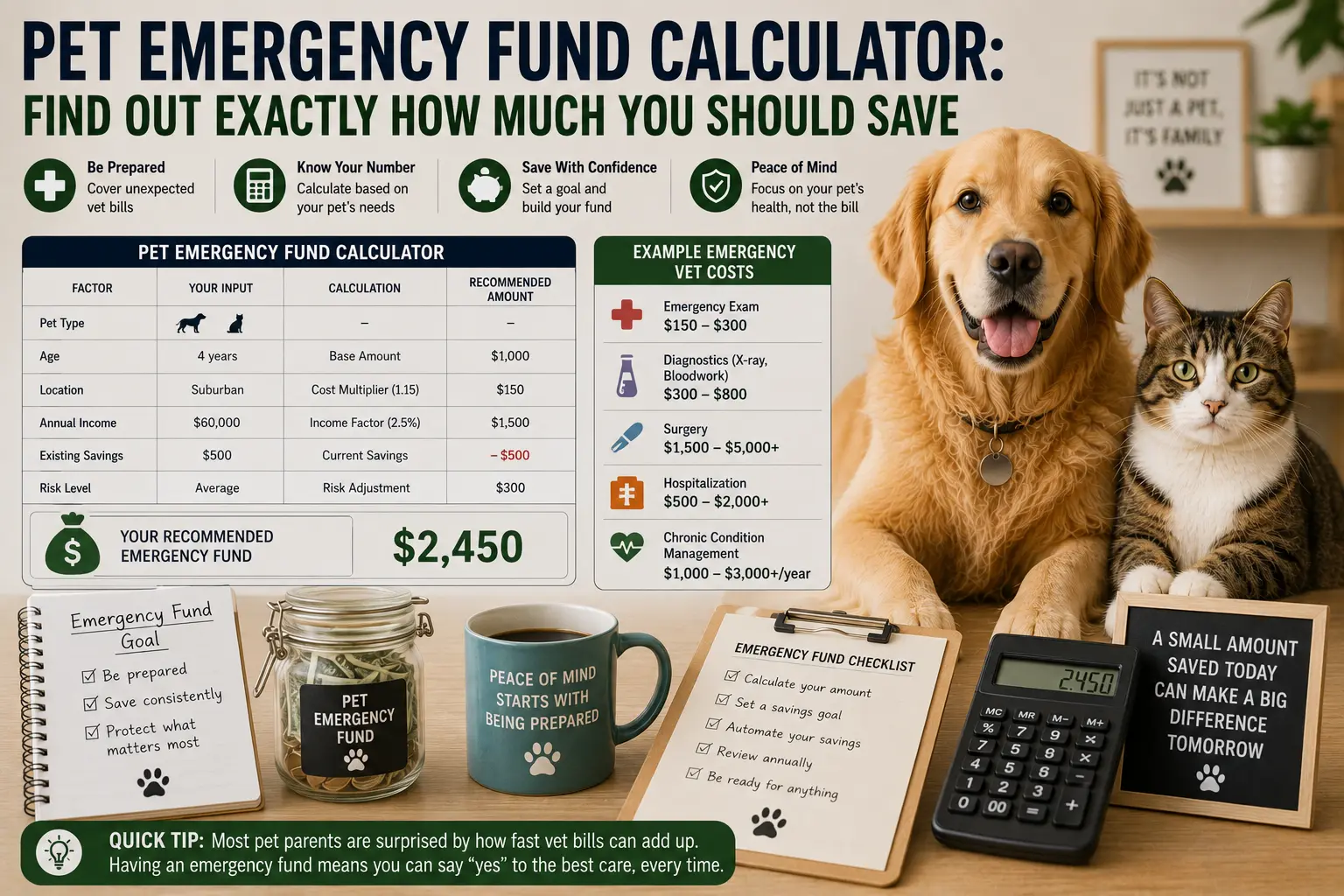
Pet Emergency Fund Calculator
Use the following information to create a personalized starting target.
Step 1: Select Your Pet
Pet type:
- Dog
- Cat
Step 2: Enter Your Pet’s Age
- Under 1 year
- 1–6 years
- 7–10 years
- Over 10 years
Age does not predict whether a pet will experience an emergency. It is simply one factor you may want to consider when reviewing your overall financial preparedness.
Step 3: Enter Your Current Emergency Savings
Current pet emergency savings:
$________
If you already have money specifically reserved for your pet, enter that amount.
Step 4: Enter Your Pet Insurance Details
Do you have pet insurance?
- Yes
- No
If yes, enter:
Annual deductible: $________
Reimbursement percentage: ______%
Annual coverage limit: $________
Remember that insurance does not necessarily eliminate the need for emergency savings. Depending on the policy, you may have to pay eligible expenses upfront and then seek reimbursement. Coverage exclusions, deductibles, reimbursement rates, waiting periods, and annual limits can also affect your out-of-pocket cost.
Step 5: Estimate Your Local Emergency Vet Cost
Emergency veterinary prices vary substantially by location and treatment.
As a current reference point, CareCredit’s May 2026 guide reports a national average emergency exam cost of about $135 for dogs and $143 for cats, with reported exam ranges of roughly $107–$246 for dogs and $113–$260 for cats. These figures refer to the emergency examination itself—not the total cost of diagnostics, treatment, hospitalization, or surgery.
For your own emergency fund, don’t stop at the exam fee.
Call a local emergency veterinary hospital and ask:
- Emergency examination fee
- Typical diagnostic fees
- Deposit requirements
- Payment options
- Whether estimates are provided before treatment
Enter the information you receive into your personal budget.
How We Calculate Your Emergency Fund
There is no scientifically established dollar amount that every pet owner should save.
We therefore do not use an arbitrary formula such as:
“Every dog needs exactly $5,000.”
Instead, our approach starts with your own financial situation and builds a planning target around several factors.
Our Basic Formula
Emergency Fund Target = Planned Veterinary Reserve + Expected Out-of-Pocket Exposure
The target can then be adjusted based on:
- Insurance coverage
- Deductible
- Existing savings
- Monthly savings capacity
- Pet’s current health needs
- Local emergency-care costs
This approach is deliberately transparent. You can see where your number comes from and change it when your circumstances change.
Step 1: Determine Your Base Veterinary Reserve
Start by finding out what emergency veterinary care costs in your area.
A practical starting point is to ask your local emergency clinic about:
Emergency examination
What does an after-hours or emergency examination cost?
Diagnostic testing
Ask whether common emergency diagnostics such as bloodwork or imaging are charged separately.
Hospitalization
Ask about the typical initial hospitalization or monitoring charges.
Surgery or procedures
You do not need a precise price for every possible surgery. The goal is simply to understand the financial scale of serious care.
AAHA recommends that pet owners estimate veterinary care costs and speak with their veterinarian about expected costs for routine and preventive services.
Step 2: Consider Your Insurance Deductible
If you have pet insurance, your emergency fund may need to cover the amount you are responsible for before reimbursement.
For example, suppose a policy has:
- $500 annual deductible
- 80% reimbursement
- Covered emergency treatment
If an eligible claim is $2,000, the exact reimbursement depends on the policy’s terms and how the insurer applies the deductible.
Therefore, don’t assume:
“I have insurance, so I don’t need savings.”
Your emergency reserve can help cover the upfront and non-covered portion of care.
Step 3: Account for Non-Covered Expenses
Pet insurance policies can have exclusions.
Depending on the policy, expenses may be affected by:
- Pre-existing conditions
- Waiting periods
- Deductibles
- Reimbursement limits
- Annual limits
- Per-condition limits
- Excluded treatments
Always read your actual policy documents.
AAHA notes that pet insurance can help with unexpected veterinary costs, but exclusions apply to many policies and owners should review plan details carefully.
Step 4: Consider Your Pet’s Existing Health Needs
A pet with an ongoing medical condition may have a different financial planning requirement from a healthy pet.
For example, you may already have recurring expenses for:
- Prescription medication
- Special food
- Diagnostic testing
- Regular veterinary visits
- Chronic-condition treatment
These should generally be included in your normal healthcare budget, rather than assuming that your emergency fund will cover every recurring expense.
AAHA recommends proactive financial planning for pets with chronic illness and specifically discusses maintaining a dedicated emergency fund for future veterinary needs.
Step 5: Consider Your Ability to Rebuild the Fund
An emergency fund is not useful only because of its size.
You also need to consider how quickly you could rebuild it after using it.
For example:
Suppose your target is:
$3,000
and you can save:
$150/month
It would take:
$3,000 ÷ $150 = 20 months
to build the fund from zero.
If you already have $1,500 saved:
($3,000 − $1,500) ÷ $150 = 10 months
This is why your monthly savings capacity belongs in the calculation.
A Simple Three-Level Emergency Fund
Instead of telling every pet owner to save the same amount, we recommend thinking in levels.
Level 1: Starter Fund
This is your first financial safety layer.
The goal is to have enough money to handle an unexpected emergency examination and smaller urgent expenses without immediately relying on credit.
This is especially useful if you currently have no dedicated pet savings.
Level 2: Stronger Emergency Fund
Once your starter fund is established, continue building it toward a larger reserve that can absorb a more substantial unexpected veterinary expense.
The exact target depends on:
- Your local veterinary prices
- Your pet’s needs
- Insurance coverage
- Your household finances
Level 3: Comprehensive Preparation
A larger reserve may make sense for households that:
- Have multiple pets
- Have limited insurance
- Own a pet with ongoing medical needs
- Live far from lower-cost veterinary services
- Have difficulty accessing emergency financing
- Want to minimize reliance on credit
The goal is not to save an unrealistic amount.
The goal is to create a financial plan that fits your actual circumstances.
Example: Dog Without Insurance
Suppose you have:
- Healthy adult dog
- No pet insurance
- $500 currently saved
- Local emergency examination: $150
- Ability to save $200/month
You might choose a personal emergency target of:
$2,500
Your remaining amount would be:
$2,500 − $500 = $2,000
At $200/month:
$2,000 ÷ $200 = 10 months
So your plan would be:
Current savings: $500
Monthly contribution: $200
Target: $2,500
Estimated time to target: 10 months
This is an example of the methodology—not a recommendation that every dog owner needs exactly $2,500.
Example: Dog With Insurance
Suppose another owner has:
- $1,000 saved
- Pet insurance
- $500 deductible
- 80% reimbursement
- $200/month available for savings
The owner may decide that a $3,000 emergency reserve is appropriate.
Amount still needed:
$3,000 − $1,000 = $2,000
At $200/month:
10 months
The insurance policy may reduce eligible out-of-pocket exposure, but the owner should still understand how claims are paid and which expenses are excluded.
Example: Multiple Pets
Suppose you have:
- Dog emergency fund: $2,000
- Cat emergency fund: $1,500
You could maintain separate accounts or one combined account.
Combined target
$2,000 + $1,500 = $3,500
A combined account can be simpler, but separate tracking can make it easier to understand how much has been reserved for each pet.
Choose the system you are most likely to maintain consistently.
What Should Your Emergency Fund Pay For?
A pet emergency fund is generally intended for unexpected expenses.
Potential examples include:
- Emergency examination
- Diagnostic testing
- Emergency medication
- Hospitalization
- Surgery
- Emergency imaging
- Urgent treatment
It can also be useful for other unexpected pet-care costs if your personal financial plan allows it.
What Shouldn’t Be Confused With an Emergency Fund?
Your emergency fund should not replace normal budgeting.
You should still plan separately for predictable expenses such as:
- Food
- Routine examinations
- Vaccinations
- Preventive medication
- Grooming
- Regular medication
- Toys
- Routine boarding
ASPCA’s published pet-cost guide separates recurring annual expenses from one-time and special costs, which is a useful budgeting model even though its published dollar figures are from 2021 and should not be treated as current 2026 prices.
Emergency Fund vs Pet Insurance
These are different financial tools.
| Feature | Emergency Fund | Pet Insurance |
|---|---|---|
| Your own savings | Yes | No |
| Monthly premium | No | Usually |
| Can cover non-covered expenses | Yes | No |
| Deductible | No | Often |
| Reimbursement | No | Policy-dependent |
| Money immediately available | Yes, if saved | Depends on claim/payment process |
| Useful for routine expenses | Potentially | Policy-dependent |
| Helps with major eligible claims | Yes | Potentially |
You don’t necessarily have to choose one or the other.
Some owners use both savings and insurance.
AAHA discusses pet insurance and dedicated pet savings as ways to prepare financially for veterinary care.
What If You Can’t Afford to Build a Large Fund?
Start smaller.
A $25 monthly contribution is better than having no plan.
For example:
$25 × 12 = $300/year
At:
$50/month = $600/year
At:
$100/month = $1,200/year
The important thing is consistency.
You can increase the amount later as your income or circumstances change.
Automate Your Pet Emergency Savings
One of the easiest ways to build an emergency fund is to automate the transfer.
For example:
Every payday → $50 → Pet Emergency Savings
You don’t have to remember to transfer money manually.
AAHA similarly recommends setting a monthly pet-health budget and using automatic transfers to build a dedicated savings account.
Where Should You Keep the Money?
A pet emergency fund should generally be kept somewhere that is:
- Separate from everyday spending
- Easy to access
- Clearly identified as pet savings
- Appropriate for your financial situation
The purpose is availability when you need it—not maximizing investment returns.
Avoid putting emergency money into investments that could lose value when you suddenly need to pay a veterinary bill.
What If an Emergency Happens Before Your Fund Is Ready?
If your savings are not enough, don’t delay necessary veterinary care simply because you haven’t reached your target.
Ask the veterinary hospital about:
- Treatment estimates
- Different treatment options
- Payment arrangements, if available
- Financing options
- Pet insurance reimbursement
- Local charitable assistance
- Veterinary assistance programs
AAHA discusses several financial approaches—including insurance, savings, payment plans, and financing—as ways owners may manage veterinary expenses.
If your pet is experiencing a genuine emergency, seek veterinary care promptly.
Build a Pet Emergency Plan Alongside Your Fund
Money is only one part of emergency preparation.
ASPCA recommends having an emergency-care plan before an emergency occurs, including knowing where to obtain after-hours veterinary care.
Keep these details available:
Primary veterinarian: __________
Emergency veterinarian: __________
Emergency phone: __________
Pet insurance provider: __________
Policy number: __________
Preferred payment method: __________
Pet medical records location: __________
This can save valuable time when you’re stressed.
Emergency Fund Checklist
Use this checklist to see how prepared you are.
Financial
- I know my local emergency vet’s examination fee.
- I know how much I currently have saved.
- I know my insurance deductible.
- I understand my reimbursement percentage.
- I know my policy’s important exclusions.
- I have a monthly savings target.
- My savings are separate from everyday spending.
Veterinary
- I know my regular veterinarian’s contact information.
- I know where the nearest emergency clinic is.
- I have my pet’s medical records available.
- I know which medications my pet takes.
Household
- Another household member knows where the emergency fund is.
- Someone knows how to access important pet records.
- I have a backup caregiver for my pet if needed.
Our Emergency Fund Methodology
This is the section that makes our calculator different from a generic “save $5,000” article.
We calculate a planning target, not a guaranteed medical-cost requirement.
Our methodology considers five inputs:
1. Local Emergency-Care Cost
Use current pricing from a nearby emergency veterinary provider when available.
2. Insurance Exposure
Consider:
- Deductible
- Reimbursement percentage
- Coverage limits
- Exclusions
- Waiting periods
3. Current Savings
Subtract the amount already dedicated to pet emergencies.
4. Monthly Savings Capacity
Determine how much you can realistically contribute each month.
5. Pet-Specific Circumstances
Consider:
- Age
- Current health
- Existing medication
- Number of pets
- Special care requirements
We deliberately do not assign arbitrary “breed risk multipliers” or “age multipliers” because there is no universal formula that can reliably predict an individual pet’s future emergency bill.
This makes the calculator easier to understand and adjust.
Our Suggested Calculation
Use this simplified planning formula:
Target Fund = Your Chosen Veterinary Reserve + Expected Out-of-Pocket Exposure
Then:
Amount Still Needed = Target Fund − Current Pet Savings
And:
Months to Goal = Amount Still Needed ÷ Monthly Savings Contribution
Example
Target:
$3,000
Current savings:
$750
Monthly contribution:
$150
Amount remaining:
$3,000 − $750 = $2,250
Time to goal:
$2,250 ÷ $150 = 15 months
Again, this is a budgeting example—not a statement that $3,000 is the correct emergency fund for every pet.
Why We Don’t Use a Universal $5,000 Rule
You may see pet websites recommend:
“Every pet owner should save $5,000.”
The problem is that this ignores individual circumstances.
A $5,000 fund may be difficult or unrealistic for one household and insufficient for another.
For example:
Household A
- One healthy adult cat
- Strong insurance coverage
- Low deductible
- Good local emergency access
Household B
- Three pets
- Limited insurance
- One pet with chronic health needs
- Higher local veterinary costs
These households have very different financial exposures.
A personalized approach is therefore more useful than a universal number.
Frequently Asked Questions
How much should I save for a pet emergency?
There is no single amount that is appropriate for every pet owner. Start with your local emergency-care costs, insurance exposure, current savings, and monthly savings capacity.
Is $1,000 enough for a pet emergency?
It may cover some urgent expenses, but it may not be enough for a serious emergency involving extensive diagnostics, hospitalization, or surgery. Current emergency-veterinary costs vary considerably.
Is $5,000 enough?
It can provide a substantial reserve for some households, but there is no guarantee that it will cover every possible emergency. Your location, pet, treatment, and insurance coverage all matter.
Do I need an emergency fund if I have pet insurance?
Having insurance does not necessarily eliminate the need for savings. You may still have deductibles, non-covered expenses, reimbursement delays, exclusions, or policy limits.
Should I have a separate emergency fund for each pet?
Not necessarily. You can use separate accounts or one combined pet emergency account. Choose the system that makes it easiest to track your available funds.
How much should I save every month?
Choose an amount you can maintain consistently. Even $25, $50, or $100 per month can build a meaningful reserve over time.
Can I use my pet emergency fund for routine veterinary care?
You can, but doing so reduces the money available for emergencies. It is better to budget routine care separately whenever possible.
Where should I keep my pet emergency fund?
Consider keeping it in a separate, accessible savings account rather than an investment that could fluctuate in value when you need the money.
Final Takeaway
A pet emergency fund is not about predicting exactly what your pet’s next medical emergency will cost.
It is about being financially prepared for an expense you cannot predict.
A useful starting process is:
1. Find your local emergency-vet prices.
2. Review your insurance deductible and coverage.
3. Decide how much risk you can comfortably retain yourself.
4. Set a realistic savings target.
5. Automate a monthly contribution.
6. Review the target at least once a year.
And remember: if your pet is experiencing a medical emergency, seek appropriate veterinary care rather than waiting for your savings balance to reach a particular number.
Sources & Methodology
The financial-planning guidance in this article is based on information from veterinary and animal-care organizations and current published cost information.
American Animal Hospital Association (AAHA)
AAHA recommends proactive budgeting for veterinary care and discusses pet savings, insurance, payment plans, and other approaches to managing veterinary expenses.
ASPCA
The ASPCA provides published pet-care cost information and recommends planning ahead for emergency veterinary care. Its published cost table is from 2021, so we use it as a cost-category reference rather than a current 2026 price benchmark.
CareCredit
CareCredit’s May 2026 emergency-veterinary guide reports current national average emergency examination costs and explains that diagnostics, treatment, and hospitalization can add substantially to the final bill.
Important Disclaimer
This calculator and article are provided for general educational and financial-planning purposes.
They do not provide veterinary, medical, insurance, legal, or financial advice.
No emergency-fund amount can guarantee that you will be able to cover every future veterinary expense.
Veterinary costs vary by location, provider, treatment, pet, and medical condition.
Always consult your veterinarian regarding your pet’s healthcare needs and review your insurance policy documents for specific coverage details.
Last reviewed: August 2026
Author: Harry Mills
