

Updated: August 2026
Adopting a cat can be one of the most rewarding decisions you make, but the adoption fee is only the beginning of the financial commitment.
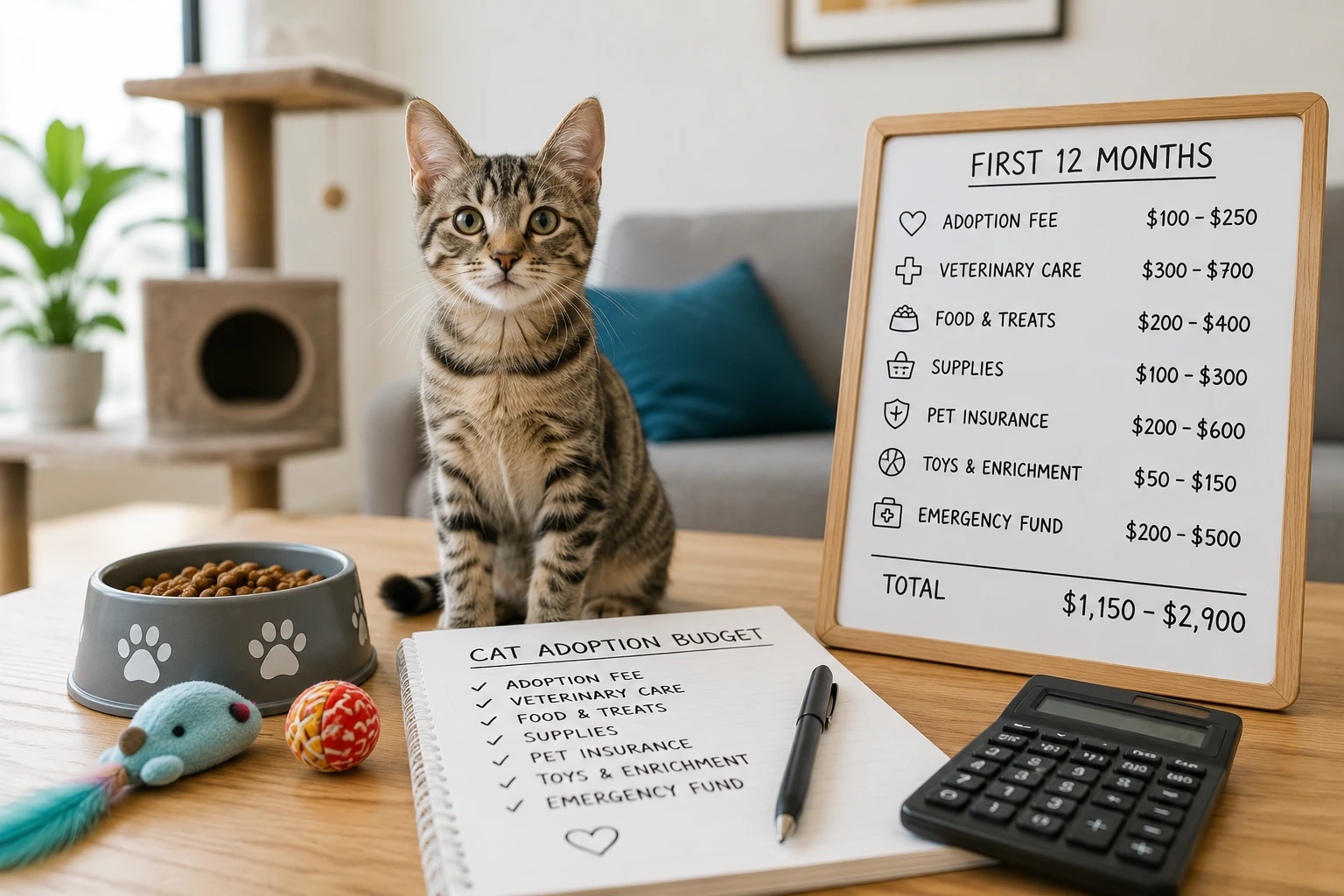
A cat may come home with an adoption fee that appears manageable, yet the first year can also include a carrier, litter equipment, food, veterinary care, preventive products, identification, toys, scratching equipment, and an emergency reserve.
That is why the better question is not:
“How much does it cost to adopt a cat?”
It is:
“How much should I realistically budget for the first 12 months after bringing an adopted cat home?”
This guide focuses specifically on the first-year budget. It separates adoption-day expenses from recurring monthly costs and less predictable expenses so you can plan before bringing your cat home.
Important: The dollar amounts in this guide are illustrative budgeting examples, not guaranteed prices. Adoption fees and veterinary costs vary by organization, location, cat age, health, and services provided. Always confirm the current fee and included services directly with the shelter or rescue.
Quick Answer: How Much Should You Budget for the First Year?
There is no universal first-year cost for an adopted cat.
A practical planning framework is:
Adoption fee
Initial supplies
Initial veterinary expenses not included in adoption
12 months of routine expenses
Emergency savings
=
First-year cat budget
For many households, a reasonable planning target may be around $1,000–$3,000+ for the first year, but individual situations can fall below or substantially above that range.
A healthy adult cat adopted from a shelter may require less initial spending than a kitten or a cat with ongoing medical needs.
The most important factor is not the exact average.
It is knowing which costs you are responsible for and which services are already included in the adoption package.
What Does a Cat Adoption Fee Usually Cover?
One of the biggest mistakes new adopters make is assuming every shelter charges the same fee or provides the same services.
They don’t.
ASPCA explains that animal welfare organizations have their own adoption processes, fees, and requirements. Adoption fees help organizations cover the cost of caring for animals, including expenses such as veterinary care, spay/neuter, vaccinations, and food.
Depending on the organization, the adoption package may include some combination of:
- Spay or neuter
- Vaccinations
- Microchip
- Basic veterinary examination
- Parasite treatment
- Identification
- Initial supplies
- Follow-up resources
But you should never assume all of these are included.
Ask the shelter exactly what the adoption fee covers.
Why the Adoption Fee Is Only One Part of the Cost
Imagine you pay:
$150 adoption fee
You may still need to purchase:
- Carrier
- Litter box
- Litter
- Food
- Bowls
- Scratching post
- Toys
- Bed
- Grooming supplies
- Veterinary care
- Preventive products
Therefore:
Adoption fee ≠ total first-year cost
The adoption fee is simply the entry point into your first-year budget.
First-Year Cat Costs at a Glance
Here is a practical planning framework:
| Expense | First-Year Planning Category |
|---|---|
| Adoption fee | $50–$300+ |
| Carrier | $30–$80 |
| Litter equipment | $30–$100 |
| Food and bowls | $30–$100+ initial setup |
| Scratching equipment | $20–$100+ |
| Toys and enrichment | $20–$100 |
| Initial veterinary care | Varies |
| Food for 12 months | Varies |
| Litter for 12 months | Varies |
| Preventive care | Varies |
| Insurance, if used | Varies |
| Emergency reserve | Personal target |
| Possible first-year total | $1,000–$3,000+ |
These are planning figures rather than official national averages.
The actual total depends heavily on what the shelter has already provided and what your cat needs.
1. The Adoption Fee
Start with the actual fee charged by the organization.
Do not rely on a generic internet average.
The fee may vary according to:
- Organization
- Location
- Cat age
- Adoption program
- Special promotions
- Medical status
- Whether the cat is part of a fee-waived event
ASPCA notes that shelters and rescue organizations may reduce or completely waive adoption fees during promotions.
For example, ASPCA’s current NYC Adoption Center page lists a suggested adoption fee rather than presenting adoption as a fixed nationwide price, illustrating why prospective adopters should check the specific organization they are working with.
Budgeting rule
Use:
Actual shelter fee + any additional adoption-day expenses
rather than an internet average.
2. Ask What Is Included Before You Pay
Before adopting, ask these questions:
Medical
- Has the cat been examined by a veterinarian?
- Has the cat been vaccinated?
- Has the cat been spayed or neutered?
- Has the cat been treated for parasites?
- Has the cat been microchipped?
- Are medical records provided?
Supplies
- Is a carrier provided?
- Is food included?
- Is litter included?
- Are medications included?
Follow-up
- Is a post-adoption veterinary visit recommended?
- Is there a medical guarantee or adoption support period?
- What happens if a medical problem appears shortly after adoption?
The answers can significantly change your first-year budget.
3. The Cat Carrier
You will need a safe way to transport your cat.
A carrier may be necessary for:
- Adoption day
- Veterinary appointments
- Emergencies
- Moving
- Travel
A basic carrier may be relatively inexpensive, while a more durable model can cost more.
If the shelter requires a secure carrier, confirm the requirement before arriving.
For example, the ASPCA’s NYC Adoption Center currently requires adopted cats and kittens to leave in a secure pet carrier and advises adopters to bring one or purchase one.
Budget category
One-time purchase
rather than a monthly expense.
4. Litter Box Setup
Your cat will need an appropriate litter setup.
Potential purchases include:
- Litter box
- Litter scoop
- Litter mat
- Waste container
- Initial litter supply
The initial setup may cost more than your ongoing monthly litter expense.
This is an important distinction.
First month
You purchase the equipment.
Following months
You mainly purchase replacement litter and waste supplies.
5. Food and Feeding Equipment
Your initial food budget may include:
- Food
- Food bowls
- Water bowl
- Water fountain, if desired
- Storage container
Don’t buy a large quantity of unfamiliar food before you know what your cat tolerates.
If the shelter tells you what food the cat has been eating, ask whether you should continue it initially or transition gradually.
For ongoing food-budget planning, you can also use our Pet Food Budget Guide.
That resource focuses specifically on food spending, while this article focuses on the complete first-year adoption budget.
6. Scratching Equipment
Scratching is a normal cat behavior.
A new cat may need:
- Scratching post
- Scratching pad
- Cat tree
- Other appropriate enrichment
You don’t necessarily need to buy an expensive cat tree immediately.
Start with a few practical items and learn what your cat actually uses.
This can prevent unnecessary spending during the first few weeks.
7. Toys and Enrichment
A new cat doesn’t need an enormous collection of toys.
A modest initial selection could include:
- Wand toy
- Ball
- Interactive toy
- Puzzle feeder
- Scratcher
Observe your cat’s preferences before buying more.
This is a simple way to keep the first-year budget under control.
8. Initial Veterinary Visit
One of the most important questions is:
What veterinary care has already been completed by the shelter?
Your cat may already have received some services.
But depending on the organization’s policies and your cat’s health, you may still need veterinary care after adoption.
Ask for:
- Medical records
- Vaccination records
- Spay/neuter documentation
- Microchip information
- Medication instructions
- Recommended follow-up schedule
Don’t assume that “adopted from a shelter” means no future veterinary expenses.
9. Preventive Care
Your cat’s preventive-care needs depend on factors such as:
- Age
- Health
- Lifestyle
- Vaccination history
- Geographic risks
- Veterinary recommendations
Potential expenses may include:
- Vaccinations
- Wellness examinations
- Parasite prevention
- Screening
- Other preventive services
Instead of guessing, ask your veterinarian what is appropriate for your cat.
Then add the expected annual cost to your budget.
10. Medication
Medication is not necessarily part of every cat’s adoption budget.
However, some adopted cats may arrive with:
- Short-term medication
- Ongoing medication
- Special treatment instructions
- Prescription diets
Ask the shelter whether the cat is currently receiving medication.
If so, ask:
- What medication?
- How often?
- For how long?
- Is a prescription required?
- Will the shelter provide any initial supply?
This information can materially change your first-year cost.
11. Microchipping
Microchipping can be an important identification tool.
The ASPCA notes that microchips can help return lost animals to their owners, provided the registration information is kept current.
Before paying for microchipping, check whether it is already included in the adoption package.
If the cat is already microchipped:
Don’t forget to update the registration information.
A microchip is much less useful if the contact information is outdated.
12. Pet Insurance
Pet insurance is optional.
If you decide to purchase it, include the premium in your first-year budget.
For example:
$35/month × 12 = $420/year
But the premium is only one part of the financial picture.
You may also have:
- Deductible
- Reimbursement share
- Non-covered expenses
- Waiting-period expenses
Because insurance is a separate financial decision, don’t automatically add it to every adoption budget.
Instead, compare the cost and coverage based on your own situation.
13. Emergency Savings
This is one of the most important parts of the first-year budget.
A newly adopted cat may be perfectly healthy.
But no owner can predict every future illness or accident.
An emergency reserve can help with unexpected:
- Veterinary examinations
- Diagnostic testing
- Medication
- Emergency treatment
- Hospitalization
You don’t need to spend this money.
The purpose is to have it available if necessary.
For a dedicated emergency-fund calculation, use our Pet Emergency Fund Calculator.
First 30 Days: What Should You Budget For?
The first month can be more expensive than later months.
You may need:
- Adoption fee
- Carrier
- Litter box
- Litter
- Food
- Bowls
- Scratcher
- Toys
- Initial veterinary care
- Medication
- Identification
This is your setup phase.
Don’t compare the first month’s spending directly with your normal monthly budget.
Months 2–12: Your Budget Becomes More Predictable
After the initial setup, your expenses may become more routine.
You may primarily spend on:
- Food
- Litter
- Preventive care
- Veterinary care
- Toys
- Replacement supplies
- Insurance, if applicable
- Emergency savings
This is why first-year cost and ongoing annual cost should be calculated separately.
First-Year Budget Example: Healthy Adult Cat
Consider this hypothetical example.
Adoption
$150
Initial supplies
$250
Food
$40/month × 12 = $480
Litter
$20/month × 12 = $240
Routine-care reserve
$300
Emergency savings
$30/month × 12 = $360
Total planned first-year spending/reserve
$1,780
This does not mean the owner will spend exactly $1,780 on the cat.
Some of that amount is a reserve for future expenses.
The example demonstrates how to construct a realistic budget.
First-Year Budget Example: Kitten
A kitten can have a different first-year spending pattern.
Potential expenses may include:
- Adoption fee
- Initial veterinary care
- Vaccinations
- Spay/neuter if not already completed
- Microchip
- Carrier
- Litter setup
- Food
- Toys
- Scratching equipment
- Emergency savings
The important point is that some kitten expenses are front-loaded.
You may spend more during the first few months and less later.
First-Year Budget Example: Senior Cat
A senior cat can have a different risk profile.
Potential additional expenses may include:
- More frequent veterinary monitoring
- Diagnostic testing
- Medication
- Prescription diet
- Ongoing treatment
Not every senior cat needs expensive medical care.
But when adopting an older cat, ask the organization for all available medical information before finalizing your budget.
Why the Cat’s Age Matters to Your Budget
Think of the first-year budget in three broad groups.
Kitten
Higher setup and preventive-care expenses may occur early.
Adult
Routine expenses may be more predictable if the cat is healthy.
Senior
Medical spending may become less predictable.
This is not a rule that every cat follows.
It is simply a useful budgeting framework.
Adoption Fee vs. Total Cost
This distinction deserves emphasis.
Suppose:
Adoption fee = $150
But your first-year budget is:
$1,800
Then the adoption fee represents only:
$150 ÷ $1,800 × 100 = 8.3%
of the planned first-year budget.
The exact percentage will vary, but the example demonstrates the larger point:
The adoption fee is only one part of the financial commitment.
What Can Make the First Year More Expensive?
Several factors can increase your budget.
Medical needs
A cat with an existing condition may require medication or follow-up care.
Young age
Kittens may require more initial veterinary care.
Senior age
Older cats may need additional monitoring.
Premium products
Food, litter, toys, and accessories can vary greatly in price.
Travel
Boarding or pet sitting adds another category.
Insurance
Insurance creates a recurring premium and possible out-of-pocket claim costs.
Unexpected problems
Emergency veterinary care can change the budget quickly.
What Can Reduce First-Year Costs?
There are legitimate ways to keep adoption costs manageable.
Adopt From a Shelter or Rescue
Adoption fees may already include services that would otherwise cost extra.
ASPCA notes that adoption fees help organizations cover care such as veterinary treatment, spay/neuter, vaccinations, and food.
Ask About Included Services
Before paying for anything separately, find out what the shelter has already provided.
Buy Only Essential Supplies Initially
You don’t need every cat product on the market on day one.
Compare Local Prices
Food, litter, grooming, and veterinary services can vary by location.
Build a Budget Before Adopting
Knowing your monthly limit can prevent impulse spending.
Don’t Confuse “Cheap” With “Affordable”
A low adoption fee is not necessarily a cheaper cat.
Imagine:
Cat A
Adoption fee:
$50
But requires:
$800 of immediate veterinary treatment
Cat B
Adoption fee:
$200
But leaves the shelter with major routine veterinary care already completed.
Cat B may require less immediate spending.
The lesson is not that one cat is better.
It is:
Evaluate the complete financial picture, not just the adoption fee.
Questions to Ask the Shelter Before Adoption
Before taking the cat home, ask:
Medical history
- What medical care has been completed?
- Is the cat vaccinated?
- Is the cat spayed or neutered?
- Is the cat microchipped?
- Has the cat received parasite treatment?
- Does the cat take medication?
- Are there known medical conditions?
Behavior
- Is the cat comfortable around people?
- Has the cat lived with other cats?
- Has the cat lived with dogs?
- Is the cat comfortable indoors?
- Does the cat have known behavioral concerns?
Documentation
- Will I receive medical records?
- Will I receive vaccination records?
- Is microchip registration information provided?
- Are there post-adoption requirements?
Financial
- What exactly is included in the adoption fee?
- Are there additional required fees?
- Is there a return or adoption-support policy?
ASPCA recommends that prospective adopters review the specific organization’s adoption process, fees, and requirements because these vary between organizations.
First-Year Cat Budget Worksheet
Use this before adopting:
| Expense | Estimated Cost |
|---|---|
| Adoption fee | $_____ |
| Carrier | $_____ |
| Litter setup | $_____ |
| Initial food | $_____ |
| Bowls | $_____ |
| Scratcher | $_____ |
| Toys/enrichment | $_____ |
| Initial veterinary care | $_____ |
| Medication | $_____ |
| Microchip | $_____ |
| Insurance | $_____ |
| Food for 12 months | $_____ |
| Litter for 12 months | $_____ |
| Preventive care | $_____ |
| Routine veterinary care | $_____ |
| Emergency savings | $_____ |
| Other | $_____ |
| Estimated first-year total | $_____ |
Before adding a number, check whether the expense is already included in the adoption package.
A Simple First-Year Budget Formula
You can calculate your own estimate with this formula:
Initial adoption and setup
Adoption fee + equipment + initial supplies
Annual recurring expenses
Food + litter + routine care + other recurring costs
Planned reserves
Veterinary reserve + emergency savings
Then:
First-year budget
Initial costs + annual recurring costs + planned reserves
This produces a much more useful estimate than multiplying a generic monthly average by 12.
How to Avoid a First-Year Budget Shock
Before adoption, complete these five steps.
1. Ask for the cat’s medical records.
Know what has already been done.
2. Confirm what the adoption fee includes.
Don’t pay twice for the same service.
3. Buy essential supplies first.
Avoid unnecessary purchases.
4. Get a local veterinary estimate.
Find out what an initial appointment may cost in your area.
5. Keep an emergency reserve.
Even a healthy cat can develop an unexpected problem.
Should You Adopt a Cat If Your Budget Is Tight?
A limited budget does not automatically mean you cannot adopt.
But you should be realistic.
Before adopting, ask:
- Can I afford food every month?
- Can I afford litter?
- Can I afford routine veterinary care?
- Can I handle an unexpected veterinary bill?
- Do I have access to affordable veterinary services?
- Can I maintain the budget for the cat’s entire life?
If the answer to the last question is uncertain, it may be better to strengthen your financial plan before adopting.
The goal is not simply to afford the adoption day.
It is to afford responsible care afterward.
How to Plan the First 12 Months
A useful approach is to divide the year into three stages.
Stage 1: Adoption Month
Budget for:
- Adoption fee
- Initial supplies
- Transportation
- Initial medical needs
Stage 2: Months 2–6
Focus on:
- Routine expenses
- Preventive care
- Veterinary follow-up
- Building emergency savings
Stage 3: Months 7–12
Review:
- Actual food spending
- Actual litter spending
- Veterinary expenses
- Medication
- Insurance
- Emergency reserve
At the end of the year, you will have real data for your second-year budget.
Your Second-Year Budget Will Be More Accurate
After 12 months, you know:
- How much food your cat actually consumes
- How much litter you actually use
- What your veterinarian charges
- How much you spend on toys
- Whether your cat needs medication
- Whether insurance makes sense
- How much emergency savings you needed
Your second-year budget can therefore be based on your actual cat, not an internet estimate.
This is one of the most useful reasons to track first-year expenses.
A Practical Monthly Tracking Method
You don’t need complicated accounting software.
Create categories such as:
Food
Litter
Veterinary
Medication
Supplies
Insurance
Emergency savings
Other
At the end of every month, record the amount spent.
After six months, calculate:
Total spending ÷ number of months
That gives you your real average.
Common Cat Adoption Budget Mistakes
Mistake 1: Budgeting Only for the Adoption Fee
The adoption fee is only the beginning.
Mistake 2: Assuming Everything Is Included
Always ask what medical services and supplies are included.
Mistake 3: Forgetting the Carrier
You may need one immediately.
Mistake 4: Buying Too Many Supplies
Start with essentials and learn what your cat actually uses.
Mistake 5: Ignoring Veterinary Costs
Routine care should be included in your plan.
Mistake 6: Having No Emergency Reserve
Unexpected veterinary expenses can occur even when your cat appears healthy.
Mistake 7: Using a Kitten Budget for an Adult Cat
Age can change the timing and type of expenses.
Mistake 8: Treating a Fee-Waived Adoption as a Free Cat
A waived adoption fee removes one upfront expense; it does not remove the ongoing cost of care.
Frequently Asked Questions
How much does it cost to adopt a cat?
Adoption fees vary by shelter and rescue organization. There is no universal national fee. ASPCA explains that organizations set their own adoption processes and fees.
Does a cat adoption fee include vaccinations?
It may, but this varies by organization and the individual animal. Ask the shelter for the cat’s medical records and exactly what services are included.
Does the adoption fee include spaying or neutering?
It may. Many organizations include spay/neuter services in their adoption program, but you should confirm this directly with the shelter or rescue.
Does adoption include a microchip?
Some organizations include microchipping, while others may not. Confirm whether the cat is already chipped and whether registration information will be transferred to you.
How much should I budget for a newly adopted cat?
A broad first-year planning range of $1,000–$3,000+ can be useful as a starting point, but actual costs vary substantially. Your adoption fee, initial supplies, veterinary needs, food, litter, and emergency reserve should determine your personal number.
Is the first year more expensive than later years?
Often, yes. The first year may include one-time purchases such as a carrier, litter equipment, scratching equipment, and other setup costs.
Are kittens more expensive than adult cats?
They can be during the first year because of initial veterinary and setup expenses. However, the actual cost depends on what the shelter has already provided and the kitten’s individual needs.
Are senior cats more expensive?
Not necessarily. Some senior cats have modest ongoing costs, while others require medication or additional veterinary monitoring.
Should I buy pet insurance immediately after adoption?
That is a personal financial decision. If you are considering insurance, compare the policy’s exclusions, waiting periods, deductible, reimbursement, and treatment limits before purchasing.
How much should I save for a cat emergency?
There is no universal amount. Consider your cat’s health, age, insurance, deductible, local veterinary costs, and how much you could comfortably pay from savings.
Final Verdict: Budget for the Cat, Not Just the Adoption
The biggest mistake in cat-adoption budgeting is focusing on the adoption fee.
The real financial commitment begins after you bring the cat home.
A realistic first-year plan should include:
Adoption fee
Initial supplies
Food and litter
Routine and preventive care
Medication when needed
Insurance, if chosen
Emergency savings
The first year may cost more than a normal year because of setup expenses and initial medical care.
Once you have completed the first 12 months, your actual spending records can give you a much more accurate ongoing budget.
If you are preparing to adopt, the best time to build your financial plan is before you bring the cat home.
A successful adoption is not just about finding the right cat.
It is also about making sure you can comfortably provide for that cat after adoption.
Related Pet Budget Resources
If you are planning your finances before adoption, these resources can help:
- Pet Ownership Cost Calculator — estimate broader annual pet ownership expenses.
- Pet Emergency Fund Calculator — plan a reserve for unexpected veterinary expenses.
- Pet Food Budget Guide — focus specifically on food spending.
- Average Vet Costs by Procedure — understand procedure-specific veterinary budgeting.
These articles have different purposes, so this page should remain focused on the first 12 months after adopting a cat rather than repeating those topics in full.
Editorial Methodology
PetPolicyFinance approaches cat-adoption costs as a budgeting problem rather than presenting one universal adoption price.
This article separates expenses into:
- Adoption-day costs
- Initial setup costs
- Recurring costs
- Periodic costs
- Emergency reserves
Dollar amounts shown as examples are intended for planning only. They are not quotes from a specific shelter, rescue organization, veterinarian, insurer, or retailer.
Because adoption fees and included services vary between organizations, readers should verify the current adoption fee and medical package directly with the shelter or rescue.
Editorial Disclaimer
PetPolicyFinance.com is an independent educational website. We are not an animal shelter, rescue organization, veterinary clinic, insurance company, insurance broker, financial adviser, or law firm.
This article provides general educational information about budgeting for cat adoption. It is not veterinary, financial, insurance, or legal advice.
Veterinary decisions should be made with a licensed veterinarian.
Adoption fees, veterinary prices, product costs, insurance premiums, and local requirements can change.
Author: Harry Mills
Last Reviewed: August 2026
