

Updated: August 2026
Flying with a dog or cat requires more planning than simply buying a passenger ticket.
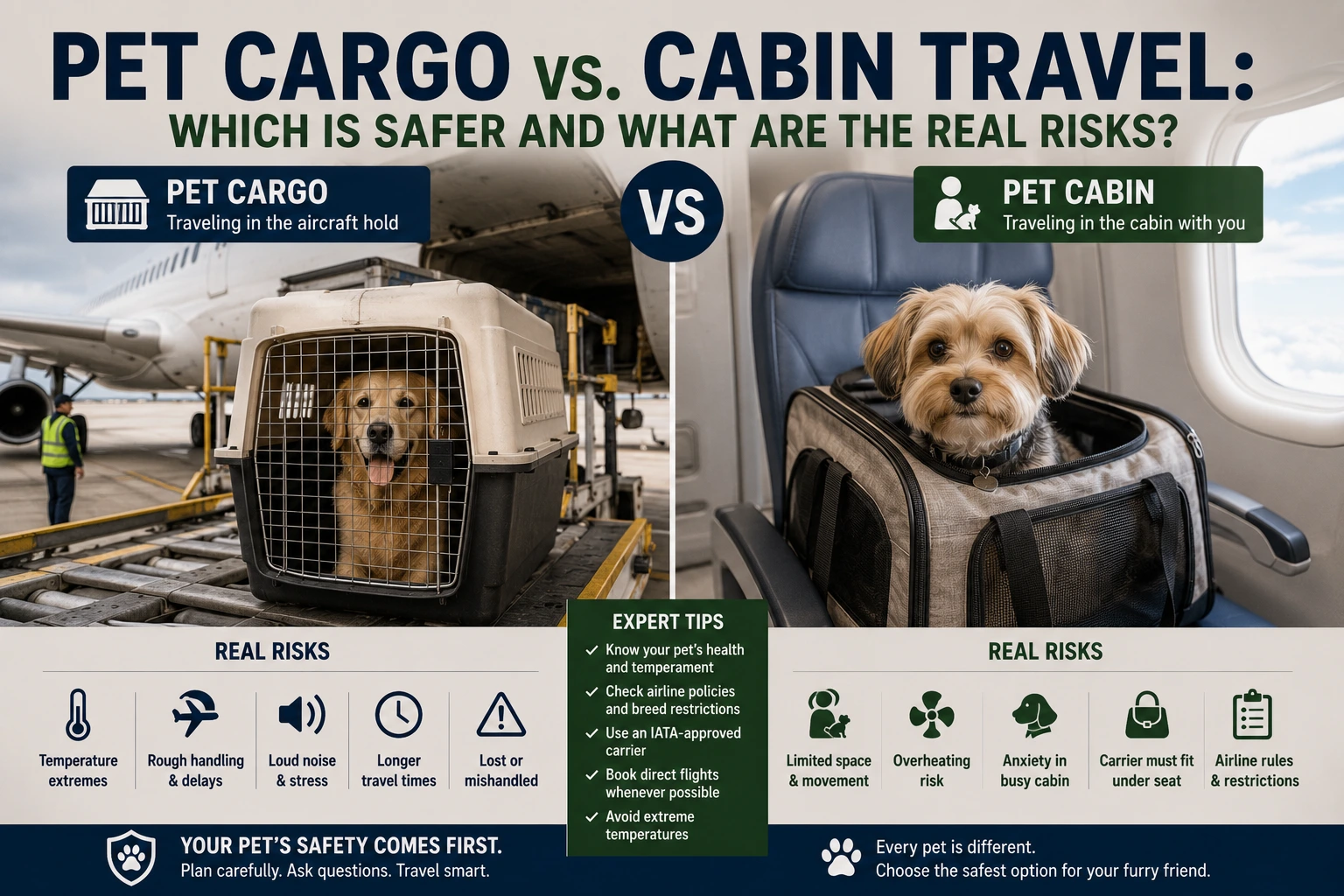
One of the biggest decisions is whether your pet can travel in the passenger cabin with you or needs to travel in the aircraft’s cargo hold through an airline’s live-animal or cargo process.
For many owners, the cabin sounds automatically safer because they can see their pet during the flight. But that does not mean cabin travel is always the best option for every animal.
The right choice depends on:
- Your pet’s size
- Health and age
- Breed and physical characteristics
- Airline rules
- Aircraft type
- Route
- Destination-country requirements
- Carrier requirements
- Weather
- Whether your pet can comfortably fit in an approved cabin carrier
- Whether the airline accepts pets as cargo
IATA explains that many airlines allow small dogs and cats in the cabin, while larger animals may need to travel in the hold or as air cargo. It also emphasizes that airlines and countries can impose their own requirements.
This guide explains the differences between cabin and cargo travel, the advantages and disadvantages of each option, how to prepare your pet, and how to decide which arrangement is appropriate for your trip.
Important: This article provides general educational information and is not veterinary, airline, legal, or travel advice. Airline policies and government requirements can change. Always confirm the current rules directly with your airline and the authorities governing your destination before booking.
Quick Answer: Is It Better for a Pet to Fly in the Cabin or Cargo?
For a small, healthy dog or cat that meets the airline’s cabin requirements, traveling in the cabin may be more convenient because the pet remains with the passenger and the carrier stays under the seat.
For a larger animal that cannot fit safely in an approved under-seat carrier, cargo or an airline’s approved animal-transport process may be the only practical option.
Neither option is automatically best for every pet.
IATA states that animals can travel safely by air when appropriate procedures are followed, but suitability depends on factors such as the animal, container, airline requirements, route, and destination rules.
The most important question is:
Which method is appropriate for your specific pet, airline, route, and destination?
Pet Cabin vs. Cargo: The Basic Difference
Cabin Travel
Your dog or cat travels inside an approved carrier in the passenger cabin.
For U.S. flights, the FAA allows each airline to decide whether pets can travel in the cabin. If permitted, the carrier generally has to fit underneath the seat and remain properly stowed during aircraft movement, takeoff, and landing.
The pet generally remains with you throughout the journey.
Cargo or Hold Travel
The pet travels separately from the passenger cabin in an area designated by the airline for animals or cargo.
Depending on the airline and route, the animal may travel:
- As checked live-animal transport
- As manifest cargo
- Through a specialized pet-shipping service
- In a temperature-controlled and ventilated area
The exact process varies considerably.
IATA notes that cargo/hold travel can be appropriate when an animal is too large for cabin travel or when the airline does not permit that pet in the cabin.
Cabin vs. Cargo at a Glance
| Factor | Cabin | Cargo/Hold |
|---|---|---|
| Pet stays near owner | Yes | No |
| Suitable for large dogs | Usually no | Potentially |
| Carrier location | Under passenger seat | Designated animal/cargo area |
| Airline restrictions | Yes | Yes |
| Advance booking | Often important | Usually important |
| Health documentation | May be required | Often required |
| International paperwork | Often required | Often required |
| Direct owner observation | Limited but nearby | No |
| Suitable for every breed | No | No |
| Airline-specific rules | Yes | Yes |
| Weather restrictions | Possible | Possible |
| Carrier requirements | Strict | Strict |
The exact rules should always be confirmed with the airline.
Can All Dogs and Cats Travel in the Cabin?
No.
Airlines commonly limit cabin pets based on factors such as:
- Animal type
- Carrier size
- Pet size
- Number of pets permitted
- Aircraft configuration
- Route
- Destination
- Available under-seat space
The FAA specifically states that each airline determines whether pets are permitted in the passenger cabin and that airlines may impose additional requirements.
IATA also notes that only small dogs and cats can generally fit the cabin requirements, and some airlines may not permit them in the cabin at all.
Why Cabin Travel Can Be Attractive
For eligible pets, cabin travel has several practical advantages.
1. Your Pet Remains Near You
You are physically close to the carrier.
That can make the journey feel easier for owners who are worried about separation.
2. You Can Observe Your Pet
You cannot continuously interact with the animal, but you may be able to notice obvious signs of distress.
3. Fewer Transfer Points
Depending on the airline’s process, your pet may avoid some of the separate handling associated with cargo transport.
4. Easier Owner Coordination
You manage:
- Check-in
- Security
- Boarding
- Arrival
with your pet’s carrier as part of the passenger journey.
Cabin Travel Is Not Automatically Stress-Free
Being beside you does not eliminate travel stress.
Your pet may still experience:
- Airport noise
- Security procedures
- Crowds
- Aircraft sounds
- Limited movement
- Changes in routine
- Long periods inside the carrier
IATA’s cabin guidance emphasizes minimizing disturbance and ensuring that animals are appropriately prepared for air travel.
The Biggest Cabin Limitation: Carrier Size
For cabin travel, your pet generally has to remain in an airline-approved carrier.
The carrier usually needs to fit under the seat.
The FAA specifically requires an approved pet container to fit under the seat without blocking the main aisle and to remain properly stowed during aircraft movement, takeoff, and landing.
This means the question is not simply:
“Is my dog small?”
The better question is:
“Can my dog comfortably fit in the airline-approved carrier required for this flight?”
Your Pet Must Be Comfortable in the Carrier
A carrier should provide enough space for the animal to maintain a natural position appropriate to the airline’s requirements.
IATA recommends that the animal have enough space to:
- Turn around normally
- Stand comfortably
- Sit appropriately
- Lie in a natural position
Specific container requirements can vary according to the type of transport.
Do not buy the carrier based only on a product’s advertised dimensions.
Check the airline’s current requirements first.
What Is Cargo Pet Travel?
Cargo pet travel means your animal is transported separately from the passenger cabin through an airline’s approved live-animal or cargo process.
This can be necessary for:
- Large dogs
- Animals that cannot fit in cabin carriers
- Airlines that do not allow pets in the cabin
- Certain international routes
- Specific aircraft or route restrictions
The exact process differs between airlines.
Is Flying in Cargo Dangerous for Pets?
It is misleading to say that cargo travel is automatically dangerous.
IATA states that millions of animals are transported by air each year and that dogs and cats can travel safely when appropriate requirements are followed.
However, air travel does involve risks.
USDA guidance notes that while most pets arrive safely, some animals can become injured or die during air travel. It highlights factors such as kennel suitability and the animal’s health and readiness for travel.
Therefore, the correct approach is not:
“Cargo is always unsafe.”
or:
“Cargo is always safe.”
Instead:
Assess the individual animal, route, airline, weather, carrier, and travel conditions.
When Cargo May Be the Better Option
Cargo or hold travel may be necessary or more practical when:
Your dog is too large for cabin travel
A large dog generally cannot fit beneath a passenger seat in an airline-approved carrier.
Your airline does not allow cabin pets
Some airlines do not allow pets in the cabin at all.
The route has cabin restrictions
International or specific aircraft routes may have different rules.
The pet is traveling without the owner
A specialized cargo process may be necessary.
What About Large Dogs?
Large dogs are one of the clearest examples where cabin travel may not be realistic.
A Labrador, German Shepherd, Golden Retriever, or similar large dog cannot normally fit comfortably inside an under-seat cabin carrier.
For such animals, owners may need to investigate:
- Airline cargo
- Specialized pet transport
- Pet relocation companies
- Ground transportation
- Alternative travel arrangements
Do not attempt to squeeze a large dog into an undersized cabin carrier.
What About Small Dogs?
Small dogs may be eligible for cabin travel, but size alone does not guarantee acceptance.
You still need to verify:
- Carrier dimensions
- Combined pet-and-carrier weight rules if applicable
- Airline pet quota
- Route restrictions
- Destination requirements
- Breed restrictions
- Health requirements
The FAA specifically notes that airlines can impose additional rules beyond the general aviation requirements.
What About Cats?
Cats can sometimes travel in the cabin if the airline allows them and they meet the carrier and route requirements.
IATA provides guidance specifically for dogs and cats traveling in the cabin.
Cats can still experience stress from:
- Airport noise
- Carrier confinement
- New environments
- Security screening
- Aircraft movement
Prepare the cat gradually rather than introducing the carrier for the first time on travel day.
Which Is Less Stressful for a Pet?
There is no universal answer.
Stress depends on:
- Individual temperament
- Previous carrier experience
- Travel duration
- Number of connections
- Airport environment
- Handling
- Route
- Health
- Familiarity with confinement
IATA recommends getting animals accustomed to their travel container well before departure.
A pet that calmly rests in a carrier may have a very different experience from a pet that panics whenever the carrier appears.
What About Brachycephalic Dogs?
Extra caution is important for short-nosed or brachycephalic breeds.
Examples include:
- Pugs
- Bulldogs
- French Bulldogs
- Pekingese
- Boxers
IATA specifically warns that snub-nosed breeds can have difficulty maintaining normal body temperature in hot weather and says transporting these breeds during hot seasons is not recommended.
IATA’s cabin guidance also notes that some airlines impose restrictions on certain dog or cat breeds.
If you own a brachycephalic dog, ask the airline specifically about:
- Cabin eligibility
- Cargo eligibility
- Breed restrictions
- Temperature restrictions
- Veterinary requirements
- Carrier requirements
Should You Sedate Your Pet Before Flying?
Do not make this decision casually.
IATA does not encourage the use of sedatives or tranquilizers for animals being transported by air because of potential adverse effects during transport.
If your pet becomes extremely anxious about travel, speak with a veterinarian well before the trip.
Do not give medication simply because another pet owner recommended it.
A veterinarian can consider:
- Your pet’s health
- Age
- Breed
- Medical history
- Travel conditions
- Medication risks
Is Cabin Travel Better for Anxious Pets?
Not necessarily.
Some anxious pets may feel better when their owner is nearby.
Others may become more distressed by:
- Airport crowds
- Noise
- Being confined under a seat
- Unfamiliar smells
- Aircraft vibration
The individual animal matters.
Before deciding, consider how your pet behaves during:
- Car rides
- Carrier confinement
- Veterinary visits
- Crowded environments
Is Cargo Better for Nervous Pets?
Not automatically.
Cargo transport can mean:
- Separation from the owner
- Additional handling
- Airport noise
- Longer periods in the kennel
However, the cargo environment can also be quieter and dimmer than the passenger cabin in some circumstances.
IATA notes that animals may rest in a darker and quieter environment in the hold.
The experience depends heavily on the airline’s procedures and the individual journey.
How Long Can a Pet Be in a Carrier?
There is no single universal time that is appropriate for every animal and every journey.
Travel time can include:
- Drive to airport
- Check-in
- Security
- Waiting
- Boarding
- Flight
- Connections
- Arrival
- Customs
- Final pickup
This is why a “3-hour flight” can become a much longer overall travel period.
When comparing cabin and cargo, calculate the entire journey, not just the time in the air.
Direct Flight vs. Connecting Flight
A direct flight is often simpler for pet travel because it can reduce:
- Handling
- Transfer time
- Missed-connection risk
- Airport changes
- Time in the carrier
When possible, compare:
Total travel time
rather than only:
Flight duration
Why Layovers Matter
Imagine:
Option A
One nonstop flight:
4 hours
Option B
Two flights:
2 hours + 3-hour layover + 2 hours
Total journey:
7 hours
Even though both options may reach the same destination, the second creates more time in transit.
For pets, minimizing unnecessary complexity can be useful.
How Weather Affects Pet Air Travel
Temperature can be an important factor.
Airlines may have restrictions concerning:
- Extreme heat
- Extreme cold
- Specific airports
- Aircraft conditions
- Breed sensitivity
Brachycephalic dogs may be especially vulnerable to heat-related problems. IATA specifically highlights concerns for snub-nosed breeds in hot weather.
Check the airline’s current temperature policy before booking.
What Documents Does a Pet Need to Fly?
Requirements vary by:
- Airline
- State
- Country
- Route
- Pet species
- Travel purpose
Possible requirements can include:
- Health certificate
- Vaccination records
- Rabies documentation
- Microchip information
- Import permit
- Entry documentation
- Quarantine arrangements
IATA advises travelers to check country-specific regulations and airline requirements.
For international travel from the United States, USDA APHIS advises travelers to contact a USDA-accredited veterinarian early because destination countries can have specific entry requirements.
International Pet Travel Requires Extra Planning
International travel can involve more than airline rules.
You may need to satisfy:
Departure-country requirements
Airline requirements
Transit-country requirements
Destination-country requirements
A mistake in one part of the process can cause delays or prevent the animal from entering the destination country.
Start planning well before the departure date.
What Is a Health Certificate?
A health certificate is veterinary documentation confirming that an animal meets specified health requirements for travel.
The exact certificate required depends on the destination and circumstances.
IATA notes that many airlines require a health certificate for transported animals.
USDA APHIS also recommends contacting an accredited veterinarian early for international travel because documentation can take time.
Does a Pet Need a Microchip?
It depends on the destination and applicable rules.
Some countries require microchipping before certain vaccinations or entry procedures.
For international travel, check the destination country’s current requirements rather than relying on a general checklist.
USDA APHIS specifically directs travelers to determine the destination country’s requirements before departure.
How Much Does Pet Air Travel Cost?
There is no universal price.
Potential costs include:
- Cabin pet fee
- Cargo transportation fee
- Pet carrier
- Airline-approved kennel
- Health examination
- Health certificate
- Vaccinations
- Microchip
- Import permits
- Customs fees
- Ground transportation
- Pet relocation services
International trips can cost substantially more because of documentation and destination requirements.
Cabin Pet Costs vs. Cargo Costs
A cabin pet may have a relatively straightforward airline pet fee.
Cargo travel can involve additional charges depending on:
- Animal size
- Kennel dimensions
- Weight
- Route
- Cargo handling
- Documentation
- Airport fees
Do not compare only the advertised airline pet fee.
Calculate the complete travel cost.
Example Pet Travel Budget
Suppose a small dog travels in the cabin.
Illustrative costs:
| Expense | Example |
|---|---|
| Airline pet fee | $125 |
| Airline-approved carrier | $60 |
| Veterinary exam | $75 |
| Health documentation | $50 |
| Travel supplies | $30 |
| Example total | $340 |
These numbers are examples only.
Actual prices vary by airline, route, veterinarian, location, and travel requirements.
Example Cargo Travel Budget
A larger dog might require:
| Expense | Example |
|---|---|
| Cargo transportation | $300 |
| Airline-approved kennel | $150 |
| Veterinary exam | $75 |
| Health documentation | $50 |
| Ground transportation | $100 |
| Example total | $675 |
Again, this is an illustration, not a universal price.
Always request a current quote from the airline or approved pet transporter.
How to Choose Between Cabin and Cargo
Use this decision process.
Step 1: Check Your Airline
Does the airline allow:
Cabin pets?
Cargo pets?
Some airlines may allow one but not the other.
The FAA specifically advises passengers to contact the airline because pet policies vary.
Step 2: Measure Your Pet
Record:
- Weight
- Height
- Length
- Carrier dimensions
Do not guess.
Step 3: Check Carrier Requirements
Make sure your carrier complies with the airline’s current rules.
Step 4: Check Health
Ask your veterinarian whether your pet is fit to travel.
This is particularly important for:
- Senior pets
- Very young animals
- Brachycephalic breeds
- Pets with respiratory disease
- Pets with heart disease
- Pets with other serious medical conditions
Step 5: Check the Route
Look for:
- Direct flights
- Connections
- Transit countries
- Airport restrictions
- Temperature concerns
Step 6: Check Destination Requirements
For international travel, identify every required document before booking.
Cabin May Be the Better Choice When:
Cabin travel may make sense when:
- Your pet is small enough.
- The airline allows cabin pets.
- The carrier meets the requirements.
- Your pet is comfortable in a carrier.
- The route permits cabin travel.
- Your pet is healthy enough for travel.
- The destination allows the animal to enter.
Cargo May Be the Better or Only Practical Choice When:
Cargo may be necessary when:
- Your dog is too large for the cabin.
- The airline does not permit cabin pets.
- The route has cabin restrictions.
- The animal is traveling separately.
- The airline’s cargo program is appropriate for the trip.
This does not mean cargo is automatically safer.
It means the transport method may better fit the circumstances.
When You Should Consider Not Flying
Sometimes the best choice is to reconsider air travel entirely.
You may want to discuss alternatives with your veterinarian if your pet:
- Is seriously ill
- Has severe respiratory problems
- Is recovering from major surgery
- Is extremely vulnerable to temperature changes
- Is not coping well with confinement
- Is too young for the applicable travel requirements
Alternative options might include:
- Driving
- Professional ground pet transport
- Delaying travel
- Having a trusted caregiver care for the pet
The best option depends on your individual circumstances.
How to Prepare Your Pet for Cabin Travel
Start preparation several weeks before the flight when possible.
Step 1: Introduce the carrier
Leave it open at home.
Step 2: Add familiar bedding
Use an item with a familiar scent where permitted by the airline.
Step 3: Encourage voluntary entry
Use treats or positive reinforcement.
Step 4: Practice short periods
Gradually increase carrier time.
Step 5: Practice movement
Carry the carrier around the home.
Step 6: Practice car trips
If appropriate, take short trips.
Step 7: Increase duration gradually
Avoid making the first long carrier experience the flight itself.
IATA specifically recommends familiarizing the animal with its crate or kennel well before departure.
How to Prepare a Pet for Cargo Travel
Cargo preparation should also begin early.
Your pet should become comfortable with the travel kennel.
Practice:
- Entering the kennel
- Remaining inside calmly
- Eating near the kennel
- Resting inside
- Short transportation
- Longer transportation
IATA emphasizes that animals accustomed to their kennel may handle transport better.
What Should Go in the Pet Carrier?
Check your airline’s rules first.
Depending on the transport method, you may need:
- Absorbent bedding
- Water container
- Food instructions
- Identification
- Contact information
- Required documentation
Do not attach or place items inside the carrier unless the airline permits them.
Identification Is Important
Make sure your pet is properly identified.
IATA recommends identification such as a microchip where appropriate and advises using identification information on the animal’s collar and travel documentation.
Consider having:
- Your name
- Phone number
- Destination contact
- Pet name
- Microchip information
Use accurate information that will remain reachable during the trip.
Should You Feed Your Pet Before Flying?
Feeding instructions vary by animal and airline.
IATA advises against a full meal immediately before travel and recommends a light meal and small drink approximately two hours before dispatch, while continuing to provide water up to travel time.
However, your veterinarian and airline may provide different instructions based on the pet and journey.
Follow the specific instructions you are given.
What About Water?
Pets need access to water, but the exact method depends on the carrier and airline requirements.
For cargo travel, airlines may have specific requirements for water containers.
For cabin travel, follow the airline’s instructions for providing water without violating carrier rules.
Airport Security With a Pet
Cabin travelers should plan for the possibility that the pet may need to be removed from the carrier during security screening.
Because procedures can vary, check the airport and airline instructions before departure.
Allow additional time.
Don’t schedule your arrival at the airport so tightly that one unexpected security step causes you to miss check-in.
Why You Should Arrive Early for Cargo Travel
Cargo or hold procedures may require additional processing.
IATA recommends checking the airline’s required check-in timing and notes that animals traveling in the hold should generally be checked in early enough for appropriate handling.
Follow the airline’s exact instructions rather than assuming passenger check-in times apply to pets.
Reconfirm Your Pet Reservation
Do not assume that buying a pet ticket guarantees transportation.
Airlines may restrict the number of pets permitted on a flight.
IATA recommends confirming the pet’s acceptance with the airline and reconfirming close to departure.
A practical approach is to confirm:
- Flight
- Pet reservation
- Carrier requirements
- Check-in location
- Documentation
- Connection arrangements
What If the Airline Changes the Aircraft?
Aircraft changes can affect:
- Under-seat space
- Pet availability
- Cabin configuration
- Pet acceptance
If your itinerary changes, reconfirm your pet reservation.
Do not assume that a previously approved cabin carrier will automatically fit on a different aircraft.
What If Your Pet Is Traveling Internationally?
Create a document checklist.
Before booking
- Destination entry requirements checked
- Transit-country requirements checked
- Airline rules checked
- Pet eligibility confirmed
- Veterinarian contacted
Before departure
- Vaccinations completed
- Microchip requirements checked
- Health certificate obtained if required
- Import permit obtained if required
- Copies of documents prepared
- Airline pet reservation confirmed
USDA APHIS recommends starting the process early because destination-country requirements can take time to satisfy.
Common Pet Air-Travel Mistakes
Mistake 1: Booking the Flight Before Checking Pet Rules
Better approach: Check the airline first.
Mistake 2: Assuming All Airlines Have the Same Rules
Better approach: Verify the specific carrier.
Mistake 3: Buying the Carrier Too Late
Better approach: Purchase early and practice with it.
Mistake 4: Ignoring Breed Restrictions
Better approach: Ask specifically about breed and route restrictions.
Mistake 5: Forgetting Transit-Country Rules
Better approach: Check every country involved in the journey.
Mistake 6: Sedating Without Veterinary Guidance
Better approach: Discuss anxiety with a veterinarian.
Mistake 7: Choosing a Flight Based Only on Price
Better approach: Compare total travel time, connections, pet fees, documentation, and transport conditions.
Mistake 8: Assuming Cargo Is Automatically Unsafe
Better approach: Evaluate the airline’s animal-transport process and the individual pet.
Pet Air Travel Checklist
4–8 Weeks Before Travel
- Check airline pet policy
- Check destination requirements
- Contact veterinarian
- Purchase appropriate carrier
- Begin carrier training
- Check microchip requirements
- Check vaccinations
1–2 Weeks Before Travel
- Confirm pet reservation
- Confirm carrier dimensions
- Confirm documentation
- Review feeding instructions
- Check weather forecast
- Confirm airport procedure
24–48 Hours Before
- Reconfirm airline requirements
- Prepare documents
- Check pet identification
- Prepare travel supplies
- Confirm flight status
Travel Day
- Follow feeding instructions
- Exercise your dog appropriately before travel
- Keep documentation accessible
- Arrive according to airline instructions
- Keep the pet calm
- Follow airline staff instructions
A Simple Cabin vs. Cargo Decision Matrix
| Question | If YES | If NO |
|---|---|---|
| Does airline allow cabin pets? | Continue checking cabin eligibility | Consider cargo/other transport |
| Does pet fit approved carrier? | Cabin may be possible | Consider cargo/other transport |
| Is pet healthy for travel? | Continue planning | Talk to veterinarian |
| Is route compatible? | Continue | Choose another route |
| Are documents ready? | Continue | Complete requirements |
| Is pet comfortable in carrier? | Good preparation | Start carrier training |
| Is weather appropriate? | Continue | Consider different timing |
This is a planning tool, not a guarantee of airline acceptance.
Frequently Asked Questions
Is it safer for pets to fly in the cabin?
Not automatically. Cabin travel may be preferable for some small pets, but safety depends on the animal, airline, route, carrier, health, and travel conditions.
Is cargo safe for dogs?
Cargo transport can be conducted safely when appropriate airline and animal-welfare procedures are followed, but air travel carries risks. USDA notes that while most pets arrive safely, some animals can be injured or die during air travel.
Can a large dog fly in the cabin?
Usually, standard cabin pet arrangements require the animal to fit in an approved carrier under the seat, so large dogs generally cannot use this option.
Can cats fly in the cabin?
Some airlines allow cats in the cabin, subject to carrier, route, and airline restrictions.
Do all airlines allow pets in the cabin?
No. The FAA specifically states that airlines decide whether pets are permitted in the cabin.
Do pets need a health certificate?
Requirements vary by airline and destination. Many airlines and international destinations require health documentation.
Can I sedate my dog for a flight?
Do not give sedatives without veterinary guidance. IATA does not encourage routine sedation or tranquilization during air transport because of potential adverse effects.
Are short-nosed dogs allowed to fly?
Rules vary by airline and route. Brachycephalic breeds may face additional restrictions because of respiratory and heat-related concerns.
Is cargo cheaper than cabin?
Not necessarily. Cargo costs vary based on airline, route, animal size, kennel, handling, and documentation. Compare the total trip cost.
Can I check my pet as baggage?
Some airlines may offer checked live-animal services while others use cargo arrangements or do not accept pets that way. Confirm the airline’s current policy.
Should I choose a nonstop flight?
When available and suitable, a nonstop flight can reduce total travel time and avoid some transfer-related complexity.
How early should I book a pet flight?
As early as possible. Airlines can limit the number of pets on a flight, so availability may be more restricted than ordinary passenger seats.
Final Verdict: Pet Cargo vs. Cabin
There is no single answer to:
“Is cabin or cargo better?”
For a small, healthy pet that meets the airline’s cabin requirements, cabin travel may be the simplest option because the animal remains with the passenger.
For a large dog that cannot fit safely under the seat, cargo or another approved transport method may be necessary.
The most important factors are:
Pet health
Pet size
Breed characteristics
Airline policy
Carrier requirements
Weather
Route
Destination regulations
Total travel time
Don’t choose a transport method based solely on fear, price, or convenience.
Instead, evaluate the complete journey.
And remember that airline rules can change. The FAA specifically advises passengers to contact their airline regarding pet policies, while IATA recommends checking the specific airline and destination requirements before travel.
For international travel, start the paperwork early. USDA APHIS recommends working with an accredited veterinarian and checking destination-country requirements well in advance.
The safest trip is usually the one that is planned early, uses an appropriate carrier, follows current airline and government requirements, and takes the individual pet’s health and temperament into account.
Sources & Editorial Methodology
This article was prepared using current guidance from aviation, animal-transport, and U.S. government sources. Airline policies and destination requirements can change, so readers should verify requirements before every trip.
International Air Transport Association (IATA)
IATA provides guidance on transporting dogs and cats by air, including cabin travel, cargo/hold transport, container requirements, health considerations, identification, feeding, and airline-specific procedures.
Federal Aviation Administration (FAA)
The FAA explains that airlines decide whether pets can travel in the passenger cabin and provides requirements concerning pet carriers and under-seat stowage.
USDA APHIS
USDA APHIS provides U.S. pet-travel information, including international travel requirements and preparation guidance.
Editorial & Pet-Travel Disclaimer
PetPolicyFinance.com provides general educational information and does not provide veterinary, airline, legal, immigration, or transportation services.
Airline pet policies, fees, aircraft restrictions, route availability, documentation requirements, and destination-country regulations can change.
This article should not be used as a substitute for checking the current requirements of your airline, destination country, transit country, airport, or veterinarian.
Before traveling, confirm all requirements directly with the airline and the relevant government authorities.
If your pet has a significant medical condition, is very young or elderly, or belongs to a breed with special travel risks, consult a veterinarian before making travel arrangements.
Author: Harry Mills
Last Reviewed: August 2026
