

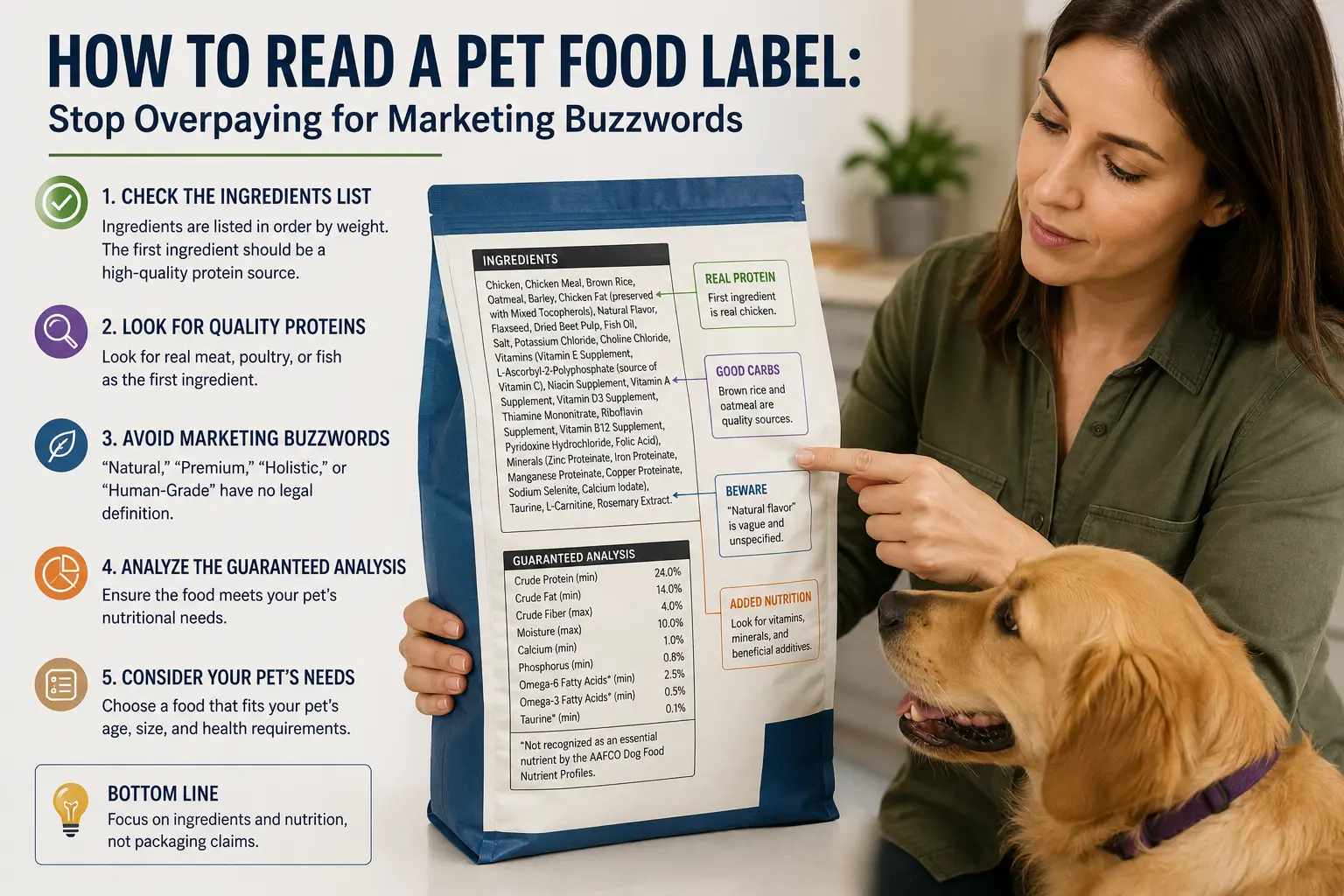
Stand in the pet food aisle for five minutes and you’ll be bombarded with language designed to make you reach for the most expensive bag on the shelf. “Holistic.” “Human-grade.” “Ancestral recipe.” “All-natural.” “Grain-free.” “Small-batch artisan.” These words appear in bold fonts on beautifully designed packaging, and they all carry one implicit message: this food is worth paying more for.
But here is the truth that the pet food industry doesn’t advertise: most of these terms are completely unregulated. They have no legal definition in pet food labeling. Any manufacturer can print them on any product, regardless of what’s actually inside the bag.
Learning how to read a pet food label correctly — past the marketing language on the front of the bag and into the actual regulatory information on the back — is one of the most powerful financial skills a pet owner can develop. It can save you $20–$50 per month without changing a single thing about the quality of nutrition your pet receives.
This comprehensive guide teaches you exactly what each part of a pet food label means, which terms are regulated and which are pure marketing, and how to use label information to make confident, cost-effective feeding decisions.
Why Pet Food Labels Matter More Than the Packaging
The front of a pet food bag is an advertisement. It is designed by marketing professionals whose job is to create an emotional connection between you and the product — not to inform you about its nutritional merits. Every color choice, font, image, and word on the front panel has been carefully selected to justify the price and trigger a purchase.
The back and side panels of the bag are where the real information lives. This is where regulatory requirements kick in and where manufacturers must disclose specific, standardized information about what is actually inside the product. Understanding how to decode this information gives you an objective basis for comparison that marketing can’t manipulate.
In the United States, pet food labeling is regulated by two main bodies:
- The Association of American Feed Control Officials (AAFCO): Sets nutritional standards and labeling guidelines that most states adopt into law
- The FDA (Food and Drug Administration): Oversees pet food safety under the Federal Food, Drug, and Cosmetic Act
Together, these regulatory frameworks require specific, verifiable information on every pet food label — information that, once you know how to read it, tells you far more about a food’s quality than any marketing claim ever could.
The 8 Required Elements of Every Pet Food Label
1. Product Name
The product name isn’t just branding — it carries specific regulatory meaning based on the percentage of the named ingredient in the formula. AAFCO has established naming rules that apply to any ingredient featured in a product name:
The 95% Rule: If a single ingredient is in the product name without any qualifying words — such as “Chicken for Dogs” or “Beef Cat Food” — that ingredient must make up at least 95% of the total product weight (excluding water). These products are almost always canned or wet foods.
The 25% or “Dinner” Rule: When the product name includes a descriptor like “dinner,” “entrée,” “platter,” “formula,” or “recipe” — such as “Chicken Dinner for Dogs” or “Salmon Recipe Cat Food” — the named ingredient must make up at least 25% of the product but less than 95%.
The 3% or “With” Rule: When the word “with” appears in the name — “Dog Food with Chicken” — the named ingredient only needs to constitute 3% of the product. This is a significant difference from a food simply named “Chicken Dog Food.”
The “Flavor” Rule: When “flavor” is used — “Chicken Flavor Dog Food” — there is no minimum percentage requirement for the named ingredient. The food simply needs to contain enough of the ingredient to be detectable.
Why this matters for your budget: A “Chicken Flavor” food and a “Chicken” food can look nearly identical on the shelf but contain vastly different amounts of actual chicken. The Chicken food may be priced higher — but the naming rule tells you it actually delivers what it promises. This context helps you evaluate whether a price premium is justified.
2. Net Weight or Net Volume
This tells you how much product is in the package. Always use this alongside price to calculate cost per ounce or cost per pound — your true unit cost comparison metric.
A $25 bag of food that contains 20 pounds costs $1.25 per pound. A $30 bag of food that contains 30 pounds costs $1.00 per pound. Net weight makes this comparison possible.
3. Manufacturer’s Name and Address
Every pet food label must display the name and address of the manufacturer, packer, or distributor. This information matters for two reasons:
Accountability: A company that stands behind its product publicly displays who makes it and where. Vague or incomplete contact information is a yellow flag.
Contract manufacturing: Many pet food brands — including some premium-priced ones — don’t own their own manufacturing facilities. They contract production to third-party facilities. This isn’t inherently problematic, but it means the “artisan” or “small-batch” language on some premium brands’ packaging can be misleading. The food may be produced in the same large facility as several other brands at very different price points.
4. Guaranteed Analysis
The guaranteed analysis panel is one of the most important sections of any pet food label. It lists minimum or maximum percentages of key nutrients:
- Crude protein (minimum): The total protein content of the food
- Crude fat (minimum): The total fat content
- Crude fiber (maximum): The maximum fiber content
- Moisture (maximum): The water content of the food
Important caveat — dry matter basis: These percentages are listed “as fed” — meaning they include the moisture content of the food. To compare foods with different moisture levels (dry kibble vs. wet food), you need to convert to a “dry matter basis” by removing the moisture percentage from the calculation.
For dry kibble with 10% moisture:
- Crude protein listed as 26% → Dry matter protein = 26 ÷ (100 – 10) = 28.9%
For wet food with 78% moisture:
- Crude protein listed as 8% → Dry matter protein = 8 ÷ (100 – 78) = 36.4%
This calculation reveals that the wet food, despite showing a lower protein percentage on the label, actually contains more protein on a dry matter basis. Without this conversion, comparing the two labels is meaningless.
5. Ingredient List
The ingredient list is organized in descending order by weight before processing — meaning the ingredient present in the greatest amount by weight appears first, and so on down the list.
What to look for:
- Named protein sources in the first one or two positions (chicken, beef, salmon, lamb, turkey) rather than vague terms like “meat” or “poultry”
- Whole food carbohydrate sources (brown rice, sweet potato, oats, barley, peas)
- Named fat sources (chicken fat, salmon oil) rather than generic “animal fat”
- Vitamins and minerals toward the end of the list — this is normal and expected in a complete and balanced food
Common ingredient list tactics to be aware of:
Ingredient splitting: A manufacturer may list corn as “ground corn,” “corn gluten meal,” and “corn bran” separately. Each individual corn ingredient appears lower on the list than the named protein, but combined, corn may actually outweigh the protein source. This manipulation makes a food appear more protein-forward than it actually is.
Water weight inflation: Fresh meats like “fresh chicken” are very high in water content — sometimes 70–80% water by weight. This water weight positions fresh chicken high on the ingredient list, but after processing removes the moisture, the actual protein contribution is significantly less than the label position suggests. “Chicken meal,” by contrast, has already had moisture removed, so its position on the list more accurately reflects its protein contribution to the final product.
What doesn’t belong in a quality food:
- Artificial colors (Red 40, Yellow 5, Blue 2): Serve no nutritional purpose
- Artificial flavors listed without specification
- Artificial preservatives (BHA, BHT, ethoxyquin): Linked to potential health concerns; natural preservatives like mixed tocopherols are preferable
- Propylene glycol: Used in some semi-moist foods; best avoided
- Added sugars or corn syrup: Unnecessary in a balanced pet diet
6. AAFCO Nutritional Adequacy Statement
This is arguably the single most important piece of information on a pet food label — and it’s frequently overlooked by pet owners distracted by front-of-bag marketing.
The AAFCO nutritional adequacy statement tells you whether the food provides complete and balanced nutrition for a specific life stage. There are two versions:
Formulated to meet AAFCO nutrient profiles: “[Product name] is formulated to meet the nutritional levels established by the AAFCO Dog (or Cat) Food Nutrient Profiles for [life stage].”
This means the food has been mathematically calculated to meet AAFCO’s nutrient minimums. It’s a lower bar than feeding trials but is still a meaningful standard.
Substantiated by AAFCO feeding trials: “Animal feeding tests using AAFCO procedures substantiate that [Product name] provides complete and balanced nutrition for [life stage].”
This is the stronger statement. It means the food was actually fed to animals and monitored over time to confirm it supports health. Look for this statement when possible, especially for your pet’s primary food.
What to watch for — foods without this statement: Some pet foods, particularly raw, freeze-dried, or “complementary” products, do not carry an AAFCO adequacy statement. These foods are not complete and balanced on their own and should not be fed as a pet’s sole diet without veterinary guidance. No AAFCO statement = not a complete food.
Life stage specificity matters:
- “All life stages” foods must meet the highest nutritional standards (puppy/kitten growth requirements) and are appropriate for any age
- “Adult maintenance” foods are formulated for adult pets only and should not be fed to puppies or pregnant/nursing animals
- “Senior” is not an AAFCO-regulated life stage — it’s a marketing term. Always check what life stage the AAFCO statement actually specifies on senior-labeled foods
7. Feeding Guidelines
Feeding guidelines provide recommended daily amounts based on your pet’s weight. These guidelines are a starting point, not a prescription — individual metabolism, activity level, age, and body condition all affect how much food your pet actually needs.
Budget insight: Feeding guidelines are also where overfeeding — and overspending — often begins. Many pet owners feed more than their pet requires, both accelerating how quickly they go through a bag and contributing to weight gain. Measuring food accurately with a proper measuring cup (not a coffee mug or handful) helps you feed the right amount, extend the life of each bag, and maintain your pet’s healthy weight.
If your pet is maintaining a healthy weight on less than the guideline amount, that’s fine — it also means your food costs less per month than you might expect.
8. Calorie Statement
As of 2016, AAFCO requires all pet foods to display a calorie statement expressed in kilocalories (kcal) per kilogram and per common household measure (per cup for dry food, per can for wet food).
This is the information you need to calculate the true daily feeding cost — the most accurate way to compare the value of different foods.
Formula: Daily kcal needed by your dog (ask your vet or use an online calculator) ÷ kcals per cup = cups per day Cups per bag ÷ cups per day = days per bag Price per bag ÷ days per bag = daily food cost
A food with higher caloric density requires smaller portions to meet your dog’s needs — meaning a bag lasts longer and the daily cost is lower than the sticker price alone would suggest. This single calculation can completely change how you evaluate “expensive” vs. “cheap” dog food.
Decoding Front-of-Bag Marketing Claims
Now that you understand what’s regulated, here’s a quick guide to common front-of-bag claims and what they actually mean:
| Marketing Term | Regulated? | What It Actually Means |
|---|---|---|
| “Human-grade” | Partially | No AAFCO definition; some states define it, most don’t |
| “Natural” | Yes (loosely) | No artificial colors, flavors, or preservatives — a low bar |
| “Holistic” | No | No legal definition in pet food; purely marketing |
| “Grain-free” | No | Contains no grains; not inherently superior or safer |
| “Ancestral” / “Biologically appropriate” | No | No legal definition; marketing language only |
| “Small-batch” | No | No legal definition; may be produced in large facilities |
| “Organic” | Yes (USDA) | Ingredients meet USDA organic standards — has meaning |
| “Premium” / “Super premium” | No | No legal definition in pet food |
| “Limited ingredient” | No | No legal minimum for how few ingredients are required |
| “High protein” | No | No standardized threshold for this claim |
The pattern is clear: the terms that appear most prominently on premium-priced packaging are overwhelmingly unregulated. They mean whatever the manufacturer wants them to mean — which is frequently very little.
A Practical Label Reading Routine
When evaluating any new pet food, follow this five-step routine using the actual label information:
Step 1: Find the AAFCO adequacy statement. If it’s not there, the food is not complete and balanced. Move on.
Step 2: Check the life stage specified in the AAFCO statement. Does it match your pet’s life stage?
Step 3: Review the first five ingredients. Is a named protein source (not “meat” or “poultry”) in the top two? Are the other ingredients recognizable whole food sources?
Step 4: Calculate the cost per day using the calorie statement and your pet’s daily caloric needs.
Step 5: Check the FDA recall database for the brand’s recent recall history.
If a food passes all five steps, it merits serious consideration regardless of price. If a significantly more expensive food passes the same five steps, ask yourself honestly what you’re paying the premium for.
Frequently Asked Questions
Does “first ingredient” always mean the food is primarily that ingredient? Not necessarily, due to moisture content differences and ingredient splitting. A named meat listed first may contribute less actual protein than a meat meal listed second once moisture is removed during processing. Look at the whole ingredient list and guaranteed analysis together for a complete picture.
Is a longer ingredient list better or worse? Neither. A longer list may include beneficial whole food ingredients, or it may include unnecessary additives and fillers. The quality and nature of individual ingredients matters more than the total number listed.
What does “complete and balanced” actually mean? It means the food meets AAFCO’s established minimum nutritional profiles for protein, fat, vitamins, and minerals for a specific life stage — either through formulation or feeding trials. It is the foundational standard for any food intended as a pet’s sole diet.
Should I avoid all artificial preservatives? Many veterinary nutritionists recommend choosing foods preserved with natural antioxidants like mixed tocopherols (vitamin E) or rosemary extract over synthetic preservatives like BHA, BHT, or ethoxyquin. This is a reasonable preference, and many mid-range and budget-friendly foods now use natural preservation.
Can I trust online pet food rating sites? Use them with caution. Many popular pet food rating websites use proprietary scoring systems based on ingredient analysis alone — without considering AAFCO compliance, feeding trial data, or manufacturer transparency. Some have faced criticism for promoting boutique brands that later became associated with health concerns. The WSAVA guidelines and input from a veterinary nutritionist are more reliable references.
Final Thoughts
Reading a pet food label correctly is genuinely empowering. It shifts the power dynamic — from a marketing-driven purchase based on packaging and price to an informed decision based on regulatory standards, nutritional content, and true cost per day.
The pet food industry spends billions of dollars annually creating the impression that premium prices equal premium nutrition. The regulated information on the back of every bag tells a more objective story — one that frequently reveals mid-range and budget-friendly options are just as nutritious as their expensive counterparts.
Your pet doesn’t care what the bag looks like. They care about what’s inside. And now you have the tools to evaluate exactly that.
Disclaimer: This article is intended for general educational purposes and does not constitute veterinary or nutritional advice. Pet food regulations and manufacturer formulations are subject to change. Always consult your licensed veterinarian or a board-certified veterinary nutritionist for guidance specific to your pet’s individual health needs and dietary requirements.
