
Close Menu
petpolicyfinance.com

    Subscribe to Updates

    Get the latest creative news from FooBar about art, design and business.

    What's Hot

    Pet Insurance Deductible Explained: How It Works and Which Type Is Better?

    What Does Pet Insurance Actually Cover? A Complete Coverage Breakdown

    Common Dog and Cat Illnesses by Age: What to Watch For at Every Life Stage

    Facebook X (Twitter) Instagram
    Facebook X (Twitter) Instagram
    petpolicyfinance.com
    • Home
    • Pet Care
      • General Pet Care
      • Pet Health
      • Pet Grooming
      • Pet Nutrition
      • Pet Training
      • Pet Products
    • Pet Insurance
      • General Pet Insurance
      • Dog-Specific Pet Insurance
      • Cat-Specific Pet Insurance
      • Cost and Affordability
      • Regional and Niche Pet Insurance
      • Coverage and Quotes
    • Pet Budgeting
      • General Pet Budgeting & Cost Planning
      • First-Year & Adoption Budgeting
      • Cost-Saving & Affordable Pet Care
      • Food & Nutrition on a Budget
      • Vet Bills & Emergency Savings
      • Multi-Pet & Family Budgeting
      • Tools, Calculators & Trackers
    • Pet Policy Guide
      • Pet Housing & Rental Policies
      • Pet Travel & Transport Policies
      • Pet Legal Rights & Regulations
      • Workplace & Public Space Pet Policies
      • Pet Insurance Policy Explained
    petpolicyfinance.com
    You are at:Home»Pet Budgeting»Homemade Pet Food vs. Store-Bought: Which Is Actually Cheaper and Safer?
    Pet Budgeting

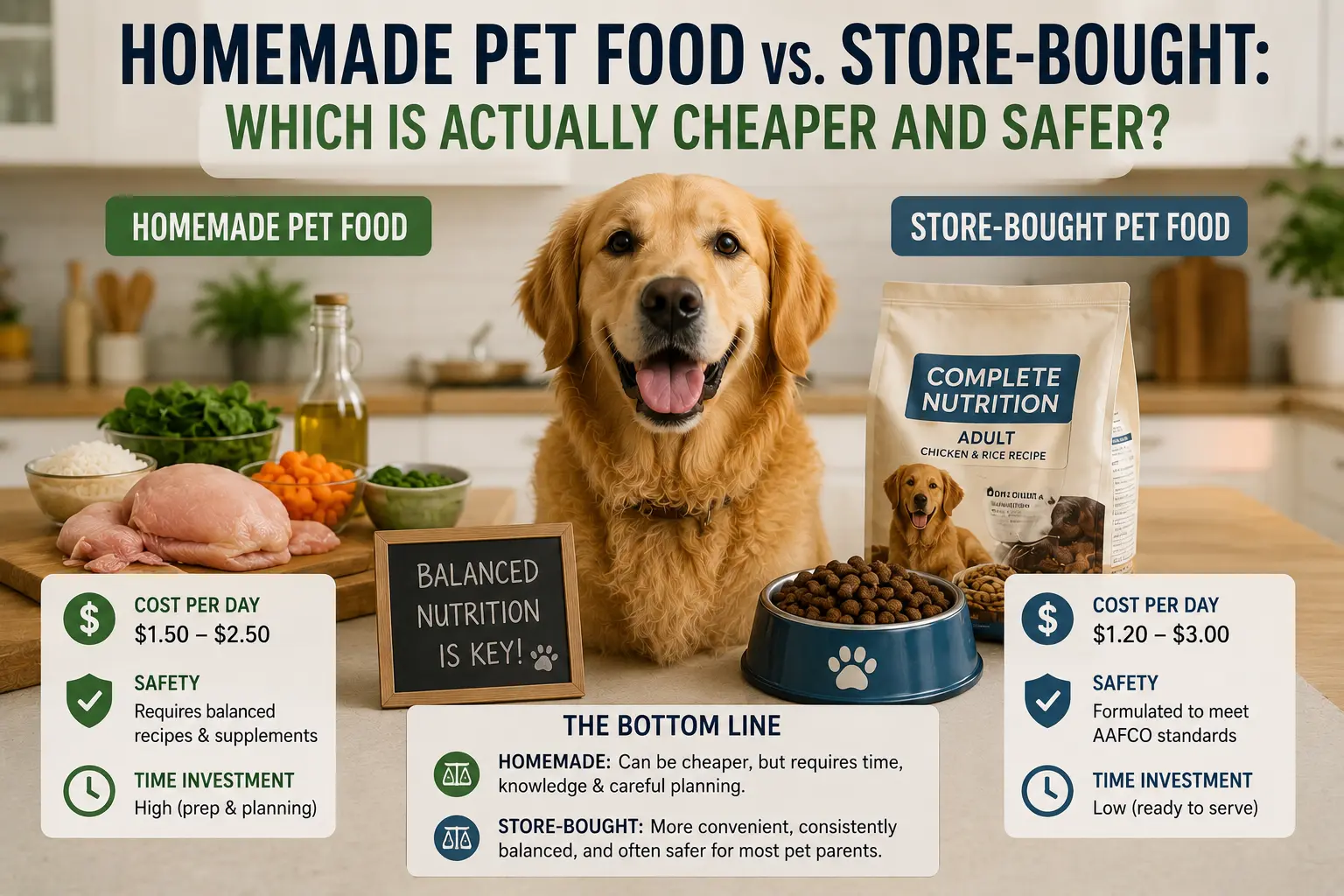
    Homemade Pet Food vs. Store-Bought: Which Is Actually Cheaper and Safer?

    Harry MillsBy Harry MillsJune 22, 20260520 Mins Read
    Share Facebook Twitter Pinterest LinkedIn Tumblr Email
    Homemade Pet Food vs. Store-Bought: Which Is Actually Cheaper and Safer?
    Share
    Facebook Twitter LinkedIn Pinterest Email

    Updated: August 2026

    Homemade pet food sounds simple.

    You buy meat, vegetables, grains or other ingredients, prepare them at home, and feed the meal to your dog or cat.

    Store-bought food seems simpler in the opposite direction: open the bag or can, measure the appropriate portion, and serve it.

    But when you compare the two options, there are two very different questions:

    Which one costs less?

    and

    Which one can provide an appropriate, nutritionally complete diet safely?

    Those questions do not always have the same answer.

    A homemade meal may appear inexpensive when you look only at the grocery-store ingredients. But a properly formulated homemade diet can require specific ingredients, supplements, precise measurements, preparation time, storage, and potentially professional nutrition guidance.

    Commercial pet food can have a higher purchase price than some basic homemade recipes, but a product formulated to be complete and balanced for the appropriate life stage can make nutritional planning much simpler.

    This guide explains how to compare the two options without assuming that either homemade or commercial food is automatically better.

    Important: This article is general educational information, not veterinary or nutritional advice. Dogs and cats have different nutritional requirements, and individual pets may have additional needs based on age, health, activity, and life stage. If you want to feed a homemade diet as a primary diet, discuss the plan with your veterinarian and consider working with a qualified veterinary nutritionist.

    Quick Answer: Is Homemade Pet Food Cheaper?

    Not necessarily.

    A basic homemade recipe may look cheaper because you can compare grocery ingredients with the price of a commercial bag or can.

    But a realistic homemade-food budget should include:

    • Meat or other protein ingredients
    • Carbohydrate ingredients when appropriate
    • Vegetables or other ingredients specified by the recipe
    • Required vitamin/mineral supplementation
    • Recipe-formulation costs when applicable
    • Preparation time
    • Storage
    • Food waste
    • Kitchen equipment
    • Shopping time

    Commercial food can also vary considerably in price.

    Therefore, the correct comparison is:

    Cost of feeding the pet appropriately for one day

    rather than:

    Price of one bag versus price of groceries.

    Is Homemade Pet Food Safer?

    It depends on how it is prepared.

    One potential advantage of preparing food yourself is greater control over ingredient handling and cooking. However, homemade food also creates additional responsibilities for food safety, storage, preparation, and nutritional balance.

    There is also an important distinction between:

    Home-cooked food

    and

    A nutritionally complete homemade diet.

    Cooking meat and vegetables for your pet does not automatically create a complete diet.

    Veterinary sources warn that homemade diets can become deficient or excessive in essential nutrients if they are not properly formulated.

    Homemade vs. Store-Bought at a Glance

    Factor Homemade Store-Bought
    Ingredient control High Depends on product
    Preparation time Higher Low
    Nutritional formulation Owner must manage it Product formulation handles much of it
    Cost predictability Can vary Usually easier to track
    Storage Usually requires more planning Generally easier
    Food safety responsibility Higher at home Manufacturer handles production
    Customization High Depends on product
    Professional nutrition guidance Often important for complete homemade diets Usually less involved for healthy pets
    Convenience Lower Higher
    Risk of recipe imbalance Significant if poorly formulated Lower when an appropriate complete-and-balanced product is selected

    This table is not saying one option is universally better.

    It shows where the responsibilities differ.

    What Does “Homemade Pet Food” Actually Mean?

    Homemade pet food can mean very different things.

    For example:

    Occasional homemade food

    A small amount of an appropriate human food used as a treat or topper.

    Home-prepared meal

    Food prepared specifically for the pet.

    Homemade primary diet

    A recipe intended to provide most or all of the pet’s daily nutrition.

    These should not be treated as identical.

    The nutritional risk becomes much more important when homemade food is intended to replace a complete primary diet.

    What Does “Store-Bought” Mean?

    Store-bought pet food includes many different products.

    Examples include:

    • Dry food
    • Canned food
    • Pouches
    • Fresh refrigerated food
    • Frozen food
    • Other commercially prepared diets

    Price and nutritional characteristics can differ significantly between products.

    Therefore, comparing “homemade” with “store-bought” as if each were one product category is too simplistic.

    The Most Important Question: Is the Diet Complete and Balanced?

    This should come before price.

    A pet needs an appropriate balance of nutrients, not simply a collection of ingredients.

    Veterinary guidance explains that dogs and cats require appropriate amounts and proportions of essential nutrients, including amino acids, fatty acids, vitamins, and minerals. Requirements can also change with age, health, activity, and life stage.

    A homemade recipe containing:

    • Chicken
    • Rice
    • Vegetables

    may look nutritious to a person.

    That does not automatically mean it meets a dog’s or cat’s nutritional requirements.

    Why Homemade Recipes Can Become Nutritionally Unbalanced

    A recipe can become unbalanced when:

    • An ingredient is omitted
    • An ingredient is substituted
    • Quantities are changed
    • A supplement is skipped
    • Portions are estimated rather than measured
    • The recipe is modified based on personal preference

    Veterinary guidance specifically warns that changing ingredients or quantities can alter the nutrient balance of a homemade recipe.

    This is sometimes called “diet drift.”

    A recipe that was originally formulated carefully can become nutritionally different after repeated substitutions.

    Why Supplements May Be Necessary

    A common misconception is:

    “If I use high-quality meat and vegetables, my pet will automatically get everything it needs.”

    Not necessarily.

    A properly formulated homemade diet may require a specifically selected vitamin-mineral supplement.

    The appropriate supplement and amount depend on the actual recipe and the pet.

    Do not assume that adding a generic multivitamin will automatically balance a homemade diet.

    Veterinary sources recommend recipes formulated by experienced veterinary nutritionists and emphasize precise use of recommended supplements.

    Why Puppies and Kittens Need Extra Care

    Growing animals have different nutritional requirements from healthy adult animals.

    That makes homemade diets particularly important to formulate correctly.

    A recipe that seems adequate for an adult animal may not be appropriate for a growing puppy or kitten.

    If you’re considering a homemade primary diet for a young pet, veterinary nutrition guidance is especially important.

    What About Senior Pets?

    Age alone doesn’t mean a pet needs homemade food.

    A senior pet may continue to do well on an appropriate commercial diet.

    Another senior pet may have a health condition that requires dietary modification.

    The correct approach is to base the diet on the animal’s health and nutritional requirements rather than assuming:

    Homemade = healthier for seniors.

    What About Pets With Medical Conditions?

    This is one situation where individualized nutrition can become particularly important.

    A pet with conditions affecting multiple body systems may have dietary requirements that are difficult to address with an improvised recipe.

    A veterinary nutritionist can formulate a diet around the animal’s medical history when appropriate. Veterinary nutrition services may involve reviewing medical records, diet history, feeding amounts, supplements, and follow-up monitoring.

    If your pet has a diagnosed condition, don’t change its diet based solely on an online article.

    Homemade Food Cost: The Simple Calculation

    To compare homemade food financially, calculate:

    Protein ingredients

    Other recipe ingredients

    Required supplements

    Preparation costs

    Storage costs

    Food waste

    =

    True homemade food cost

    Then calculate:

    Total cost ÷ number of days of food produced

    This gives you an estimated cost per feeding day.

    Example Homemade Food Budget

    Consider a hypothetical recipe for one dog.

    Monthly ingredients:

    Ingredient Monthly Cost
    Protein $75
    Other ingredients $25
    Required supplement $20
    Storage/packaging $5
    Total $125

    Monthly food cost:

    $125

    Annual cost:

    $125 × 12 = $1,500

    This is only a budgeting example.

    The actual ingredients, quantities, supplements, and costs should come from an appropriately formulated diet.

    Store-Bought Food Cost: The Same Method

    Suppose a commercial food costs:

    $55 per bag

    and lasts:

    30 days

    Then:

    $55 ÷ 30 = $1.83/day

    Annual estimate:

    $1.83 × 365 ≈ $668

    If treats or other food products are separate, add them.

    Why Cost Per Bag Is Misleading

    Consider two foods:

    Food A

    $40 per bag

    Lasts 20 days

    Daily cost:

    $2.00

    Food B

    $60 per bag

    Lasts 40 days

    Daily cost:

    $1.50

    Food B costs more at checkout.

    But Food A costs more per day.

    The same principle applies when comparing homemade food with commercial food.

    Compare Cost Per Day, Not Cost Per Purchase

    Your spreadsheet should contain:

    Option Total Cost Days of Food Cost/Day
    Homemade $125 30 $4.17
    Commercial $55 30 $1.83

    The example suggests the commercial option is cheaper under these hypothetical assumptions.

    But your actual numbers may be very different.

    Don’t Forget Your Time

    This is one of the biggest differences between homemade and commercial feeding.

    Homemade food may require:

    1. Planning
    2. Grocery shopping
    3. Ingredient preparation
    4. Cooking
    5. Measuring
    6. Mixing
    7. Portioning
    8. Refrigeration/freezing
    9. Cleaning

    If you prepare food for several days at once, the process may become more efficient.

    Still, your time has value.

    How Much Is Your Preparation Time Worth?

    Suppose you spend:

    3 hours per week

    preparing your pet’s food.

    That’s:

    3 × 52 = 156 hours/year

    If you personally value that time at even:

    $15/hour

    the time value would be:

    156 × $15 = $2,340/year

    This does not mean you should literally add $2,340 to your grocery bill.

    It demonstrates that food preparation has an opportunity cost.

    If you enjoy cooking for your pet, you may not consider that time a financial cost.

    If you’re already struggling to find time, it may matter considerably.

    Homemade Food Can Be More Expensive Than It Looks

    A basic grocery list might contain:

    • Chicken
    • Rice
    • Carrots

    and appear inexpensive.

    But a properly formulated diet may also require specific:

    • Ingredients
    • Quantities
    • Supplements
    • Storage
    • Preparation

    Veterinary sources note that the final cost of a home-prepared diet depends on factors such as ingredient selection and supplements, and that costs can be more significant for larger dogs because they require more food.

    Commercial Food Can Also Be Expensive

    Not all store-bought food is inexpensive.

    Your budget can change depending on:

    • Brand
    • Product type
    • Pet size
    • Feeding amount
    • Special dietary requirements
    • Retailer
    • Shipping
    • Subscription pricing

    Therefore, don’t assume:

    Commercial food = cheap.

    Compare the actual feeding cost.

    What About Fresh Commercial Pet Food?

    Fresh or gently cooked commercial products are another category.

    They may provide some of the characteristics that attract owners to homemade diets while shifting formulation and production responsibilities to the manufacturer.

    When evaluating such a product, look for an appropriate nutritional adequacy statement and consider whether the product is intended to be a complete diet or a treat/topper.

    Veterinary guidance recommends checking the nutritional adequacy information on commercial products.

    Food Safety: Homemade Responsibilities

    With homemade food, you control:

    • Ingredient selection
    • Cooking
    • Handling
    • Storage
    • Cross-contamination prevention
    • Serving

    That can be an advantage.

    It also means you are responsible for getting these steps right.

    Improper storage or handling can create food-safety problems.

    What About Raw Homemade Food?

    Raw feeding deserves a separate level of caution.

    Raw meat, eggs, milk, poultry, and bones can present food-safety and physical risks.

    Veterinary sources note that raw diets can carry risks from bacterial contamination and that bones can cause injuries or gastrointestinal obstruction.

    This article is therefore focused primarily on home-prepared cooked diets versus commercially prepared food, not on recommending raw feeding.

    Why Freezing Doesn’t Solve Every Food-Safety Problem

    Freezing can extend storage life, but it should not be treated as a universal method of making raw food safe.

    Some microorganisms can survive freezing.

    Safe handling, cooking where appropriate, and proper storage remain important.

    Storage Is Part of the Cost

    Homemade food often requires:

    • Refrigerator space
    • Freezer space
    • Containers
    • Labels
    • Portioning

    These costs are easy to overlook.

    Suppose you spend:

    $40 on reusable containers

    and use them for several years.

    That’s a small long-term cost.

    But if you’re purchasing disposable containers repeatedly, your annual cost can increase.

    Food Waste Can Change the Comparison

    Imagine you prepare:

    $120 worth of food

    but your pet refuses:

    10%

    Potential waste:

    $12

    If this happens every month:

    $12 × 12 = $144/year

    Your effective food cost becomes higher.

    Commercial food can also be wasted, so track actual consumption for both options.

    What If My Pet Doesn’t Like Homemade Food?

    Homemade doesn’t automatically mean more palatable.

    Pets have individual preferences.

    A carefully formulated recipe is only useful if the pet eats enough of it to maintain appropriate nutrition and body condition.

    If your pet suddenly refuses food, don’t assume it is simply being picky. Discuss significant appetite changes with your veterinarian.

    What If My Pet Likes Homemade Food More?

    Palatability is useful information, but it isn’t enough to determine whether a diet is nutritionally appropriate.

    A pet can enjoy food that doesn’t provide complete nutrition.

    The goal is:

    Palatability + nutritional adequacy + appropriate calories + food safety

    Can Homemade Food Be Healthier?

    There is no simple yes-or-no answer.

    A properly formulated home-prepared diet can be appropriate for some pets.

    But veterinary sources do not support the assumption that homemade food is automatically healthier than commercial food. There is limited evidence that balanced homemade diets provide significant health benefits over appropriate commercial diets in healthy dogs and cats.

    Therefore, avoid claims such as:

    “Homemade food prevents disease.”

    or

    “Commercial food is unhealthy.”

    Those statements are far too broad.

    Can Commercial Food Be Complete and Balanced?

    Yes, many commercial pet foods are formulated to provide complete and balanced nutrition for particular life stages.

    When evaluating a product, look for the nutritional adequacy information on the label and choose a product appropriate for your pet.

    Veterinary guidance specifically recommends checking this information rather than judging food solely from marketing claims or ingredient-list impressions.

    Don’t Judge Food Only by the Ingredient List

    A long ingredient list doesn’t automatically mean better nutrition.

    Likewise, seeing a familiar ingredient near the top doesn’t tell you everything about the finished diet.

    Nutritional adequacy depends on the complete formulation, nutrient levels, feeding amount, and the individual pet.

    VCA notes that ingredient lists alone are not a reliable way to determine overall food quality.

    Homemade vs. Commercial: Which Is Cheaper?

    The answer depends on your actual numbers.

    Homemade may cost less when:

    • Ingredients are inexpensive locally.
    • Your pet eats a relatively small amount.
    • You already have suitable cooking equipment.
    • Food waste is low.
    • Preparation time is not a concern.

    Commercial may cost less when:

    • You buy food at competitive prices.
    • The product is calorie-efficient for your pet.
    • You have little preparation time.
    • Homemade ingredients and supplements are expensive.
    • You would otherwise pay for professional recipe formulation.

    Neither result is guaranteed.

    Homemade vs. Commercial: Which Is Safer?

    For a healthy pet, a commercially prepared diet that is appropriately formulated and handled can be a convenient way to provide complete nutrition.

    A homemade diet can also be appropriate when properly formulated and prepared.

    The major risk with homemade feeding is assuming that ordinary human meals automatically meet canine or feline nutritional requirements.

    Veterinary sources recommend working with an experienced veterinary nutritionist for a complete homemade diet.

    The Most Important Difference: Responsibility

    With commercial food, much of the formulation work has already been done.

    With homemade food, you take responsibility for:

    • Recipe accuracy
    • Ingredient quantities
    • Supplements
    • Food preparation
    • Storage
    • Nutritional adequacy

    That’s not necessarily bad.

    But it requires more knowledge and consistency.

    A Practical Cost Comparison Worksheet

    Use this table before choosing.

    Expense Homemade Commercial
    Main ingredients/food $___ $___
    Supplements $___ $___
    Treats $___ $___
    Shipping $___ $___
    Containers $___ $___
    Preparation time $___ $___
    Food waste $___ $___
    Professional nutrition consultation $___ $___
    Estimated monthly total $___ $___

    You don’t have to assign a dollar value to every category.

    The important thing is to recognize the categories before making the comparison.

    Example: Homemade vs. Commercial

    Consider this hypothetical example.

    Homemade

    Ingredients:

    $100/month

    Supplements:

    $20/month

    Storage:

    $5/month

    Food waste:

    $5/month

    Total:

    $130/month

    Commercial

    Food:

    $70/month

    Treats:

    $10/month

    Shipping:

    $5/month

    Total:

    $85/month

    Difference:

    $45/month

    Annual difference:

    $45 × 12 = $540

    Under these assumptions, commercial food would cost $540 less per year.

    But another household could get a completely different result.

    What About Professional Nutrition Consultation?

    If you’re preparing a homemade primary diet, professional formulation may be an additional expense.

    That can seem like a disadvantage.

    However, it is better viewed as part of the cost of creating a properly balanced diet.

    Veterinary nutrition services can involve reviewing the pet’s medical records and creating an individualized recipe and feeding plan.

    If you’re serious about long-term homemade feeding, include this potential cost in your comparison.

    How to Make Homemade Feeding More Predictable

    If you choose a professionally formulated homemade diet:

    Follow the recipe exactly.

    Don’t casually replace ingredients.

    Measure accurately.

    Use appropriate measuring equipment.

    Use the specified supplement.

    Don’t assume a different supplement is equivalent.

    Prepare consistently.

    Avoid changing quantities from batch to batch.

    Track your pet.

    Monitor weight, body condition, appetite, stool quality, and other changes with your veterinarian.

    Veterinary guidance specifically warns that ingredient substitutions and omissions can change the nutritional balance of a recipe.

    How to Make Commercial Feeding More Budget-Friendly

    You don’t necessarily need the most expensive product.

    Instead:

    Compare cost per day

    Not bag price.

    Compare retailers

    Look at the final delivered price.

    Track feeding amount

    Don’t buy more than your pet actually uses.

    Reduce unnecessary extras

    Treats and toppers can increase spending.

    Avoid overbuying

    Large bags are not automatically cheaper if they aren’t used efficiently.

    Should You Choose Homemade or Store-Bought?

    Use this decision framework.

    Homemade may make sense if:

    • You genuinely want to prepare food.
    • You can follow a precise recipe.
    • You have time for preparation.
    • You can manage safe storage.
    • You’re willing to work with veterinary nutrition guidance when needed.

    Commercial food may make sense if:

    • You prioritize convenience.
    • You want easier portion and cost tracking.
    • You don’t want to formulate recipes.
    • You need a commercially available therapeutic diet.
    • Your current food is appropriate for your pet.

    There is no universal winner.

    A Better Question Than “Which Is Healthier?”

    Instead of asking:

    “Is homemade healthier?”

    ask:

    Is this diet:

    • Nutritionally complete?
    • Appropriate for my pet’s life stage?
    • Appropriate for my pet’s health?
    • Safe to prepare and store?
    • Affordable long term?
    • Practical for my household?
    • Consistently prepared?

    Those questions produce a much better decision.

    When Homemade Feeding May Not Be Practical

    Homemade food may become difficult if:

    • You have very little preparation time.
    • You travel frequently.
    • You cannot reliably measure ingredients.
    • You cannot store food safely.
    • You frequently substitute ingredients.
    • You cannot maintain the recipe consistently.

    In those situations, a commercially prepared complete diet may be more practical.

    What About Feeding Both?

    Some owners use a combination of commercial food and home-prepared foods.

    But don’t assume that adding homemade ingredients automatically creates a balanced diet.

    If homemade food becomes a significant portion of the daily diet, discuss the overall feeding plan with your veterinarian.

    A food that is intended only as a treat or topper may not provide complete nutrition by itself.

    Don’t Let Cost Alone Decide

    Food is an important part of your pet budget.

    But it is only one category.

    Your total pet budget may also include:

    • Veterinary care
    • Preventive care
    • Medication
    • Grooming
    • Training
    • Insurance
    • Boarding
    • Emergency savings

    For a broader calculation, use our Pet Ownership Cost Calculator.

    For food-specific budgeting, see our Pet Food Budget Guide.

    Homemade Pet Food vs. Store-Bought: Final Verdict

    There is no universal answer to:

    “Which is cheaper and safer?”

    A homemade diet can provide greater control over ingredients, but that control comes with additional responsibility.

    A commercial diet can provide convenience and, when appropriately formulated, a practical way to provide complete nutrition.

    From a financial perspective, compare:

    Ingredients

    Supplements

    Preparation

    Storage

    Waste

    Professional nutrition costs

    against:

    Commercial food

    Shipping

    Treats and extras

    Then calculate the cost per day.

    From a nutritional perspective, don’t make the decision based on ingredient lists, marketing terms, or the assumption that “natural” automatically means healthier.

    The most important question is whether the diet is appropriate, nutritionally complete, safely prepared, and sustainable for your individual pet.

    If you want to feed a homemade diet as your pet’s primary food, the safest approach is to discuss the plan with your veterinarian and, when appropriate, a qualified veterinary nutritionist.

    Frequently Asked Questions

    Is homemade pet food cheaper than commercial food?

    Not necessarily. Homemade food may have inexpensive basic ingredients, but a complete diet can require supplements, precise preparation, storage, and professional formulation.

    Is homemade food healthier for dogs?

    Not automatically. A properly formulated homemade diet can be appropriate, but there is no basis for assuming every homemade diet is healthier than an appropriate commercial diet.

    Is homemade food safe for cats?

    It can be appropriate when properly formulated and prepared, but cats have specific nutritional requirements. Homemade diets should not be improvised.

    Can I make pet food from chicken, rice, and vegetables?

    Those ingredients alone should not be assumed to provide complete nutrition. A primary homemade diet should be appropriately formulated.

    Do homemade diets need supplements?

    Many properly formulated homemade diets require specific vitamin-mineral supplementation. The appropriate supplement depends on the actual recipe.

    Can I change ingredients in a homemade recipe?

    Don’t make substitutions casually. Even apparently small changes can alter the nutritional balance.

    Is store-bought pet food safer?

    Commercial food can simplify nutritional formulation and preparation, but food safety still depends on proper manufacturing, storage, handling, and feeding practices.

    Is raw homemade food safer than cooked food?

    Raw feeding has additional food-safety and physical risks. Veterinary sources caution about bacterial contamination and other hazards.

    How can I compare homemade and commercial food prices?

    Calculate the total cost of each option for the same number of feeding days, then compare the cost per day.

    Should I feed homemade food to a puppy or kitten?

    Don’t improvise a homemade diet for a growing animal. Growth creates specific nutritional requirements, so professional veterinary nutrition guidance is particularly important.

    Related Pet Finance Resources

    If you’re evaluating the financial side of feeding your pet, these guides may also help:

    How Much Should You Spend on Pet Food? — Build a food budget from actual feeding costs.

    Pet Ownership Cost Calculator — Estimate broader annual pet expenses.

    Pet Emergency Fund Calculator — Plan for unexpected veterinary expenses.

    Average Vet Costs by Procedure — Separate veterinary costs from your food budget.

    These pages cover different financial questions, while this article specifically addresses the cost, practicality, nutritional responsibility, and safety considerations of homemade versus commercially prepared pet food.

    Editorial Methodology

    PetPolicyFinance compares homemade and commercially prepared pet food using four primary factors:

    1. Actual feeding cost
    2. Nutritional responsibility
    3. Food preparation and safety
    4. Time and practical household requirements

    Homemade-food examples are illustrative rather than universal cost estimates.

    The article does not claim that homemade or commercial food is inherently superior for every animal.

    Nutritional recommendations should be individualized based on the pet’s species, life stage, health, activity, and body condition.

    Veterinary sources recommend professional nutrition guidance when formulating a complete homemade diet.

    Editorial Disclaimer

    PetPolicyFinance.com is an independent educational website. We are not a veterinary clinic, veterinary nutrition service, pet-food manufacturer, retailer, insurance company, financial adviser, or animal-health provider.

    This article provides general educational information and does not constitute veterinary, nutritional, medical, or financial advice.

    Do not replace or discontinue a veterinarian-recommended diet based solely on information in this article.

    If your pet has a medical condition, is pregnant, is growing, is underweight or overweight, or requires a therapeutic diet, consult your veterinarian before making significant dietary changes.

    Author: Harry Mills
    Last Reviewed: August 2026

    Share. Facebook Twitter Pinterest LinkedIn Tumblr Email
    Previous ArticleHow to Read a Pet Food Label: A Complete Guide for Dog and Cat Owners
    Next Article How Much Should You Spend on Pet Food? A Practical Budget-Based Feeding Guide
    Harry Mills
    • Website

    Harry Mills is a pet policy and personal finance writer dedicated to helping pet owners make informed decisions through clear, accurate, and well-researched content. At PetPolicyFinance.com, he covers topics including pet laws, pet insurance, pet deposits, pet-friendly housing, pet travel regulations, veterinary costs, and responsible pet ownership. Harry focuses on translating complex legal, financial, and policy-related information into practical guidance that everyday pet owners can easily understand. His articles are based on research from official government agencies, reputable organizations, and trusted industry sources whenever available. His mission is to empower readers with reliable information so they can confidently navigate the legal and financial responsibilities of caring for their pets. Areas of Expertise Pet Laws and Regulations Pet Insurance Pet Deposits, Pet Fees, and Pet Rent Emotional Support Animals (ESA) Service Animal Policies Pet-Friendly Housing Pet Travel Rules and Airline Policies Veterinary Costs and Pet Budgeting Responsible Pet Ownership Editorial Standards Harry is committed to publishing content that is: Accurate and fact-checked Research-driven Easy to understand Regularly reviewed and updated Transparent and reader-focused Every article is carefully reviewed before publication to ensure it provides practical value and reflects the most current information reasonably available. Connect If you have questions, feedback, or suggestions regarding Harry's articles, please visit the Contact Us page on PetPolicyFinance.com. Reader feedback helps us improve our content and maintain high editorial standards.

    Related Posts

    Pet Ownership Cost Calculator: Estimate Your Dog or Cat’s Annual Cost

    June 29, 2026

    Pet Emergency Fund Calculator: How Much Should You Save for Your Dog or Cat?

    June 29, 2026

    Free Monthly Pet Budget Template: Track Every Dollar You Spend on Your Pet

    June 29, 2026
    Add A Comment
    Leave A Reply Cancel Reply

    Top Posts

    Pet Expense Tracker Apps: 7 Ways to Track Vet Bills, Food & Pet Spending in 2026

    October 28, 202525 Views

    The Best Daily Routine for Pets: A Complete Guide

    July 27, 202618 Views

    How to Groom a Dog at Home for Beginners

    October 2, 202517 Views
    Stay In Touch
    • Facebook
    • YouTube
    • TikTok
    • WhatsApp
    • Twitter
    • Instagram
    Most Popular

    Pet Expense Tracker Apps: 7 Ways to Track Vet Bills, Food & Pet Spending in 2026

    October 28, 202525 Views

    The Best Daily Routine for Pets: A Complete Guide

    July 27, 202618 Views

    How to Groom a Dog at Home for Beginners

    October 2, 202517 Views
    Our Picks

    Pet Insurance Deductible Explained: How It Works and Which Type Is Better?

    What Does Pet Insurance Actually Cover? A Complete Coverage Breakdown

    Common Dog and Cat Illnesses by Age: What to Watch For at Every Life Stage

    September 2026
    M T W T F S S
     123456
    78910111213
    14151617181920
    21222324252627
    282930  
    « Jul    
    © 2026 Petpolicyfinance.com All Right reserved
    • About Us
    • Contact Us
    • Affiliate Disclosure
    • Disclaimer
    • Editorial Policy
    • Privacy Policy
    • Terms and Conditions

    Type above and press Enter to search. Press Esc to cancel.