

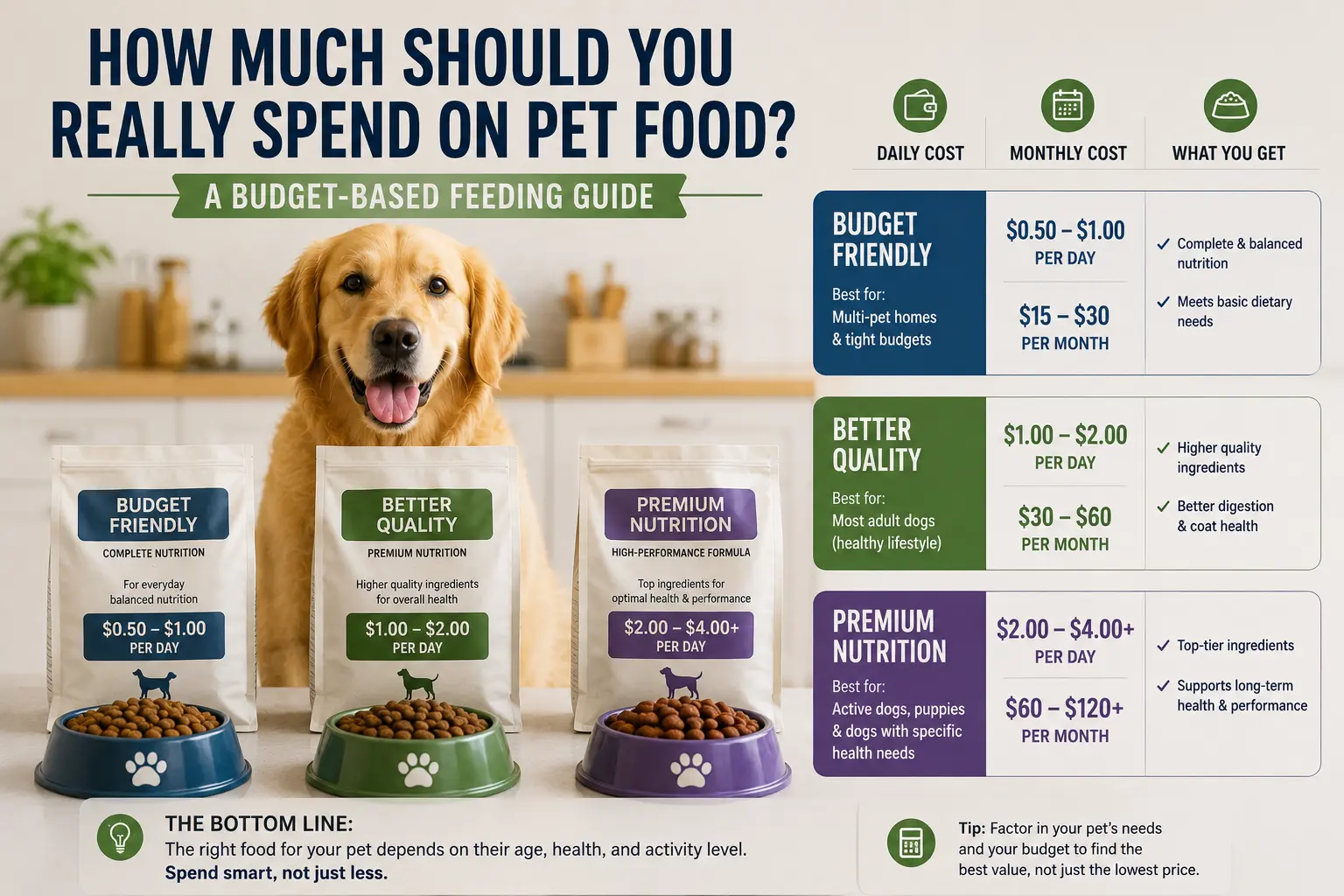
Ask ten different pet owners how much they spend on pet food each month and you’ll get ten wildly different answers. One might spend $25 on a large bag of store-brand kibble. Another might spend $150 on a premium fresh food subscription. A third might be somewhere in between, unsure whether they’re spending too much, too little, or just about right.
The pet food industry generates over $50 billion annually in the United States alone — and a significant portion of that revenue comes from convincing pet owners that spending more automatically means feeding better. It doesn’t. But spending too little carries its own risks, particularly when it means choosing nutritionally inadequate food to hit a price point.
So what is the right amount to spend on pet food? The honest answer is: it depends on factors specific to your pet — their size, life stage, health status, and species — combined with the nutritional quality and caloric density of the food you choose. This guide breaks all of that down into a practical, budget-based framework that helps you spend confidently, not anxiously.
Why There Is No Single “Right” Amount to Spend
Before establishing budget benchmarks, it’s important to understand why the question “how much should I spend on pet food?” doesn’t have one universal answer.
Pet size is the biggest variable. A Chihuahua eating 150 calories per day requires dramatically less food — and therefore dramatically less spending — than a Great Dane eating 2,500 calories per day. Food spending scales significantly with size.
Life stage matters. Puppies and kittens require calorie-dense, nutrient-rich growth formulas. Pregnant and nursing animals have elevated nutritional demands. Senior pets may need lower-calorie formulations or specialized health support diets.
Health status affects cost. A healthy adult pet can thrive on a quality mid-range commercial food. A pet managing kidney disease, severe food allergies, diabetes, or inflammatory bowel disease may require a prescription veterinary diet that costs 2–3 times as much as standard commercial food.
Food type dramatically affects cost. Dry kibble is the most cost-effective format per calorie. Wet food costs more per calorie but provides additional moisture. Fresh commercial foods and freeze-dried options cost the most. The same nutritional outcome can sometimes be achieved at very different price points depending on format choices.
With these variables in mind, the benchmarks below are organized by pet type and size to give you a practical starting point.
Budget Benchmarks by Pet Type and Size
These estimates represent monthly food costs using quality mid-range commercial foods that meet AAFCO nutritional standards. They do not include treats, supplements, or prescription diets.
Dogs
| Dog Size | Weight Range | Daily Calorie Need (approx.) | Monthly Food Cost (Mid-Range) | Monthly Food Cost (Premium) |
|---|---|---|---|---|
| Extra Small | Under 10 lbs | 200–350 kcal | $15–$25 | $30–$50 |
| Small | 10–25 lbs | 350–650 kcal | $20–$35 | $40–$70 |
| Medium | 25–50 lbs | 650–1,100 kcal | $35–$55 | $65–$100 |
| Large | 50–90 lbs | 1,100–1,800 kcal | $50–$80 | $90–$150 |
| Giant | 90+ lbs | 1,800–3,000+ kcal | $75–$120 | $140–$220 |
Cats
| Cat Type | Weight Range | Daily Calorie Need (approx.) | Monthly Food Cost (Dry Only) | Monthly Food Cost (Mixed Wet/Dry) |
|---|---|---|---|---|
| Small/Average Cat | 6–10 lbs | 180–280 kcal | $15–$25 | $25–$45 |
| Large Cat | 10–15 lbs | 280–380 kcal | $20–$35 | $35–$60 |
| Kitten | Any | Higher caloric density needed | $20–$40 | $35–$65 |
These figures assume quality mid-range food purchased through standard retail channels. Buying in bulk, using auto-ship subscriptions, or purchasing during sales can reduce these figures by 15–30%.
The Minimum Responsible Spending Threshold
Budget-conscious pet owners reasonably want to spend as little as possible on food — but there is a floor below which spending becomes a false economy.
The minimum responsible pet food investment is the price point at which you can reliably find AAFCO-compliant, nutritionally complete food with named protein sources and no artificial preservatives. In practice, this minimum threshold looks like:
- Small to medium dogs: Approximately $20–$35 per month for dry kibble
- Large dogs: Approximately $40–$65 per month for dry kibble
- Cats (dry food): Approximately $12–$20 per month
Below these thresholds, you’re typically looking at store-brand foods from discount retailers that may technically carry AAFCO statements but come from manufacturers with limited quality control infrastructure, higher rates of recall history, and ingredient lists heavy in generic by-products and artificial additives.
The financial risk of feeding below this threshold is real: nutritionally poor food can contribute to obesity, skin conditions, digestive problems, and immune dysfunction — all of which generate veterinary bills that dwarf the monthly savings achieved by buying the cheapest possible food.
The Point of Diminishing Returns: When Spending More Stops Helping
Just as important as understanding the minimum is understanding the ceiling — the price point above which additional spending stops translating into meaningfully better nutrition.
The pet food market has a significant premium tier where price increases are driven primarily by marketing, packaging, and brand positioning rather than nutritional superiority. Several research-backed observations support this:
Many ultra-premium brands lack feeding trial data. Some of the most expensive pet foods on the market are formulated to meet AAFCO nutrient profiles through calculation alone — without conducting actual feeding trials in live animals. Less expensive brands with longer track records often have more robust scientific validation behind their formulations.
The FDA’s DCM investigation involved premium brands. The ongoing investigation into dilated cardiomyopathy in dogs implicated several boutique and premium-priced grain-free diets — a reminder that high price does not equal high safety or nutritional science.
Veterinary nutritionists consistently recommend mid-range brands. When board-certified veterinary nutritionists discuss food recommendations publicly, they consistently mention mid-range brands with long track records, dedicated nutrition staff, and feeding trial histories — not the most expensive boutique options.
Practical premium ceiling for most pets:
- Small/medium dogs: $55–$70 per month for dry kibble represents the practical ceiling for nutritional return on investment
- Large dogs: $80–$110 per month
- Cats: $35–$55 per month (mixed wet/dry)
Spending significantly above these figures — for healthy pets without specific medical needs — is largely paying for marketing rather than better nutrition.
Budget Allocation by Pet Food Category
How you allocate your pet food budget across different food formats matters as much as the total amount you spend. Here’s how to think about it strategically:
Dry Kibble as the Foundation (60–80% of food budget)
Quality dry kibble delivers the best nutritional value per dollar for most pets. It is calorie-dense, shelf-stable, easy to portion, and available in AAFCO-compliant formulations across a wide range of price points. For budget-conscious pet owners, dry kibble should form the foundation of the diet.
Allocating 60–80% of your food budget to a quality mid-range dry kibble ensures nutritional completeness at a manageable cost.
Wet Food as a Supplement (20–40% of food budget)
Wet food offers real benefits — higher moisture content (supporting urinary health, particularly in cats), greater palatability for picky eaters, and higher protein percentages on a dry matter basis. But it costs more per calorie than dry food, making it impractical as a sole diet for most budgets.
Using wet food as a daily topper — 1–2 tablespoons for small pets, more for larger animals — captures most of these benefits at a fraction of the cost of a full wet food diet. Allocating 20–40% of your food budget to occasional wet food supplementation is a smart middle ground.
Treats (10–15% of food budget — maximum)
Treats should never exceed 10% of your pet’s total daily caloric intake, and this guideline translates directly into a budget cap. Spending more than 10–15% of your total food budget on treats is a common hidden driver of unnecessary pet food expense — and excessive treat feeding contributes to weight gain and associated health costs.
Choose treats that serve a purpose — dental health, training reinforcement, enrichment — rather than impulse buying decorative or novelty treats with minimal nutritional benefit.
How to Calculate Your Optimal Pet Food Budget
Rather than using broad estimates, you can calculate a precise optimal food budget for your specific pet in four steps:
Step 1: Determine your pet’s daily caloric need. Ask your veterinarian for your pet’s resting energy requirement (RER) and maintenance energy requirement (MER), or use an online pet calorie calculator as a starting estimate. A healthy 30-pound adult dog needs approximately 800–900 calories per day; a 10-pound cat needs approximately 200–250 calories per day.
Step 2: Find the caloric content of your food. Check the calorie statement on your current or prospective food bag (required on all AAFCO-compliant foods since 2016). This is expressed in kcal per cup (dry food) or kcal per can (wet food).
Step 3: Calculate daily food quantity. Divide your pet’s daily caloric need by the food’s caloric density. If your dog needs 900 calories per day and your food provides 360 kcal/cup, your dog needs 2.5 cups per day.
Step 4: Calculate monthly cost. Determine how many cups are in a bag (total weight ÷ weight per cup, or check manufacturer information). Divide bag price by number of cups to get cost per cup, then multiply by daily cups and by 30 for monthly cost.
Example:
- 30-lb bag of quality kibble at $45, providing approximately 120 cups
- Cost per cup: $0.375
- Daily requirement: 2.5 cups
- Daily cost: $0.94
- Monthly cost: $28.20
This calculation reveals the true cost of feeding and allows precise comparison between different foods regardless of bag size or price.
Budget Strategies That Don’t Compromise Nutrition
Once you’ve established a target budget range, these practical strategies help you stay within it without reducing nutritional quality:
Use auto-ship subscriptions consistently. Chewy’s Autoship program regularly offers 30–35% off first orders and 5–10% off recurring orders. Amazon Subscribe & Save provides 5–15% discounts. For a household spending $60/month on dog food, a consistent 10% auto-ship discount saves $72 per year — the equivalent of more than a month of food.
Buy the largest bag size that storage allows. Per-pound cost decreases as bag size increases in virtually every pet food brand. Buying a 40-pound bag instead of two 20-pound bags of the same food typically saves 10–20%. Store open bags in airtight containers in a cool, dry location and use within 4–6 weeks of opening.
Time major purchases around sales events. Pet retailers consistently run sales events during the holiday season, National Pet Month (May), and periodic clearance events. Purchasing 1–2 months’ supply during a 15–20% off sale can generate meaningful annual savings.
Compare price per calorie, not price per pound. A denser food that requires smaller portions may cost more per pound but less per day than a less calorie-dense budget option. Always compare foods on a cost-per-day basis using the calculation above.
Reduce treats to their functional minimum. Most pets receive far more treats than they need. Reducing treat frequency to training sessions and targeted dental care — and choosing cost-effective, single-ingredient options like freeze-dried meat pieces — can save $10–$25 per month without any negative impact on your pet’s health.
Leverage manufacturer rebates and coupons. Major pet food brands regularly offer rebates — sometimes $20–$50 per year — through their websites, veterinary offices, and retailer partnerships. Subscribing to brand email newsletters costs nothing and can yield meaningful coupon savings throughout the year.
Special Circumstances That Justify Higher Spending
While the benchmarks above apply to healthy pets, certain circumstances legitimately warrant spending more:
Prescription veterinary diets: Pets managing kidney disease, urinary crystals, severe food allergies, diabetes, pancreatitis, or heart disease often require prescription veterinary diets that cost $80–$200 per month or more. These are medical necessities, not optional upgrades — the cost of not feeding the appropriate diet is inevitably higher than the diet itself.
Life stage transitions: Puppies and kittens have higher caloric and nutritional needs per pound of body weight than adults. Investing in a quality growth formula during this critical developmental window pays dividends in long-term health — and the period is finite.
Recovery from illness or surgery: Pets recovering from significant illness or surgical procedures may benefit from calorie-dense, highly palatable foods that support healing. Your veterinarian will guide appropriate choices.
Senior pets with declining appetite: Older pets with reduced appetite may need more calorie-dense, highly palatable food — sometimes at higher per-calorie cost — to maintain healthy body weight.
Red Flags That Suggest You’re Overspending
If any of these apply to your current pet food budget, you may be paying more than necessary without a corresponding nutritional benefit:
- You’re spending more than 30% above the premium ceiling for your pet’s size without a specific medical reason
- Your food does not carry AAFCO feeding trial substantiation (only formulation certification) despite its high price
- The primary marketing language on your food’s packaging includes terms like “holistic,” “human-grade,” “ancestral,” or “small-batch” without regulatory backing
- You’re buying a grain-free diet for a healthy pet without a diagnosed grain sensitivity
- Your food is grain-free, legume-heavy, and boutique-branded — a profile that falls within the FDA’s DCM investigation scope
- You’re buying from a brand that has faced multiple recalls within the past five years while continuing to premium-price their products
Frequently Asked Questions
Is it ever okay to buy the cheapest pet food available? If the cheapest available option carries a valid AAFCO nutritional adequacy statement, named protein sources, and comes from a manufacturer with a reasonable safety record, it can be a legitimate choice — particularly for healthy adult pets. The real concern with the cheapest options is when they lack AAFCO compliance or come from manufacturers with limited quality oversight. Always check the label, not just the price.
Should I spend the same percentage of my income on pet food as on my own food? No — this is not a useful benchmark. Pet food spending should be anchored to your pet’s nutritional needs and the price at which those needs can be reliably met, not to proportional income calculations.
Does spending more on food reduce vet bills? Potentially, yes — but the relationship is not linear. Feeding a quality mid-range food that meets AAFCO standards provides most of the preventative nutrition benefit available through diet. Upgrading to an ultra-premium food at twice the price is unlikely to produce meaningfully better health outcomes than a solid mid-range option.
How do I know if my current food is worth what I’m paying? Evaluate it against these criteria: Does it carry an AAFCO adequacy statement based on feeding trials? Is a named protein source in the first two ingredients? Does the manufacturer employ qualified nutritionists and conduct regular quality testing? Is the daily feeding cost reasonable relative to the size of your pet? If yes to all four, you’re likely getting good value.
How much should treats add to my monthly pet food budget? Treats should be budgeted as a separate line item capped at 10–15% of your total pet food spend. For a pet whose food costs $50/month, treats should cost no more than $5–$7.50/month in additional food budget terms.
Final Thoughts
There is no single right number for how much to spend on pet food — but there is a range within which smart spending lives. Below the responsible minimum, you risk nutritional inadequacy. Above the practical premium ceiling, you risk paying for marketing rather than nutrition. In between lies a well-defined zone where quality, value, and your pet’s genuine health needs align.
Use the benchmarks and calculation tools in this guide to find your pet’s personal sweet spot. Feed them well, spend thoughtfully, and redirect the savings toward the veterinary care, emergency funds, and preventative health investments that make a genuine difference in how long and how well your companion lives.
Disclaimer: The cost benchmarks and nutritional guidance in this article represent general estimates based on typical market conditions and established nutritional standards. Individual pet needs vary significantly. Always consult your licensed veterinarian or a board-certified veterinary nutritionist for dietary recommendations specific to your pet’s health status, breed, and life stage. Pricing is subject to change based on market conditions.
