

Updated: August 2026
Choosing between a puppy and an adult dog is often presented as a lifestyle decision.
Puppies are young, playful, and require early training. Adult dogs may already have established habits and, depending on their history, may require less initial training.
But there is another question worth asking before you adopt:
Which one is likely to be easier on your budget during the first 12 months?
The answer isn’t simply “adult dogs are cheaper.”
A puppy can require additional first-year expenses such as vaccinations, training, equipment, spay/neuter, and frequent replacement of items as the dog grows. An adult dog may have fewer puppy-specific expenses, but an individual adult dog can still have medical, behavioral, grooming, or other needs.
The most useful comparison is therefore:
Acquisition cost + first-year healthcare + training + equipment + recurring expenses + emergency preparation
This guide walks through that comparison so you can build a realistic first-year budget before choosing your new dog.
Important: Costs vary by location, dog size, age, breed, health, adoption organization, and lifestyle. The dollar amounts in this article are illustrative budgeting examples, not guaranteed prices or national averages.
Puppy vs. Adult Dog: The Short Answer
If you are looking strictly at first-year budgeting, an adult dog may be easier to predict financially because many puppy-specific setup and training expenses may already be behind you.
However, that does not mean every adult dog costs less.
A healthy adult dog may still need:
- Veterinary care
- Preventive treatment
- Food
- Grooming
- Training or behavior support
- Medication
- Emergency savings
Meanwhile, a puppy may require additional early expenses such as:
- Initial veterinary visits
- Vaccinations
- Spay/neuter
- Puppy training
- Crate
- Puppy-sized equipment
- Replacement collars or harnesses
- Chew toys
- More frequent supply replacement
The individual dog’s needs matter more than age alone.
Puppy vs. Adult Dog: First-Year Cost Categories
| Expense | Puppy | Adult Dog |
|---|---|---|
| Adoption fee | Varies | Varies |
| Initial supplies | Usually higher | Usually lower |
| Food | Ongoing | Ongoing |
| Veterinary care | Often more front-loaded | Varies |
| Vaccinations | May require multiple visits | Depends on records |
| Spay/neuter | May still be required | May already be completed |
| Training | Often a significant expense | May be lower, but not always |
| Grooming | Depends on coat | Depends on coat |
| Boarding/daycare | Lifestyle-dependent | Lifestyle-dependent |
| Medication | Individual | Individual |
| Emergency reserve | Recommended | Recommended |
This table shows why a simple “puppies cost X and adult dogs cost Y” comparison would be misleading.
What Makes a Puppy More Expensive During Year One?
Puppies can create several expenses that are concentrated in the first year.
These include:
- Early veterinary care
- Vaccinations
- Spay/neuter when applicable
- Puppy training
- Crate and puppy equipment
- Replacement equipment as the puppy grows
- Chew and enrichment items
- Potentially higher supervision or daycare costs
The American Veterinary Medical Association recommends scheduling a veterinary examination for a new dog and notes that puppies can involve initial medical expenses for wellness examinations, vaccinations, and neutering.
That doesn’t mean every puppy will require the same amount of spending.
It means those categories should be considered before setting your budget.
What Makes an Adult Dog Potentially More Affordable?
An adult dog may already have some of the following completed:
- Basic training
- Spay/neuter
- Initial vaccinations
- Microchipping
- House training
- Basic equipment
However, this depends entirely on the individual dog and the organization from which you adopt.
A shelter or rescue should be able to tell you what care has already been provided.
ASPCA explains that adoption organizations have their own fees, processes, and requirements, and that adoption fees can help cover veterinary care, spay/neuter, vaccinations, food, and other animal-care costs.
So before comparing a puppy and adult dog, ask:
What has already been paid for?
1. Adoption Fee
Start with the actual adoption fee.
Don’t assume puppies always have a higher fee or adult dogs always have a lower one.
Shelters and rescues set their own fees.
ASPCA specifically notes that adoption fees vary among organizations and that some organizations run fee-waived promotions.
For example, two dogs at the same shelter could have different adoption requirements or promotional pricing.
Budgeting rule
Use the actual fee for the dog you are considering, not a generic puppy or adult-dog average.
2. What Is Already Included?
This can completely change the comparison.
Ask the shelter or rescue:
- Has the dog been spayed or neutered?
- Which vaccinations were given?
- Has the dog been microchipped?
- Has the dog received parasite treatment?
- Has the dog had a veterinary examination?
- Are medical records available?
- Is any follow-up care included?
Suppose:
Puppy adoption fee
$250
Adult dog adoption fee
$300
At first glance, the puppy appears cheaper.
But if the adult dog’s fee includes several services that you would otherwise pay for separately, the real first-year difference could be very different.
3. Puppy Veterinary Expenses
Puppies often have more early veterinary milestones.
Your first-year budget may need to account for:
- Wellness examinations
- Vaccinations
- Parasite prevention
- Spay/neuter
- Microchip
- Follow-up visits
- Other veterinary recommendations
The exact schedule should come from your veterinarian.
Don’t build your budget from an internet checklist alone.
4. Adult Dog Veterinary Expenses
An adult dog may have fewer puppy-specific veterinary expenses.
But that does not mean veterinary care disappears.
An adult dog may still need:
- Routine examinations
- Vaccinations
- Preventive care
- Dental care
- Medication
- Diagnostic testing
- Treatment for existing conditions
The dog’s medical history matters more than simply calling it “adult.”
5. Puppy Training Costs
Training is one of the biggest financial differences worth considering.
A puppy may need help with:
- House training
- Basic commands
- Leash walking
- Socialization
- Chewing
- Jumping
- Crate training
- Appropriate behavior
Options can include:
- Group puppy classes
- Private training
- Online training resources
- Professional behavior consultation
Not every owner needs professional training.
But it is sensible to leave room in the first-year budget.
6. Adult Dog Training Costs
Adult dogs are not automatically “already trained.”
An adult rescue may need help adjusting to:
- A new home
- New routines
- Other pets
- New people
- Leash walking
- Separation
- Household rules
Some adult dogs may need very little training.
Others may require significant behavioral support.
This is why you should ask the shelter about the dog’s known behavior rather than assuming age tells you everything.
7. Crate and Equipment Costs
Puppies can require more equipment because they grow.
You might initially purchase:
- Small crate
- Puppy collar
- Puppy harness
- Puppy leash
- Food bowls
- Bedding
- Chew toys
Later, you may need larger equipment.
An adult dog may be able to use the same appropriately sized equipment for much longer.
8. Growing Out of Equipment
This is a classic puppy expense.
A puppy may outgrow:
- Collar
- Harness
- Bed
- Crate
- Clothing
- Other equipment
You don’t necessarily need to replace everything.
But if the equipment becomes unsafe or unsuitable, it may need to be replaced.
An adult dog’s size is generally more established, which can make equipment purchases easier to plan.
9. Puppy Food
Puppies have different nutritional requirements from adult dogs.
Your veterinarian can help determine an appropriate feeding plan.
Food costs depend on:
- Dog size
- Expected adult size
- Food type
- Brand
- Feeding amount
- Special dietary needs
A large-breed puppy can have a very different food budget from a small-breed puppy.
For food-specific budgeting, see our:
That article focuses on food spending, while this article compares puppy versus adult first-year costs.
10. Adult Dog Food
Adult dog food is also influenced by size and lifestyle.
For example, a large adult dog generally consumes more food than a small adult dog.
Activity level can also influence feeding requirements.
Don’t assume:
Adult dog = cheap food.
Instead, calculate your actual food requirement and current product cost.
11. Spay/Neuter Cost
Before adoption, determine whether the dog has already been spayed or neutered.
This is particularly important when comparing a puppy with an adult dog.
Puppy
The procedure may still be ahead.
Adult
It may already have been completed.
But don’t assume.
Ask for documentation.
If the procedure has not been completed, include the expected expense in your first-year budget.
12. Vaccination Costs
A puppy may have a different vaccination schedule from an adult dog.
Ask for the dog’s vaccination records.
You want to know:
- What has already been given?
- When was it administered?
- What follow-up is expected?
- What does your veterinarian recommend?
This prevents you from budgeting for care that has already been completed while also avoiding the opposite mistake of assuming everything is current.
13. Microchip and Identification
Check whether the dog is already microchipped.
If it is:
- Obtain the microchip number.
- Confirm registration.
- Update your contact information.
If it isn’t, ask your veterinarian about microchipping.
You may also need:
- Collar
- ID tag
- License where required
These costs are relatively small, but they belong in a complete first-year budget.
14. Grooming Costs
Grooming is more dependent on coat type than age.
A puppy of a high-maintenance breed may need professional grooming.
An adult dog of the same breed may need similar grooming.
Therefore, don’t assume the puppy is cheaper or more expensive.
Ask:
- How often does the coat need grooming?
- Can I handle basic grooming at home?
- What are local professional grooming prices?
Example
If grooming costs:
$65 × 6 appointments = $390/year
Monthly planning equivalent:
$390 ÷ 12 = $32.50
15. Dog Walking and Daycare
This is a lifestyle expense rather than an age-specific expense.
A puppy may require more supervision.
An owner working long hours may therefore use:
- Dog walker
- Daycare
- Pet sitter
An adult dog might also need these services.
The deciding factor is usually your schedule and the dog’s needs.
16. Boarding Costs
If you travel, boarding or pet sitting can affect the first-year budget.
Example:
$60/night × 8 nights = $480
Monthly sinking-fund contribution:
$480 ÷ 12 = $40
The expense doesn’t need to happen monthly for it to belong in your monthly budget.
17. Emergency Savings
Both puppies and adult dogs need financial preparation for unexpected veterinary expenses.
A puppy may be healthy and still experience an accident or illness.
An adult dog may also require unexpected treatment.
Therefore:
Emergency savings should not be based solely on age.
Your reserve should reflect your financial situation and ability to handle a veterinary bill.
For a more detailed calculation:
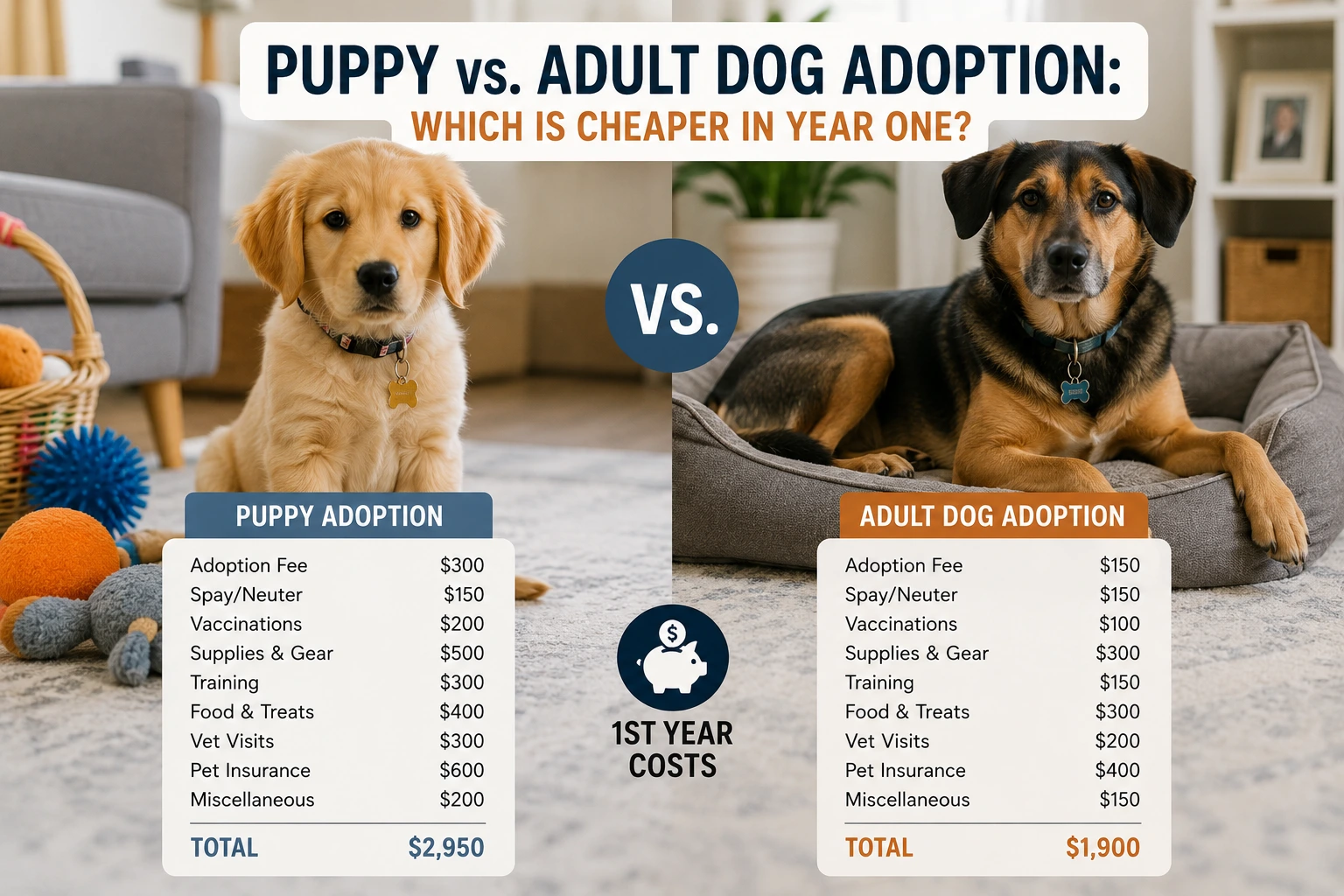
Puppy vs. Adult Dog: Example First-Year Budgets
The following examples are deliberately hypothetical.
They demonstrate the structure of the budget, not average national prices.
Example Puppy Budget
| Category | Example |
|---|---|
| Adoption fee | $250 |
| Initial equipment | $350 |
| Veterinary reserve | $500 |
| Training | $400 |
| Food | $720 |
| Grooming | $300 |
| Routine supplies | $180 |
| Emergency savings | $600 |
| Planned first-year total | $3,300 |
Example Adult Dog Budget
| Category | Example |
|---|---|
| Adoption fee | $250 |
| Initial equipment | $200 |
| Veterinary reserve | $350 |
| Training | $150 |
| Food | $720 |
| Grooming | $300 |
| Routine supplies | $180 |
| Emergency savings | $600 |
| Planned first-year total | $2,750 |
In this hypothetical example, the puppy costs:
$3,300 − $2,750 = $550 more
during the first year.
But another puppy and adult dog could produce completely different numbers.
Why You Shouldn’t Treat These Examples as “Average Costs”
A first-year budget can vary because of:
- Dog size
- Breed
- Location
- Health
- Training requirements
- Grooming
- Adoption fee
- Included veterinary services
- Owner’s lifestyle
For example, an adult dog needing significant medical care could easily cost more than a healthy puppy.
That is why the article uses budgeting methodology instead of claiming one universal price.
Puppy vs. Adult Dog: Where the Difference Usually Comes From
The biggest potential differences are often:
Puppy
Training + initial healthcare + equipment
Adult
Medical history + possible ongoing care
Food, grooming, insurance, boarding, and emergency savings can apply to both.
So the financial comparison is not:
Puppy has more expenses.
It is:
Puppy and adult dogs tend to have different expense patterns.
First-Year Cost vs. Ongoing Cost
This distinction is especially important for puppies.
Suppose a puppy costs:
$3,300 during year one
But $600 of that is equipment and training that won’t repeat at the same level.
Your second-year budget could be significantly different.
Similarly, an adult dog may have lower setup costs but develop medical expenses later.
Don’t use first-year cost as a permanent annual cost.
How to Calculate Your Own Puppy Budget
Use:
Initial expenses
Adoption fee
Equipment
Initial veterinary care
Training
Then add:
Recurring expenses
Food
Routine supplies
Grooming
Insurance, if applicable
Finally:
Financial protection
Emergency savings
=
First-year puppy budget
How to Calculate Your Own Adult Dog Budget
Use the same framework:
Adoption fee
Initial supplies
Medical follow-up
Food
Grooming
Training if needed
Insurance if chosen
Emergency savings
=
First-year adult-dog budget
The formula is similar.
The numbers are what change.
A Better Way to Compare Two Dogs
If you are choosing between a puppy and an adult dog, create two columns.
| Cost | Puppy | Adult |
|---|---|---|
| Adoption fee | $___ | $___ |
| Initial supplies | $___ | $___ |
| Veterinary care | $___ | $___ |
| Vaccinations | $___ | $___ |
| Spay/neuter | $___ | $___ |
| Training | $___ | $___ |
| Food | $___ | $___ |
| Grooming | $___ | $___ |
| Boarding | $___ | $___ |
| Insurance | $___ | $___ |
| Emergency savings | $___ | $___ |
| First-year total | $___ | $___ |
Now you are comparing actual financial commitments instead of assumptions.
Questions to Ask Before Adopting a Puppy
Ask the shelter or rescue:
- What does the adoption fee include?
- Which vaccinations have been completed?
- Has the puppy been examined by a veterinarian?
- Has the puppy been spayed or neutered?
- Is the puppy microchipped?
- What medical records are provided?
- What food is the puppy currently eating?
- Are there known medical concerns?
- What behavior information is available?
- What training has already occurred?
ASPCA notes that adoption organizations have their own adoption processes, fees, and requirements, so these details should be confirmed with the individual organization.
Questions to Ask Before Adopting an Adult Dog
Ask:
- What is the dog’s medical history?
- Which vaccinations are current?
- Is the dog spayed or neutered?
- Is the dog microchipped?
- Does the dog take medication?
- Are there known chronic conditions?
- Is the dog house-trained?
- How does the dog behave around other animals?
- Does the dog have separation concerns?
- What type of exercise does the dog need?
- What training has already been completed?
These answers can be more financially useful than simply knowing the dog’s age.
The Health History Can Matter More Than Age
Consider two hypothetical adult dogs.
Adult Dog A
- Healthy
- No medication
- Basic training
- Routine veterinary care
Adult Dog B
- Chronic medication
- Frequent veterinary monitoring
- Special diet
- Behavioral support
Dog B may cost substantially more despite being the same age.
Now compare them with a puppy.
A healthy puppy may have higher setup costs but fewer ongoing medical expenses.
This demonstrates why individual health information matters more than age alone.
What About Rescue Puppies?
A puppy adopted from a rescue or shelter can combine some of the financial characteristics of both categories.
You may have:
- Adoption fee
- Initial medical care
- Puppy training
- Puppy equipment
- Food
- Emergency savings
So don’t assume:
“Shelter puppy = cheap.”
The source of the dog and the age of the dog are separate variables.
What About Adult Dogs From Shelters?
Adult shelter dogs may have advantages from a budgeting perspective if the organization has already completed some medical care and the dog has established behavior.
But again, this varies.
Some adult dogs may need:
- Dental treatment
- Medication
- Behavior support
- Special diets
Always review the dog’s available records.
Can an Adult Dog Be More Expensive Than a Puppy?
Absolutely.
For example:
Puppy
Lower medical needs + higher training costs
Adult
Higher medical needs + lower training costs
If the adult dog requires significant ongoing treatment, the adult may cost more.
This is why “adult dogs are cheaper” should never be treated as a universal rule.
Can a Puppy Be Cheaper Than an Adult Dog?
Yes.
A healthy puppy with:
- Low adoption fee
- Included veterinary care
- Minimal grooming
- Owner-provided training
- No medical problems
could cost less than an adult dog requiring:
- Medication
- Professional grooming
- Behavioral support
- Frequent veterinary visits
Again, individual circumstances determine the result.
How Lifestyle Changes the Comparison
Your daily routine can be more important than the dog’s age.
Work From Home
You may spend less on:
- Dog walking
- Daycare
- Pet sitting
Full-Time Office Worker
You may need:
- Dog walker
- Daycare
- More structured care
Frequent Traveler
Boarding can become a major expense.
Therefore, calculate your lifestyle costs before deciding whether a puppy or adult dog is financially suitable.
What Should You Prioritize If Your Budget Is Limited?
If money is tight, prioritize:
Essential
- Appropriate food
- Necessary veterinary care
- Necessary medication
- Safe housing
- Basic equipment
Planned
- Preventive care
- Training
- Grooming
- Boarding
Optional
- Premium accessories
- Extra toys
- Subscription boxes
- Luxury products
Cutting optional purchases is generally more sustainable than cutting necessary care.
Is a Puppy Worth the Extra First-Year Cost?
That depends on your priorities.
A puppy may appeal to someone who wants:
- To experience the puppy stage
- To train from an early age
- A particular developmental experience
But puppies also require:
- Time
- Supervision
- Training
- Patience
- Financial preparation
The extra first-year cost may be worthwhile for you.
The important thing is to enter the decision knowing what you’re committing to.
Is an Adult Dog Better Financially?
An adult dog can be financially attractive when:
- The adoption fee includes important medical services.
- The dog’s health history is well documented.
- Basic training is already established.
- You don’t need extensive puppy equipment.
- Your lifestyle fits the dog’s needs.
But don’t choose an adult dog purely because you assume it will be cheaper.
Choose based on the complete financial and lifestyle picture.
A 5-Minute Financial Decision Test
Before adopting, answer these questions:
1. What is my maximum monthly pet budget?
$________
2. How much emergency savings do I already have?
$________
3. How much will the first-year setup cost?
$________
4. Will I need paid training, grooming, walking, or boarding?
Yes / No
5. What medical care has already been completed?
6. What expenses are likely during the next 12 months?
7. Can I maintain this budget after the first year?
Yes / No
If you cannot answer these questions, gather more information before adopting.
Puppy vs. Adult Dog: Decision Matrix
| Factor | Puppy | Adult Dog |
|---|---|---|
| Initial training | Usually higher | May be lower |
| Equipment replacement | Potentially higher | Often more predictable |
| Early healthcare | Can be front-loaded | Depends on history |
| Behavior predictability | Still developing | Often easier to assess |
| Food needs | Changes with growth | More predictable |
| Grooming | Depends on breed | Depends on breed |
| Emergency risk | Still exists | Still exists |
| Time commitment | Usually high | Varies |
| First-year predictability | Can be less predictable | Can be more predictable |
This is not a ranking.
It is a reminder that different types of costs occur at different stages.
How to Make Your First Year More Affordable
Ask What Is Included
Don’t pay separately for a service that is already included in the adoption package.
Buy Essential Equipment First
Avoid purchasing every accessory before you know what you need.
Use Sinking Funds
Divide annual costs by 12.
Track Actual Spending
Your first six months will reveal where your money is actually going.
Build Emergency Savings
Don’t rely entirely on your normal monthly budget for unexpected veterinary care.
Reassess After Six Months
Adjust the budget based on actual expenses.
Puppy vs. Adult Dog: Final Verdict
If your only question is:
“Which is cheaper during the first year?”
an adult dog may be easier to budget for because some puppy-specific expenses can already be behind you.
But that is not a guarantee.
A healthy puppy with included veterinary care and modest training needs could cost less than an adult dog with ongoing medical or behavioral needs.
The most accurate approach is to compare:
Adoption fee
Included services
Initial equipment
Veterinary care
Training
Food
Grooming
Lifestyle expenses
Emergency savings
Once you calculate those categories, the financial difference between the specific puppy and adult dog you’re considering becomes much clearer.
The best choice isn’t necessarily the cheapest dog.
It’s the dog whose financial needs, care requirements, and lifestyle fit your household for the long term.
Frequently Asked Questions
Is adopting an adult dog cheaper than adopting a puppy?
It can be, particularly when the adult dog already has basic training and initial veterinary care completed. However, medical or behavioral needs can make an adult dog more expensive.
Why can puppies cost more in the first year?
Puppies may require additional veterinary visits, vaccinations, spay/neuter, training, equipment, and replacement supplies as they grow.
Are adult dogs cheaper to feed?
Not necessarily. Food costs depend heavily on size, activity level, food type, and individual needs.
Does a puppy require more veterinary care?
Puppies commonly have more early veterinary milestones, but the exact schedule depends on the individual dog and veterinary recommendations.
Is training more expensive for puppies?
Puppies often benefit from early training and socialization, but adult dogs may also need professional training depending on their background and behavior.
Can an adult rescue dog be more expensive than a puppy?
Yes. An adult dog with medication, chronic health needs, special food, or behavioral support may have higher ongoing costs.
Should I choose a puppy because I think it will be healthier?
Age alone does not guarantee health. Review the animal’s available medical history and have your veterinarian assess your new dog.
How much emergency savings should I have before adopting?
There is no universal amount. Consider your household budget, insurance, deductible, local veterinary costs, and how much you could comfortably pay for unexpected care.
What should I ask a shelter before adopting?
Ask about the dog’s medical records, vaccinations, spay/neuter status, microchip, medications, behavior, training, and exactly what the adoption fee includes.
Related Pet Finance Resources
If you’re comparing the financial commitment of bringing a dog home, these resources can help:
Pet Ownership Cost Calculator — Estimate broader annual pet ownership expenses.
How Much to Budget for a Dog Per Month — Build a recurring monthly dog budget.
Pet Emergency Fund Calculator — Plan an emergency reserve.
Pet Food Budget Guide — Focus specifically on food spending.
Average Vet Costs by Procedure — Research individual veterinary expenses.
These articles intentionally cover different questions. This page focuses specifically on puppy versus adult dog first-year economics.
Editorial Methodology
PetPolicyFinance compares puppy and adult-dog costs using a first-year budgeting framework.
The analysis separates:
- Acquisition costs
- Included veterinary services
- Initial equipment
- Healthcare
- Training
- Recurring expenses
- Lifestyle expenses
- Emergency preparation
Dollar figures used as examples are illustrative and should not be interpreted as national averages.
Actual costs vary by location, dog size, breed, health, adoption organization, household lifestyle, and services selected.
Readers should obtain current information from the shelter or rescue and consult a veterinarian for health-related decisions.
Editorial Disclaimer
PetPolicyFinance.com is an independent educational website. We are not an animal shelter, rescue organization, veterinary clinic, insurance company, insurance broker, financial adviser, or law firm.
This article provides general educational information about pet budgeting and does not constitute veterinary, financial, insurance, or legal advice.
Adoption fees, veterinary prices, insurance terms, and other pet-related costs can change.
Always verify current medical records, adoption terms, and costs before making a decision.
Author: Harry Mills
Last Reviewed: August 2026
