

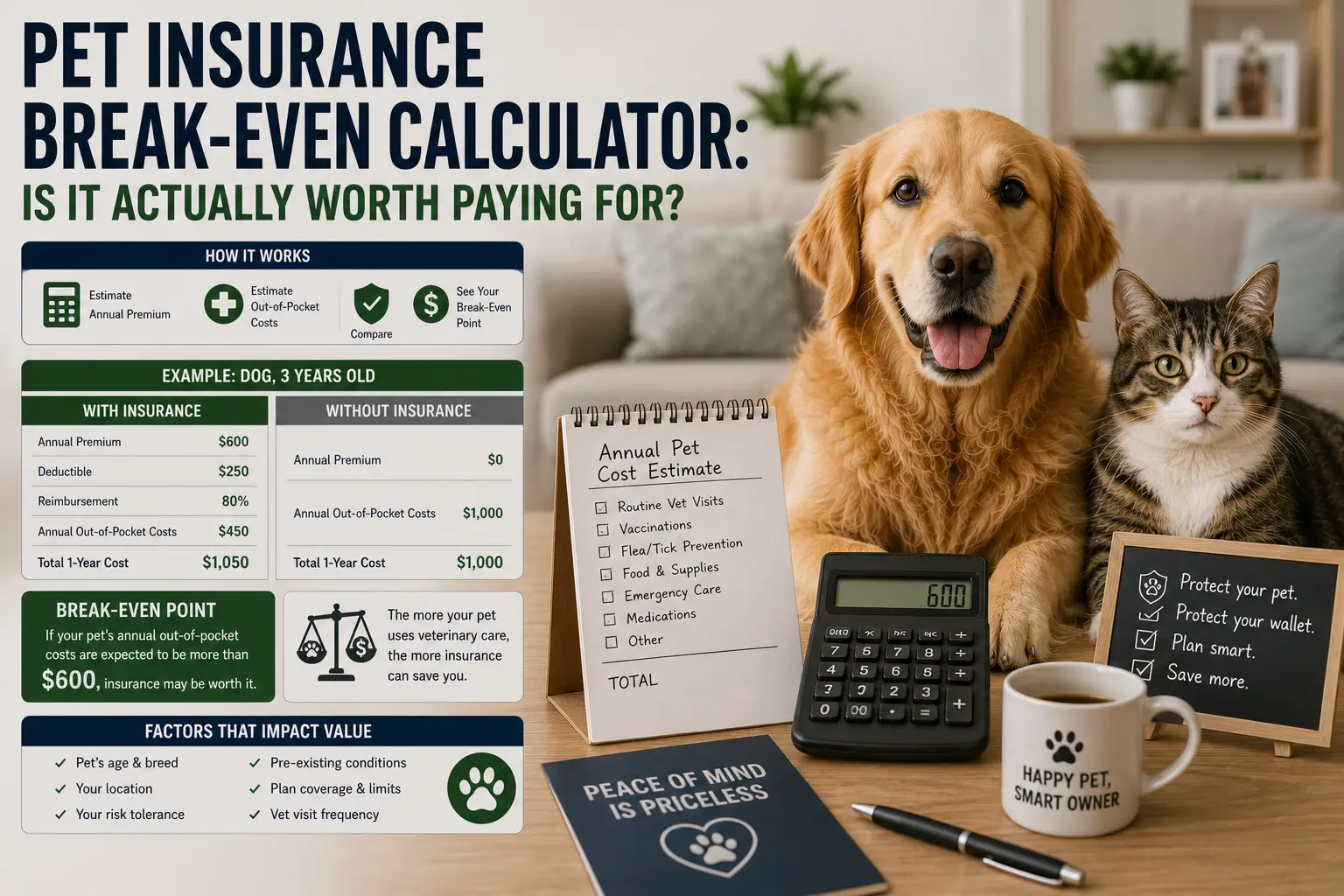
Every pet owner faces the same uncomfortable question: You’re signing up for pet insurance, writing a check every month, and wondering — will I ever actually come out ahead? Or am I just handing money to an insurance company that’s banking on my dog never getting seriously sick?
The honest answer is: it depends. But “it depends” is only useful if you know what it depends on. That’s exactly what a pet insurance break-even calculator helps you figure out — and in this guide, we’ll walk you through the math, the real-world data, and the factors that tip the scales one way or the other.
What Is a Pet Insurance Break-Even Point?
The break-even point is the moment when the total cost of your vet bills covered by insurance equals the total amount you’ve paid in premiums, deductibles, and out-of-pocket costs. Before that point, you’re “losing” money on insurance. After it, insurance has paid for itself.
The break-even formula looks like this:
Break-Even Point = (Total Premiums Paid + Deductibles + Co-pays) ÷ Annual Vet Savings from Insurance
For example, if you pay $600/year in premiums, have a $250 annual deductible, and your insurer covers 80% of eligible costs after that deductible, you need to have at least $850 in covered vet bills per year just to break even. Anything above that is where the insurance starts working in your favor.
How to Use a Pet Insurance Break-Even Calculator
You don’t need to be a mathematician to run your own numbers. Here’s a simple step-by-step approach:
Step 1: Know Your Monthly Premium
Pet insurance premiums vary widely based on your pet’s species, breed, age, location, and the plan you choose. According to the North American Pet Health Insurance Association (NAPHIA), the average monthly premium in the U.S. is approximately:
- Dogs: $53–$67/month (accident and illness plans)
- Cats: $28–$35/month (accident and illness plans)
That translates to roughly $636–$804/year for dogs and $336–$420/year for cats.
Step 2: Factor In Your Deductible
Most plans offer either an annual deductible (you pay once per year before coverage kicks in) or a per-incident deductible (you pay a deductible each time a new condition arises). Common deductible amounts range from $100 to $1,000.
For break-even purposes, a per-incident deductible can actually hurt you more if your pet has multiple unrelated issues in a year.
Step 3: Calculate Your Reimbursement Rate
Most plans reimburse 70%, 80%, or 90% of covered expenses after the deductible. The lower your reimbursement rate, the more you pay out of pocket — and the higher the bar to break even.
Step 4: Estimate Your Annual Vet Spending
This is the trickiest variable. Healthy young pets may only need annual wellness exams ($50–$200), while older pets or certain breeds may require chronic disease management, dental cleanings, or emergency care that can run into thousands of dollars.
A realistic break-even table:
| Monthly Premium | Annual Deductible | Reimbursement Rate | Annual Covered Bills Needed to Break Even |
|---|---|---|---|
| $50 | $250 | 80% | $1,125 |
| $65 | $500 | 80% | $1,600 |
| $40 | $100 | 90% | $933 |
| $80 | $250 | 70% | $2,417 |
The Real Costs Pet Insurance Is Designed to Cover
Pet insurance becomes obviously worthwhile when your pet experiences a catastrophic event. Here’s a snapshot of what common veterinary emergencies actually cost, which puts the break-even math into sharp relief:
- Torn ACL (cruciate ligament repair): $3,500–$7,000 per leg
- Swallowed foreign object (surgery): $2,000–$5,000
- Cancer treatment (chemotherapy + surgery): $5,000–$20,000+
- Diabetes management (annual): $1,500–$3,000/year
- Emergency hospitalization: $1,500–$5,000+
- Hip dysplasia surgery: $3,500–$7,000 per hip
If your dog tears an ACL — a surprisingly common injury, especially in active medium and large breeds — a single surgery can pay off three to ten years of premiums in one incident.
When Pet Insurance Is Clearly Worth It
1. You Have a High-Risk Breed
Certain breeds carry significantly elevated health risks that make insurance actuarially advantageous for pet owners. Insurance companies price premiums knowing these risks, but if your pet actually develops a condition, the payout potential dwarfs the cost of coverage.
High-risk breeds include:
- Bulldogs and French Bulldogs – Brachycephalic airway syndrome, skin issues, joint problems
- German Shepherds – Hip dysplasia, degenerative myelopathy
- Golden Retrievers – Exceptionally high cancer rates (over 60% lifetime risk)
- Great Danes – Bloat (GDV), heart conditions, shorter lifespan
- Maine Coon cats – Hypertrophic cardiomyopathy
For these breeds, the statistical probability of a major claim is high enough that insurance isn’t just a safety net — it’s a near-certainty of paying off.
2. You Have a Young Pet and Lock In a Low Premium
Pet insurance premiums increase with age. If you enroll a puppy or kitten while they’re healthy and premiums are low, you lock in coverage before pre-existing conditions can be excluded. Over a 10–15 year pet lifespan, a low early premium can make the lifetime math dramatically more favorable.
3. You Live in a High-Cost Veterinary Market
Vet costs in metropolitan areas like New York City, San Francisco, or Boston can be 30–50% higher than national averages. Your premium is also location-adjusted — but the gap between insured reimbursement and out-of-pocket expense often favors insured owners more in expensive markets.
4. You Can’t Comfortably Absorb a $5,000+ Emergency
This is arguably the most important factor — and it’s not purely mathematical. If a $4,000 emergency surgery would force you to choose between your pet’s life and your finances, pet insurance is worth every cent regardless of break-even math. Insurance is fundamentally about protecting against catastrophic loss, not generating a “profit.”
When Pet Insurance Might Not Be Worth It
1. Your Pet Is Already Older With Pre-Existing Conditions
Most pet insurance policies exclude pre-existing conditions entirely. If your 8-year-old Labrador already has arthritis, hip dysplasia, or a history of ear infections, those conditions — and anything reasonably related to them — won’t be covered. You’d be paying premiums for coverage that excludes your pet’s most likely health issues.
2. You Have a Healthy, Low-Risk Mixed Breed
Mixed-breed dogs and cats generally have lower rates of genetic disease due to hybrid vigor. If your healthy, young mixed-breed pet has sailed through five years of vet visits with nothing but routine care, the break-even math may never work in your favor — especially if you’re paying a premium that doesn’t reflect their actual low risk profile.
3. You Have a Large Emergency Fund
If you have $10,000–$20,000 in liquid savings that you’ve mentally earmarked for pet emergencies, self-insuring may be the smarter financial move. You avoid premiums and deductibles, and in a worst-case scenario, you draw from your own fund rather than fighting with an insurer over covered conditions.
4. The Policy Has Too Many Exclusions
Read the fine print carefully. Some policies exclude hereditary conditions, bilateral conditions (if one knee is gone, the other may be excluded), dental disease, behavioral issues, or alternative therapies. If the most likely conditions your pet could develop are all excluded, you’re essentially paying for very narrow coverage.
The Self-Insurance Alternative: Running the Numbers
One popular alternative is to skip pet insurance entirely and instead deposit the equivalent of your monthly premium into a dedicated savings account.
Example:
- Monthly premium saved: $60/month
- Annual savings: $720
- 5-year savings: $3,600
- 10-year savings: $7,200 (plus interest)
If your pet never has a major emergency, you keep that money. If they do, you have a meaningful fund — though it may not cover a truly catastrophic $10,000+ event in the early years before the fund has grown.
The self-insurance strategy works best for financially disciplined owners with low-risk pets. The problem is that emergencies don’t wait for your savings account to mature. A six-month-old puppy can swallow a sock and need emergency surgery before you’ve saved $500.
Key Questions to Ask Before Buying Pet Insurance
Before signing up for any policy, get clear answers to these questions:
1. What is excluded as a pre-existing condition? Ask specifically whether conditions your pet has ever shown any symptoms of — even mild ones — will be permanently excluded.
2. Is the deductible annual or per-incident? Annual deductibles are almost always better for pets with multiple health issues in a given year.
3. Does the premium increase with age? Nearly all policies do. Ask for the rate schedule so you can model long-term costs.
4. Is there a lifetime or annual payout cap? Some policies cap total reimbursements at $10,000/year or over the pet’s lifetime. For a cancer diagnosis requiring $20,000 in treatment, that cap matters enormously.
5. Are hereditary and congenital conditions covered? This is critical for purebred dogs and cats where genetic conditions are statistically common.
6. How does reimbursement work — actual cost or benefit schedule? Some insurers reimburse based on a “benefit schedule” (a predetermined amount they’ll pay for each procedure), which can be dramatically less than your actual vet bill.
How to Actually Run Your Break-Even Calculation
Here’s a quick worksheet you can fill in manually:
A. Monthly premium:              $______
B. Annual premium (A × 12):      $______
C. Annual deductible:            $______
D. Total annual out-of-pocket (B + C): $______
E. Reimbursement rate:           ______%
F. Annual vet bills needed to break even: D ÷ E = $______
Example:
- Monthly premium: $55 → Annual: $660
- Annual deductible: $300
- Total out of pocket: $960
- Reimbursement rate: 80%
- Break-even vet bills: $960 ÷ 0.80 = $1,200/year
If your pet’s annual covered vet expenses are likely to exceed $1,200 per year, insurance pays off. If they’re typically $400/year, it probably doesn’t — unless you’re factoring in the catastrophic scenario protection.
The Right Way to Think About Pet Insurance
The mathematical break-even analysis is useful, but it can also be misleading if taken too literally. Here’s why:
Insurance is not an investment — it’s risk transfer. You’re not trying to “profit” from your pet getting sick. You’re buying protection against a financially devastating event that would otherwise be unpredictable and uncontrollable.
The real question isn’t “Will I break even?” It’s: “Can I comfortably handle a $5,000 to $15,000 vet bill without insurance?”
For most pet owners, the honest answer is no. And that’s the strongest case for pet insurance — not the math, but the peace of mind of knowing you’ll never have to choose between your savings account and your pet’s life.
Final Verdict: Is Pet Insurance Worth It?
Pet insurance is worth it if:
- You have a purebred pet with known health risks
- You enrolled your pet young before any conditions developed
- You don’t have a dedicated emergency fund of $10,000+
- You’re in a high-cost veterinary market
- You want to eliminate financial stress from medical decisions
Pet insurance is less worthwhile if:
- Your pet is older with pre-existing conditions
- You have a healthy mixed-breed with low genetic risk
- You have substantial savings and strong financial discipline
- The policy you’re considering has excessive exclusions or low reimbursement caps
The break-even calculator is a starting point — a way to understand the math behind the decision. But ultimately, the best pet insurance is the one that lets you focus entirely on your pet’s health, not your bank balance, when the worst happens.
Frequently Asked Questions
Q: At what age does pet insurance stop being worth it? Generally, premiums rise steeply after age 7–8 for dogs and 10 for cats, while simultaneously excluding more conditions as pre-existing. Many owners find coverage becomes financially impractical in the senior years, particularly for pets with existing health issues.
Q: Should I get accident-only or accident and illness coverage? Accident-only plans are cheaper but cover a narrow range of events. For most pets, an accident and illness plan is worth the higher premium because illness claims (cancer, diabetes, heart disease) are statistically more common and more expensive than accidents.
Q: Can I use any vet with pet insurance? Most pet insurance plans in the U.S. are reimbursement-based — you pay the vet, submit a claim, and get reimbursed. This means you can use any licensed veterinarian, including specialists and emergency clinics, which is a major advantage over human health insurance networks.
Q: Does pet insurance cover dental cleanings? Standard accident and illness policies typically don’t cover routine dental cleanings. Some comprehensive wellness add-ons do. However, most policies will cover dental accidents and disease-related dental procedures once the condition reaches a certain threshold.
Q: What’s the average pet insurance payout per claim? According to industry data from the Insurance Information Institute, average claim payouts range from $300 to $1,500 for routine illness claims, while surgical and emergency claims can reach $3,000 to $10,000+. The distribution is heavily skewed — a small number of large claims account for most of the insurance value for pet owners.
Disclaimer: The cost figures and premium ranges cited in this article reflect general industry data and averages. Individual premiums, coverage terms, and veterinary costs vary significantly based on location, provider, pet characteristics, and policy terms. Always review policy documents carefully and consult with your veterinarian before making coverage decisions.
