

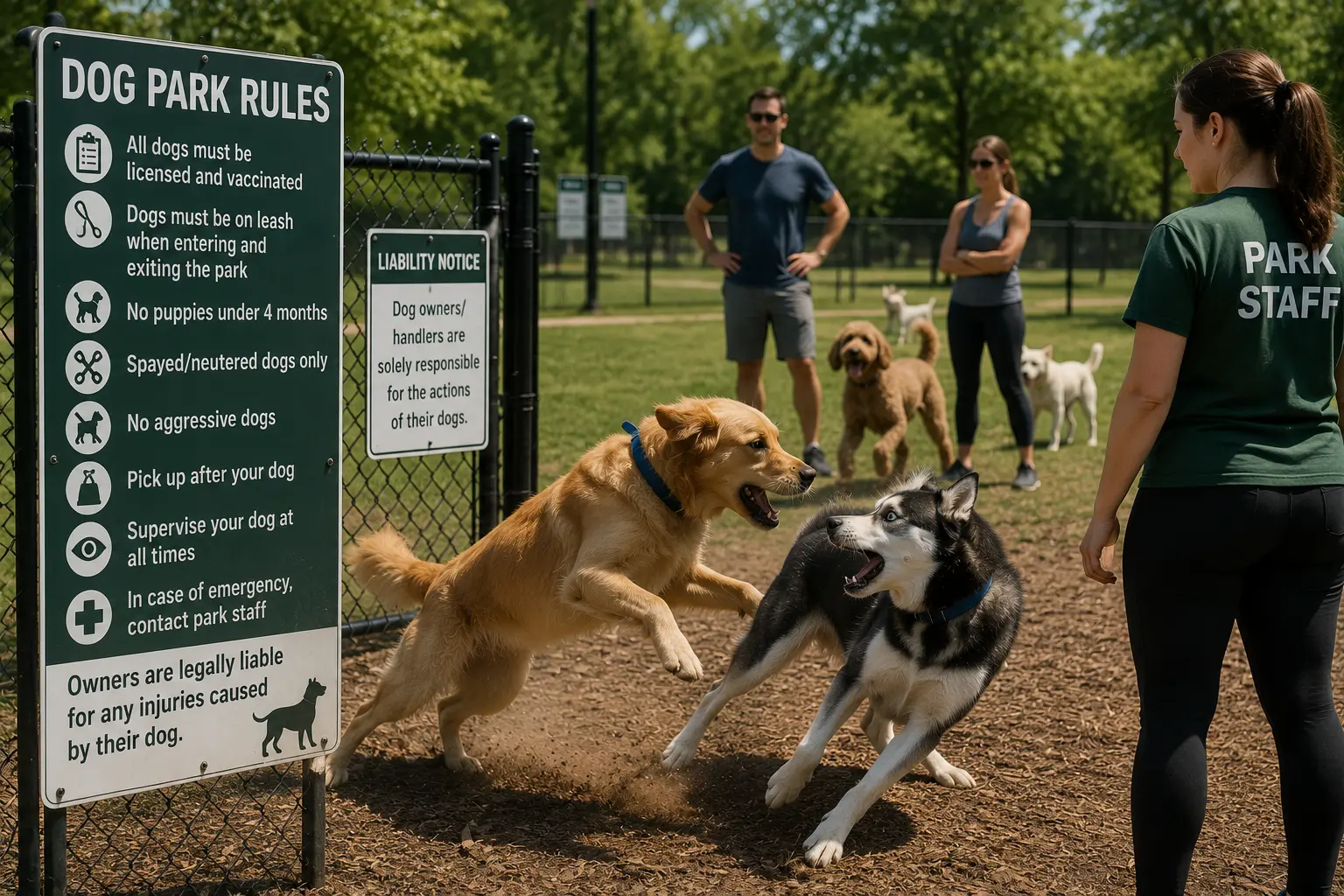
Dog parks are one of the few places where off-leash play is not just tolerated but actively encouraged — which is exactly what makes them uniquely risky from a legal standpoint. Multiple dogs, multiple owners, and minimal physical restraint create a setting where conflicts happen more often than in almost any other public space. When one dog injures another, the legal questions that follow are genuinely different from a typical dog-bites-human case, and many owners are surprised by how liability actually gets sorted out.
This guide covers the practical rules that govern most dog parks, the legal framework for dog-on-dog incidents specifically, and what to actually do if your dog is involved in a bite — whether as the one who bit or the one who got bitten.
Common Dog Park Rules You’ll Actually Encounter
While every dog park sets its own specific rules, a fairly consistent set of standards has emerged across most municipal and private dog parks in the U.S.:
- Vaccination requirements: Most parks require dogs to be current on rabies and other core vaccinations, though this is rarely verified on-site and instead relies on an honor system backed by liability waivers.
- Age and health restrictions: Puppies under a certain age (commonly four to six months) and dogs in heat are typically prohibited.
- Size-segregated areas: Many larger parks separate small and large dog areas to reduce injury risk from significant size mismatches.
- Leash-on entry and exit: Dogs are typically required to be leashed when entering and exiting the park, even though the interior area is off-leash.
- Owner supervision requirements: Owners are generally required to stay within sight of their dog at all times and to intervene if their dog’s behavior becomes aggressive or overly rough.
- Waste cleanup: Nearly universal, and often enforced with fines in municipal parks.
- Limits on food and toys: Many parks restrict bringing food, treats, or toys into shared areas, since these frequently trigger resource-guarding conflicts between dogs.
- Aggressive dog removal: Most parks reserve the right to require an aggressive or repeatedly disruptive dog be removed, sometimes with a temporary or permanent ban.
Why Every Dog Park Has a Sign About “Assumption of Risk”
Nearly every dog park posts some version of a “use at your own risk” sign, invoking a legal concept called assumption of risk. The idea is that by voluntarily entering an off-leash area, visitors accept certain foreseeable hazards that come with that environment — dogs bumping into people, minor scuffles during normal rough play, or muddy paws on clothing.
However, this doctrine has real limits, and understanding them matters enormously if an incident occurs:
- Assumption of risk covers inherent risks, not risks created by irresponsible behavior. If an owner brings a dog they already know to be aggressive, and that dog attacks another dog, the posted sign generally won’t shield that owner from liability.
- You don’t assume the risk that other users will break the park’s rules. Courts have generally held that visitors can assume other people will follow the law and the park’s posted rules — not that they’ll act recklessly or negligently.
- A sign cannot override state dog bite statutes. In strict liability states particularly, a posted waiver doesn’t eliminate a dog owner’s statutory responsibility, since park signage is not the same as a legally binding, individually signed waiver. DogBiteLaw.com’s overview of assumption of risk in dog park cases explains why courts generally won’t let this doctrine shield unreasonable or unlawful conduct.
Some dog parks go further and require users to sign an actual waiver or explicitly acknowledge posted rules before entry, which can carry more legal weight than a simple posted sign, though enforceability still varies by state and by the specific circumstances of an incident.
How Liability Actually Works for Dog-on-Dog Incidents
When one dog injures another at a dog park, the legal analysis differs somewhat from a typical dog-bites-human claim, largely because of how the law treats pets.
The Core Question: Negligence
Unlike bites against people — where many states apply strict liability regardless of an owner’s fault — dog-on-dog incidents are generally analyzed under a negligence standard. The central question becomes: did the attacking dog’s owner fail to use reasonable care in controlling their animal? Relevant factors typically include whether the owner had prior knowledge of the dog’s aggressive tendencies, whether the owner was actively supervising, and whether the owner took reasonable action once a conflict began.
Pets Are Generally Treated as Property in These Claims
Because most jurisdictions still classify pets as personal property in a legal sense, an injured dog’s owner typically recovers under a property damage framework rather than a personal injury framework used for human victims. In practice, this usually means compensation is limited to veterinary bills and the animal’s fair market value, rather than the broader categories — like pain and suffering — available in human injury claims. Some jurisdictions have begun allowing limited additional damages in specific circumstances, but this remains far from universal, and expectations should be set accordingly.
Common Defenses Owners Raise
Owners of the attacking dog have several potential defenses available, including:
- Lack of knowledge of aggressive tendencies: If the owner had no reason to suspect their dog posed a danger, this can weaken a negligence claim.
- Provocation: If the injured dog (or its owner) provoked the incident, this can reduce or eliminate liability.
- Contributory or comparative negligence: If the injured dog’s owner acted unreasonably — for example, ignoring posted rules or bringing a dog with known aggression issues into a general population area — liability may be reduced or shared.
- Assumption of risk: As discussed above, this defense has real limits and generally doesn’t protect an owner who behaved unreasonably or violated park rules.
What Happens If a Person Gets Bitten While Breaking Up a Dog Fight
This is one of the most common real-world dog park incidents, and it raises its own distinct legal question. If a bystander is bitten while intervening in a fight between two dogs, liability generally still falls on the owner of the dog that caused the bite, following standard dog bite liability rules for injuries to people — meaning strict liability may apply in states that use that framework, even though the underlying incident began as a dog-on-dog conflict. California’s strict liability rule, for example, is codified in California Civil Code Section 3342, which holds an owner responsible for a bite regardless of the dog’s prior history.
That said, some courts have applied assumption of risk more readily in these specific situations, reasoning that a person who deliberately steps into an active dog fight has knowingly accepted the danger involved, particularly if safer intervention methods were available and not used.
Who Else Might Bear Responsibility
Depending on the circumstances, liability isn’t always limited to the dog’s owner alone:
- Municipalities: If a dog park is owned and operated by a city or county, the municipality can sometimes bear some liability, particularly if the park’s design, signage, or maintenance contributed to the incident. Government entities often benefit from various forms of immunity, however, which can significantly limit or bar certain claims.
- Private dog park operators: Privately owned dog parks may face premises liability claims if unsafe conditions — inadequate fencing, poor sight lines, or unenforced entry policies — contributed to an incident.
- Multiple dog owners: In situations involving more than one aggressive dog or a chain-reaction conflict, liability can be shared or apportioned among multiple owners.
What to Do If Your Dog Is Involved in an Incident
Whether your dog was the one bitten or the one that caused an injury, how you handle the immediate aftermath matters both practically and legally.
- Separate the dogs safely without directly reaching into an active conflict, using noise, water, or a barrier rather than your hands whenever possible.
- Exchange contact and insurance information with the other owner, similar to how you’d handle a minor vehicle accident.
- Document the scene, including photos of injuries, witness contact information, and notes on what led up to the incident.
- Seek veterinary care promptly and keep all records and bills, since these form the basis of any property damage claim.
- Report the incident to the park operator, whether municipal or private, since many parks track incidents and this can matter for any future dispute.
- Contact your homeowners or renters insurance provider if you’re the dog’s owner facing a potential claim, since many policies include liability coverage for dog-related incidents.
- Consult an attorney if the injury is serious or if a dispute over veterinary costs can’t be resolved directly between the owners.
How to Reduce Risk as a Responsible Dog Park User
Beyond understanding liability after the fact, a few practical habits meaningfully reduce the odds of an incident in the first place:
- Actively supervise your dog rather than being absorbed in a phone or conversation.
- Learn to recognize early signs of tension between dogs — stiff posture, prolonged direct eye contact, raised hackles — and intervene before play escalates into conflict.
- Be honest with yourself about your own dog’s temperament, and avoid off-leash group settings if your dog has shown resource-guarding, fear-based aggression, or poor social skills with unfamiliar dogs.
- Avoid bringing high-value treats, toys, or food into shared off-leash areas.
- Respect posted rules around size segregation, age limits, and entry procedures, since violating these can affect your legal position if an incident occurs.
Final Thoughts
Dog parks operate under a legal framework that’s genuinely different from a typical dog bite case — dog-on-dog incidents are generally analyzed as negligence claims rather than strict liability, and injured pets are usually treated as property rather than injury victims in the eyes of the law, which caps the type of compensation available. Posted “assumption of risk” signs offer some protection to responsible owners, but they don’t shield anyone whose negligence or rule-violating behavior caused the incident. Understanding these distinctions — and following basic dog park etiquette — is the best protection any owner has, both for their dog’s safety and their own legal standing.
This article is intended for general informational purposes and does not constitute legal advice. Dog park liability laws vary significantly by state and municipality, so consult a licensed attorney in your jurisdiction for guidance specific to your situation.
