

Updated: August 2026
Homemade dog food can sound like an affordable and healthy alternative to commercial pet food.
You can choose the ingredients yourself, control the portions, and potentially use foods that your dog already enjoys. For some owners, homemade meals can also be useful as an occasional topper or treat.
But there is an important distinction between a homemade meal and a complete and balanced homemade diet.
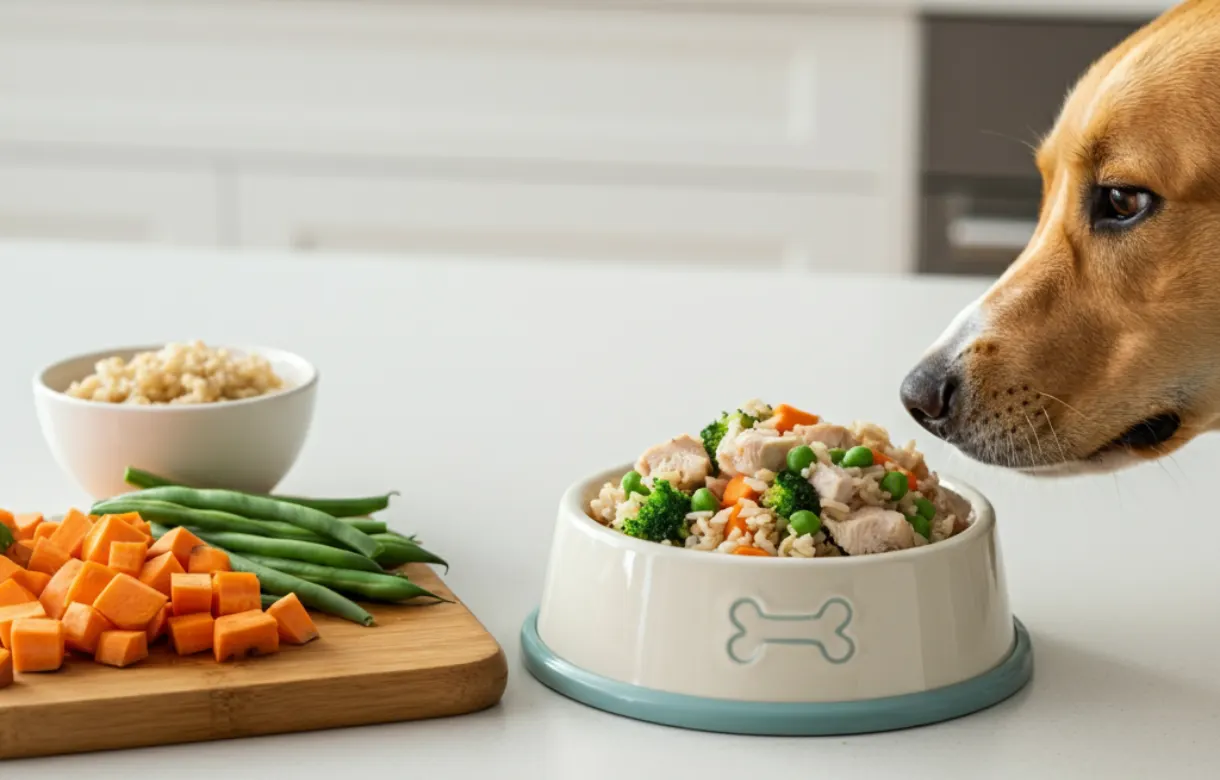
A bowl containing chicken, rice, and vegetables may look nutritious, but that does not automatically mean it provides every nutrient a dog needs over the long term.
The Association of American Feed Control Officials (AAFCO) explains that creating a complete and balanced homemade diet is complex because dogs have many nutritional requirements, including specific nutrient minimums and ratios that vary with life stage.
This guide therefore focuses on safe preparation, practical recipes for supplemental use, cost planning, and what you need to know before feeding homemade food regularly.
Important: The recipes in this article are intended as general food ideas or occasional additions to a dog’s normal diet. They are not presented as complete and balanced long-term diets. If you want to feed homemade food as your dog’s primary diet, work with your veterinarian or a board-certified veterinary nutrition professional to formulate a nutritionally complete recipe for your individual dog.
Can Dogs Eat Homemade Food?
Yes, dogs can eat many properly prepared foods that are safe for them.
Examples include certain:
- Cooked meats
- Cooked eggs
- Plain rice
- Certain vegetables
- Certain fruits
- Some plain carbohydrates
However, safe ingredients do not automatically create a nutritionally complete meal.
For example:
Chicken + rice + vegetables
may provide protein, carbohydrates, fiber, and some vitamins and minerals.
But it may still be deficient or unbalanced in nutrients such as:
- Calcium
- Certain essential fatty acids
- Vitamins
- Trace minerals
- Other essential nutrients
AAFCO specifically warns that making a complete and balanced homemade dog food is a complex task because nutrient requirements depend on the dog’s life stage and the correct ratios of nutrients to calories.
Homemade Dog Food vs. Commercial Dog Food
The biggest difference is nutritional formulation.
A commercial dog food labeled as complete and balanced is designed to meet established nutritional standards for the intended species and life stage.
AAFCO explains that the nutritional adequacy statement on a pet-food label is one of the key things owners should check when selecting a food.
With homemade food, you become responsible for the nutritional formulation.
That is why homemade food can be perfectly reasonable as an occasional addition while being much more complicated as a dog’s sole diet.
3 Simple Homemade Dog Food Recipes
The following recipes are designed as occasional food ideas or meal toppers, not complete long-term diets.
If your dog has a medical condition, food allergy, obesity, kidney disease, diabetes, pancreatitis, or another condition requiring a therapeutic diet, do not use these recipes without veterinary guidance.
Recipe 1: Chicken, Rice & Pumpkin Bowl
This is a simple combination using ingredients that many dogs tolerate well.
Ingredients
- 1 cup cooked, unseasoned chicken breast
- 1 cup cooked white rice
- ¼ cup plain pumpkin puree
- Small amount of cooked carrots
Important
Use plain pumpkin, not pumpkin pie filling.
Pumpkin pie filling can contain added sugar, spices, or other ingredients that are not appropriate for dogs.
Preparation
Step 1
Cook the chicken thoroughly.
Do not add:
- Salt
- Garlic
- Onion
- Butter
- Spices
- Sauce
Step 2
Cook the rice until soft.
Step 3
Cook the carrots until they are soft enough to reduce choking risk.
Step 4
Allow all ingredients to cool.
Step 5
Mix the ingredients together.
Step 6
Serve a small portion as an occasional topper or treat.
Recipe 2: Turkey, Sweet Potato & Green Bean Bowl
This recipe provides a different combination of protein and vegetables.
Ingredients
- Plain cooked lean turkey
- Cooked sweet potato
- Cooked green beans
Preparation
- Cook the turkey thoroughly.
- Remove bones and excess fat.
- Cook the sweet potato until soft.
- Cut the green beans into small pieces.
- Allow everything to cool.
- Combine a small amount of each ingredient.
- Serve as an occasional addition to your dog’s normal diet.
Do not add
- Onion
- Garlic
- Gravy
- Salt
- Butter
- Spicy seasoning
- Sauce
Recipe 3: Beef, Rice & Carrot Topper
This is another simple combination that can be used as a small topper.
Ingredients
- Plain cooked lean ground beef
- Cooked white rice
- Cooked carrots
Preparation
Step 1
Cook the beef thoroughly.
Step 2
Drain excess fat.
Step 3
Cook the rice.
Step 4
Steam or boil the carrots until soft.
Step 5
Cool the ingredients.
Step 6
Combine a small amount and use it as a topper.
Do not season the food.
Important: These Recipes Are Not Complete Dog Diets
This is the most important section of this article.
A homemade recipe can contain healthy ingredients and still be nutritionally incomplete.
For example:
Chicken provides protein.
Rice provides carbohydrates.
Vegetables provide fiber and some micronutrients.
But dogs need much more than these three categories.
AAFCO states that dog-food nutrient profiles contain numerous nutritional parameters and that different life stages require different nutrient amounts and ratios.
Therefore, do not feed one of the recipes above as your dog’s only food day after day unless it has been properly formulated to meet the dog’s nutritional requirements.
Why Chicken and Rice Alone Is Not Enough
“Chicken and rice” is commonly recommended online as a simple homemade meal.
That does not mean it is a nutritionally complete long-term diet.
Chicken and rice can provide calories and some nutrients, but the combination does not automatically supply every nutrient a dog needs in appropriate amounts.
This distinction is particularly important for:
- Puppies
- Pregnant dogs
- Nursing dogs
- Senior dogs with medical conditions
- Dogs with chronic disease
- Dogs requiring therapeutic diets
AAFCO notes that nutrient requirements vary according to life stage, and a growing puppy does not have the same nutritional requirements as a mature adult dog.
What Nutrients Does a Complete Dog Diet Need?
A complete diet needs more than protein and calories.
Depending on the dog’s life stage and circumstances, the diet needs appropriate amounts and ratios of nutrients including:
- Protein
- Fat
- Essential fatty acids
- Amino acids
- Calcium
- Phosphorus
- Vitamins
- Trace minerals
- Other essential nutrients
The challenge is that simply adding a multivitamin does not automatically solve the problem.
The amount and balance of nutrients matter.
AAFCO explains that its dog nutrient profiles establish minimum and, in some cases, maximum nutrient levels for particular life stages.
Why Calcium Is Especially Important
One common problem with homemade dog food is inadequate calcium.
Meat contains phosphorus but generally does not provide enough calcium to balance a long-term diet by itself.
If the calcium-to-phosphorus relationship is inappropriate, long-term feeding can create nutritional problems.
AAFCO specifically explains that ingredients contain different amounts of nutrients and that complete formulations must account for these differences to meet nutritional requirements.
This is one reason why homemade dog food should not be formulated by simply guessing ingredient percentages.
Can You Add a Dog Multivitamin?
A supplement does not automatically turn a homemade recipe into a complete diet.
AAFCO notes that healthy dogs eating a complete and balanced diet generally do not need additional nutritional supplements, and excessive supplementation can create problems because some nutrients have upper safe limits.
For a homemade diet, the appropriate supplement depends on:
- Ingredients
- Amounts
- Dog’s age
- Body weight
- Life stage
- Health status
- Total calorie intake
Therefore, do not randomly add human multivitamins or calcium tablets.
If a homemade diet is intended to be your dog’s primary food, ask a veterinary professional to formulate or review it.
Homemade Dog Food for Puppies
Puppies require particular nutritional attention because they are growing rapidly.
A diet that is adequate for an adult dog may not provide the appropriate nutrient concentrations for a growing puppy.
AAFCO recognizes growth as a separate life stage and explains that puppies require different nutrient quantities and ratios from mature dogs.
Practical recommendation
For puppies:
Do not use a homemade recipe as the primary diet unless it has been professionally formulated for growth.
A complete and balanced puppy food is usually a simpler way to meet known nutritional requirements.
Homemade Dog Food for Senior Dogs
Senior dogs can have very different nutritional needs depending on their health.
For example, a senior dog may also have:
- Kidney disease
- Diabetes
- Arthritis
- Dental problems
- Obesity
- Heart disease
- Gastrointestinal disease
There is no single “senior homemade recipe” that is appropriate for all older dogs.
If your senior dog has a medical condition, ask your veterinarian whether diet changes are appropriate.
Homemade Food for Dogs With Medical Conditions
This is where generic online recipes become particularly risky.
Dogs with certain conditions may require diets with specific nutritional characteristics.
Examples can include:
- Kidney disease
- Urinary disease
- Diabetes
- Pancreatitis
- Food allergies
- Gastrointestinal disorders
- Heart disease
- Obesity
A diet that is healthy for one dog may be inappropriate for another.
AAFCO advises owners to seek veterinary care and advice for sick pets rather than trying to manage illness through homemade feeding alone.
Safe Ingredients Commonly Used in Homemade Dog Food
Some foods commonly used in properly prepared dog meals include:
Protein Sources
- Plain cooked chicken
- Plain cooked turkey
- Lean cooked beef
- Cooked eggs
- Certain cooked fish
Carbohydrate Sources
- Plain cooked rice
- Oatmeal
- Cooked sweet potato
- Plain cooked potato
Vegetables
- Carrots
- Green beans
- Pumpkin
- Certain cooked leafy vegetables
But “safe ingredient” does not mean “complete diet ingredient.”
The overall formulation still matters.
Foods You Should Never Add to Homemade Dog Food
Some common human foods can be dangerous for dogs.
Avoid ingredients such as:
Onion
Can damage red blood cells and cause illness.
Garlic
Also belongs to the Allium family and should not be intentionally included in dog food.
Chocolate
Contains compounds that can be toxic to dogs.
Grapes and raisins
Can cause serious illness, including kidney injury, in dogs.
Xylitol
This sweetener can cause dangerous low blood sugar and other serious effects.
Alcohol
Unsafe for dogs.
Macadamia nuts
Can cause toxicity in dogs.
Excessively fatty foods
Can cause gastrointestinal problems and may contribute to pancreatitis in susceptible dogs.
Always check every ingredient before using it in a homemade recipe.
Don’t Season Homemade Dog Food Like Human Food
Dogs do not need your normal dinner seasoning.
Avoid adding:
- Salt
- Garlic
- Onion powder
- Spice mixes
- Hot sauce
- Gravy
- Butter
- Heavy sauces
A simple homemade dog meal should be plain.
This also makes it easier to identify ingredients if your dog develops a digestive reaction.
Raw Meat vs. Cooked Meat
Some homemade-diet advocates recommend feeding raw meat.
However, raw food requires additional safety considerations.
AAFCO warns that raw pet food can carry bacteria such as Salmonella and that cross-contamination can pose risks to people in the household. Dogs and cats can also become ill from contaminated raw foods.
For a simple homemade-food approach:
Cook animal proteins thoroughly and practice safe food handling.
If you are considering a raw diet, discuss the risks and benefits with your veterinarian.
Homemade Dog Food Food-Safety Checklist
Treat homemade dog food like human food when it comes to kitchen hygiene.
Before cooking
- Wash your hands.
- Clean preparation surfaces.
- Wash utensils.
- Keep raw meat separate from other foods.
During cooking
- Cook animal proteins thoroughly.
- Avoid cross-contamination.
- Do not add unsafe seasonings.
After cooking
- Cool food promptly.
- Store leftovers in the refrigerator.
- Use clean containers.
- Wash the dog’s bowl regularly.
AAFCO recommends safe handling practices for pet food, including hand washing, cleaning bowls and utensils, and appropriate storage.
How Long Can Homemade Dog Food Stay in the Refrigerator?
Homemade food is perishable.
Instead of leaving cooked meat or mixed meals sitting at room temperature, refrigerate leftovers promptly and follow safe food-storage practices.
For longer storage, freezing individual portions can make meal preparation easier.
Practical system
Prepare a batch.
Divide it into daily portions.
Refrigerate the amount you will use soon.
Freeze the rest.
Thaw portions safely in the refrigerator.
If food smells spoiled, develops mold, or has been stored improperly:
Throw it away.
How Much Homemade Food Should You Feed?
This is another area where generic online formulas can be misleading.
There is no universal rule such as:
“Feed 2% of body weight.”
Calorie requirements vary between individual dogs.
They depend on:
- Body weight
- Age
- Activity
- Neutering status
- Body condition
- Health
- Life stage
- Calorie density of the food
AAFCO notes that feeding directions for complete pet foods are guidelines and may need adjustment based on the individual animal’s activity and condition.
If you’re using homemade food only as a topper, keep the amount small enough that it does not displace a substantial portion of your dog’s complete diet.
How to Introduce Homemade Food
Don’t suddenly replace your dog’s normal food with a large homemade meal.
A sudden dietary change can cause digestive upset.
Instead:
Day 1–2
Add a very small amount.
Day 3–4
If your dog is tolerating it, gradually increase the amount.
Day 5–7
Continue only if your dog remains comfortable and stools remain normal.
This is a practical example, not a veterinary requirement.
If your dog develops:
- Repeated vomiting
- Significant diarrhea
- Refusal to eat
- Weakness
- Abdominal pain
stop experimenting and contact your veterinarian.
Homemade Food as a Topper
For many owners, using homemade food as a small topper is simpler than trying to create an entire homemade diet.
For example:
Complete and balanced dog food
Small amount of plain cooked chicken
or
Complete and balanced dog food
Small amount of cooked pumpkin
This lets you provide variety without making the homemade portion responsible for supplying the dog’s entire nutritional requirement.
Remember that treats and supplemental foods should not displace too much of a complete diet.
AAFCO explains that treats and supplements are generally not intended to provide complete and balanced nutrition.
Homemade Dog Food for Weight Management
Homemade food is not automatically lower calorie.
For example:
- Fatty meat
- Peanut butter
- Cheese
- Large portions of rice
- Oils
can add significant calories.
If your dog is overweight, don’t simply replace commercial food with homemade food without considering total calorie intake.
Your veterinarian can help determine an appropriate weight-management plan.
Homemade Dog Food and Pet Costs
Homemade food can sometimes appear cheaper than commercial food.
But you should calculate the actual cost per day.
Include:
- Meat
- Vegetables
- Carbohydrates
- Supplements if professionally prescribed
- Storage containers
- Freezer costs
- Food waste
- Preparation time
Example
Suppose a batch costs:
$24
and provides:
12 daily portions
Then:
$24 ÷ 12 = $2 per day
Monthly estimate:
$2 × 30 = $60
Annual estimate:
$60 × 12 = $720
This is only an example.
Compare the result with the cost of your dog’s current complete food.
Homemade vs. Commercial Dog Food: Cost Comparison
| Factor | Homemade | Commercial |
|---|---|---|
| Ingredient control | High | Depends on product |
| Preparation time | High | Low |
| Nutritional formulation | Owner responsibility | Manufacturer responsibility |
| Storage | Requires planning | Usually easier |
| Cost predictability | Can vary | Usually easier |
| Complete & balanced claim | Requires formulation | Check label |
| Medical diet | Requires professional formulation | Therapeutic products available |
| Convenience | Lower | Higher |
The cheapest option is not necessarily the safest or nutritionally best option.
When Homemade Food May Not Be the Best Choice
Homemade feeding may be difficult if:
- You cannot measure ingredients consistently.
- You don’t have time to prepare meals.
- Your dog has multiple medical conditions.
- Your dog requires a therapeutic diet.
- You cannot maintain the necessary supplements.
- Your dog needs a carefully controlled calorie intake.
In these situations, a properly selected commercial diet may be easier and more reliable.
If You Want Homemade Food as Your Dog’s Main Diet
This is where professional formulation becomes important.
A suitable process is:
Step 1
Discuss your goal with your veterinarian.
Step 2
Provide your dog’s:
- Age
- Weight
- Breed/type
- Activity level
- Health conditions
- Current food
- Treats
- Medications
Step 3
Ask whether a homemade diet is appropriate.
Step 4
If appropriate, request a properly formulated recipe.
Step 5
Follow the recipe precisely.
Step 6
Do not randomly substitute ingredients.
Step 7
Have the recipe reviewed if your dog’s health or nutritional needs change.
AAFCO emphasizes that homemade diet formulation is complex because nutrient requirements and ratios vary by species and life stage.
Why Ingredient Substitutions Can Matter
Suppose a professionally formulated recipe specifies:
Chicken breast
You decide to replace it with:
Ground beef
That may change:
- Calories
- Fat
- Protein
- Minerals
- Other nutrients
Similarly, replacing one carbohydrate or vegetable with another can change the nutrient profile.
This is why a recipe designed to be nutritionally complete should not be modified casually.
Homemade Dog Food Myths
Myth 1: “If every ingredient is healthy, the meal is balanced.”
Not necessarily.
Healthy ingredients can still create an incomplete diet when combined incorrectly.
Myth 2: “Dogs only need meat.”
Incorrect.
Dogs require a range of nutrients, not simply protein.
Myth 3: “Adding a multivitamin makes any recipe complete.”
Not necessarily.
The type and amount of nutrients must be appropriate.
AAFCO warns that excessive supplementation can itself create nutritional risks.
Myth 4: “Homemade is always healthier.”
Not automatically.
A carefully formulated homemade diet can be appropriate, but an unbalanced homemade diet can create nutritional deficiencies.
Myth 5: “Chicken and rice is a complete everyday diet.”
No.
It can be a simple short-term food combination in some veterinary situations, but it should not automatically be treated as a complete long-term diet.
Myth 6: “Natural ingredients are automatically safe.”
No.
Some natural foods are toxic to dogs.
AAFCO specifically warns that certain common human foods can be toxic to pets.
Simple Homemade Dog Food Preparation Checklist
Before serving:
- Meat is fully cooked.
- Bones have been removed.
- No onion or garlic has been added.
- No chocolate is included.
- No xylitol-containing ingredient is included.
- No grapes or raisins are included.
- Food is appropriately portioned.
- Food has been stored safely.
- The meal is being used appropriately as a topper/treat unless professionally formulated as a complete diet.
What If Your Dog Has Diarrhea After Homemade Food?
Don’t automatically assume that the recipe is healthy because the ingredients are natural.
A new food can cause digestive upset, but diarrhea can also have many other causes.
If diarrhea is:
- Severe
- Persistent
- Bloody
- Accompanied by vomiting
- Accompanied by weakness
- Associated with loss of appetite
contact your veterinarian.
The same applies if symptoms repeatedly return whenever you feed a particular recipe.
What If My Dog Refuses Homemade Food?
Don’t force the issue.
Dogs have individual preferences.
If your dog normally eats a complete diet and suddenly refuses food, particularly if other symptoms are present, investigate the underlying cause rather than assuming the dog simply dislikes the recipe.
If a dog refuses food for a prolonged period or appears unwell, contact your veterinarian.
Homemade Dog Food Budget Worksheet
Use this simple table to calculate your actual cost.
| Ingredient | Quantity | Cost |
|---|---|---|
| Chicken | ___ | $___ |
| Rice | ___ | $___ |
| Vegetables | ___ | $___ |
| Pumpkin | ___ | $___ |
| Other ingredients | ___ | $___ |
| Total batch cost | $___ | |
| Number of portions | ___ | |
| Cost per portion | $___ |
Formula
Cost per portion = Total batch cost ÷ Number of portions
This makes it easier to compare homemade food with commercial dog food.
A Better Way to Save Money on Dog Food
If your goal is primarily to reduce pet expenses, homemade food is not your only option.
Consider:
1. Compare price per calorie
A larger bag is not automatically cheaper.
2. Avoid unnecessary treats
Treats can become a significant recurring expense.
3. Measure portions
Overfeeding increases both food costs and obesity risk.
4. Reduce food waste
Store food properly.
5. Compare complete commercial foods
Look for appropriate nutritional adequacy statements and life-stage suitability.
AAFCO recommends checking the nutritional adequacy statement and feeding directions when selecting pet food.
Frequently Asked Questions
Is homemade dog food healthier than commercial dog food?
Not automatically. A homemade diet can be appropriate when properly formulated, but an unbalanced homemade diet may fail to provide required nutrients.
Can I feed my dog chicken and rice every day?
Chicken and rice alone should not be assumed to provide complete and balanced long-term nutrition. If you want to feed homemade food as the primary diet, have the recipe professionally formulated.
Can puppies eat homemade dog food?
They can eat properly formulated diets, but puppies have specific growth requirements. A generic adult homemade recipe should not be assumed to be appropriate for a growing puppy.
Can I add vitamins to homemade dog food?
Only use supplements when appropriate and in appropriate amounts. Random supplementation can create nutrient excesses.
Is raw homemade dog food safe?
Raw diets have additional food-safety concerns, including bacterial contamination and cross-contamination in the household. AAFCO recommends careful handling of raw pet food.
Can I use human food for my dog?
Some human foods are safe in appropriate amounts, but others can be toxic. Never assume that a food is safe simply because humans eat it.
Can homemade food help a dog with allergies?
A food allergy requires veterinary assessment. Simply changing ingredients does not prove or treat an allergy.
Can homemade dog food be cheaper?
Sometimes, but not always. Calculate the cost of all ingredients, supplements, storage, and preparation before deciding.
How long does homemade dog food last?
Homemade food is perishable. Refrigerate or freeze it promptly and follow safe food-handling practices. When in doubt about spoilage or storage, discard it.
Do I need a supplement for homemade dog food?
If the homemade food is intended as the dog’s complete diet, a professionally formulated recipe may require specific vitamin/mineral supplementation. The correct supplement and dose depend on the complete recipe—not simply the meat or vegetable ingredients.
Our Homemade Dog Food Safety Framework
At PetPolicyFinance.com, we evaluate homemade dog food using five practical questions:
1. Is the food safe?
No toxic ingredients, bones, dangerous seasonings, or unsafe preparation.
2. Is the portion appropriate?
Homemade food should not unintentionally overwhelm the dog’s normal calorie intake.
3. Is the food nutritionally complete?
If it is intended as the primary diet, it needs professional formulation or an appropriate complete-and-balanced formulation.
4. Is it affordable?
Calculate the real cost per day rather than assuming homemade food is cheaper.
5. Is it appropriate for this individual dog?
Age, health, activity, body condition, and medical needs all matter.
This framework is our editorial approach—not an official veterinary scoring system.
Final Takeaway
Homemade dog food can be a useful way to add variety to your dog’s meals, but “homemade” does not automatically mean “complete and balanced.”
The safest approach is to separate two goals:
Occasional homemade food
Plain, properly cooked ingredients can be used as small additions or treats when appropriate.
Long-term homemade diet
A diet intended to replace commercial food should be properly formulated for your dog’s species, life stage, calorie needs, and health status.
The biggest mistake is not using homemade food.
The biggest mistake is assuming that a simple recipe automatically contains everything your dog needs.
If you want to feed homemade food regularly, work with your veterinarian or a qualified veterinary nutrition professional.
For occasional meals or toppers, keep things simple:
Cook ingredients thoroughly.
Avoid toxic foods and seasonings.
Remove bones and dangerous pits.
Control portions.
Store food safely.
Monitor your dog’s response.
And remember:
Your dog’s main diet should provide complete and balanced nutrition appropriate for its life stage.
Sources & Editorial Methodology
This article was developed using veterinary and pet-food nutrition guidance, with particular attention to the nutritional limitations of homemade diets.
AAFCO — Association of American Feed Control Officials
AAFCO explains that creating complete and balanced homemade pet food is complex because dogs have numerous nutritional requirements and different life stages require different nutrient amounts and ratios.
AAFCO also provides consumer guidance on nutritional adequacy statements, feeding directions, supplements, treats, and pet-food safety.
Raw Food Safety
AAFCO discusses bacterial contamination and household cross-contamination risks associated with raw pet foods and emphasizes safe handling practices.
Editorial Method
The recipes in this article are intentionally presented as supplemental food ideas rather than complete long-term diets. We do not claim that a fixed ingredient ratio is nutritionally adequate for every dog.
For long-term homemade feeding, professional nutritional formulation is recommended.
Last reviewed: August 2026
Author: Harry Mills
Pet Health & Nutrition Disclaimer
This article is for general educational purposes only. It does not provide veterinary, medical, nutritional, or financial advice.
Every dog is different. Age, weight, activity, breed, medical conditions, medications, allergies, and other factors can change nutritional requirements.
The recipes in this article are not intended to diagnose, treat, cure, or prevent any disease and should not be used as the sole diet for a dog without appropriate nutritional formulation.
If your dog is sick, has a diagnosed medical condition, is pregnant or nursing, is still growing, or requires a therapeutic diet, consult your veterinarian before making significant dietary changes.
