

Updated: August 2026
Bringing home a kitten is exciting, but one of the first practical skills every new cat owner needs to establish is reliable litter-box use.
The good news is that most kittens can learn to use a litter box with the right setup, a consistent routine, and a little patience. Cats naturally prefer to eliminate in suitable, clean locations, but kittens still need an environment that makes the correct choice easy.
Litter-box problems are also not always a simple training issue. A kitten that suddenly stops using the box may be experiencing stress, an environmental problem, or a medical issue.
This guide explains how to set up a kitten’s litter area, introduce the box, establish a routine, handle accidents, choose appropriate litter, troubleshoot common problems, and recognize situations that require veterinary attention.
Important: This article provides general educational information and is not veterinary advice. If your kitten repeatedly avoids the litter box, strains to urinate, produces little or no urine, has blood in the urine or stool, cries while eliminating, or appears sick, contact a veterinarian promptly.
Quick Answer: How Do You Litter-Box Train a Kitten?
A simple process is:
- Choose an appropriately sized litter box.
- Put it somewhere quiet and easy for the kitten to access.
- Use a kitten-appropriate litter.
- Show the kitten where the box is.
- Place the kitten in the box after sleeping, eating, and active play.
- Praise calm, appropriate litter-box use.
- Clean accidents thoroughly.
- Keep the box clean.
- Never punish the kitten for accidents.
- Investigate repeated accidents instead of assuming the kitten is simply being stubborn.
Consistency is usually more useful than forcing the kitten to stay in the box.
Why Do Kittens Usually Learn to Use a Litter Box?
Cats naturally have an instinct to bury their urine and feces.
This means many kittens do not require complicated training.
However, a kitten may still have accidents because:
- It cannot find the box.
- The box is too far away.
- The box is difficult to enter.
- The litter texture is unfamiliar.
- The box is dirty.
- The location is frightening.
- Another pet is blocking access.
- The kitten is stressed.
- The kitten has a medical problem.
The goal of litter-box training is therefore not simply to “teach” the kitten.
It is to create an environment where using the box is the easiest and most comfortable option.
Step 1: Choose the Right Litter Box
The litter box should be large enough for the kitten to enter, turn around, squat, and leave comfortably.
For a very young kitten, the sides should not be so high that getting inside becomes difficult.
A good beginner box should be:
- Easy to enter
- Easy to clean
- Stable
- Large enough for the kitten
- Located in a quiet area
Avoid starting with a box that is unnecessarily complicated.
A simple open litter box is often easier for a kitten to understand.
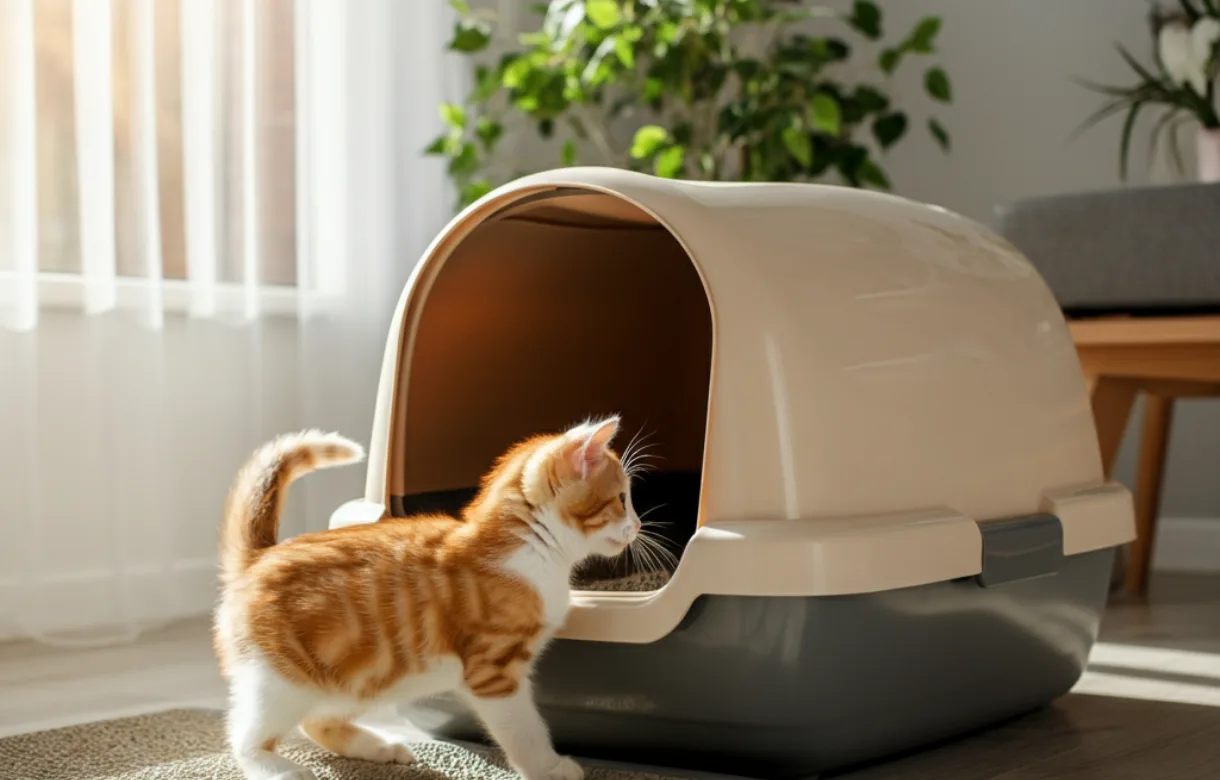
Should You Use a Covered or Open Litter Box?
Both types can work, but some cats prefer open boxes.
A covered box can:
- Reduce visible litter
- Contain some odor
- Provide privacy
But it can also:
- Trap odors
- Feel enclosed
- Make it harder to notice how frequently the kitten uses the box
For a new kitten, an open box is often a straightforward starting point.
If your kitten consistently uses an open box, you can later experiment with another style if necessary.
Step 2: Choose the Right Location
Location is extremely important.
Put the litter box somewhere:
- Quiet
- Easily accessible
- Away from loud appliances
- Away from heavy household traffic
- Separate from food and water
- Safe from other animals
Do not place the box beside a washing machine if sudden noise could frighten the kitten.
Likewise, avoid putting it somewhere the kitten has difficulty reaching.
Why Access Matters
Imagine a kitten needs to eliminate but the litter box is:
behind a closed door
or
upstairs
or
inside a room occupied by another animal.
The kitten may choose another location.
The simplest solution is often to make the correct location easier to reach.
Step 3: Consider Having More Than One Box
For one kitten, having more than one litter box can make training easier, especially in a large home.
A commonly used guideline for multi-cat households is:
Number of cats + 1 = number of litter boxes
For example:
- 1 cat → 2 boxes
- 2 cats → 3 boxes
- 3 cats → 4 boxes
This is a practical guideline rather than an absolute rule.
The best setup depends on the home’s layout and the individual cats.
Why Multiple Boxes Can Help
Multiple boxes can reduce:
- Competition
- Long-distance travel
- Waiting
- Territorial conflict
- Accidents caused by poor access
If your kitten consistently uses one box but ignores another, the problem may be location, box design, or litter preference.
Step 4: Choose the Litter Carefully
Kittens can have individual preferences about litter.
Common litter types include:
- Clay
- Clumping clay
- Paper
- Wood
- Plant-based litter
- Other specialized products
There is no single litter that every kitten prefers.
For a new kitten, avoid making multiple changes at the same time.
If the kitten already uses a particular litter successfully, keeping the same type initially may make the transition easier.
Unscented vs. Scented Litter
Some cats prefer unscented litter.
Strong fragrances may be unpleasant to an animal with a sensitive sense of smell.
If your kitten avoids a strongly scented litter, try an unscented alternative.
The goal is not to make the litter box smell like perfume.
The goal is to make it comfortable and acceptable to the cat.
How Deep Should the Litter Be?
You generally do not need to fill the box extremely deeply.
A moderate layer that allows the kitten to dig and cover waste is usually sufficient.
Follow the litter manufacturer’s directions and observe your kitten’s behavior.
If the kitten digs excessively and throws litter everywhere, excessive depth may be part of the problem.
Step 5: Show the Kitten Where the Box Is
When your kitten first arrives home:
- Take it to the litter-box area.
- Allow it to investigate.
- Let it sniff the litter.
- Give it time to step inside.
- Do not force its paws into the litter.
- Keep the area calm.
The kitten should learn:
“This is the place where I eliminate.”
Step 6: Use Natural Timing to Encourage Litter-Box Use
You do not need to constantly place the kitten in the box.
Instead, use predictable moments.
Good opportunities include:
After waking
Many kittens may need to eliminate after sleeping.
After eating
Meals can be a useful cue for a litter-box opportunity.
After active play
Play can stimulate movement and may be followed by elimination.
Before bedtime
A calm litter-box opportunity can become part of the daily routine.
What Should You Do When the Kitten Uses the Box?
Stay calm.
You can use:
- Gentle praise
- A calm voice
- Positive attention
You do not need to create a dramatic celebration.
The goal is simply to associate litter-box use with a safe, positive experience.
Never Punish a Kitten for an Accident
This is one of the most important rules.
Do not:
- Yell
- Hit
- Rub the kitten’s face in the accident
- Chase the kitten
- Force it into the litter box
Punishment can create fear and may make litter-box problems worse.
Instead:
Clean the accident.
Identify the possible cause.
Make the litter box easier to use.
Monitor the kitten.
What If the Kitten Has an Accident?
Accidents are common during the learning process.
If you find urine or stool outside the box:
Step 1
Do not punish the kitten.
Step 2
Clean the area thoroughly.
Step 3
Use an appropriate enzymatic cleaner where suitable to remove odor.
Step 4
Review the litter-box setup.
Ask:
- Was the box nearby?
- Was it clean?
- Could the kitten enter easily?
- Was another pet blocking access?
- Did the kitten recently experience stress?
- Did you change the litter?
Step 5
Monitor whether accidents continue.
Why Cleaning the Accident Matters
Cats have a strong sense of smell.
If urine odor remains, the kitten may return to the same area.
Ordinary surface cleaning may not completely remove the odor.
An appropriate enzymatic cleaner can help break down biological residues.
Always follow the product label and use cleaning products safely around pets.
Step 7: Keep the Litter Box Clean
Cats are generally clean animals, and many will avoid a dirty box.
Remove waste regularly.
A simple routine can be:
Scoop → dispose safely → check litter level → clean surrounding area
The exact cleaning frequency depends on:
- Number of cats
- Number of boxes
- Type of litter
- Box size
- Individual cat preferences
How Often Should You Scoop?
For a single kitten, checking the box at least daily is a practical starting point.
Some households may need to scoop more frequently.
If your kitten suddenly starts avoiding the box even though it previously used it reliably, inspect the cleanliness.
A dirty box can be enough to cause avoidance in some cats.
How Often Should You Completely Change the Litter?
This depends on the type of litter.
Follow the manufacturer’s instructions and monitor odor, moisture, and cleanliness.
Clumping litter may be maintained by regular removal of waste, while other litter types may require more frequent complete replacement.
The important point is:
Don’t wait until the box becomes heavily soiled before cleaning it.
Step 8: Make the Litter Box Easy to Find
For a young kitten, a large house can create a simple problem:
The kitten may not know where the box is.
If your kitten has access to several rooms, consider placing boxes in convenient locations.
During the early adjustment period, keeping the kitten in a smaller, safe area with easy access to food, water, sleeping space, and a litter box can make learning easier.
How Long Does Kitten Litter-Box Training Take?
There is no exact number of days that applies to every kitten.
Some kittens begin using the box almost immediately.
Others need more time because of:
- Previous living conditions
- Age
- Stress
- New surroundings
- Litter preferences
- Box location
- Health problems
The most useful measure is not:
“Has my kitten learned in three days?”
Instead ask:
“Is the kitten consistently using the box more often and having fewer accidents?”
What If the Kitten Was Already Litter Trained?
If your kitten already uses a litter box reliably, avoid changing everything immediately.
If possible, initially use:
- Similar litter
- Similar box style
- Similar location concept
- Similar routine
Once the kitten is comfortable, you can gradually make changes if necessary.
Bringing Home a Kitten From a Shelter
Shelter kittens may have experienced:
- New people
- New sounds
- Other animals
- Different litter
- Different food
- Different routines
Give the kitten time to adjust.
Ask the shelter or previous caregiver:
What litter did the kitten use?
What food was it eating?
Was it already using a litter box?
Keeping some familiar elements can reduce unnecessary changes during the first few days.
Kitten Litter Training in a Small Apartment
Small homes can actually make litter-box access easier.
You still need to choose a location carefully.
Avoid placing the box:
- Beside the food bowl
- In a high-traffic walkway
- Near loud machinery
- Where the kitten can be trapped
- Somewhere difficult to access
If space is limited, prioritize accessibility and cleanliness.
Kitten Litter Training in a Large House
Large homes can create a different problem.
A kitten may be too far from the litter box when it needs to eliminate.
Consider placing boxes on different floors or in different areas.
As the kitten becomes reliable, you can determine which boxes are actually necessary.
What If My Kitten Keeps Pooping Outside the Box?
Don’t automatically assume it is a training failure.
Check:
1. Box cleanliness
Is it being cleaned regularly?
2. Box size
Can the kitten comfortably turn around?
3. Litter
Does the kitten dislike the texture or fragrance?
4. Location
Is the area noisy or difficult to access?
5. Stress
Has something changed in the household?
6. Medical issues
Constipation, diarrhea, pain, or other health problems can affect elimination behavior.
If the problem persists, consult your veterinarian.
What If My Kitten Pees Outside the Box?
Urination outside the litter box deserves particular attention.
Possible reasons include:
- Dirty litter box
- Litter preference
- Location problem
- Stress
- Difficulty accessing the box
- Urinary discomfort
- Other medical conditions
If a kitten repeatedly urinates outside the box, do not simply keep moving the box around without investigating the cause.
Important: Urinary Problems Can Be an Emergency
A kitten that repeatedly tries to urinate but produces little or no urine may have a serious urinary problem.
Watch for:
- Repeated trips to the litter box
- Straining
- Crying while urinating
- Frequent small amounts of urine
- Blood in urine
- Excessive licking of the genital area
- Little or no urine production
Little or no urine production can be an emergency.
Contact a veterinarian promptly if you see these signs.
Do not wait for “training” to solve a potentially medical problem.
Could Stress Cause Litter-Box Problems?
Yes.
Cats can react to environmental changes.
Potential stressors include:
- Moving house
- New people
- New pets
- Loud construction
- Changes in routine
- Conflict with another cat
- Lack of safe hiding areas
If litter-box problems start after a major change, consider whether stress is contributing.
But don’t assume stress is the only explanation.
Medical causes should still be considered when problems are persistent or unusual.
What If Another Cat Blocks the Kitten?
In multi-cat households, territorial behavior can affect litter-box access.
A kitten may avoid a box if another cat:
- Guards the entrance
- Chases the kitten
- Waits near the box
- Frequently interrupts the kitten
Multiple boxes placed in different locations can reduce competition.
Litter Boxes and Multi-Cat Homes
A common practical guideline is:
One box per cat + one additional box.
For example:
| Cats | Suggested Starting Point |
|---|---|
| 1 | 2 boxes |
| 2 | 3 boxes |
| 3 | 4 boxes |
| 4 | 5 boxes |
This is not a rigid rule.
Some households may need fewer or more depending on:
- Home size
- Cat relationships
- Box locations
- Cleaning routine
- Individual preferences
Should You Put Food Near the Litter Box?
Generally, keep food and water separate from the litter area.
Cats may prefer to eat and eliminate in separate locations.
If the food bowl is directly beside a dirty litter box, the environment may become less appealing.
Create distinct areas for:
Eating
Sleeping
Playing
Eliminating
Should You Use a Litter-Mat?
A litter mat can help reduce the amount of litter tracked around the house.
It is not required for litter training.
If you use one:
- Keep it clean.
- Choose a pet-safe design.
- Check that the kitten can walk comfortably across it.
Think of it as a household-cleanliness tool rather than a training tool.
What About Automatic Litter Boxes?
Automatic litter boxes can reduce some cleaning work, but they are not necessarily the best starting point for every kitten.
A young kitten may need time to become comfortable with unfamiliar equipment.
For beginners, a simple box can make it easier to observe:
- Urination
- Stool
- Frequency
- Litter preferences
- Accidents
Once your kitten reliably uses a standard box, you can consider whether an automatic system fits your household.
How Much Does Kitten Litter Training Cost?
Litter training itself does not need to be expensive.
Typical costs may include:
- Litter box
- Litter
- Scoop
- Waste bags
- Litter mat
- Cleaning supplies
Example starter budget
| Item | Example Cost |
|---|---|
| Basic litter box | $10 |
| Scoop | $5 |
| Initial litter | $15 |
| Litter mat | $10 |
| Cleaning supplies | $10 |
| Example total | $50 |
These are illustrative amounts, not current universal prices.
Prices vary by location, brand, box size, and litter type.
How Much Can Litter Cost Per Month?
Monthly litter cost depends on:
- Type of litter
- Number of cats
- Number of boxes
- Cleaning frequency
- Box size
- Waste habits
For budgeting, track your actual spending for two or three months.
Then calculate:
Average monthly litter cost = Total litter spending ÷ Number of months
For example:
If you spend:
$90 over 3 months
then:
$90 ÷ 3 = $30/month
This gives you a more realistic number for your pet budget.
Ways to Reduce Litter Costs
You do not necessarily need to buy the most expensive litter.
You can save money by:
1. Comparing cost per pound/kg
Package size alone can be misleading.
2. Reducing waste
Scoop regularly rather than throwing away large amounts of clean litter.
3. Choosing an appropriate box size
An unnecessarily small box may require more frequent replacement or create mess.
4. Buying sensible quantities
Bulk purchases can help if you have adequate storage and the product remains suitable.
5. Tracking actual usage
Measure how much litter your household consumes each month.
Don’t Choose Litter Solely by Price
The cheapest litter can become expensive if your kitten refuses to use it.
You may end up buying:
- A second litter type
- Additional cleaning products
- Replacement boxes
- Carpet cleaners
A better approach is to find a litter your kitten consistently accepts while still fitting your budget.
Common Litter-Box Training Mistakes
Mistake 1: Putting the Box Somewhere Inconvenient
Solution: Make access easy.
Mistake 2: Changing Litter Frequently
Solution: Give your kitten consistency.
Mistake 3: Using Strong Fragrances
Solution: Consider unscented litter if your kitten avoids scented products.
Mistake 4: Keeping the Box Dirty
Solution: Scoop regularly.
Mistake 5: Punishing Accidents
Solution: Clean the area and investigate the cause.
Mistake 6: Using Only One Box in a Multi-Cat Home
Solution: Consider multiple boxes.
Mistake 7: Ignoring Medical Signs
Solution: Contact a veterinarian when elimination behavior changes significantly.
Mistake 8: Expecting Instant Perfection
Solution: Give the kitten time and maintain a consistent routine.
A Simple 7-Day Kitten Litter Routine
This is a practical example rather than a strict veterinary schedule.
Day 1
Show the kitten:
- Litter box
- Food
- Water
- Sleeping area
Keep the environment calm.
Day 2
Observe when the kitten naturally uses the box.
Day 3
Continue placing the kitten near the box after:
- Sleeping
- Eating
- Playing
Day 4
Maintain the same litter and location.
Day 5
Clean accidents thoroughly and review possible causes.
Day 6
Continue positive reinforcement.
Day 7
Review progress.
Ask:
Is the kitten using the box consistently?
If yes, continue the routine.
If no, investigate box location, litter preference, cleanliness, stress, and possible medical issues.
A Practical Kitten Litter-Box Checklist
Before bringing the kitten home
- Litter box purchased
- Appropriate litter selected
- Scoop purchased
- Cleaning supplies ready
- Litter location selected
- Food area separated from litter area
First few days
- Show kitten the litter box
- Observe litter-box use
- Keep routine consistent
- Scoop regularly
- Clean accidents immediately
- Avoid punishment
If accidents continue
- Check box cleanliness
- Check box size
- Check litter type
- Check location
- Check accessibility
- Look for household stress
- Consider other pets blocking access
- Contact veterinarian if appropriate
When Should You Call the Veterinarian?
Contact your veterinarian if:
- The kitten repeatedly stops using the litter box.
- The kitten strains to urinate.
- The kitten produces little or no urine.
- There is blood in the urine or stool.
- The kitten cries during elimination.
- The kitten has persistent diarrhea.
- The kitten appears constipated.
- The kitten vomits repeatedly.
- The kitten becomes unusually weak or lethargic.
- The kitten stops eating.
- The kitten shows significant pain.
A litter-box problem can sometimes be the first visible sign that something is wrong medically.
Litter-Box Training vs. Medical Problems
This distinction is important.
Training/environment problem
Possible signs:
- Occasional accidents
- Box is dirty
- Kitten cannot access the box
- New litter was introduced
- Household routine changed
Possible medical problem
Possible signs:
- Straining
- Pain
- Blood
- Frequent unsuccessful attempts
- Sudden major change
- Persistent diarrhea
- Constipation
- Lethargy
You cannot determine the cause from the accident alone.
When medical signs are present, veterinary evaluation is more important than additional training.
What If My Kitten Uses the Box but Still Has Occasional Accidents?
Occasional accidents can happen, especially with very young kittens.
Look for patterns.
For example:
Accidents happen far from the box
→ Add another box.
Accidents happen when the box is dirty
→ Increase cleaning frequency.
Accidents happen after changing litter
→ Consider returning to the previous litter.
Accidents happen after a household change
→ Reduce stress and provide a quiet area.
Accidents happen despite a good setup
→ Discuss the issue with your veterinarian.
Final Takeaway
Kitten litter-box training does not need to be complicated.
The basic formula is:
Easy access + appropriate box + acceptable litter + cleanliness + consistency + patience
Most importantly, don’t treat every accident as bad behavior.
A kitten may avoid the box because:
- It dislikes the litter.
- The box is dirty.
- The location is inconvenient.
- Another cat is interfering.
- The environment is stressful.
- The kitten is still learning.
- Or the kitten may have a medical problem.
Your job is to identify which situation you’re dealing with.
Start with a simple, accessible litter box.
Keep it clean.
Use a consistent litter.
Offer the kitten opportunities to use it after sleeping, eating, and playing.
Praise appropriate behavior.
Clean accidents thoroughly.
Never punish the kitten.
And if your kitten suddenly changes its elimination habits, especially with straining, pain, blood, or little/no urine, contact a veterinarian rather than assuming it is a training issue.
Good litter-box habits are not only about keeping your home clean.
They can also help you notice changes in your kitten’s health early.
Frequently Asked Questions
At what age can kittens use a litter box?
Kittens can begin learning litter-box habits when they are developmentally ready. Very young orphaned kittens may require different elimination care and should not be treated like independently toileting older kittens.
How long does it take to litter-train a kitten?
There is no universal timeline. Some kittens use the box almost immediately, while others need more adjustment.
Should I put my kitten in the litter box after every meal?
You can offer a litter-box opportunity after meals, sleep, and play, but you do not need to force the kitten to remain there.
Should I use scented litter?
Some kittens tolerate it, while others prefer unscented litter. If your kitten avoids scented litter, an unscented option may be worth trying.
How many litter boxes does one kitten need?
One box may be sufficient in some homes, but having two can provide more flexibility, especially in a larger home.
How many litter boxes should I have for multiple cats?
A common starting guideline is the number of cats plus one additional box. Adjust based on your home’s layout and the cats’ behavior.
Should I punish my kitten for using the floor?
No. Punishment can increase fear and does not teach the desired behavior effectively.
Why does my kitten keep going back to the same spot?
Residual odor can encourage repeat elimination. Thorough cleaning, including an appropriate enzymatic cleaner where suitable, can help remove the odor.
Why is my kitten suddenly peeing outside the box?
Possible causes include litter preference, box cleanliness, stress, accessibility problems, or medical issues. Sudden changes should be taken seriously.
What if my kitten is straining but cannot urinate?
Treat this as potentially urgent and contact a veterinarian promptly.
Can I move the litter box?
Yes, but sudden changes can confuse some cats. If you need to relocate it, gradual movement may be easier.
Is a covered litter box better?
Not necessarily. Some cats prefer open boxes, while others tolerate or prefer covered boxes.
Does litter-box training cost a lot?
It does not have to. A basic setup can be relatively inexpensive, although ongoing litter costs vary according to litter type and household size.
Sources & Editorial Methodology
This article was prepared using established animal-care and veterinary guidance rather than commercial litter-product claims.
ASPCA — Cat Care
The ASPCA provides general cat-care information covering litter-box habits, nutrition, veterinary care, grooming, behavior, and home safety. ASPCA Cat Care Resources
ASPCA — General Cat Care
ASPCA provides guidance on caring for cats and kittens, including their environmental and daily-care needs. ASPCA General Cat Care
Veterinary Guidance
Litter-box avoidance can sometimes be associated with medical problems, so persistent or sudden changes should not automatically be treated as a behavioral issue.
Editorial & Pet-Care Disclaimer
This article is intended for general educational purposes only. It does not provide veterinary, medical, behavioral, or financial advice.
Every kitten is different. Age, health, previous environment, household structure, litter preferences, and other factors can influence litter-box behavior.
If your kitten shows signs of pain, urinary difficulty, blood, repeated straining, little or no urine production, persistent diarrhea, constipation, severe lethargy, or other concerning symptoms, seek veterinary care.
PetPolicyFinance.com does not diagnose medical conditions or recommend specific medications or treatments.
Author: Harry Mills
Last Reviewed: August 2026
