

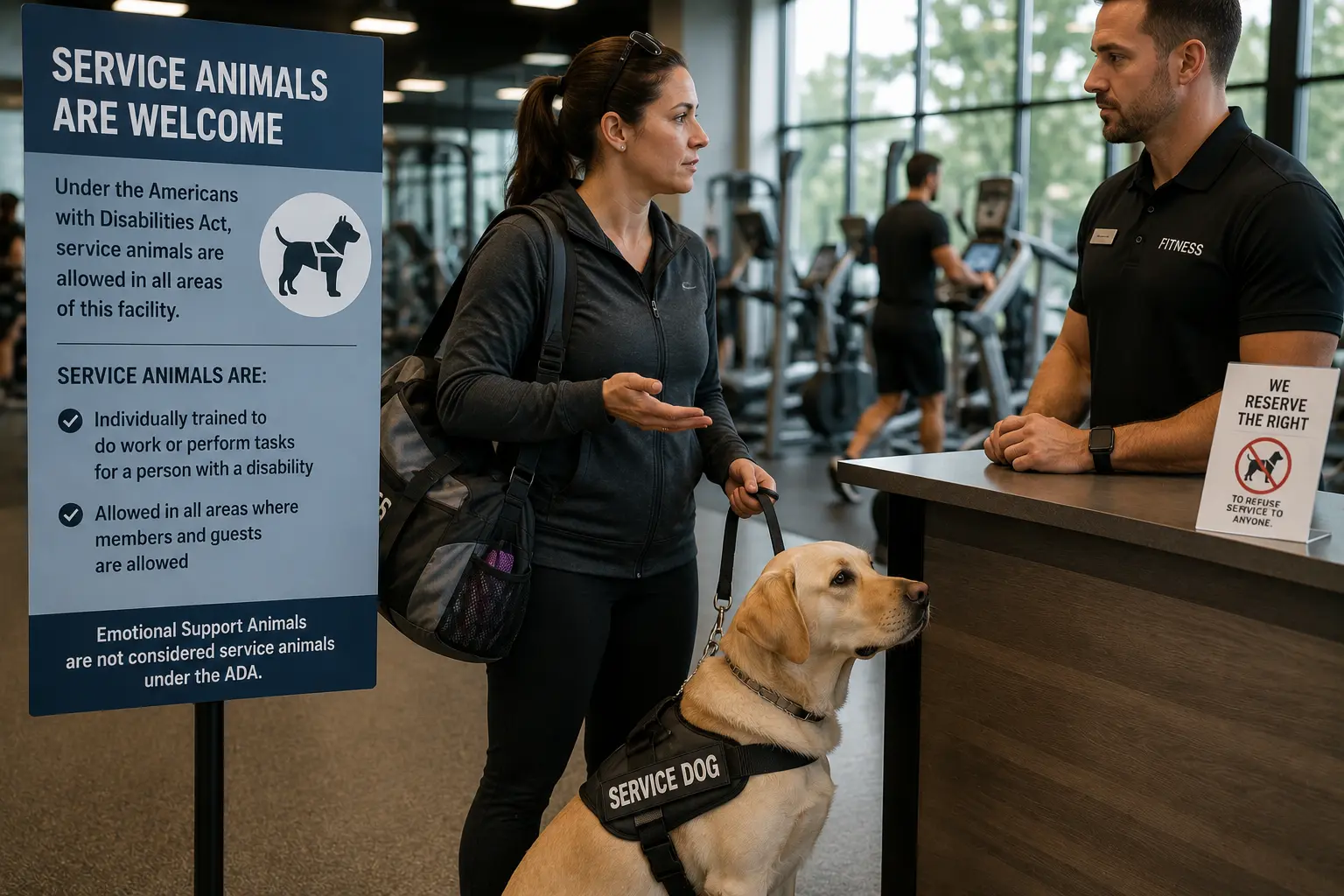
Fitness spaces raise a genuinely unusual question under the Americans with Disabilities Act: what happens when a legitimate access right runs into a legitimate public health rule? A service animal generally has the right to go virtually anywhere its handler goes — but a swimming pool is water, not floor space, and health codes governing pools exist for real sanitary reasons that have nothing to do with disability rights. This creates one of the few areas where the ADA’s usual “yes, always” answer becomes more nuanced.
This guide walks through exactly where the line falls in gyms, pools, locker rooms, and fitness centers, what facilities can and can’t require, and what both members and business owners should know.
The General Rule: Fitness Facilities Are Public Accommodations
Gyms, fitness centers, and health clubs are generally considered places of public accommodation under Title III of the ADA, which means they’re subject to the same core service animal access rules as restaurants, retail stores, and hotels. A service animal — legally defined as a dog (or in limited cases, a miniature horse) individually trained to perform a task for a person with a disability — must generally be allowed to accompany its handler throughout the facility, including workout floors, cardio areas, weight rooms, and group fitness studios.
This means a gym cannot lawfully turn away a member with a legitimate service animal simply because of a blanket “no pets” or “no animals” policy. That policy, whatever it says, doesn’t apply to a qualifying service animal, because the animal is legally treated as an extension of the handler’s disability accommodation rather than as a pet.
The Exception: Swimming Pools
Here’s where fitness facilities differ from almost any other public space. The Department of Justice has directly addressed this exact scenario, stating clearly that the ADA does not override public health rules prohibiting dogs from swimming in pools. This means a service animal is not required to be allowed in the water of a public or club swimming pool, since water sanitation rules are treated as legitimate health regulations that operate independently of disability access law. The official ADA.gov Service Animals page confirms this framework directly, including the requirement that service animals still be permitted in surrounding areas like the pool deck.
However, this exception is narrow and specific. It applies only to the water itself — not to the surrounding area. The service animal must still be allowed on the pool deck and in other areas around the pool where the general public has access. A facility cannot use the water-based health exception as a justification for banning the animal from the pool area entirely, requiring the handler to leave the dog in a car, a lobby, or an unattended space elsewhere in the building.
In practice, this typically means a service animal can accompany its handler to poolside, wait on a leash on the deck while the handler swims or participates in aquatic therapy, and then continue with the handler once they exit the water — the dog just can’t get in the pool itself.
Locker Rooms and Changing Areas
Locker rooms and changing facilities generally fall under the same standard access rules as the rest of the gym, since they don’t carry the same specific water-sanitation health code concerns that swimming pools do. Service animals are generally permitted in locker rooms and changing areas, provided the animal remains under control and doesn’t pose a direct threat to health or safety.
Some municipal facilities formalize this in writing. Public recreation department policies commonly state explicitly that service dogs are granted access to pool natatoriums and locker rooms, provided the dog stays on a leash, doesn’t enter the water, and remains calm enough not to create a hazard for other patrons, lifeguards, or staff.
What Fitness Facilities Can and Can’t Ask
Regardless of the specific area of the facility, gyms are bound by the same limited inquiry rules that apply to any place of public accommodation. Staff may ask only two questions if it’s not obvious what service the animal provides:
- Is the animal required because of a disability?
- What work or task has the animal been trained to perform?
Staff cannot ask about the specifics of a member’s disability, request medical documentation, demand to see a certification or registration card, or require the dog to demonstrate its trained task on the spot. There’s no federal requirement that a service animal wear a vest, ID tag, or any other visible marker — the animal’s behavior and the handler’s answers to the two permitted questions are the only basis a facility has for making a determination.
When a Fitness Facility Can Legally Refuse a Service Animal
Beyond the specific pool-water exception, there are only two general circumstances under which a business can lawfully exclude a service animal, and they apply identically at a gym as anywhere else:
- The animal is out of control, and the handler doesn’t take effective action to correct the behavior.
- The animal is not housebroken.
Neither general discomfort from other members, allergies, nor fear of dogs qualifies as a legal basis for exclusion. Even in these two narrow circumstances, a facility is generally expected to still offer the member the opportunity to participate in the class, program, or facility area without the animal present, rather than denying them access to the gym altogether.
Group Fitness Classes and Specialty Equipment
Group fitness classes — spin, yoga, weightlifting circuits, and similar formats — are generally treated like any other area of the gym, meaning a service animal must be allowed to accompany its handler into the class itself, provided the dog can be safely accommodated within the physical space (for example, positioned where it won’t be struck by equipment or block an exit path).
Facilities with genuinely high-risk equipment areas, such as certain specialized machinery zones, may have narrow safety-based limitations, but these must be based on a specific, individualized safety concern rather than a blanket policy targeting all service animals as a category. The U.S. Access Board’s guidelines for sports facilities provide additional detail on accessibility requirements across different areas of recreation and fitness facilities.
What Fitness Centers Should Do to Stay Compliant
For gym owners and fitness facility operators, a few practical steps go a long way toward ADA compliance and avoiding disputes:
- Train staff on the two-question rule before an incident occurs, rather than relying on front-desk employees to improvise a policy in the moment.
- Write a clear, ADA-compliant service animal policy that specifically addresses the pool exception, so pool staff and gym floor staff apply the rule consistently.
- Avoid requiring documentation, registration, or ID for service animals, since none of these are legally required and requesting them can itself create liability exposure.
- Designate a clear waiting area near the pool deck where a service animal can safely stay while its handler swims, so the pool-water exception doesn’t functionally become a full facility ban.
- Document any exclusion decision carefully, since the only lawful grounds are an out-of-control or non-housebroken animal — a decision an untrained staff member might otherwise justify on the wrong basis.
What Members Should Know Before Bringing a Service Animal to the Gym
If you’re a service animal handler planning to use a gym, health club, or fitness center, it helps to know your rights clearly going in:
- Your service animal can accompany you throughout the facility, including workout floors, group classes, and locker rooms.
- Your service animal cannot enter the pool water itself, but must be permitted on the pool deck and surrounding areas.
- Staff can ask only the two permitted questions — you don’t need to carry certification, registration, or a doctor’s note.
- If a staff member incorrectly denies you access based on a blanket no-pets policy, it’s worth calmly citing the ADA’s public accommodation rules, and if necessary, following up with a formal complaint.
Final Thoughts
Gyms, fitness centers, and health clubs are bound by the same core ADA service animal access rules as any other public accommodation, with one specific and well-documented exception: the water inside a swimming pool, which remains off-limits due to legitimate public health rules that the ADA doesn’t override. Everywhere else in the facility — the gym floor, locker rooms, group classes, and the pool deck itself — a legitimate service animal generally has the same right to be present as its handler does. Understanding this narrow distinction helps both fitness facility operators and service animal handlers avoid unnecessary disputes over a rule that, in practice, is far more limited than many people assume.
This article is intended for general informational purposes and does not constitute legal advice. ADA regulations and their application can vary by specific circumstance, so consult the U.S. Department of Justice’s ADA guidance or a licensed attorney for questions specific to your situation.
