

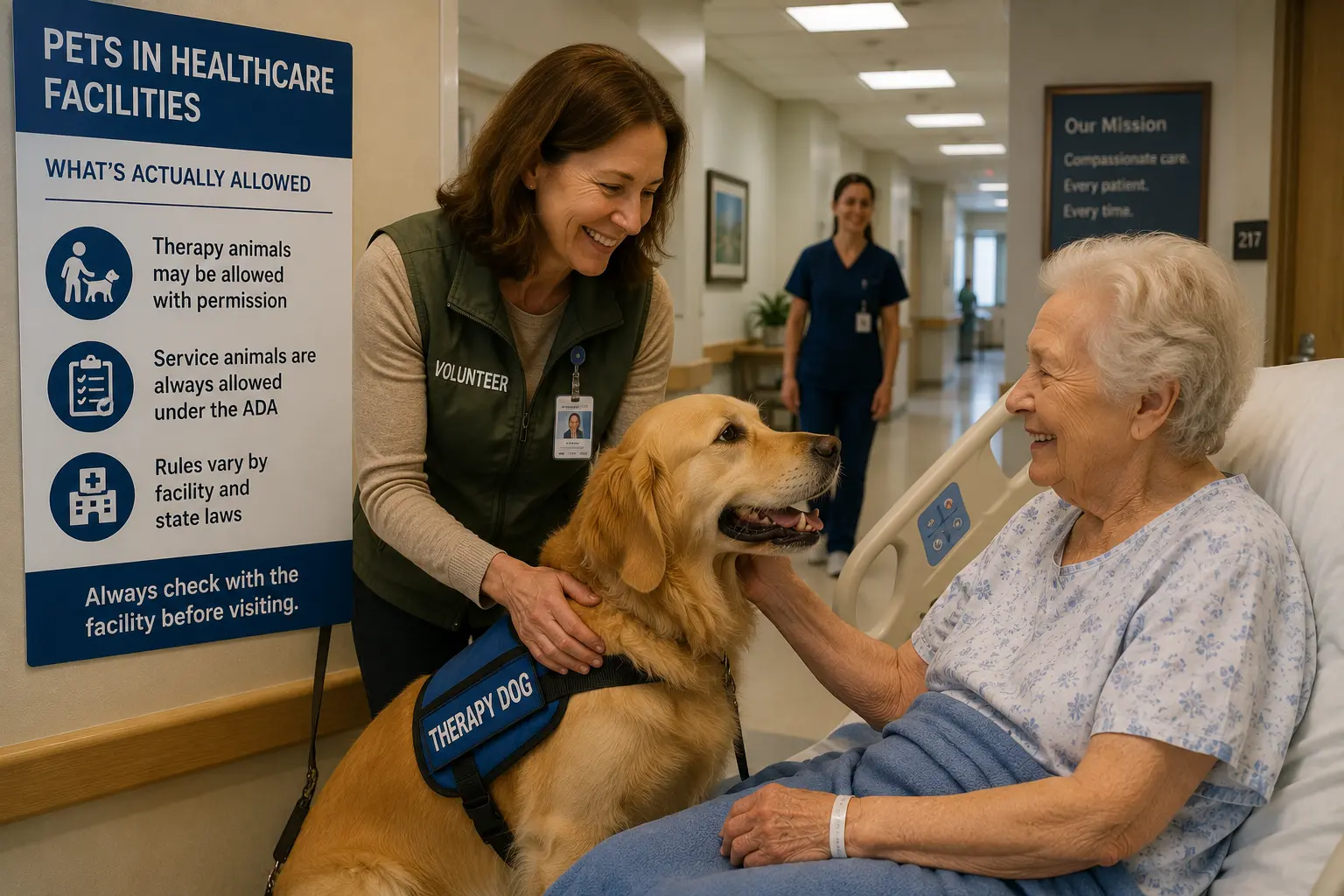
Healthcare settings raise some of the most complex pet and animal access questions in the entire ADA framework — and for good reason. A hospital or nursing home has to balance genuine disability access rights against equally genuine infection control and patient safety standards. On top of that, healthcare facilities juggle three completely different categories of animals — service animals, therapy animals, and resident-owned pets — each governed by different rules and different levels of legal protection.
This guide breaks down exactly what’s allowed for each type of animal, where sterile-area exceptions apply, and how nursing homes and long-term care facilities typically handle resident pet ownership and animal visitation.
Three Different Categories, Three Different Rules
Before diving into specific settings, it’s important to understand that healthcare facilities deal with three legally distinct categories of animals, and conflating them is the most common source of confusion.
Service Animals
Legally defined under the ADA as dogs (or in limited cases, miniature horses) individually trained to perform a task directly related to a person’s disability. Service animals have strong, federally protected public access rights, including in most areas of hospitals and healthcare facilities.
Therapy Animals
Animals — typically dogs, but sometimes cats, rabbits, or other species — that visit healthcare facilities to provide comfort to multiple patients or residents, usually through a structured, facility-approved volunteer program. Therapy animals are not protected under the ADA and have no legal right of access; their presence depends entirely on whether a facility chooses to host a therapy animal program.
Resident-Owned Pets and Emotional Support Animals
In long-term care and nursing home settings specifically, some residents wish to keep a personal pet in their room, or have family bring a pet to visit. This is governed by facility policy and state nursing home regulations rather than federal disability law, since the animal generally isn’t a trained service animal.
Service Animals in Hospitals: The General Rule
Under Title II and III of the ADA, hospitals, clinics, emergency rooms, and doctors’ offices are treated as places of public accommodation, meaning service animals generally must be allowed to accompany their handler into patient rooms, clinics, cafeterias, waiting rooms, and exam spaces — the same broad access rule that applies to restaurants, retail stores, and hotels. A hospital’s “no pets” policy is legally irrelevant here, since a qualifying service animal isn’t considered a pet under federal law.
This applies whether the person with the disability is the patient or simply a visitor. A visitor with a disability can generally bring a service animal into most patient and visitor areas of a healthcare facility, subject to the same control and conduct standards that apply to patients themselves.
The Sterile-Area Exception
Healthcare settings host the ADA’s most well-established access exception: sterile and infection-controlled environments. It may be appropriate to exclude a service animal from limited-access areas that employ general infection control measures — such as operating rooms and burn units — where the animal’s presence could compromise a sterile field.
This exception is intentionally narrow. It applies to specific high-risk clinical environments, not to the hospital generally. Facilities commonly apply the sterile-area exception to areas such as:
- Operating rooms and surgical suites
- Burn units
- Intensive care units
- Isolation rooms and areas requiring personal protective equipment
- Dialysis and infusion clinics
- Sterile processing, decontamination, and sterile storage areas
- MRI and radiology exam rooms during active procedures
Outside of these specific clinical environments, service animals generally cannot be restricted from other areas of the hospital where patients or members of the public are permitted to go. A facility can’t extend the sterile-area exception into a blanket policy covering the entire building — the exclusion has to be tied to an actual, medically grounded risk in a specific space, not a general preference to keep animals out of the hospital.
What Hospitals Can and Cannot Do
The same limited-inquiry rules that apply everywhere else under the ADA apply in healthcare settings as well. Staff may ask only two questions if it’s not obvious what task the animal performs: whether the animal is required because of a disability, and what task it’s trained to perform. Hospitals cannot request medical documentation, demand proof of certification, or ask about the specifics of a patient’s or visitor’s disability.
Fear of dogs and allergies — even from other patients or staff — are explicitly not valid reasons for denying access to a legitimate service animal. Courts have generally upheld this standard, though there are rare, narrow exceptions where a documented direct threat to specific individuals with severe medical conditions has been found to justify exclusion in a particular case, reflecting how fact-specific these determinations can be.
Where Emotional Support and Therapy Animals Stand in Hospitals
This is a critical distinction that trips up both facilities and the public. Emotional support animals do not have the same guaranteed access rights as service animals under the ADA, since they aren’t individually trained to perform a specific disability-related task. A hospital is legally permitted to exclude an ESA from patient-care areas, even if a doctor has recommended the animal as part of a treatment plan.
That said, many hospitals voluntarily choose to allow supervised therapy-animal visits through their own internal volunteer programs, separate from any ADA obligation. These programs typically involve extensively vetted, temperament-tested animals working with trained handlers under strict facility protocols — a very different arrangement from a family member’s personal pet or an individual’s ESA showing up unannounced.
Pets in Nursing Homes and Long-Term Care Facilities
Nursing homes present a different situation entirely, since residents are living there full-time rather than visiting briefly. This creates three overlapping pet-related questions: can a resident keep their own service animal, can a resident keep a personal pet, and can family or volunteers bring animals to visit.
Service Animals for Residents
Under the ADA, nursing homes must generally allow service animals into the facility, and a person moving into a nursing home does not have to give up their service animal as a condition of admission, since it isn’t legally considered a pet.
Resident-Owned Personal Pets
Beyond service animals, whether a resident can keep a personal pet in their room depends entirely on the individual facility’s policy, and practices vary enormously. Some long-term care facilities allow residents to keep personal pets, subject to requirements around vaccination, temperament evaluation, and a designated pet-free zone elsewhere in the building for residents or staff who prefer not to be around animals. Other facilities restrict personal pets significantly or prohibit them outright, particularly in higher-acuity skilled nursing units, due to infection control and liability concerns.
State nursing home regulations often formalize specific requirements for facilities that do allow pets. Common conditions include:
- Current vaccination records for any resident-owned or visiting pet
- Licensing and identification tags where applicable
- A requirement that animals not be in heat at the time of a visit
- Restrictions keeping pets out of nursing stations, medication preparation areas, linen storage, and sterile supply rooms
- A rule that food service staff not be involved in animal waste cleanup
- A designated pet-free area within the facility
Pet Visitation for Non-Resident-Owned Pets
Many nursing homes that don’t allow residents to keep personal pets still permit family members to bring a beloved pet in for a visit during designated hours, which can offer meaningful comfort without requiring the facility to manage full-time pet care responsibilities.
Therapy Animal Programs in Long-Term Care
Therapy animal visitation programs are common in nursing homes and are often specifically valued for residents living with dementia or cognitive decline, since interaction with a calm, well-trained animal can meaningfully improve mood and provide a sense of connection. Some facilities also use robotic companion animals as an alternative for residents unable to have live animal interaction due to health restrictions.
Practical Guidance for Facilities
Healthcare organizations developing pet-related policies should consider:
- Clearly separate service animals, therapy animals, and personal pets in written policy, since each category carries different legal obligations.
- Define sterile-area exceptions narrowly and specifically, tying restrictions to actual infection control standards rather than general animal-avoidance preferences.
- Train front-line staff on the two-question rule, so service animal handlers aren’t improperly questioned or turned away.
- Establish a formal therapy animal program with health screening protocols if choosing to offer this voluntarily, since it isn’t legally required but can provide real patient and resident benefit.
- Document any resident pet policy clearly, including vaccination requirements and restricted areas, to reduce liability and ensure consistent application.
Practical Guidance for Patients, Residents, and Families
If you or a loved one relies on a service animal, or you’re considering a facility that might allow a personal pet:
- Confirm your service animal’s access rights apply broadly, but expect narrow, legitimate restrictions in sterile clinical areas.
- If evaluating a nursing home for a loved one who owns a pet, ask directly about the facility’s specific pet policy, since this varies enormously and isn’t standardized nationally.
- Ask whether the facility offers a therapy animal visitation program as an alternative if personal pet ownership isn’t permitted.
- Have a backup care plan for any personal pet in case of a resident’s hospitalization or declining ability to provide care.
Final Thoughts
Healthcare facilities operate under one of the most nuanced pet-access frameworks in the country, balancing broad ADA service animal protections against real, medically grounded infection control needs in specific sterile environments. Emotional support animals and therapy animals occupy a separate category entirely, with access depending on facility discretion rather than federal mandate. Nursing homes add yet another layer, where resident-owned pets and visitation policies are governed largely by individual facility rules and state long-term care regulations rather than a single uniform standard. Understanding which category applies — service animal, therapy animal, or personal pet — is the key to understanding what’s actually allowed in any given healthcare setting.
This article is intended for general informational purposes and does not constitute legal or medical advice. Regulations vary by state and facility, so consult the specific healthcare provider or a licensed attorney for guidance specific to your situation.
