

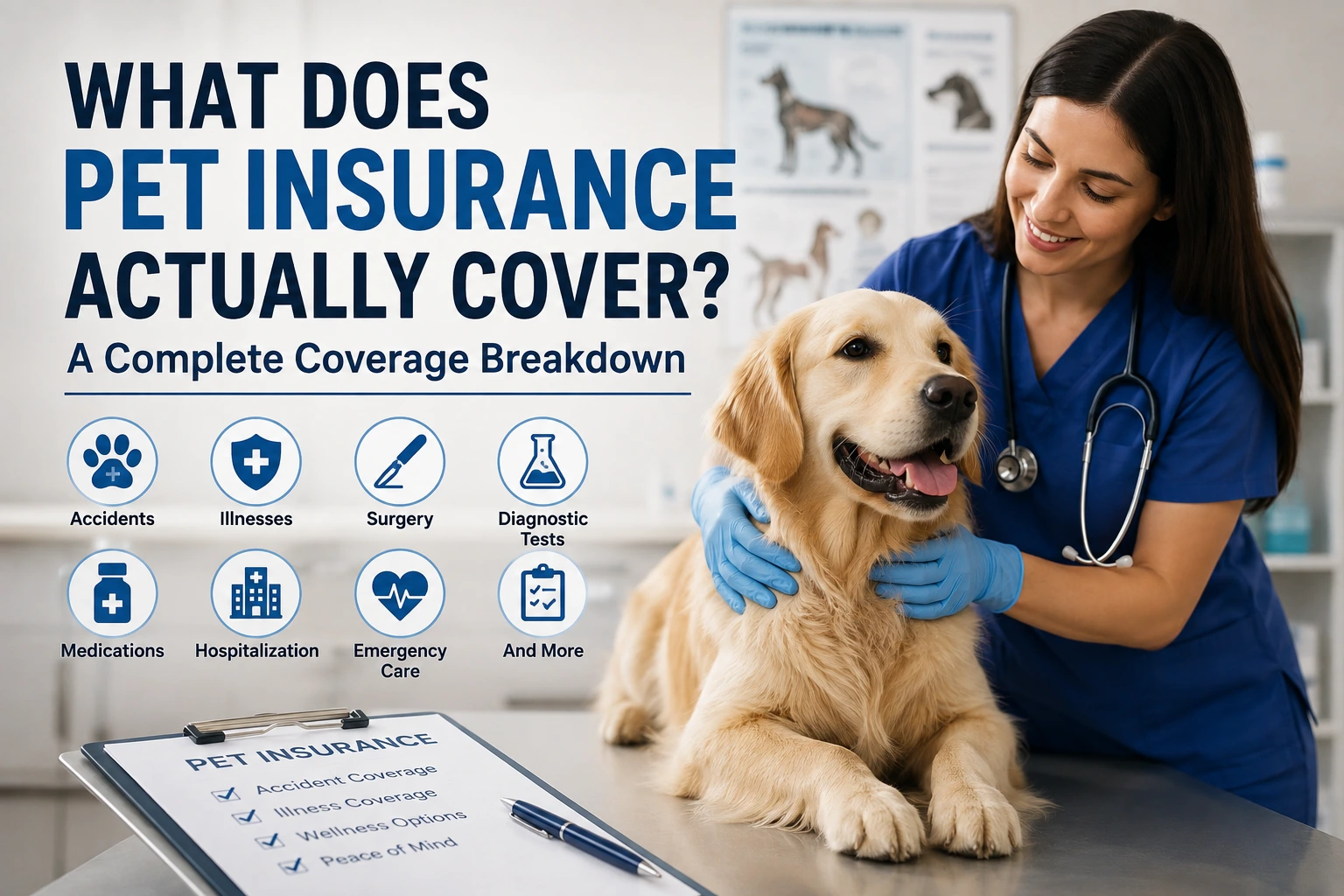
Bringing a pet into your family means being prepared for more than food, toys, and regular veterinary visits. An unexpected injury or illness can sometimes result in a large veterinary bill, leaving pet owners with an important question:
What does pet insurance actually cover?
The short answer is that it depends on the policy you choose. Some pet insurance plans cover only accidents, while others may help pay for accidents, illnesses, diagnostic tests, surgery, hospitalization, prescription medications, and other eligible veterinary treatments.
However, pet insurance does not usually mean that every veterinary expense is automatically covered.
Most policies have deductibles, reimbursement percentages, waiting periods, coverage limits, and exclusions. Understanding these terms before buying a policy can help you avoid unpleasant surprises when your pet needs medical care.
This complete guide explains what pet insurance commonly covers, what it may exclude, and how to understand your policy before filing a claim.
Quick Answer: What Does Pet Insurance Cover?
A typical comprehensive pet insurance policy may help cover eligible veterinary expenses related to:
- Accidental injuries
- Unexpected illnesses
- Emergency veterinary treatment
- Diagnostic tests
- Surgery
- Hospitalization
- Prescription medications
- Cancer treatment
- Specialist care
- Some hereditary or congenital conditions
- Rehabilitation and alternative treatments, depending on the policy
However, coverage varies significantly between insurance companies and individual plans.
The National Association of Insurance Commissioners (NAIC) explains that pet insurance products commonly fall into three broad categories: accident-only coverage, accident-and-illness coverage, and wellness coverage. Policies can also include exclusions, deductibles, waiting periods, reimbursement limits, and other conditions that affect how much an insurer ultimately pays.
The most important rule is simple:
Never assume something is covered simply because it is a veterinary expense. Always check the specific policy terms.
Pet Insurance Coverage at a Glance
The table below provides a general overview of common coverage categories.
| Veterinary Expense or Service | Commonly Covered? | Important Considerations |
|---|---|---|
| Broken bones | Often | Usually covered under accident policies |
| Swallowed objects | Often | May be subject to deductible and waiting period |
| Emergency treatment | Often | Depends on the policy and eligible expenses |
| Cancer treatment | Often in comprehensive plans | Coverage limits may apply |
| Diagnostic tests | Often | Must usually relate to a covered condition |
| Surgery | Often | Policy conditions and limits apply |
| Hospitalization | Often | Check room, nursing, and treatment limitations |
| Prescription medications | Often | Must usually be prescribed for a covered condition |
| Chronic illnesses | Sometimes | Depends on policy wording and prior medical history |
| Hereditary conditions | Sometimes | Some policies include exclusions or limitations |
| Routine checkups | Usually not | May require wellness coverage |
| Vaccinations | Usually not | Often available through wellness add-ons |
| Grooming | Rarely | Generally not standard medical insurance |
| Pre-existing conditions | Usually not | Definitions vary by policy |
| Breeding expenses | Usually not | Commonly excluded |
Important: This table is a general educational guide. Actual coverage depends on the insurance company, the policy purchased, your pet’s medical history, and the terms of the insurance contract.
1. Does Pet Insurance Cover Accidents?
For many pet owners, accident coverage is one of the most valuable parts of pet insurance.
Accidents can happen unexpectedly, even when you are extremely careful.
A dog may:
- Break a leg while playing
- Swallow a toy
- Eat something dangerous
- Suffer an injury during an accident
- Experience a bite or other injury from another animal
A cat may:
- Fall and suffer an injury
- Swallow a foreign object
- Experience an accidental injury
- Require emergency treatment after an unexpected incident
An accident-only insurance policy is generally designed to help with eligible medical costs resulting from accidental injuries.
Depending on the policy, eligible expenses may include:
- Veterinary examinations
- X-rays and diagnostic imaging
- Surgery
- Emergency care
- Hospitalization
- Medication
- Treatment for eligible injuries
Example Scenario: Max Swallows a Toy
Imagine that Max, a young Labrador Retriever, accidentally swallows part of a rubber toy.
His owner immediately takes him to an emergency veterinary clinic.
The veterinarian recommends:
- A physical examination
- X-rays
- Additional diagnostic testing
- Emergency surgery to remove the object
- Medication
- Overnight monitoring
The total veterinary bill is $4,500.
If Max’s insurance policy covers the accident and the treatment meets the policy’s conditions, the insurance company may reimburse a portion of eligible expenses after applying the deductible and reimbursement rules.
However, the owner should not assume that the entire $4,500 will be reimbursed. The final claim payment could depend on several factors.
These may include:
- The annual or per-condition deductible
- The reimbursement percentage
- The policy’s annual limit
- Any excluded expenses
- The specific terms of the insurance contract
2. Does Pet Insurance Cover Illnesses?
Accident-and-illness plans generally provide broader protection than accident-only policies.
Depending on the policy, illnesses that may be covered can include:
- Infections
- Digestive problems
- Diabetes
- Allergies
- Cancer
- Urinary conditions
- Respiratory illnesses
- Skin conditions
- Heart conditions
- Other unexpected medical problems
However, one word is extremely important here:
Eligible.
Insurance companies generally reimburse only expenses that meet the policy’s definition of covered treatment.
The NAIC notes that some pet insurance policies may reimburse eligible expenses related to illnesses, surgeries, X-rays, prescriptions, hospitalizations, emergency treatment, and cancer care. However, exclusions and limitations can vary significantly between policies.
For this reason, pet owners should read more than the marketing page.
The actual policy documents deserve careful attention.
3. Does Pet Insurance Cover Emergency Veterinary Care?
Emergency veterinary care may be covered when the emergency results from an eligible accident or illness.
For example, your pet may suddenly experience:
- Severe vomiting
- Difficulty breathing
- A serious injury
- A urinary blockage
- Severe allergic reactions
- Sudden illness requiring immediate treatment
Emergency treatment can involve several different expenses, including:
- Emergency consultation fees
- Diagnostic testing
- Imaging
- Medication
- Surgery
- Hospitalization
- Intensive care
Whether every expense is covered depends on the policy.
A Realistic Financial Example
Suppose your cat, Luna, suddenly becomes seriously ill on a weekend.
You take her to an emergency veterinary hospital, where the veterinarian performs:
| Treatment | Example Cost |
|---|---|
| Emergency examination | $200 |
| Blood tests | $300 |
| Diagnostic imaging | $500 |
| Hospitalization | $1,200 |
| Medication | $300 |
| Total | $2,500 |
Suppose Luna’s policy has:
- A $500 deductible
- An 80% reimbursement rate
- No relevant annual limit remaining
A simplified calculation could look like this:
Eligible expenses: $2,500
Minus deductible: $500
Remaining eligible amount: $2,000
80% reimbursement: $1,600
In this simplified example, the insurer might reimburse $1,600.
The owner would still have out-of-pocket expenses.
Actual claim calculations can be more complicated because insurers may calculate deductibles and reimbursements differently. Some policies also have limits or exclusions that affect the final payment.
4. Are Diagnostic Tests Covered by Pet Insurance?
Diagnostic testing is often an important part of veterinary treatment.
Before a veterinarian can treat a pet, they may first need to determine what is causing the problem.
Common diagnostic procedures may include:
- Blood tests
- Urine tests
- X-rays
- Ultrasound
- CT scans
- MRI scans
- Laboratory testing
Many accident-and-illness policies may cover eligible diagnostic expenses when the tests are medically necessary for diagnosing or treating a covered condition.
For example, imagine your dog suddenly begins limping.
The veterinarian may recommend:
- A physical examination
- X-rays
- Blood work
- Additional imaging
If the underlying problem is an eligible covered condition, the related diagnostic costs may also qualify for reimbursement.
However, routine testing performed during a standard wellness visit may not be covered by a regular accident-and-illness policy.
5. Does Pet Insurance Cover Surgery?
Surgery can be one of the most expensive veterinary treatments a pet owner may face.
Depending on the policy, eligible surgical procedures may include treatment for:
- Broken bones
- Foreign object removal
- Cancer
- Torn ligaments
- Internal injuries
- Urinary conditions
- Other covered illnesses or injuries
Surgical coverage may include certain related expenses, such as:
- Anesthesia
- Operating room costs
- Surgical procedures
- Hospitalization
- Post-operative medications
Again, the key factor is whether the underlying condition is covered.
For example, surgery for a sudden accident may qualify under an accident policy.
But surgery related to a condition that existed before the policy became effective may be excluded.
This is why buying insurance after a pet becomes sick may not provide coverage for that existing medical issue.
6. Does Pet Insurance Cover Prescription Medication?
Many comprehensive policies may cover prescription medications used to treat eligible accidents or illnesses.
For example, if your pet develops a covered medical condition, the veterinarian may prescribe medication as part of the treatment plan.
Possible expenses could include medications for:
- Pain management
- Infections
- Chronic diseases
- Cancer treatment
- Allergies
- Digestive conditions
However, policy details matter.
Some policies may:
- Cover only specific prescription medications
- Apply reimbursement limits
- Exclude certain medications
- Require the medication to treat a covered condition
Always check the policy’s definition of eligible veterinary expenses.
7. Does Pet Insurance Cover Cancer Treatment?
Cancer treatment can involve multiple veterinary services over an extended period.
Depending on the policy, an accident-and-illness plan may help cover eligible expenses such as:
- Diagnostic testing
- Specialist consultations
- Surgery
- Chemotherapy
- Medication
- Hospitalization
However, coverage depends heavily on when the condition developed and the terms of the policy.
A major issue is whether the condition could be considered pre-existing.
8. What Are Pre-Existing Conditions?
A pre-existing condition is one of the most important concepts to understand before purchasing pet insurance.
In general, a pre-existing condition involves a medical condition, symptom, or health issue that existed before the insurance coverage became effective or during an applicable waiting period.
The NAIC’s Pet Insurance Model Act defines a pre-existing condition using factors such as whether the pet received veterinary advice or treatment, or showed signs or symptoms related to the condition before the policy’s effective date or during the waiting period.
However, definitions and rules can vary between insurers and jurisdictions.
Example Scenario: Buying Insurance Too Late
Imagine that Bella has been limping for several months.
Her owner takes her to a veterinarian, who recommends further investigation.
The owner then purchases pet insurance.
A few weeks later, Bella receives a diagnosis related to the same limping problem.
Even if the official diagnosis occurred after purchasing the policy, the insurer may investigate whether the earlier symptoms are related to the condition.
This is why pet owners should consider purchasing insurance before a major medical problem develops.
9. Does Pet Insurance Cover Hereditary and Congenital Conditions?
This area can be confusing.
A hereditary condition is generally associated with genetics, while a congenital condition is present at birth.
Coverage varies widely between insurance policies.
Some insurers may cover certain hereditary or congenital conditions if:
- The condition was not present before coverage
- The pet showed no related symptoms before the policy began
- The policy does not exclude the specific condition
Other policies may impose exclusions or limitations.
The NAIC identifies hereditary disorders and congenital anomalies as important disclosure areas for pet insurance policies because coverage limitations can apply.
Therefore, if your pet’s breed has a known risk for particular health problems, carefully review the policy before purchasing it.
10. Does Pet Insurance Cover Chronic Conditions?
A chronic condition is a health problem that may require long-term management.
Examples may include certain:
- Heart conditions
- Diabetes cases
- Allergies
- Skin disorders
- Other ongoing medical problems
Some policies may continue covering an eligible chronic condition that developed after the policy became effective.
However, coverage may be affected by:
- Policy renewals
- Annual limits
- Policy changes
- The specific definition of a covered condition
- Whether the condition was pre-existing
Never assume that every future expense for a chronic illness will automatically be paid.
Read the policy carefully and ask the insurer specific questions before purchasing coverage.
11. Does Pet Insurance Cover Routine and Preventive Care?
Standard accident-and-illness insurance often does not cover routine wellness care.
Routine care may include:
- Annual examinations
- Vaccinations
- Flea and tick prevention
- Routine dental cleaning
- Spaying or neutering
- Preventive testing
Some insurers offer wellness plans or optional wellness coverage.
Wellness coverage is different from traditional accident-and-illness insurance because it focuses on predictable routine expenses rather than unexpected accidents and illnesses.
The NAIC specifically distinguishes wellness coverage from standard accident and illness coverage.
Before purchasing a wellness add-on, compare the additional premium with the benefits you expect to receive.
Sometimes the extra cost may be worthwhile. In other situations, paying for routine care directly may make more financial sense.
12. What Does Pet Insurance Usually NOT Cover?
Every policy is different, but common exclusions may include:
Pre-Existing Conditions
Conditions that existed or showed symptoms before coverage may be excluded.
Routine Wellness Care
Standard policies often do not include:
- Vaccinations
- Routine examinations
- Preventive treatments
unless wellness coverage is added.
Breeding Expenses
Expenses related to breeding and pregnancy are often excluded.
Cosmetic Procedures
Elective or cosmetic procedures may not qualify for coverage.
Grooming
Routine grooming is generally not considered an insurable veterinary medical expense.
Certain Dental Care
Some policies cover dental injuries or medically necessary dental treatment but may not cover routine dental cleaning.
Experimental Treatment
Some experimental or non-standard treatments may be excluded.
The exact exclusions should always be found in your specific policy documents.
13. Understanding Deductibles, Reimbursement, and Policy Limits
Knowing what is covered is only half the story.
You also need to understand how the insurance company calculates your payment.
Deductible
A deductible is the amount you may be responsible for before insurance begins reimbursing eligible expenses, depending on the policy’s terms.
For example:
- Veterinary bill: $3,000
- Deductible: $500
The deductible may reduce the amount eligible for reimbursement.
Reimbursement Percentage
A policy may reimburse a percentage of eligible expenses.
Common examples include:
- 70%
- 80%
- 90%
However, a 90% reimbursement rate does not necessarily mean you receive 90% of the total bill.
The deductible, exclusions, and other limitations may affect the final payment.
Annual Limit
Some policies have a maximum amount the insurer will pay during a policy year.
For example:
- $5,000 annual limit
- $10,000 annual limit
- Unlimited coverage, subject to policy conditions
Once a policy limit is reached, the pet owner may become responsible for additional expenses.
The NAIC emphasizes that pet insurance policies can include deductibles, waiting periods, coinsurance or reimbursement limitations, and annual or lifetime limits, all of which can affect the consumer’s actual coverage.
14. How Waiting Periods Affect Pet Insurance Coverage
A waiting period is the time between purchasing a policy and the beginning of certain coverage.
For example, a policy might have different waiting periods for:
- Accidents
- Illnesses
- Orthopedic conditions
The exact rules vary by insurer and, in some cases, applicable state law.
A pet that becomes ill during a waiting period may not receive coverage for that condition.
That is why waiting until your pet becomes sick to purchase insurance can be risky.
The NAIC’s model law identifies waiting periods as an important policy provision that should be clearly disclosed to consumers.
A Simple Pet Insurance Coverage Checklist
Before buying a policy, ask these questions:
Coverage Questions
- Does the policy cover accidents?
- Does it cover illnesses?
- Are emergency visits covered?
- Are diagnostic tests included?
- Does the policy cover surgery?
- Are prescription medications included?
- Is cancer treatment covered?
- Are hereditary conditions covered?
Financial Questions
- What is the deductible?
- How is the deductible applied?
- What is the reimbursement percentage?
- Is there an annual or lifetime limit?
- Are examination fees included?
Exclusion Questions
- How does the company define a pre-existing condition?
- What happens if my pet has symptoms before enrollment?
- Are chronic conditions covered?
- Are there breed-specific exclusions?
- Is routine dental care excluded?
Practical Questions
- Can I visit any licensed veterinarian?
- Do I pay the veterinarian first?
- How do I submit a claim?
- How long does claim processing typically take?
These questions can help you compare policies based on real value rather than simply choosing the lowest monthly premium.
Pet Insurance vs. Paying Veterinary Bills Yourself
Pet insurance is not the only way to prepare for veterinary expenses.
Some pet owners prefer to build an emergency savings fund specifically for their pets.
For example, you might set aside a fixed amount each month in a dedicated pet emergency fund.
You can also read our guide on how much you should save in a pet emergency fund to better understand how much financial preparation may be appropriate for unexpected veterinary expenses.
A dedicated savings fund can provide flexibility, while insurance may help reduce the financial impact of certain large, unexpected eligible medical expenses.
Some pet owners even choose to use both strategies:
- Maintain pet insurance for eligible major accidents and illnesses.
- Keep an emergency fund for deductibles, exclusions, routine care, and unexpected out-of-pocket expenses.
There is no single solution that works perfectly for every pet owner.
Your decision may depend on:
- Your monthly budget
- Your pet’s age
- Your pet’s breed
- Your available savings
- Your risk tolerance
- Your ability to pay for a large emergency bill
For a broader look at managing regular and unexpected pet expenses, you may also find our pet expense tracker guide useful.
The Most Important Thing to Remember About Pet Insurance
The biggest mistake pet owners can make is believing that pet insurance works exactly the same way for every company and every situation.
It does not.
Two policies with similar monthly premiums may have very different:
- Deductibles
- Reimbursement percentages
- Annual limits
- Waiting periods
- Exclusions
- Definitions of covered conditions
For this reason, the best pet insurance policy is not necessarily the one with the cheapest monthly price.
The best policy for your situation is one whose coverage, exclusions, limits, and costs you clearly understand.
For additional consumer information about pet insurance and the issues to consider when comparing policies, visit the National Association of Insurance Commissioners’ pet insurance resource.
You can also review the NAIC Pet Insurance Model Act to better understand important consumer disclosure concepts, including exclusions, waiting periods, deductibles, reimbursement limitations, and policy limits.
Frequently Asked Questions About Pet Insurance Coverage
What does basic pet insurance usually cover?
Basic pet insurance may provide accident-only coverage. Depending on the policy, this can include eligible treatment for injuries such as broken bones, swallowed objects, and other accidental incidents.
Does pet insurance cover all veterinary bills?
No. Pet insurance usually covers only eligible expenses according to the terms of the policy. Deductibles, reimbursement percentages, exclusions, waiting periods, and policy limits can affect the amount paid.
Does pet insurance cover emergency visits?
Many accident-and-illness policies may cover eligible emergency veterinary treatment. However, the underlying medical condition and specific policy terms determine whether a claim qualifies.
Does pet insurance cover surgery?
Many comprehensive policies cover eligible surgery resulting from a covered accident or illness. Pre-existing conditions and other exclusions may affect coverage.
Are prescription medications covered by pet insurance?
Many policies may cover eligible prescription medications used to treat covered conditions. Always review the specific policy for medication limitations and exclusions.
Does pet insurance cover cancer?
Many accident-and-illness plans may cover eligible cancer treatment if the condition is not excluded as pre-existing and all other policy requirements are met.
Does pet insurance cover pre-existing conditions?
Pre-existing conditions are commonly excluded, although definitions and specific rules vary by insurer and policy.
Does pet insurance cover vaccinations?
Standard accident-and-illness policies usually do not cover routine vaccinations. Some insurers offer separate wellness coverage or preventive-care benefits.
Can I use any veterinarian with pet insurance?
Some policies allow you to visit any eligible licensed veterinarian, while others may have network requirements or other restrictions. Check the policy before purchasing.
Is pet insurance worth buying?
Whether pet insurance is worthwhile depends on your financial situation, your pet’s health risks, available savings, and the policy you are considering. The most useful approach is to compare the potential benefits with the total cost and understand what you would still need to pay yourself.
Conclusion: What Does Pet Insurance Actually Cover?
Pet insurance can help protect pet owners from some of the financial consequences of unexpected veterinary care, but it is not a blank check for every pet-related expense.
Depending on the policy, pet insurance may help cover:
- Accidents
- Illnesses
- Emergency treatment
- Diagnostic tests
- Surgery
- Hospitalization
- Prescription medications
- Cancer treatment
- Specialist care
At the same time, many policies may exclude or limit:
- Pre-existing conditions
- Routine wellness care
- Breeding expenses
- Cosmetic procedures
- Certain hereditary or congenital conditions
- Other treatments specifically excluded by the policy
The best way to understand what your pet insurance actually covers is to read the complete policy documents—not just the promotional summary.
Before buying a policy, carefully compare the coverage, exclusions, deductible, reimbursement percentage, waiting periods, and policy limits.
A well-understood pet insurance policy can be a useful financial planning tool. However, knowing exactly what is and is not covered is essential before your pet experiences an emergency.
Disclaimer
This article is provided for general educational and informational purposes only. It does not constitute insurance, legal, financial, or veterinary advice. Pet insurance coverage, exclusions, reimbursement calculations, waiting periods, premiums, and policy limits vary by insurer, policy, location, and individual circumstances. Always read the complete policy documents and consult the insurance provider or a qualified professional regarding your specific situation before purchasing or relying on an insurance policy.
