

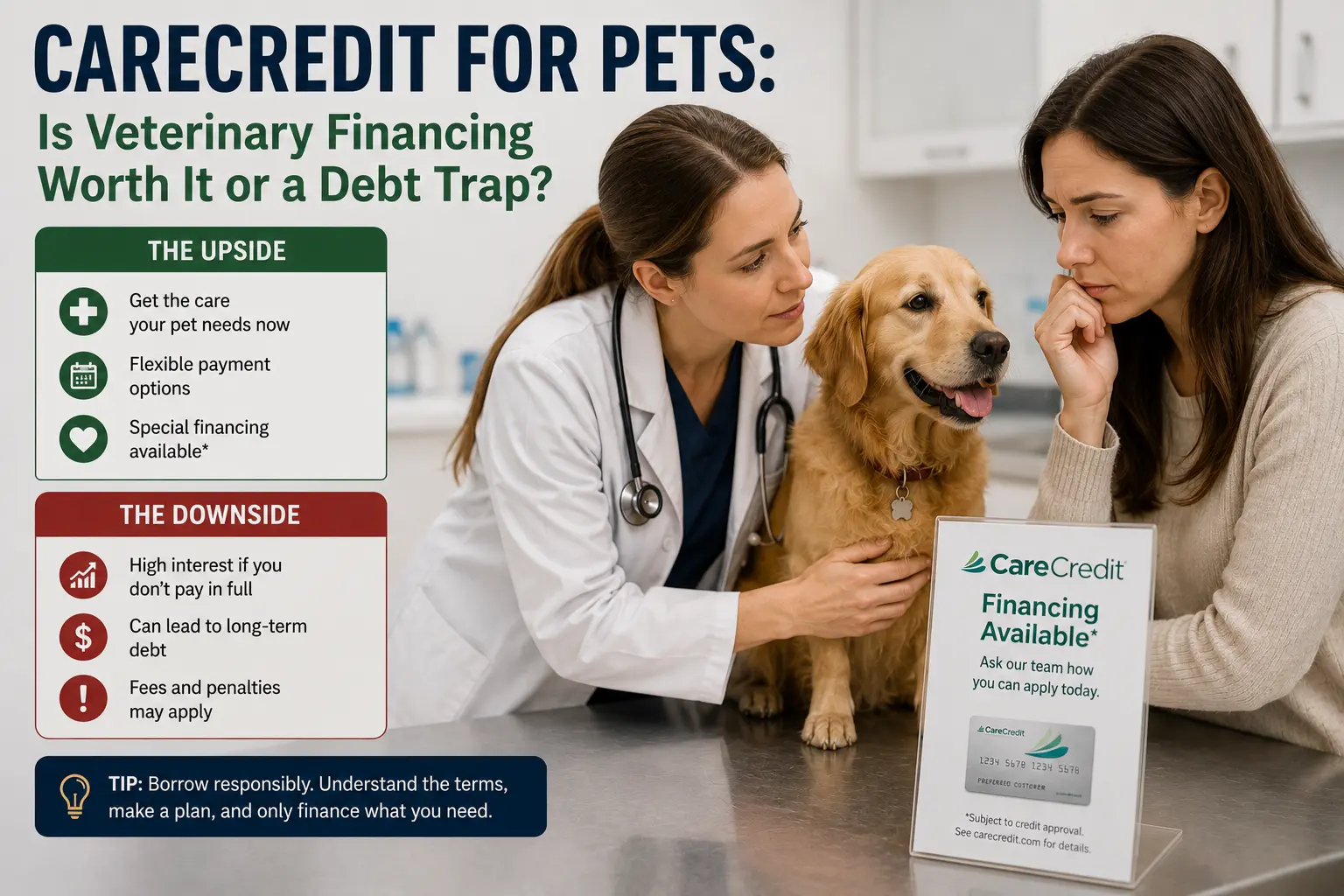
Your dog just swallowed something she shouldn’t have. The emergency vet is recommending surgery. The estimate sits in front of you: $2,800. You have $400 in your checking account and no pet insurance. The veterinary receptionist slides a brochure across the desk and says, “We do accept CareCredit.”
This is the moment millions of pet owners face every year — a financial crossroads where love for their animal collides with the reality of their bank account. CareCredit has become the de facto financing solution at veterinary offices across the country, and for good reason: it works quickly, it’s widely accepted, and it allows pet owners to say yes to treatment when they otherwise couldn’t.
But CareCredit is also a financial product with specific terms, potential pitfalls, and real consequences for pet owners who don’t fully understand how it works before they sign up. Used correctly, it can be a genuinely useful tool. Used incorrectly, it can turn a $2,800 vet bill into a $4,000+ debt spiral.
This guide gives you the complete, honest picture of CareCredit for pets — how it works, when it makes financial sense, when it doesn’t, and what alternatives exist so you can make the most informed decision possible in a high-stress moment.
What Is CareCredit?
CareCredit is a healthcare credit card issued by Synchrony Bank, designed specifically for medical expenses — including both human and animal healthcare. It is accepted at over 25,000 veterinary practices across the United States, making it one of the most widely available financing options for pet owners facing unexpected veterinary costs.
Unlike a traditional credit card that can be used anywhere, CareCredit is a dedicated healthcare financing card. It operates like a credit card in that it carries a credit limit, charges interest, and reports to credit bureaus — but it is designed exclusively for healthcare and wellness spending.
CareCredit offers two primary types of promotional financing that make it appealing for veterinary expenses:
Deferred Interest Promotional Periods: For qualifying purchases, CareCredit offers promotional periods of 6, 12, 18, or 24 months during which no interest is charged — provided the entire balance is paid in full before the promotional period ends. During this window, minimum monthly payments are still required.
Reduced APR Installment Plans: For larger purchases, CareCredit sometimes offers reduced fixed interest rate plans (typically 14.90% APR) with equal monthly payments over a set term. These differ from deferred interest plans in that interest accrues at the lower rate from the start rather than being retroactively applied.
Understanding the difference between these two plan types is critical — and is where many CareCredit users run into financial trouble.
How CareCredit’s Deferred Interest Model Really Works
The deferred interest feature is CareCredit’s primary marketing hook — and its most misunderstood feature. Here is exactly how it works, with no marketing language:
When you make a qualifying purchase using a deferred interest promotional offer:
- You are charged no interest during the promotional period (e.g., 12 months) as long as you make required minimum monthly payments
- If you pay the entire balance in full before the promotional period ends, you pay zero interest — exactly as advertised
- If you do not pay the entire balance by the end of the promotional period — even if you have only $50 remaining — Synchrony Bank retroactively applies interest to your original purchase amount at the standard CareCredit APR
That standard APR is 26.99% as of current terms — among the highest interest rates in the consumer credit market.
A concrete example:
- Veterinary bill: $2,800
- CareCredit 12-month deferred interest promotional offer
- You make minimum payments each month and have $200 remaining when month 12 ends
- Synchrony Bank charges you 26.99% interest retroactively on the original $2,800 — approximately $755 in interest charges — added to your remaining balance immediately
This is not a hypothetical worst-case scenario. It is a documented, widely experienced outcome that has generated significant consumer complaints and regulatory scrutiny. The Consumer Financial Protection Bureau (CFPB) has received thousands of complaints about deferred interest products, specifically related to this retroactive interest mechanism.
The deferred interest model is not inherently predatory — if you pay the balance in full before the promotional period ends, you genuinely pay zero interest. But it requires discipline, accurate financial planning, and a clear understanding of the mechanics before you sign up.
When CareCredit Makes Genuine Financial Sense
Despite its risks, CareCredit is a legitimate and genuinely useful financial tool in the right circumstances. Here are the situations where using it for veterinary expenses is financially sound:
Situation 1: You Can Realistically Pay the Balance Within the Promotional Period
If your vet bill is $1,500 and you have a 12-month deferred interest promotional period, you need to pay approximately $125 per month to clear the balance in full before interest kicks in. If your budget genuinely accommodates that payment — and you can commit to making it a non-negotiable monthly priority — CareCredit functions as a true interest-free loan.
The math is straightforward: divide your total balance by the number of months in the promotional period, and ask yourself honestly whether that monthly payment is sustainable. If yes, CareCredit is a reasonable tool.
Situation 2: You Have Pet Insurance with a Reimbursement Timeline
Many pet insurance policies reimburse claims within 5–30 days. If your pet is insured and you’re confident a significant portion of the bill will be reimbursed within weeks, using CareCredit as a bridge financing tool — charging the bill and paying it off immediately upon reimbursement — costs you nothing while solving the immediate cash flow problem.
This is arguably the smartest use of CareCredit for pet expenses: short-term bridge financing between the expense and the insurance reimbursement.
Situation 3: The Alternative Is Delaying or Forgoing Necessary Treatment
If the choice is genuinely between using CareCredit and not treating your pet for a serious or life-threatening condition, the financial cost of the interest (if the promotional period isn’t fully met) may be worth it. Pet owners should never be in a position where financial products feel like the only humane option — but in acute emergencies, CareCredit can be the tool that makes necessary care possible.
Situation 4: Your Credit Score Qualifies You for the Best Terms
CareCredit approval and the promotional terms offered are credit-score dependent. Applicants with strong credit (typically 700+) are most likely to qualify for longer promotional periods and lower promotional APRs. If your credit score is strong and you qualify for an 18 or 24-month promotional period for a large expense, the interest-free window gives you meaningful time to pay down the balance.
When CareCredit Becomes a Financial Risk
The situations where CareCredit’s risks outweigh its benefits are equally important to understand:
Risk 1: You Cannot Realistically Pay the Balance Before the Promotional Period Ends
If your monthly budget cannot accommodate the payments needed to clear the balance within the promotional period, deferred interest is not a no-interest loan — it is a delayed high-interest loan. At 26.99% APR, a $2,800 balance carried for a full year after the promotional period expires generates approximately $755 in retroactive interest charges. At that point, you would have been better served by a lower-interest personal loan from the outset.
Risk 2: You Make Only Minimum Payments
CareCredit’s minimum monthly payments are calculated to keep the account current — not to pay off the balance within the promotional period. Following the minimum payment schedule almost guarantees you will not clear the balance before interest retroactively applies. If you use CareCredit, always pay significantly more than the minimum — ideally the amount needed to pay the balance in full within the promotional window.
Risk 3: You Have Multiple CareCredit Balances
It is possible to accumulate multiple CareCredit balances with overlapping promotional periods — a situation that becomes extremely difficult to track and manage. Each promotional period has its own expiration date, and missing even one results in retroactive interest on that specific balance. Managing multiple balances requires careful recordkeeping and disciplined payment allocation.
Risk 4: Your Credit Score Is Below the Approval Threshold
CareCredit applications result in a hard inquiry on your credit report. If you apply and are declined — which is more likely with scores below 620-640 — your credit score takes a small hit without you receiving any benefit. In an emergency, this wasted time and credit impact can be frustrating and counterproductive.
Risk 5: You’re Already Carrying High-Interest Debt
Adding CareCredit debt on top of existing high-interest credit card balances or personal loans compounds your debt burden. In this situation, the 26.99% deferred interest rate — if triggered — adds to an already stressed financial picture. Alternative financing options with lower fixed interest rates may be more appropriate.
Alternatives to CareCredit for Veterinary Financing
CareCredit is not the only option when facing an unaffordable veterinary bill. Here are the most viable alternatives:
Scratchpay
Scratchpay is a veterinary-specific financing service that offers installment payment plans with fixed interest rates ranging from 0% to approximately 29.99% APR depending on your creditworthiness and the plan selected. Unlike CareCredit’s deferred interest model, Scratchpay’s interest-bearing plans accrue interest from the start at the stated rate — there is no retroactive interest surprise at the end of a promotional period.
Scratchpay is accepted at a growing number of veterinary practices and can be applied for quickly online or through a mobile app.
Personal Loans
A personal loan from a bank, credit union, or online lender may offer a lower fixed interest rate than CareCredit’s deferred interest APR — particularly for borrowers with good to excellent credit. Personal loan APRs for qualified borrowers typically range from 6% to 18%, compared to CareCredit’s 26.99% deferred interest rate.
The trade-off is speed: personal loan approval and funding typically takes 1–5 business days, which may not work in a true emergency. For planned procedures or non-emergency care, a personal loan often represents better value than CareCredit.
Nonprofit Financial Assistance Programs
Several organizations provide financial assistance grants to pet owners who cannot afford necessary veterinary care:
- RedRover Relief (redrover.org): Urgent care grants for pets in crisis
- The Pet Fund (thepetfund.com): Assistance for non-emergency, non-basic veterinary care
- Brown Dog Foundation (browndogfoundation.org): Helps cover life-saving treatment costs
- Frankie’s Friends (frankiesfriends.org): Supports pets with serious illnesses
These programs are income-based and require applications, making them better suited to situations where the expense is anticipated or the emergency is not immediately life-threatening.
Payment Plans Directly From the Veterinary Practice
Many veterinary practices — particularly long-established clinics with established client relationships — offer in-house payment plans that allow clients to pay balances over time without involving third-party financing. These plans typically charge no interest and require no credit check.
This option is worth asking about before defaulting to CareCredit. The worst the clinic can say is no — and many will say yes, particularly for clients with a track record of timely payment.
Pet Insurance (The Proactive Solution)
The only truly proactive solution to veterinary financial emergencies is pet insurance enrolled before any health conditions develop. A comprehensive pet insurance policy with a $250–$500 deductible and 80–90% reimbursement coverage transforms a $2,800 emergency surgery into a $280–$560 out-of-pocket expense — a cost that most pet owners can manage without financing.
If you’re reading this article after an emergency has already occurred, pet insurance obviously can’t help you today. But enrolling immediately after this experience — before any newly diagnosed conditions become pre-existing exclusions — is the most important financial step you can take to prevent this situation from recurring.
How to Use CareCredit Responsibly if You Decide to Use It
If CareCredit is the right tool for your situation, these practices maximize its value and minimize its risks:
Calculate your required monthly payment before you sign up. Divide the total balance by the number of months in the promotional period. This is the minimum amount you need to pay each month to avoid retroactive interest. Write this number down and treat it as a fixed monthly bill.
Set up automatic payments above the minimum. Configure automatic payments for your calculated monthly amount — not the CareCredit minimum payment amount, which is almost certainly insufficient to clear the balance within the promotional period.
Mark the promotional period end date on your calendar. Know exactly when the promotional period expires and set a reminder 60 days before that date to confirm your balance trajectory.
Pay the remaining balance in full before the promotional period ends. If you have any remaining balance as the end date approaches, pay it in full immediately — even if it means temporarily drawing from savings. The retroactive interest on a $500 remaining balance is far more expensive than a brief reduction in your savings account.
Avoid using the card for additional purchases. Each new purchase on your CareCredit card may carry a different promotional period (or no promotional period at all), creating multiple overlapping balances at different interest terms. Keep your CareCredit use focused on the single expense you’re managing.
CareCredit vs. Alternatives: A Quick Comparison
| Feature | CareCredit | Scratchpay | Personal Loan | Vet Payment Plan |
|---|---|---|---|---|
| Interest Rate | 0% promo, 26.99% if not paid off | 0%–29.99% fixed | 6%–18% fixed | Usually 0% |
| Retroactive Interest Risk | Yes — significant risk | No | No | No |
| Approval Speed | Minutes | Minutes | 1–5 days | Immediate |
| Credit Check Required | Yes (hard inquiry) | Yes (soft inquiry) | Yes (hard inquiry) | Usually no |
| Accepted at Most Vets | Yes — very widely | Growing network | Universal (cash/check) | Practice-specific |
| Best For | Short-term bridge financing | Transparent installments | Larger amounts, good credit | Established clients |
Frequently Asked Questions
Does CareCredit hurt my credit score? Applying for CareCredit results in a hard inquiry on your credit report, which typically reduces your score by 5–10 points temporarily. If approved and used responsibly — with on-time payments and low utilization — CareCredit can actually improve your credit over time. Missed payments or maxing out the card will negatively impact your score.
What credit score do I need for CareCredit approval? CareCredit does not publish a minimum credit score requirement. In practice, approval is most likely for applicants with scores of 620 or above, with better promotional terms offered to those with scores of 700+. Applicants with scores below 600 face a higher likelihood of denial.
Can I use CareCredit at any veterinarian? CareCredit is accepted at over 25,000 veterinary practices, but not all. Verify whether your specific veterinarian accepts CareCredit before applying. The CareCredit website offers a provider search tool to confirm acceptance.
What happens if I miss a minimum payment during the promotional period? Missing a minimum payment during the promotional period may cancel the promotional offer entirely, causing interest to retroactively apply immediately rather than waiting until the promotional period ends. On-time minimum payments throughout the entire promotional period are required to maintain the deferred interest offer.
Is there an annual fee for CareCredit? No — CareCredit does not charge an annual fee. Costs are limited to interest charges (if applicable) and potential late payment fees.
Can I use CareCredit for regular veterinary visits, not just emergencies? Yes. CareCredit can be used for any veterinary expense — routine wellness exams, vaccinations, dental cleanings, and scheduled procedures — not just emergencies. Using it for planned expenses where you have time to budget repayment is often smarter than using it in the stress of an emergency.
Final Thoughts
CareCredit for pets is neither a financial miracle nor a guaranteed debt trap. It is a tool — and like any tool, its value depends entirely on how it is used.
Used with full understanding of the deferred interest mechanism, a realistic repayment plan, and the discipline to pay more than the minimum each month, CareCredit can be a genuinely interest-free way to manage an unexpected veterinary expense that would otherwise be impossible to cover upfront.
Used without understanding how retroactive interest works, while making only minimum payments, or in a financial situation where clearing the balance within the promotional period is not realistic, it can turn an already difficult financial situation into a significantly worse one.
The best financial protection against veterinary emergencies is not CareCredit — it is pet insurance enrolled early, combined with a dedicated emergency savings fund. CareCredit is most valuable as a bridge tool when these protections are in place but temporarily insufficient, not as a substitute for proactive financial planning.
Know how it works before you need it. That knowledge, more than anything else, determines whether CareCredit becomes a helpful resource or an expensive lesson.
Disclaimer: This article is intended for general informational and educational purposes only and does not constitute financial or veterinary advice. CareCredit terms, APRs, and promotional offers are subject to change. Always review current terms and conditions directly with Synchrony Bank before applying. Consult a licensed financial advisor for personalized financial guidance.
