

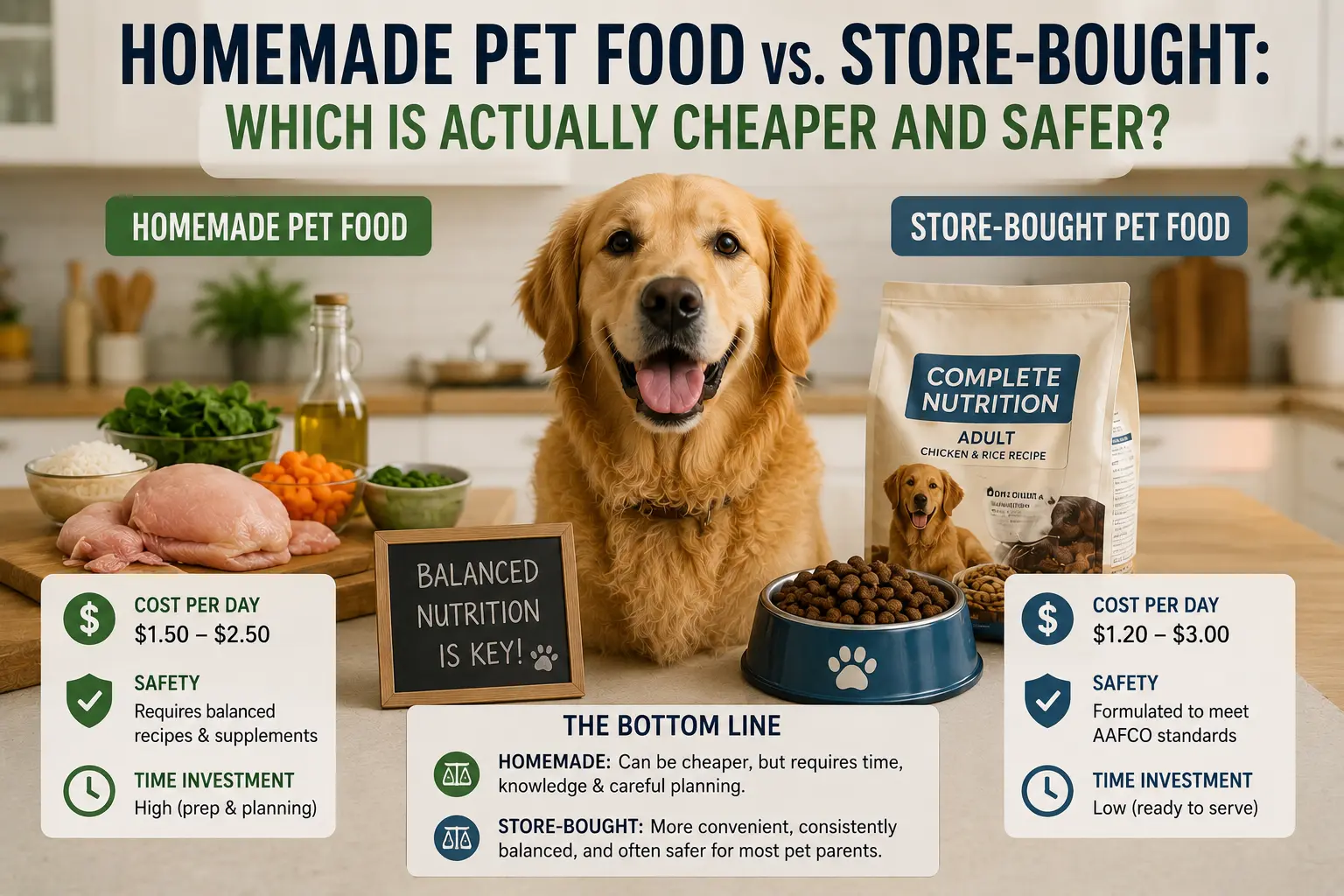
The idea of cooking fresh, wholesome meals for your pet has undeniable appeal. You control every ingredient. You know exactly what your dog or cat is eating. You avoid the preservatives, mysterious meat meals, and marketing buzzwords that crowd commercial pet food labels. And maybe — just maybe — you save some money in the process.
But is homemade pet food actually cheaper than store-bought? Is it safer? And is it nutritionally complete enough to serve as your pet’s primary diet?
These are questions that deserve honest, evidence-based answers — not the idealized version promoted by raw feeding advocates or the dismissive response sometimes given by those with a financial stake in commercial pet food. This guide gives you the full picture: real cost comparisons, genuine safety considerations, and the nutritional science you need to make an informed decision for your pet.
The Appeal of Homemade Pet Food — And Why It’s Growing
Interest in homemade pet food has surged in recent years, driven by several converging factors:
High-profile commercial pet food recalls. When contaminated commercial pet food causes illness or death in pets — as has happened multiple times over the past two decades — owners understandably seek alternatives they can control.
Growing human food transparency movement. As more people scrutinize their own food sources, it’s natural to extend that scrutiny to what their pets eat.
Social media influence. Images of beautifully prepared homemade pet meals circulate widely on platforms like Instagram and TikTok, making the practice look straightforward and aspirational.
Specific health conditions. Some pets with food allergies, intolerances, or chronic conditions genuinely benefit from carefully managed homemade diets formulated under veterinary guidance.
These are legitimate motivations. The challenge is that the reality of homemade pet feeding — its true costs, time demands, and nutritional risks — is frequently more complex than the appealing images suggest.
The True Cost of Homemade Pet Food
Let’s start with the question most pet owners ask first: is it actually cheaper?
The honest answer is: it depends — and for most pet owners, it is not cheaper once all costs are properly accounted for.
Ingredient Costs
The raw ingredient cost of homemade pet food varies enormously based on the protein sources you choose, whether you use organic ingredients, and your local food prices. Here are realistic monthly cost estimates for homemade diets for a medium-sized dog (approximately 40 pounds) based on typical ingredient costs:
Basic homemade diet (ground beef or chicken, rice, vegetables, basic supplements):
- Protein (ground beef or chicken, ~1 lb/day): $60–$100/month
- Carbohydrate source (rice, oats, sweet potato): $10–$20/month
- Vegetables: $15–$25/month
- Basic supplements (calcium, multivitamin): $15–$30/month
- Total: $100–$175/month
Mid-range homemade diet (varied proteins, quality produce):
- Varied proteins (chicken, beef, fish, organ meats): $80–$140/month
- Carbohydrates and vegetables: $25–$40/month
- Comprehensive supplement pack: $25–$50/month
- Total: $130–$230/month
Premium homemade diet (organic, grass-fed, wild-caught ingredients):
- Organic/grass-fed proteins: $120–$200/month
- Organic produce: $35–$60/month
- Premium supplement formulation: $30–$60/month
- Total: $185–$320/month
For comparison, a quality mid-range commercial dry kibble for a 40-pound dog typically costs $40–$70 per month. Even a premium commercial food rarely exceeds $80–$120 per month for a dog this size.
Hidden Costs Most Homemade Feeders Don’t Account For
The ingredient cost is just the beginning. Honest cost accounting for homemade pet food must also include:
Veterinary nutritionist consultation: A one-time consultation with a board-certified veterinary nutritionist to formulate a complete and balanced recipe costs $200–$500 — and is not optional if you want a nutritionally sound homemade diet. Recipes found online or in books are frequently nutritionally incomplete, sometimes dangerously so. Professional formulation is a non-negotiable investment.
Ongoing supplement costs: A nutritionally complete homemade diet requires specific supplements to fill gaps that whole food ingredients alone cannot provide — particularly calcium (if you’re not feeding bones), zinc, copper, vitamin D, and iodine. Comprehensive supplement packs formulated for homemade diets cost $25–$60 per month.
Kitchen equipment: Dedicated food preparation equipment — a large food processor, storage containers, a kitchen scale for accurate portioning, and potentially a freezer for batch cooking — adds $100–$300 in one-time setup costs.
Time investment: Homemade pet food preparation takes time — typically 2–4 hours per week for batch cooking once you have an established routine. If you value your time at even a modest hourly rate, this represents a meaningful additional cost that rarely appears in homemade feeding comparisons.
Follow-up nutritional testing: Periodic blood panels to monitor your pet’s nutritional status are strongly recommended when feeding homemade diets, adding $100–$200 per year in additional veterinary costs.
When all of these costs are factored in, homemade pet food is almost universally more expensive than commercial alternatives — often 2–4 times more expensive than quality mid-range commercial food on a monthly basis.
The Safety Question: Is Homemade Pet Food Safer?
This is where the homemade vs. commercial debate becomes most nuanced — and where the honest answer may surprise advocates on both sides.
Commercial Food Safety Concerns
Commercial pet food has experienced genuine safety issues that have rightfully shaken consumer confidence:
- The 2007 melamine contamination crisis resulted in the deaths of thousands of pets and led to one of the largest pet food recalls in history
- Multiple recalls have occurred over the years involving salmonella contamination, elevated vitamin D levels, and foreign material contamination
- The ongoing FDA investigation into a potential link between grain-free diets and dilated cardiomyopathy (DCM) in dogs raised concerns about certain diet formulations
These are legitimate safety issues. However, it’s important to note that the regulatory framework surrounding commercial pet food — FDA oversight, mandatory recall systems, and AAFCO nutritional standards — also provides a layer of accountability and quality control that homemade diets entirely lack.
Homemade Food Safety Concerns
Homemade pet food carries its own distinct set of safety risks that are frequently underemphasized in discussions about its benefits:
Nutritional deficiency — the most serious risk: Studies examining homemade pet food recipes — including those published in veterinary journals and books recommended by holistic pet care advocates — have consistently found that the vast majority are nutritionally incomplete. A landmark study published in the Journal of Nutritional Science evaluated 200 homemade dog food recipes and found that fewer than one-third met all of AAFCO’s minimum nutrient requirements. Common deficiencies include calcium, zinc, copper, vitamin D, iodine, and essential fatty acids.
Nutritional deficiencies don’t always produce immediate, obvious symptoms. They develop slowly, potentially over months or years, causing bone disease, immune dysfunction, skin and coat deterioration, heart problems, and other serious conditions that may not be recognized as diet-related until significant damage has occurred.
Bacterial contamination: Raw meat — a common component of homemade diets — carries significant bacterial contamination risk. Salmonella, Listeria, Campylobacter, and E. coli are all potential pathogens in raw meat that can cause illness in both pets and the humans who handle and prepare their food. The Centers for Disease Control and Prevention (CDC) and the FDA have both issued guidance on the public health risks associated with raw pet food.
Incorrect preparation of certain ingredients: Some human foods are safe for people but toxic to pets — onions, garlic, grapes, raisins, xylitol, macadamia nuts, and chocolate, among others. Recipes that include these ingredients, or owners who improvise without careful research, put their pets at genuine risk.
Inconsistency: Homemade diets are only as consistent as the cook. Ingredient substitutions, portion variations, and batch-to-batch differences can introduce nutritional variability that commercial foods — produced under standardized manufacturing conditions — avoid.
When Homemade Pet Food Makes Genuine Sense
Despite the cost and safety considerations, there are specific situations where a veterinarian-formulated homemade diet represents a legitimate and valuable option:
Severe food allergies or intolerances: Pets with multiple food allergies who react to commercially available novel protein diets may genuinely benefit from a precisely controlled homemade diet formulated to avoid all problem ingredients.
Chronic kidney disease management: Some pets with chronic kidney disease require carefully calibrated phosphorus restriction that commercial foods may not provide at the exact level needed. A custom homemade diet formulated by a veterinary nutritionist can address this precisely.
Inflammatory bowel disease: Some dogs and cats with severe IBD respond better to homemade diets when commercial foods — even prescription options — fail to manage symptoms effectively.
Highly picky eaters with medical conditions: Pets who refuse all available commercial foods due to palatability issues may accept homemade preparations that allow for greater flavor customization.
The critical requirement in all these cases: The diet must be formulated by a board-certified veterinary nutritionist — not based on a recipe from a book, website, or well-meaning social media community. The American College of Veterinary Nutrition (ACVN) maintains a directory of board-certified veterinary nutritionists who offer consultation services, some of which are available remotely.
The Middle Ground: Commercially Prepared Fresh Pet Food
Between traditional commercial kibble and fully homemade diets lies a growing category of commercially prepared fresh pet food — brands that produce refrigerated or frozen meals using whole food ingredients, formulated to meet AAFCO standards.
Companies in this space offer the whole-food appeal of homemade feeding with the nutritional completeness and convenience of commercial food. Examples include subscription-based fresh food delivery services that ship portion-controlled meals directly to your door.
Cost comparison for a 40-pound dog:
- Fresh commercial food (full diet): $80–$180/month
- Fresh commercial food (as topper, 25% of diet): $20–$45/month
- Quality dry kibble with fresh food topper: $50–$90/month combined
Using fresh commercial food as a partial meal topper — rather than a complete diet — is a popular compromise that adds palatability, moisture, and whole-food variety to a base of quality dry kibble, at a cost significantly below full homemade feeding.
Side-by-Side Comparison: Homemade vs. Store-Bought vs. Fresh Commercial
| Factor | Homemade | Store-Bought Kibble | Fresh Commercial |
|---|---|---|---|
| Monthly cost (40 lb dog) | $100–$320+ | $40–$120 | $80–$180 |
| Nutritional completeness | Risk of deficiency without expert formulation | AAFCO-guaranteed if labeled | AAFCO-guaranteed |
| Ingredient control | Full control | Limited | High |
| Convenience | Low — significant time investment | High | Medium — subscription delivery |
| Bacterial safety risk | Higher (especially raw) | Low | Low to medium |
| Customization for health conditions | High (with vet nutritionist) | Limited | Medium |
| Regulatory oversight | None | FDA + AAFCO | FDA + AAFCO |
| Setup investment | $200–$800+ (equipment + nutritionist) | None | None |
If You Want to Feed Homemade: A Responsible Starting Point
If you’ve weighed the costs and considerations and want to pursue homemade feeding — either as a primary diet or as a meaningful supplement to commercial food — here is a responsible framework to follow:
Step 1: Consult a board-certified veterinary nutritionist. This is non-negotiable. Use the ACVN directory (acvn.org) to find a qualified professional. Many offer remote consultations. Expect to pay $200–$500 for a personalized recipe formulation — this is the most important investment you’ll make in a homemade diet.
Step 2: Follow the formulated recipe exactly. Substitutions, portion variations, and “improvements” can alter the nutritional balance of a carefully formulated recipe. If you want to make changes, consult your nutritionist first.
Step 3: Use a complete supplement. Even well-formulated homemade diets typically require supplementation to fill micronutrient gaps. Your veterinary nutritionist will specify exactly which supplements are needed and at what doses.
Step 4: Schedule regular veterinary monitoring. Annual bloodwork at minimum — more frequently in the early months — allows your vet to identify any nutritional deficiencies before they cause clinical problems.
Step 5: Practice rigorous food safety. Handle raw meat with the same precautions you’d use for human food preparation. Clean all surfaces and utensils thoroughly. Store prepared food safely and use within recommended timeframes.
Step 6: Transition gradually. Switching abruptly from commercial to homemade food causes digestive upset in most pets. Transition over 7–14 days, gradually increasing the proportion of homemade food.
Frequently Asked Questions
Is homemade pet food always better than commercial food? No — and this is one of the most important misconceptions to address. Homemade food is only superior when it is nutritionally complete and balanced, formulated by a qualified professional, and prepared consistently. An improperly formulated homemade diet is nutritionally inferior to any AAFCO-compliant commercial food — and potentially harmful over time.
Can I use recipes I find online or in pet nutrition books? Use them with extreme caution. Multiple peer-reviewed studies have found that the majority of published homemade pet food recipes — including those in books authored by veterinarians — are nutritionally incomplete. Always have any recipe reviewed by a board-certified veterinary nutritionist before feeding it as a primary diet.
Is raw homemade food better than cooked homemade food? The evidence does not support raw food being nutritionally superior to cooked food for dogs and cats. Raw food carries significantly higher bacterial contamination risks. Cooking destroys pathogens while preserving the vast majority of nutritional value. Both the FDA and CDC recommend against raw pet food diets due to public health concerns.
Can I mix homemade food with commercial kibble? Yes — and for many pet owners, this is the most practical approach. Using homemade food as a partial meal component (25–50% of diet) alongside a complete and balanced commercial food reduces nutritional risk while providing some of the whole-food variety and palatability benefits of home cooking. Inform your veterinarian about the proportion you’re mixing.
What’s the minimum I should spend to do homemade feeding safely? Budget a minimum of $200–$500 for an initial veterinary nutritionist consultation, $25–$60 per month for supplements, and $100–$200 additional per month in ingredient costs above what you’d spend on commercial food. If these figures make homemade feeding financially impractical, a quality commercial food with a fresh food topper delivers excellent nutrition at a fraction of the cost.
Final Thoughts
Homemade pet food can be a genuinely valuable option — but only when done right, and “right” is more demanding and more expensive than most people realize going in. For the majority of healthy pets without specific medical conditions, a high-quality commercial food that meets AAFCO standards provides complete, balanced, and proven nutrition at a significantly lower cost and time investment than a properly formulated homemade diet.
If cost-saving is your primary motivation for considering homemade feeding, the numbers are unlikely to work in your favor. If ingredient control, a specific health condition, or palatability is driving your interest, a properly formulated homemade diet — developed with professional guidance — can be a worthwhile investment in your pet’s wellbeing.
The best diet for your pet is the one that is nutritionally complete, appropriate for their life stage and health status, and one they will actually eat consistently. Whether that comes from a commercial bag or your own kitchen is secondary to those fundamentals.
Disclaimer: This article is for general informational and educational purposes only and does not constitute veterinary or nutritional advice. Always consult a licensed veterinarian or board-certified veterinary nutritionist before making significant changes to your pet’s diet, particularly if your pet has existing health conditions. Raw pet food safety guidance reflects current positions of the FDA and CDC and is subject to update as research evolves.
