

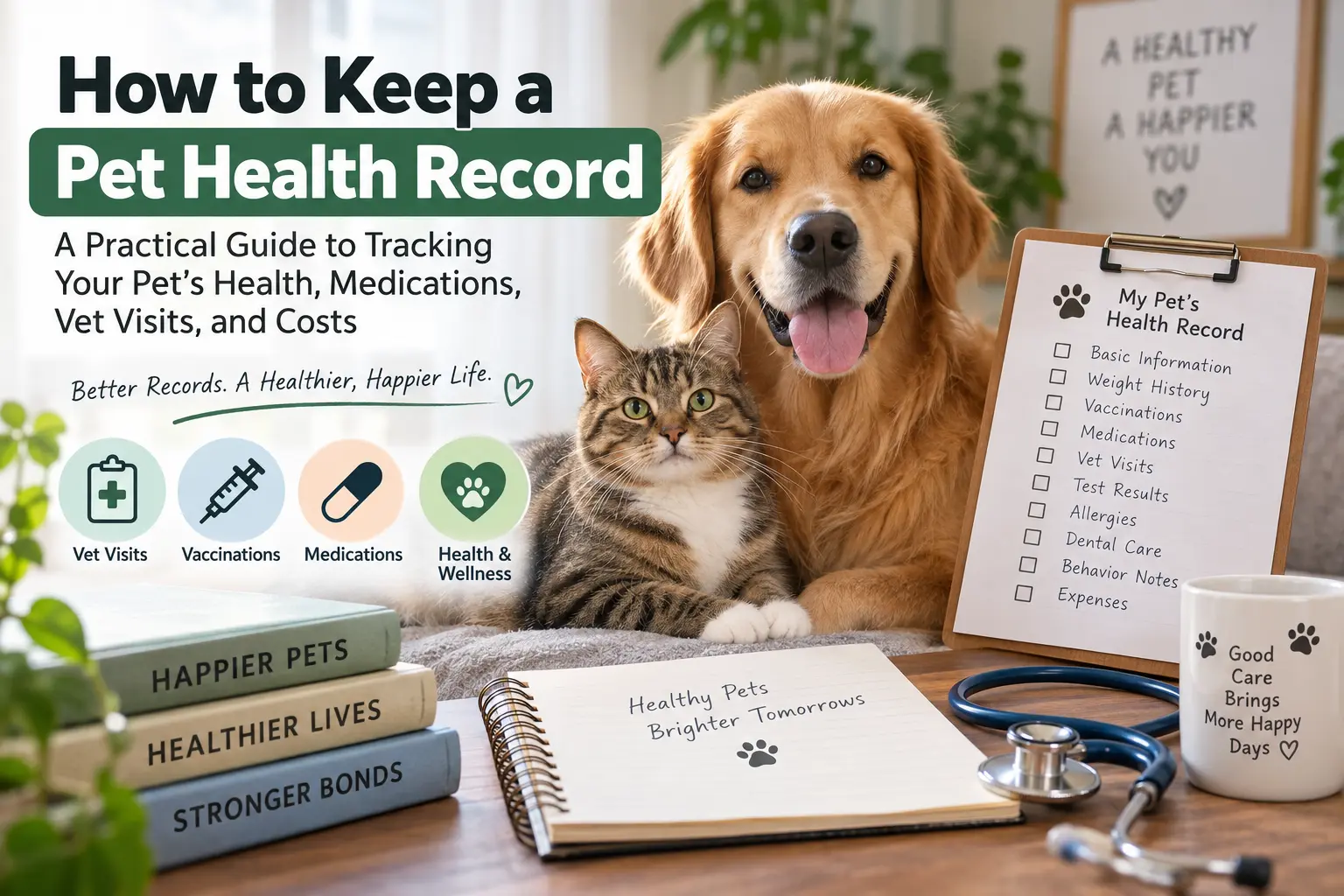
A pet can seem perfectly healthy while small changes are happening in the background.
Maybe your dog has started drinking slightly more water. Your cat is sleeping longer than usual. A medication was changed three months ago, but you cannot remember the exact dose. Or your veterinarian asks when your pet last received a particular vaccine, and you have to search through old emails, receipts, and text messages to find the answer.
These situations are common.
One of the simplest ways to make pet healthcare easier is to maintain a personal health record for your dog or cat.
A pet health record does not replace veterinary care. Instead, it gives you an organized history that can help you and your veterinarian understand what has changed over time.
The American Veterinary Medical Association (AVMA) notes that veterinary records can include preventive care such as vaccinations, heartworm testing, preventive medications, deworming, weight, illnesses, procedures, and medication reactions.
This guide explains what to record, how to organize it, what information is most useful during a veterinary visit, and how keeping better records can also make unexpected pet expenses easier to manage.
Important: This article is for general educational purposes. It is not a diagnosis or treatment guide. If your pet appears seriously ill, injured, or in distress, contact a veterinarian or emergency veterinary service.
Why a Pet Health Record Is More Useful Than Most Owners Expect
Many owners think health records are something the veterinary clinic handles.
The clinic should maintain medical records, but having your own organized copy can still be extremely useful.
Imagine a common situation.
You take your eight-year-old dog to a new veterinary clinic after moving to another city. The veterinarian asks:
- What medications has your dog taken?
- When was the last vaccination?
- Has your dog ever had an allergic reaction?
- What was your dog’s previous weight?
- When was the last blood test?
- Has your dog ever had surgery?
- What happened during the previous illness?
If you have kept a health record, you do not have to rely entirely on memory.
You can provide dates, medication names, previous results, and other useful information.
This becomes particularly valuable when pets move between veterinary clinics, when an emergency occurs outside normal business hours, or when more than one family member participates in their care.
What Should a Pet Health Record Include?
You do not need complicated software.
A notebook, spreadsheet, cloud document, or dedicated pet-management app can work.
The important thing is consistency.
At minimum, organize your record into the following sections.
1. Basic Pet Information
Start with information that identifies your pet.
Record:
- Pet’s name
- Species
- Breed or breed mix
- Sex
- Date of birth or estimated age
- Color and identifying markings
- Microchip number, if applicable
- Adoption or purchase date
- Current veterinarian
- Veterinary clinic phone number
- Emergency veterinary clinic information
Keep a recent photograph with the record.
This can be particularly useful if your pet becomes lost.
The AVMA also recommends maintaining identifying information and keeping microchip registration information current.
2. Weight History
Weight is one of the easiest health measurements for an owner to track.
Instead of recording only the current weight, create a simple history.
| Date | Weight | Notes |
|---|---|---|
| January 10 | 52 lb | Routine check |
| April 12 | 50.8 lb | Eating normally |
| July 15 | 48.9 lb | Vet recommended monitoring |
| October 20 | 49.5 lb | Follow-up |
The numbers above are only an example.
Your pet’s appropriate weight depends on factors such as species, breed, age, body condition, and individual health.
The important point is the trend, not simply one number.
A gradual change may be more informative than a single measurement.
AAHA preventive-care guidance specifically emphasizes regular assessment of body condition and weight management.
3. Vaccination Records
Create a dedicated vaccination section.
Include:
- Vaccine name
- Date administered
- Veterinary clinic
- Next recommended date, if provided
- Certificate number or documentation when applicable
- Any reaction that occurred afterward
Do not create your own vaccination schedule based solely on an online article.
Vaccination recommendations can depend on the animal’s species, age, lifestyle, location, exposure risk, and other factors.
For example, AAHA’s canine vaccination guidance distinguishes core vaccines from additional vaccines that may be appropriate based on an individual dog’s lifestyle and risk factors.
That is why your record should document what your veterinarian recommended rather than trying to replace professional advice.
4. Medication History
Medication records are extremely important.
For every medication, record:
- Medication name
- Strength
- Dose prescribed
- Frequency
- Start date
- End date, if applicable
- Reason it was prescribed
- Veterinarian’s instructions
- Any suspected adverse reaction
For example:
| Medication | Purpose | Instructions | Start | End |
|---|---|---|---|---|
| Example medication | Example condition | As prescribed | May 2 | May 12 |
Do not copy a medication schedule from another pet or change a dose because another animal received a different amount.
Two animals with apparently similar symptoms can have very different medical needs.
If you are uncertain about a medication, contact the prescribing veterinarian.
5. Allergies and Previous Reactions
Create a section specifically for reactions.
Record anything your veterinarian has identified as important, including:
- Medication reactions
- Vaccine reactions
- Food sensitivities or confirmed allergies
- Environmental allergies
- Previous anesthesia reactions
- Other clinically significant reactions
This information can become particularly important if your pet needs treatment at a different clinic.
A short note such as:
“Previous reaction reported after medication X — veterinarian advised avoiding it”
can be much easier to communicate than trying to remember the details during a stressful appointment.
6. Veterinary Visit History
After every veterinary visit, record the basic details.
You do not need to reproduce the entire medical chart.
A useful summary might include:
Date: September 4, 2026
Reason: Annual examination
Weight: 51.2 lb
Main findings: Dental tartar noted
Tests: Bloodwork discussed
Treatment: None at visit
Follow-up: Dental evaluation recommended
This makes it easier to understand your pet’s healthcare history.
AAHA/AVMA preventive-care guidance emphasizes regular examinations and individualized healthcare based on factors such as life stage and lifestyle.
7. Laboratory and Diagnostic Results
If your veterinarian performs bloodwork, urine testing, imaging, or another diagnostic test, keep a copy of the report.
Do not only record:
“Blood test normal.”
Keep the actual report when possible.
Over time, previous results can provide useful comparison points for your veterinarian.
For example, a veterinarian may be interested in how a measurement has changed rather than whether today’s result is simply within a reference range.
Store:
- Test date
- Type of test
- Laboratory or clinic
- Results
- Veterinarian’s interpretation
- Recommended follow-up
8. Dental Health
Dental care is often forgotten when owners think about overall pet health.
Keep notes about:
- Dental examinations
- Professional cleanings
- Dental procedures
- Tooth extractions
- Oral medications
- At-home dental routine
- Any dental problems identified by your veterinarian
AAHA identifies dental care as an important component of preventive healthcare for dogs and cats.
If your veterinarian recommends a dental procedure, keep the estimate and final invoice with your records as well.
That helps you understand both the medical history and the financial history.
9. Changes in Behavior
Behavior can sometimes provide useful health information.
Your record might include observations such as:
- Sleeping more than usual
- Reduced appetite
- Changes in drinking
- Increased hiding
- New aggression
- Changes in bathroom habits
- Reduced interest in normal activities
- Difficulty climbing stairs
- Changes in interaction with family members
A behavior change does not automatically mean your pet is sick.
But documenting when the change started and how it progressed can help your veterinarian investigate it.
AAHA’s preventive-care guidance specifically encourages owners to discuss behavior changes with their veterinarian because some behavioral changes can have underlying medical causes.
A Real-Life Example: Why Dates Matter
Consider a fictional but realistic example.
A seven-year-old cat named Luna begins sleeping more frequently.
Her owner initially assumes she is simply getting older.
Instead of ignoring it, the owner adds a note:
March 3: Sleeping more than normal. Appetite appears normal.
A week later:
March 10: Still sleeping more. Playing less in the evening.
Two weeks later:
March 17: Appetite slightly reduced.
When Luna visits the veterinarian, the owner can explain that the change has been occurring for approximately two weeks rather than simply saying:
“She hasn’t seemed herself lately.”
That difference can make a veterinary conversation much more useful.
The record does not diagnose Luna.
It simply provides better information.
How Health Records Can Save Money
A health record is not a substitute for pet insurance, emergency savings, or veterinary care.
But good records can help you make better financial decisions.
Suppose your pet has had:
- Repeated skin problems
- Several previous medications
- A previous diagnostic test
- A recurring dental issue
When planning future expenses, that history may help you understand that your pet’s healthcare budget should be different from the budget for a young, healthy animal with no significant medical history.
It can also help you avoid unnecessary duplication.
For example, if you have a copy of a recent test report, you can show it to a new veterinarian rather than relying on memory about what was previously done.
Whether a test should be repeated is ultimately a veterinary decision, but having accurate records gives the veterinarian more information to work with.
Keep Your Pet’s Health Records Together With Your Emergency Fund Plan
Medical records and financial preparation work particularly well together.
Your health record tells you what has happened.
Your emergency fund helps you prepare for what might happen next.
If you are building an emergency savings plan for your pet, our guide on how much to save in a pet emergency fund can help you think through the financial side.
You can also use our pet emergency fund calculator to build a more structured savings target.
A Simple Monthly Pet Health Check-in
You do not need to spend an hour updating your record every week.
A simple monthly review can take only a few minutes.
Ask yourself:
Physical
- Has my pet’s weight changed?
- Is appetite normal?
- Is water consumption noticeably different?
- Does my pet move normally?
- Have I noticed any persistent changes?
Behavior
- Is my pet behaving normally?
- Has sleep changed?
- Has activity changed?
- Are there new behavioral concerns?
Healthcare
- Are any medications currently being used?
- Is a veterinary appointment due?
- Are any follow-up tests pending?
- Are vaccination or parasite-control recommendations due for review?
Financial
- What veterinary expenses occurred this month?
- Are there upcoming planned expenses?
- Is my emergency fund still adequate for my situation?
This is not a medical examination.
It is simply a record-keeping habit.
Create a One-Page Emergency Pet Information Sheet
In addition to your full health record, create a one-page summary.
Keep it on your phone and print a copy for your home emergency kit.
Include:
Pet name:
Species/breed:
Age:
Weight:
Microchip number:
Veterinarian:
Veterinary clinic:
Emergency clinic:
Current medications:
Known allergies/reactions:
Major medical conditions:
Important recent procedures:
Insurance provider/policy information, if applicable:
Emergency contact person:
This summary can be particularly useful when you’re stressed and need information quickly.
The AVMA recommends keeping important veterinary documents and medical information accessible as part of emergency preparedness.
Digital vs. Paper Pet Health Records
Both systems can work.
Digital record
Advantages:
- Easy to update
- Searchable
- Easy to back up
- Can store photographs and PDF reports
- Available from your phone
Disadvantages:
- Requires a device
- Files can become disorganized
- You need reliable backups
Paper record
Advantages:
- Simple
- No technology required
- Easy to keep with emergency documents
Disadvantages:
- Can be lost
- Difficult to search
- Medical reports can become bulky
Best approach: use both
Keep a digital master record and a short printed emergency summary.
That gives you redundancy without creating unnecessary work.
How Often Should You Update a Pet Health Record?
Update it whenever something meaningful happens.
For example:
- Veterinary appointment
- New diagnosis
- New medication
- Medication stopped
- Vaccine administered
- Diagnostic test completed
- Surgery
- Significant reaction
- Major weight change
- New veterinarian
- Microchip information change
You do not need to create a new entry every time your dog eats dinner or your cat takes a nap.
The goal is useful information, not excessive documentation.
What Not to Put in Your Pet Health Record
Avoid turning your health record into a collection of unverified internet diagnoses.
For example, avoid writing:
“My dog definitely has kidney disease.”
unless a veterinarian has actually diagnosed it.
Instead write:
“Drinking more water than usual since June 10; discussed with veterinarian on June 15.”
That distinction is important.
A personal record should document observations and verified medical information, not replace professional diagnosis.
Questions to Ask at Your Next Veterinary Visit
Bring your record and ask practical questions.
For example:
- Is my pet’s current weight appropriate?
- Have you noticed any changes compared with previous visits?
- Are any tests recommended based on age or lifestyle?
- Which preventive treatments are appropriate for my pet?
- Are there any symptoms I should monitor at home?
- When should we schedule the next follow-up?
- Which records should I keep for future visits?
- Are there any changes I should make to my pet’s diet or activity?
- What signs would require earlier veterinary attention?
- Can I receive copies of the test results or treatment records?
These questions turn the health record into a communication tool rather than simply a storage folder.
When a Health Record Is Especially Valuable
A detailed record can be particularly helpful when:
You adopt a new pet
You may receive vaccination or medical documents from the shelter, rescue organization, breeder, or previous owner.
Organize them immediately.
You change veterinarians
Your own copy provides useful background while records are transferred.
You travel
Some destinations require specific documentation, vaccinations, certificates, or other health information.
Your pet develops a chronic condition
Tracking appointments, medications, symptoms, and test results becomes more important over time.
Multiple people care for the pet
A shared record prevents one family member from accidentally missing important information.
Your pet has an emergency
You may not remember everything under stress.
A one-page summary can help communicate essential information quickly.
A Simple Pet Health Record Template
You can create the following structure in a spreadsheet:
| Section | What to record |
|---|---|
| Pet profile | Name, breed, age, sex, microchip |
| Weight | Date + weight |
| Veterinary visits | Date, reason, findings, follow-up |
| Vaccinations | Vaccine, date, next recommendation |
| Medications | Name, dose, reason, dates |
| Tests | Test, date, results, notes |
| Dental | Exams, cleanings, procedures |
| Allergies/reactions | Substance + reaction |
| Behavioral changes | Date + observation |
| Major illnesses | Diagnosis + treatment |
| Emergency information | Vet + emergency clinic |
| Insurance | Provider + policy information |
| Expenses | Date + category + amount |
The purpose is not to create another complicated household project.
It is to make important information easy to find when you actually need it.
How Good Records Improve Pet-Owner Decision Making
One of the biggest advantages of keeping a health record is that it changes your decisions from memory-based decisions to information-based decisions.
Instead of:
“I think we had that test last year.”
you can check the date.
Instead of:
“I think the medication caused a reaction.”
you can look at the medication history and discuss it with your veterinarian.
Instead of:
“Vet bills seem to be getting higher.”
you can review actual spending over the previous six or twelve months.
This is particularly valuable for households trying to balance responsible pet care with a realistic budget.
Final Takeaway
A pet health record does not need to be complicated.
Start with five things:
- Basic identification information
- Veterinary visits
- Medications and reactions
- Vaccinations and test results
- Important changes in weight, behavior, or health
Then keep the information updated.
Professional veterinary organizations emphasize preventive healthcare, individualized care plans, regular examinations, vaccination, parasite control, dental care, nutrition, and monitoring.
Your own record supports that process by making your pet’s history easier to understand and communicate.
The goal isn’t to become your pet’s veterinarian.
The goal is to become a better-informed pet owner who can provide accurate information when professional care is needed.
Sources & Further Reading
For authoritative veterinary information, consult:
- American Animal Hospital Association (AAHA) – Preventive Healthcare Guidelines
- American Veterinary Medical Association (AVMA) – Pet Ownership & Health Guidance
Medical disclaimer: This article provides general educational information and should not be used to diagnose, treat, or manage a pet’s medical condition. Veterinary recommendations can vary according to species, age, breed, lifestyle, location, and individual health history. When you are concerned about your pet’s health, consult a qualified veterinarian.
