

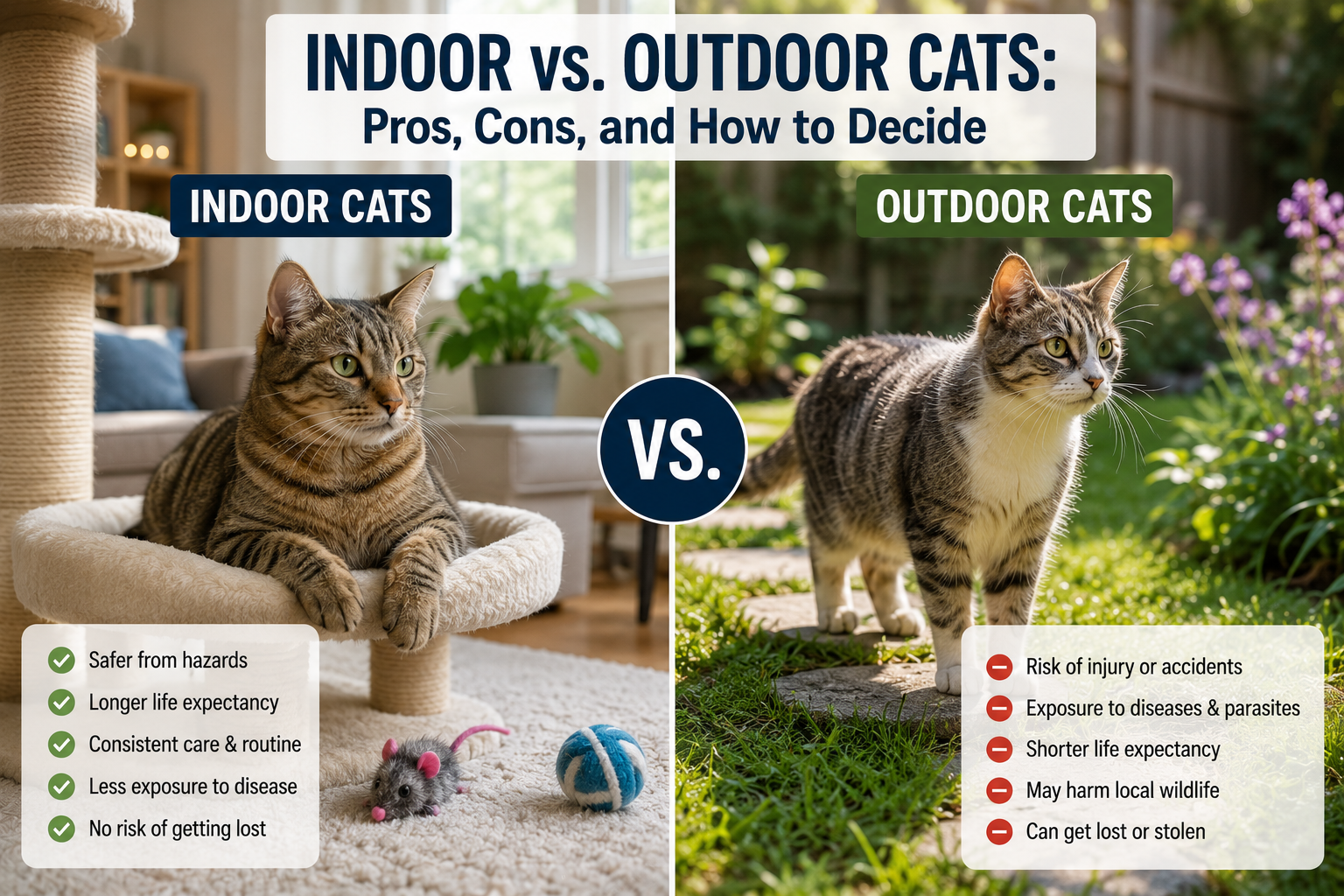
Few pet ownership decisions generate as much genuine debate as whether a cat should live indoors, roam outdoors, or split time between the two. Cat owners tend to hold strong opinions on this topic, often shaped by how they themselves grew up around cats, and both sides make real points worth taking seriously. The honest answer is that this isn’t a simple right-or-wrong choice — it involves real tradeoffs around safety, lifespan, behavior, and quality of life that deserve a clear-eyed look rather than a purely emotional one.
This guide walks through the genuine pros and cons of indoor versus outdoor living for cats, what the veterinary and conservation communities actually say about the tradeoffs, and how to think through the decision for your own cat and household. It includes a side-by-side comparison table, answers to common questions, and links to trusted resources for anything you’d like to explore further.
The Core Tradeoff: Safety and Lifespan vs. Natural Behavior
At the heart of this debate is a genuine tension. Indoor cats face significantly fewer physical dangers and tend to live considerably longer, while outdoor access allows cats to express natural behaviors — hunting, exploring, marking territory — that many owners believe contribute meaningfully to a cat’s quality of life. Neither side of this tradeoff is imaginary, which is exactly why the decision deserves careful thought rather than a simple default.
The Case for Keeping Cats Indoors
Significantly Longer Lifespan
This is the most consistently cited difference between indoor and outdoor cats, and it isn’t a minor gap. Various veterinary and research sources put average indoor cat lifespans somewhere in the range of 10 to 17 years, sometimes well beyond 20 with excellent care, compared to an average outdoor or free-roaming lifespan frequently cited in the range of 2 to 5 years. Estimates vary somewhat by source and methodology, but the direction and scale of the difference is remarkably consistent across the veterinary and research literature.
Reduced Risk of Injury and Death
The American Veterinary Medical Association has stated directly that free-roaming cats face a reduced life span and are exposed to injury, suffering, and death from vehicles, attacks from other animals, human cruelty, poisons, traps, and extreme weather. Indoor cats simply aren’t exposed to most of these specific risks in the first place.
Lower Risk of Infectious Disease
Outdoor cats face meaningfully higher exposure to infectious diseases transmitted through contact with other cats or wildlife, including feline leukemia virus, feline immunodeficiency virus, and various parasites, since disease transmission often requires direct contact or shared territory with other animals.
No Contribution to Wildlife Predation
Outdoor domestic cats are effective, instinctive predators, and their cumulative impact on wild bird and small mammal populations is a significant conservation concern, distinct from any individual cat’s behavior or intent. The American Bird Conservancy’s Cats Indoors program documents this impact in detail and offers practical solutions, including catios and secure enclosures, for owners who still want to provide some outdoor experience.
The Case for Outdoor Access
Natural Behavioral Expression
Cats are natural hunters and explorers, and outdoor access allows for behaviors — stalking, climbing, extended territory exploration — that are difficult to fully replicate indoors, even with dedicated enrichment. Some owners and behaviorists argue that this natural expression contributes meaningfully to a cat’s psychological well-being.
Reduced Risk of Indoor-Specific Health Issues
Indoor cats face their own set of health challenges, particularly obesity and related conditions like diabetes and joint problems, largely driven by reduced physical activity compared to a more naturally active outdoor lifestyle. Indoor cats also sometimes develop stress-related behaviors — like over-grooming or destructive scratching — that can result from insufficient environmental stimulation.
More Physical Activity
Outdoor cats generally get considerably more incidental exercise through natural exploration, climbing, and hunting behavior than the average indoor cat gets through toys and play sessions alone, particularly in households where dedicated enrichment time is inconsistent.
The Middle Ground: Supervised and Enclosed Outdoor Access
For many owners, the most practical answer isn’t a strict either-or choice. A growing number of cat owners are turning to controlled outdoor access options that aim to capture some of outdoor living’s benefits while minimizing its most serious risks:
- Catios: Enclosed outdoor structures, ranging from small window boxes to elaborate multi-level enclosures, that give cats safe outdoor access, fresh air, and sensory stimulation without the risks of free roaming.
- Leash and harness training: Some cats can be gradually trained to walk on a harness and leash, providing supervised outdoor time under an owner’s direct control.
- Secure yard modifications: Cat-proof fencing systems and specialized barriers can convert an existing yard into a contained outdoor space, preventing escape while still allowing outdoor access.
- Cat strollers and backpacks: For cats who don’t adapt well to a harness, an enclosed stroller or carrier-style backpack offers outdoor sensory experience with full physical containment.
This middle-ground approach has gained meaningful traction among both veterinary organizations and wildlife conservation groups, since it directly addresses the core risks associated with unsupervised free-roaming access — vehicle strikes, predator encounters, disease transmission, and wildlife predation — while still offering many of outdoor access’s behavioral and enrichment benefits.
Indoor vs. Outdoor: A Side-by-Side Comparison
| Factor | Indoor Cats | Outdoor Cats |
|---|---|---|
| Average lifespan | Roughly 10–17+ years | Roughly 2–5 years |
| Risk of vehicle injury | Minimal to none | Significant |
| Risk of predator attack | Minimal to none | Present, varies by region |
| Infectious disease exposure | Lower | Higher |
| Natural behavior expression | Requires deliberate enrichment | More readily available |
| Physical activity level | Depends heavily on owner effort | Generally higher, incidental |
| Risk of obesity | Higher without enrichment | Lower |
| Impact on local wildlife | Minimal | Significant |
| Weather exposure | None | Full exposure |
| Escape/loss risk | Low | Higher |
This comparison reflects general patterns rather than guarantees for any individual cat — a well-enriched indoor cat can be extremely active and content, and a supervised, contained outdoor cat faces meaningfully lower risk than a fully free-roaming one.
Common Misconceptions in the Indoor vs. Outdoor Debate
A few widely repeated claims tend to muddy this discussion more than clarify it, and it’s worth addressing them directly.
“Cats Need to Go Outside to Be Truly Happy”
This claim is often stated as an absolute fact, but it doesn’t hold up consistently across individual cats. Many cats, particularly those raised indoors from kittenhood, show no persistent interest in going outside and thrive with sufficient indoor enrichment. Others clearly do show a strong drive toward outdoor stimulation. The honest answer is that this varies meaningfully by individual cat rather than being a universal feline need.
“Indoor Cats Are Always Safer, Full Stop”
While indoor cats face dramatically lower risk from external hazards, an indoor environment without adequate enrichment carries its own genuine welfare concerns — obesity, stress-related behavior issues, and reduced physical conditioning are all real risks specific to an under-stimulated indoor lifestyle. “Indoor” alone doesn’t guarantee good welfare; the quality of that indoor environment matters just as much as the decision itself.
“One Bad Outdoor Cat Experience Means All Outdoor Access Is Reckless”
Fully unsupervised, unrestricted free-roaming access carries meaningfully more risk than supervised, contained outdoor access through a catio, secure yard enclosure, or leash training. Lumping every form of outdoor exposure together obscures a genuinely important distinction between “roaming freely with no containment” and “spending time outside under safe, controlled conditions.”
“Indoor-Outdoor Cats Get the Best of Both Worlds”
Cats with unrestricted access to come and go — often through a cat door — do get more natural behavioral expression than a fully indoor cat, but they’re still exposed to essentially the same major risks (traffic, predators, disease, weather) as a fully outdoor cat during the time they spend outside unsupervised. This arrangement doesn’t meaningfully reduce those core risks; it simply reduces the total amount of time exposed to them.
How Age and Health Status Affect the Decision
A cat’s age, health status, and history also meaningfully shape whether outdoor access makes sense.
Kittens
Very young kittens are especially vulnerable to predators, traffic, and disease exposure, and most veterinarians recommend keeping kittens indoors, or providing only closely supervised, contained outdoor time, until they’re fully vaccinated and more physically capable of navigating hazards.
Senior Cats
Older cats often have reduced mobility, slower reaction times, and a higher likelihood of underlying health conditions that make outdoor risks — including extreme temperature exposure and physical injury — more dangerous than they would be for a younger, healthier cat.
Cats With Chronic Health Conditions
Cats managing conditions like diabetes, kidney disease, or mobility issues generally do better with the consistency and closer monitoring an indoor environment allows, since outdoor time makes it harder to track appetite, hydration, and general condition day to day.
Rescued or Formerly Feral Cats
Cats with a significant outdoor or feral history sometimes struggle more with a purely indoor transition and may benefit from a gradual approach that includes some contained outdoor access, such as a catio, rather than an abrupt, complete transition to indoor-only living.
Practical Enrichment Tips for a Thriving Indoor Cat
If you decide on a primarily or fully indoor lifestyle, a few practical enrichment strategies meaningfully improve quality of life:
- Vertical space: Cat trees, shelves, and window perches give cats the vertical territory and observation points they naturally seek.
- Rotating toys: Regularly rotating a modest toy collection keeps novelty high without requiring a large number of toys at once.
- Puzzle feeders: These engage natural foraging instincts and slow down eating, which can help address both boredom and weight management simultaneously.
- Window access: A secure window perch with a view of outdoor activity offers meaningful passive stimulation for many cats.
- Scheduled interactive play: Regular, dedicated play sessions using wand toys or similar interactive options help satisfy natural hunting instincts in a controlled, indoor-safe way.
How to Make the Right Decision for Your Cat
Consider Your Location
Urban and suburban environments with heavy traffic, high predator density (coyotes, birds of prey), or busy roads generally present significantly higher risk for outdoor cats than quieter, rural settings might. Local wildlife regulations and neighborhood norms also vary considerably and are worth researching before deciding.
Consider Your Cat’s Individual Temperament
Some cats show little interest in going outdoors at all and settle happily into an enriched indoor life, while others display persistent, high-intensity signs of wanting outdoor access — repeated attempts to escape, fixation on windows and doors, or general restlessness that indoor enrichment doesn’t fully resolve.
Consider Your Ability to Provide Indoor Enrichment
If you choose the indoor route, be honest about your ability to actually provide the mental and physical stimulation that makes indoor life genuinely fulfilling — scratching posts, climbing structures, regular interactive play, window perches, and rotating toys all meaningfully offset the tradeoffs of a purely indoor lifestyle.
Consider a Gradual, Contained Approach
If you’re drawn to giving your cat some outdoor experience without full free-roaming risk, starting with a catio, secure yard enclosure, or gradual leash training often satisfies much of the underlying desire for outdoor stimulation while keeping the most serious risks meaningfully contained.
Talk to Your Veterinarian
Your veterinarian knows your specific cat’s health history, temperament, and regional risk factors, and can offer guidance tailored to your individual situation rather than a generic recommendation.
What to Do If You Already Have an Outdoor Cat
If you currently have a cat with established outdoor access and are considering transitioning to an indoor or contained lifestyle, a gradual approach tends to work far better than an abrupt change. Start by reducing outdoor time incrementally, add substantial indoor enrichment before removing outdoor access entirely, and consider a catio or enclosed space as a bridge that maintains some outdoor sensory experience while meaningfully reducing risk. Cats accustomed to full outdoor freedom can experience real stress during this transition, so patience and a gradual pace generally produce a smoother, more successful outcome.
Frequently Asked Questions
Do indoor cats really live that much longer than outdoor cats? Yes, based on consistently cited veterinary and research estimates. While exact figures vary by source, indoor cats are commonly reported to live roughly 10 to 17 years or more, compared to an average outdoor lifespan frequently cited in the 2-to-5-year range, driven largely by the additional risks outdoor cats face.
Is it cruel to keep a cat entirely indoors? Not inherently, provided the indoor environment includes adequate mental and physical enrichment. Many indoor cats live long, content lives with appropriate stimulation, though a purely indoor environment without deliberate enrichment can contribute to boredom-related behavior issues.
What’s a catio, and is it worth the investment? A catio is an enclosed outdoor structure that gives cats safe, contained outdoor access without the risks of free roaming. Many owners find it offers a meaningful middle ground, capturing much of the benefit of outdoor stimulation while substantially reducing the most serious risks.
Can an outdoor cat be transitioned to indoor living? Yes, though it generally works best as a gradual process rather than an abrupt change, paired with meaningful indoor enrichment to help offset the loss of outdoor stimulation.
Do outdoor cats really have a significant impact on wildlife? Yes. Outdoor domestic cats are effective natural predators, and their cumulative impact on wild bird and small mammal populations is a well-documented conservation concern independent of any individual cat’s specific behavior.
Is leash training realistic for most cats? It varies considerably by individual cat. Some cats adapt well to a harness and leash with gradual, positive introduction, while others show little tolerance for it regardless of training approach. It’s worth trying gradually and without pressure, but isn’t guaranteed to work for every cat.
What breeds or types of cats do best indoors? Most cats, regardless of breed, can adapt well to an indoor lifestyle given sufficient enrichment, though individual temperament varies more than breed does. Cats accustomed to outdoor access from a young age sometimes show a stronger drive toward outdoor stimulation than cats raised indoors from kittenhood.
Budgeting for Either Lifestyle
Whichever path you choose, both indoor and outdoor cat lifestyles come with distinct cost considerations — enrichment items and a catio setup for indoor cats, versus potentially higher veterinary costs from injury or illness for cats with outdoor access. If you’re weighing these costs as part of your broader decision, our guide to general pet budgeting and cost planning can help you think through the full financial picture alongside the safety and lifestyle tradeoffs discussed here.
Conclusion
There’s no universally correct answer to whether a cat should live indoors, outdoors, or somewhere in between — but there is a clear, well-documented set of tradeoffs worth understanding before you decide. Indoor cats face significantly lower physical risk and tend to live considerably longer, while outdoor access offers natural behavioral expression that’s genuinely harder to fully replicate indoors. For many owners, a middle-ground approach — a catio, secure yard enclosure, or supervised leash time — offers a practical way to capture much of the benefit of outdoor stimulation while substantially reducing the most serious risks. Whatever you decide, the right choice is the one that accounts honestly for your specific cat’s temperament, your local environment, and your genuine ability to provide enrichment, rather than defaulting to whatever felt normal growing up around cats.
Disclaimer
This article is intended for general informational and educational purposes only and does not constitute veterinary or professional advice. Individual circumstances, regional risk factors, and each cat’s specific temperament and health status vary considerably. Consult a licensed veterinarian for guidance tailored to your specific cat and living situation.
