

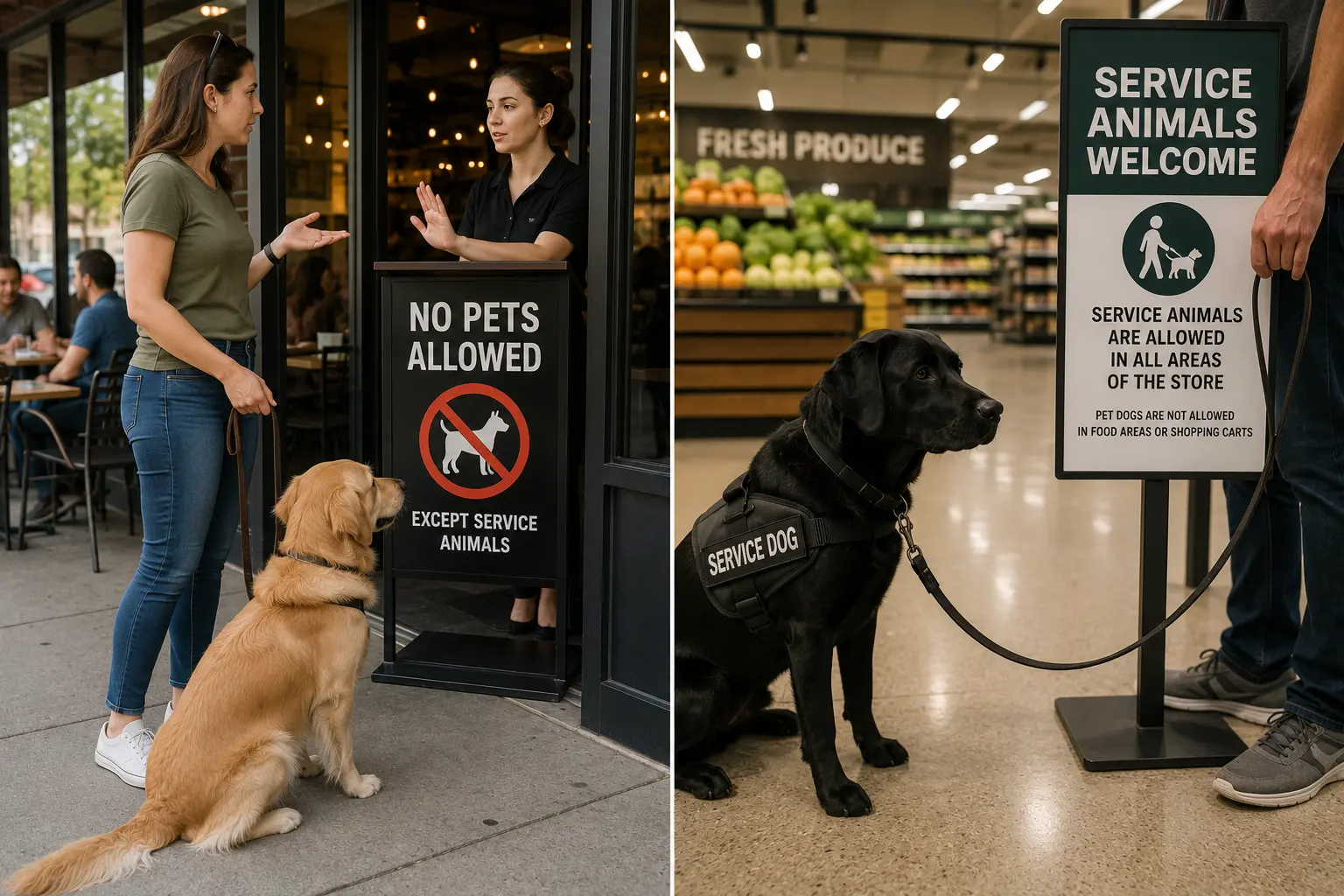
Few situations trigger more confusion — and more heated front-door disputes — than bringing a dog into a restaurant or grocery store. Employees often cite “health codes” as though they automatically ban all animals, while some customers assume any dog with a vest gets automatic access. Neither assumption is quite right. Federal food safety law and federal disability law actually work together here, carving out a specific, well-defined exception that many business owners and employees genuinely don’t know exists.
This guide breaks down exactly what the law says about dogs in restaurants and grocery stores, where the food-safety exception ends, and what both business owners and dog owners need to know to avoid an unnecessary confrontation.
The Starting Point: Health Codes Do Ban Animals — With One Key Exception
It’s true that food safety regulations generally prohibit animals in restaurants and grocery stores. The FDA Food Code, the model regulation that most state and local health departments adopt or closely mirror, states that live animals may not be allowed on the premises of a food establishment — but immediately carves out specific exceptions to that general rule.
The most important exception for this discussion: service animals. The FDA Food Code aligns directly with the ADA’s definition, treating a service animal as a dog individually trained to perform tasks directly related to a person’s disability. Under this framework, a legitimate service animal is not treated as an “animal” for health code purposes in the way a pet is — it’s treated as an extension of its handler’s disability accommodation, which is why the general animal ban doesn’t apply to it.
This means employees who cite “health code” as an automatic reason to exclude any dog are only telling half the story. The health code itself contains the very exception that protects a legitimate service animal’s access.
Where Service Animals Are Allowed in Restaurants
Under this combined ADA and food-code framework, service animals are generally permitted anywhere the public is normally allowed in a restaurant, including:
- Indoor dining rooms
- Outdoor patio and sidewalk seating areas
- Waiting areas and host stands
- Restrooms open to customers
Where Service Animals Are Not Allowed — The Genuine Exceptions
The food-code exception has real limits, and they’re specifically tied to food preparation and storage, not to the presence of customers generally. Areas typically off-limits to service animals in a restaurant include:
- Kitchens and food preparation areas
- Dry food storage rooms
- Walk-in coolers and freezers
- Dishwashing areas
These restrictions exist for a straightforward reason: they’re about protecting food that’s actively being prepared or stored, not about excluding the dog from the establishment altogether. A service animal remaining at its handler’s feet in the dining room, nowhere near actual food preparation, doesn’t implicate these health code concerns at all.
Grocery Stores Work the Same Way — With a Few More Moving Parts
Grocery stores operate under the identical FDA Food Code framework, which means a legitimate service animal generally has the same right to accompany its handler through customer shopping areas — produce, the bakery, the deli line, and general aisles — as it would in a restaurant’s dining room.
One additional rule specific to grocery shopping deserves attention: the ADA specifically addresses self-service food lines, such as buffets, salad bars, or bulk food bins. Service animals must be allowed to accompany their handlers through these areas and cannot be excluded from communal self-service sections, though the ADA does not require that the animal be permitted to sit on chairs or be fed at customer tables where food is served.
Grocery stores are frequently cited as one of the more difficult environments for legitimate service animal handlers, largely because employees trained heavily on general food-safety anxiety are less likely to know the specific service-animal exception exists, and because a service animal accompanying someone without an obviously visible disability sometimes draws more scrutiny from staff.
What Businesses Can and Cannot Ask
Regardless of the specific area of a restaurant or grocery store, staff are limited to the same two permitted questions used across all ADA public accommodations, if it’s not obvious what task the animal performs:
- Is the animal required because of a disability?
- What work or task has the animal been trained to perform?
Staff cannot demand documentation, ask about the specific disability, require the animal to demonstrate its task, or insist on registration, certification, or a vest — none of which are legally required under federal law. Employees also cannot isolate the handler to a specific section of the restaurant or charge a pet fee or cleaning surcharge specifically because of the service animal’s presence, even if the establishment normally charges such fees for pets. The official ADA.gov Service Animals page lays out this two-question standard directly.
Emotional Support Animals Do Not Receive This Protection
This is a critical distinction that trips up both business staff and customers. Emotional support animals are not considered service animals under the ADA, since they aren’t individually trained to perform a specific disability-related task — they provide comfort simply through their presence. This means a restaurant or grocery store can lawfully deny entry to an ESA, even with a doctor’s note or letter, since ESAs fall entirely outside both the ADA’s service animal definition and the FDA Food Code’s service-animal exception.
When a Business Can Lawfully Remove a Service Animal
Even a legitimate service animal can be asked to leave under two specific, narrow circumstances that apply consistently across all ADA public accommodations:
- The animal is out of control, and the handler doesn’t take effective action to correct the behavior.
- The animal is not housebroken.
Even in these situations, the business is generally expected to offer the person the opportunity to obtain goods or services without the animal present, rather than denying them service entirely. Neither general discomfort from other customers, fear of dogs, nor allergies qualify as valid grounds for exclusion under federal law.
The Fake Service Dog Problem — And Why It Cuts Both Ways
A growing number of states have passed laws specifically penalizing people who misrepresent an ordinary pet as a trained service animal, largely in response to the rise of untrained “emotional support” pets in fake vests purchased online. As of 2026, a majority of states have adopted some version of a misrepresentation law, with penalties ranging from modest civil fines in the low hundreds of dollars to misdemeanor charges carrying fines up to $1,000 and, in a few states, potential jail time for repeat offenses.
This trend matters for legitimate handlers in two ways. First, it gives businesses a genuine legal basis to be cautious, which can occasionally translate into extra scrutiny even for handlers with real service animals. Second, it also protects legitimate handlers — a manager who has previously been misled by a fake service animal now has state law backing them up in confidently applying the correct two-question standard, rather than either over-restricting all dogs or under-enforcing against clearly fraudulent claims.
Notably, no federal registration, certification, or ID card exists for service animals, despite the existence of many commercial websites that sell exactly these products. Purchasing one of these products does not confer any legal status, and relying on one as “proof” doesn’t change how the law actually treats the animal.
What to Do If You’re Wrongly Denied Access
If you’re a legitimate service animal handler and a restaurant or grocery store denies you entry:
- Calmly cite the two-question standard and explain that federal law, along with the FDA Food Code’s specific service animal exception, protects your access.
- Ask to speak with a manager if front-line staff are unfamiliar with the rule.
- Document the incident, including the date, location, and specifics of what was said.
- File a complaint with the U.S. Department of Justice’s Civil Rights Division if the issue isn’t resolved, since ADA Title III violations are enforceable at the federal level.
- Consult a disability rights attorney if the denial caused significant harm or if it’s part of a repeated pattern at the same establishment.
What Restaurants and Grocery Stores Should Do
For business owners and managers, a few practical steps reduce both legal risk and unnecessary customer conflict:
- Train staff specifically on the two-question rule and the FDA Food Code’s service animal exception, rather than relying on a general “no animals” health code assumption.
- Clarify which specific areas are off-limits — food prep, storage, dishwashing — and communicate that the rest of the establishment remains accessible.
- Avoid requesting documentation or certification, since doing so can itself create ADA liability exposure.
- Apply the housebroken/out-of-control standard consistently and narrowly, documenting any exclusion decision carefully.
Final Thoughts
Restaurants and grocery stores are bound by the same core ADA service animal access rules as any other public accommodation, and the FDA Food Code doesn’t override those rights — it specifically incorporates them. A legitimate service animal can generally go anywhere customers are allowed, with the narrow exception of active food preparation and storage areas. Emotional support animals, by contrast, receive no such protection and can be lawfully excluded. Understanding this distinction — and the two permitted questions that govern the entire interaction — resolves the vast majority of disputes that arise at the front door.
This article is intended for general informational purposes and does not constitute legal advice. Regulations can vary by state and locality, so consult the U.S. Department of Justice’s ADA guidance or a licensed attorney for questions specific to your situation.
