

Updated: August 2026
An unexpected veterinary bill can create a difficult financial decision.
A routine visit may be manageable, but emergency surgery, hospitalization, advanced imaging, or specialist treatment can cost hundreds or thousands of dollars. If you don’t have enough savings available, you may start looking for ways to spread the cost over time.
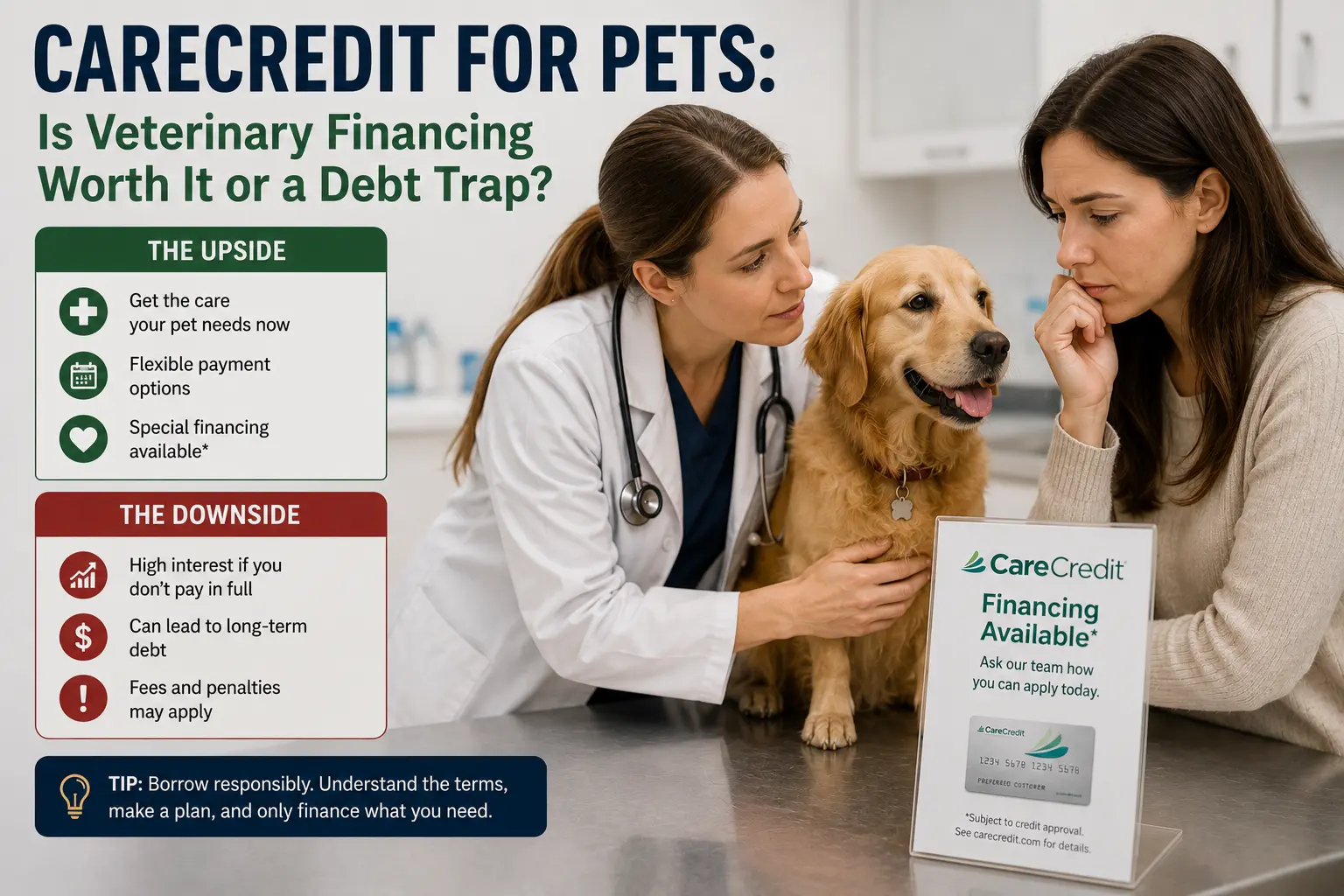
CareCredit is one financing option that some pet owners consider for veterinary expenses.
But financing a veterinary bill is not the same as getting free or inexpensive care. Depending on the promotional offer, purchase amount, repayment period, and whether the balance is paid according to the agreement, you may pay interest or other costs.
This guide explains how CareCredit can be used for eligible veterinary expenses, how promotional financing can work, what questions to ask before using it, and what alternatives you should consider.
Important: This article is educational and is not an endorsement or recommendation of CareCredit. Financing terms, promotional offers, eligibility requirements, fees, and participating providers can change. Always review the current agreement and disclosures before applying or using a financing account.
What Is CareCredit?
CareCredit is a healthcare credit card that can be used for eligible healthcare expenses at participating providers.
Its pet-care program can be used at participating veterinary practices for eligible veterinary services and products.
CareCredit describes its network as covering veterinary care as well as human healthcare categories. Availability and financing terms depend on the provider and the specific account or promotional offer. CareCredit official website
For a pet owner, the basic idea is:
Veterinary bill → eligible CareCredit transaction → repayment according to the account terms
The important point is that CareCredit is a credit product, not an emergency grant or insurance policy.
Can You Use CareCredit for Veterinary Bills?
Potentially, yes.
CareCredit’s veterinary program is designed for eligible expenses at participating veterinary providers.
Depending on the veterinary practice and transaction, eligible expenses may include services such as:
- Veterinary examinations
- Emergency veterinary care
- Surgery
- Dental procedures
- Diagnostic testing
- Hospitalization
- Medications or eligible products
However, you should confirm with the veterinary clinic before treatment that the practice accepts CareCredit and that the particular transaction qualifies under the terms being offered.
Do not assume that every veterinary expense automatically qualifies.
How CareCredit Works for Pet Expenses
The process generally looks like this:
Step 1: Choose a participating veterinary provider
Ask the clinic whether it accepts CareCredit.
Step 2: Receive a treatment estimate
Before financing anything, ask for an itemized estimate.
For example:
| Service | Example Cost |
|---|---|
| Emergency examination | $150 |
| Bloodwork | $250 |
| X-ray | $300 |
| Medication | $100 |
| Hospitalization | $700 |
| Example total | $1,500 |
This is only an example. Your actual veterinary estimate may be very different.
Step 3: Ask which financing promotion applies
CareCredit may offer promotional financing options, but the exact terms depend on the transaction and current offer.
Step 4: Review the terms
Before agreeing, check:
- Promotional period
- APR
- Minimum monthly payment
- Payment due date
- Deferred-interest terms, if applicable
- Regular APR after a promotional period
- Fees or other account terms
Step 5: Make payments on time
Follow the payment schedule and keep track of the promotional expiration date if one applies.
What Does “No Interest” Mean?
This is one of the most important things to understand.
A promotional offer described as “no interest if paid in full within” a specified period is not necessarily the same as a loan with zero interest under all circumstances.
Certain CareCredit promotional plans may use deferred interest.
Under a deferred-interest arrangement, interest can accrue during the promotional period and may become payable if the promotional balance is not paid in full by the required deadline.
The exact terms depend on the account and promotion.
Therefore:
Never assume that making only the minimum payment will pay the promotional balance in full before the deadline.
Read the current account agreement and promotional disclosure before using the offer.
Example: A $2,000 Veterinary Bill
Suppose your veterinary treatment costs:
$2,000
and you receive a promotional financing offer.
Your first question should not simply be:
“How much is the monthly payment?”
Instead, ask:
“How much must I pay each month to make sure the promotional balance is completely paid before the promotional period ends?”
For example, if a $2,000 balance had to be paid in full over 12 months:
$2,000 ÷ 12 = approximately $166.67 per month
This is a simple mathematical illustration—not a statement of CareCredit’s current required payment.
If the promotional period were different, the required amount would change.
Minimum Payment vs. Paying the Balance in Full
This distinction is extremely important.
Suppose your statement says:
Minimum payment: $60
But your promotional balance is:
$2,000
Paying $60 each month may not be enough to eliminate the balance before the promotional deadline.
You therefore need to calculate your own payoff target.
Simple formula
Required monthly payoff = Promotional balance ÷ Number of months remaining
For example:
$2,000 ÷ 10 months = $200/month
Again, this is a budgeting calculation, not the account’s minimum-payment requirement.
What Happens If You Don’t Pay the Promotional Balance in Time?
The answer depends on the exact promotional financing terms.
With deferred-interest financing, failing to pay the promotional balance in full by the deadline can result in interest that accrued during the promotional period becoming payable according to the agreement.
The regular purchase APR may also apply after the promotional period.
Because financing terms can change, use the actual disclosures attached to your account rather than relying on an old article or someone else’s CareCredit experience.
Review CareCredit account terms and disclosures
What Is APR?
APR means Annual Percentage Rate.
It represents the annualized cost of borrowing under the applicable credit terms.
For a credit product, APR matters because a balance carried outside a promotional arrangement can become significantly more expensive than the original veterinary bill.
For example, imagine you finance:
$2,000
If interest applies and the balance takes a long time to repay, your total repayment can exceed $2,000.
The exact amount depends on:
- APR
- Balance
- Payment amount
- Payment timing
- Promotional terms
Never calculate your expected total cost using only the veterinary bill.
Consider the financing cost as well.
CareCredit Is Not Pet Insurance
This is another important distinction.
Pet Insurance
Insurance is designed to help cover eligible veterinary expenses according to the policy.
You pay:
- Premiums
- Possible deductible
- Potential copay/reimbursement difference
The insurer then pays eligible claims according to the policy.
CareCredit
CareCredit is financing.
You receive credit for an eligible purchase and repay the amount according to the credit agreement.
You may still be responsible for the entire financed veterinary expense.
Simple comparison
| Feature | Pet Insurance | CareCredit |
|---|---|---|
| Type | Insurance | Credit |
| Monthly premium | Usually | Not the same concept |
| Helps with eligible covered care | Yes | No — finances the bill |
| Repayment required | Not for insurance reimbursement itself | Yes |
| Deductible | Policy-dependent | Not an insurance deductible |
| Credit account | No | Yes |
| Can help spread payments | Indirectly | Yes |
They solve different financial problems.
CareCredit vs. Paying From Savings
If you already have enough emergency savings to comfortably pay the veterinary bill, using savings may avoid financing costs.
For example:
Veterinary bill: $2,000
Available pet emergency fund: $3,000
After paying:
$3,000 − $2,000 = $1,000
The disadvantage is that your emergency reserve becomes smaller.
You then need to consider how quickly you can rebuild it.
There is no universally correct answer.
The decision depends on:
- Your remaining savings
- Other household expenses
- Income stability
- Insurance coverage
- Your ability to rebuild savings
- Financing terms
CareCredit vs. Pet Insurance
These options should not be viewed as direct substitutes.
Imagine an eligible veterinary bill of:
$4,000
If you have insurance, your out-of-pocket cost may depend on:
- Deductible
- Reimbursement percentage
- Annual limit
- Covered services
- Exclusions
If you use CareCredit, you may be financing the amount you owe the veterinary provider.
Some pet owners may use insurance and financing together when the insurance reimbursement does not arrive immediately or does not cover the full bill.
Always review your actual insurance policy and financing agreement.
CareCredit vs. a Personal Loan
Another option may be a personal loan.
The comparison should include:
| Factor | CareCredit | Personal Loan |
|---|---|---|
| Designed specifically for healthcare | Yes | Usually no |
| May be available at veterinary provider | Yes, if participating | Usually separate application |
| Promotional financing | Some transactions may offer it | Depends on lender |
| APR | Account/promotion dependent | Lender dependent |
| Repayment period | Terms vary | Terms vary |
| Credit check | May apply | Usually applies |
| Best choice automatically? | No | No |
Do not choose based only on the monthly payment.
Compare the total amount you will repay.
CareCredit vs. a Veterinary Payment Plan
Some veterinary practices may offer their own payment arrangements or financing options.
Before accepting one, ask:
- Is there interest?
- Is there an application fee?
- Is there a late fee?
- How long is the repayment period?
- Is there a credit check?
- What happens if you miss a payment?
- Is the arrangement handled by the clinic or a third-party lender?
A clinic payment arrangement may be simpler in some circumstances, but terms vary widely.
CareCredit Pros
CareCredit can have potential advantages for some pet owners.
1. Immediate Access to Financing
If you face an unexpected veterinary expense and don’t have enough cash available, financing may allow treatment to proceed without paying the entire bill immediately.
2. Promotional Financing May Be Available
Certain transactions may qualify for promotional financing.
However, the details matter.
3. Can Be Used for Eligible Veterinary Care
Participating veterinary practices may accept CareCredit for eligible services.
4. Predictable Payments
A structured repayment schedule can make a large bill easier to incorporate into a monthly household budget.
CareCredit Cons
There are also important risks.
1. It Is Still Debt
You are borrowing money.
The veterinary bill does not disappear.
2. Promotional Terms Can Be Misunderstood
A “no interest if paid in full” promotion can have different consequences from a simple zero-interest loan.
3. Interest Can Increase the Cost
If applicable promotional conditions are not met, interest may become payable according to the account terms.
4. Minimum Payments May Not Be Enough
The minimum payment can be lower than the amount needed to eliminate the promotional balance before the deadline.
5. Credit Matters
Applying for and using a credit product can affect your credit profile depending on the circumstances.
Questions to Ask Before Using CareCredit
Before financing a veterinary bill, ask these questions.
About the promotion
- What promotional financing applies?
- How long is the promotional period?
- Is it deferred interest?
- What happens if I don’t pay the promotional balance in full?
About the payment
- What is my minimum monthly payment?
- How much should I pay monthly to finish before the promotion ends?
- When is the first payment due?
About the account
- What APR applies outside the promotion?
- Are there fees?
- Where can I find the complete account terms?
About your veterinary bill
- What exactly is included in the treatment estimate?
- Could additional diagnostics or treatment increase the bill?
- Is there a less expensive medically appropriate option?
These questions can prevent unpleasant surprises.
A Realistic Financing Example
Imagine your pet needs treatment costing:
$3,600
You have:
$1,100 available in savings.
You could pay the entire bill from savings, but doing so would leave only:
$1,100 − $3,600 = negative $2,500
In other words, your savings are not enough.
You might consider:
Option A: Financing the entire bill
Finance:
$3,600
Option B: Use some savings + finance the remainder
Pay:
$1,100
Finance:
$2,500
Option C: Insurance reimbursement + financing
If you have eligible insurance coverage, the amount ultimately financed may differ depending on how the claim is handled.
Which option is best depends on:
- Your emergency savings
- Insurance
- Financing terms
- Income
- Other debt
- Ability to make monthly payments
There is no universal answer.
Calculate the Monthly Payment You Can Actually Afford
Before financing, look at your household budget.
Suppose your monthly income after taxes is:
$4,000
And your normal monthly expenses are:
$3,400
That leaves:
$600
before considering other irregular expenses.
A new financing payment of $250 may technically fit, but it could leave less room for:
- Rent
- Food
- Utilities
- Existing debt
- Insurance
- Future veterinary care
- Emergency savings
The important question is not:
“Can I make the minimum payment?”
It is:
“Can I comfortably make the required payments without creating another financial emergency?”
Don’t Finance More Than You Need
If your veterinarian provides an itemized treatment estimate, review it carefully.
Ask:
“Which services are medically necessary right now?”
and:
“Which services can safely be scheduled later?”
This does not mean you should refuse recommended treatment simply to reduce a bill.
Instead, ask your veterinarian to explain:
- What is urgent?
- What is time-sensitive?
- What can wait?
- What are the expected benefits and risks?
- What is the estimated cost of each option?
This gives you information for a better financial decision.
What If You Cannot Afford the Treatment?
If you are facing an unaffordable veterinary bill, tell the veterinary team.
Ask about:
- Itemized estimates
- Medically appropriate treatment options
- Payment arrangements
- Financing
- Pet insurance
- Local charitable assistance
- Veterinary teaching hospitals where appropriate
- Lower-cost veterinary providers for non-emergency services
The American Veterinary Medical Association encourages pet owners to discuss costs and payment options with veterinary professionals rather than avoiding care because of uncertainty about price. AVMA Pet Owner Resources
For an emergency, do not delay necessary care while searching for the cheapest possible option.
Build a Pet Emergency Fund Before You Need Financing
The strongest strategy is often preparation.
Suppose you save:
$100/month
After one year:
$1,200
After two years:
$2,400
After three years:
$3,600
You may still encounter an emergency that costs more than your savings, but having a dedicated reserve can reduce the amount you need to finance.
A useful approach is:
Pet emergency savings + appropriate insurance + realistic monthly budgeting
rather than relying entirely on credit.
How Much Should You Save?
There is no universal number that works for every pet.
Your target can depend on:
- Pet’s age
- Existing health conditions
- Number of pets
- Insurance coverage
- Local veterinary prices
- Household income
- Existing savings
- Ability to borrow
For a personalized estimate, start with the emergency-care costs in your local area and decide how much of that potential expense you want to be able to cover from savings.
CareCredit and Your Credit
Because CareCredit is a credit product, it should be treated like other forms of borrowing.
Before applying or using an existing account, understand:
- Whether an application involves a credit inquiry
- Your account’s current APR
- Promotional terms
- Minimum payment requirements
- Payment due dates
- Consequences of missed payments
The effect on your credit profile depends on your individual circumstances and the account activity involved.
If you are concerned about your credit, read the current account disclosures and consider how the new debt fits with your existing obligations.
Common Mistakes to Avoid
Mistake 1: Looking Only at the Monthly Payment
A low monthly payment can make a purchase appear affordable while extending repayment.
Look at the total repayment and promotional deadline.
Mistake 2: Assuming “No Interest” Means “No Risk”
Read the complete promotional terms.
Mistake 3: Ignoring the Promotional Expiration Date
Put the deadline on your calendar.
Mistake 4: Using Your Entire Emergency Fund
Paying a bill with savings may leave you with no reserve for the next emergency.
Mistake 5: Financing Without an Itemized Vet Estimate
You should understand what you’re paying for before borrowing.
Mistake 6: Borrowing More Than Necessary
Finance only the amount required for the treatment you decide to proceed with.
A Simple Decision Framework
Before using CareCredit, ask yourself:
Question 1
Is my pet’s treatment urgent?
If yes, prioritize appropriate veterinary care.
Question 2
How much is the total treatment estimate?
Get it in writing.
Question 3
How much can I pay from savings without leaving myself financially exposed?
Calculate the remaining emergency fund.
Question 4
How much would I need to finance?
Calculate the exact amount.
Question 5
What are the current financing terms?
Read the promotion and account disclosures.
Question 6
Can I afford the payment even if another expense occurs?
If not, reconsider the amount financed and discuss alternatives.
CareCredit Decision Checklist
Before accepting financing:
- I have an itemized veterinary estimate.
- I know exactly how much I need to finance.
- I understand the promotional period.
- I know whether the offer uses deferred interest.
- I know the APR that may apply.
- I know the minimum monthly payment.
- I calculated my own payoff target.
- I know the promotional expiration date.
- I have checked my insurance coverage.
- I considered using some savings.
- I compared other available options.
- I can realistically afford the payments.
Frequently Asked Questions
Is CareCredit a loan?
CareCredit is a healthcare credit card/account rather than a traditional installment loan. Purchases are subject to the account’s credit terms and applicable promotional financing offers. CareCredit official website
Can CareCredit be used for emergency vet bills?
CareCredit may be used for eligible veterinary expenses at participating providers. Confirm acceptance and the applicable financing terms with your veterinary practice before proceeding.
Does CareCredit always have 0% interest?
No. Do not assume every CareCredit transaction is interest-free. Promotional financing terms vary, and some offers may involve deferred interest. Review the specific offer and account disclosures.
What happens if I don’t pay a promotional balance in full?
The consequences depend on the promotional terms. With deferred-interest promotions, accrued interest may become payable if the promotional balance is not paid in full by the required deadline. Read your agreement carefully.
Is CareCredit better than pet insurance?
They serve different purposes. Pet insurance can reimburse eligible veterinary expenses according to a policy, while CareCredit provides financing that you repay.
Should I use CareCredit or my emergency savings?
There is no universal answer. Consider how much savings you have, how much you would have left after paying the bill, the financing terms, and your ability to rebuild savings.
Can I use CareCredit for routine veterinary care?
Eligible routine veterinary services may qualify at participating providers. Confirm with the clinic and review the terms of the specific transaction.
Can I use CareCredit for pet medication?
Some eligible veterinary products or services may qualify, depending on the provider and transaction. Ask the participating veterinary practice.
Does applying for CareCredit affect credit?
A credit application can involve a credit inquiry, and account activity can affect your credit profile depending on the circumstances. Review the current application and account disclosures before applying.
Bottom Line: Is CareCredit Worth Considering for Pet Care?
CareCredit can be a useful financing option for some pet owners facing a large veterinary expense, particularly when they need treatment before they have enough cash available.
But it should not be viewed as “free money.”
Before using it, understand:
The veterinary bill
Your insurance coverage
Your savings
The promotional period
The APR
The minimum payment
The amount required to pay the balance in time
And what happens if you don’t
The safest financial approach is to prepare before an emergency occurs.
Build a pet emergency fund, understand your insurance, know where your nearest emergency veterinary hospital is, and keep important pet medical information accessible.
If you eventually need financing, you’ll be making that decision from a position of better information rather than panic.
Sources & Verification
This article is based primarily on publicly available information from:
CareCredit
CareCredit’s official materials explain its healthcare credit-card/account structure, promotional financing, veterinary use, and applicable account terms.
CareCredit terms and disclosures
American Veterinary Medical Association
AVMA provides pet-owner resources covering veterinary care and financial conversations with veterinary professionals.
American Animal Hospital Association
AAHA provides guidance on pet-health budgeting, veterinary costs, insurance, and financial preparation for unexpected care.
AAHA Pet Health Cost Resources
Because financing products and promotional offers can change, readers should verify the current terms directly with CareCredit and the participating veterinary provider before applying or using an account.
Editorial & Financial Disclaimer
PetPolicyFinance.com is not a lender, financial institution, veterinarian, insurance company, or credit counselor.
This article is for general educational purposes only. It does not constitute financial, veterinary, legal, insurance, or credit advice.
CareCredit is a third-party financial product. PetPolicyFinance.com does not guarantee approval, financing availability, promotional terms, interest rates, or suitability for any individual.
Always review the current credit agreement and promotional disclosures before using any financing product.
Author: Harry Mills
Last Reviewed: August 2026
