

Updated: August 2026
Walking into a pet store can be overwhelming.
Pet-food packages often contain words such as “natural,” “premium,” “high protein,” “grain-free,” “human-grade,” “limited ingredient,” and “complete and balanced.” Some packages also display detailed ingredient lists, nutritional percentages, calorie information, feeding instructions, and other claims.
But which information actually matters?
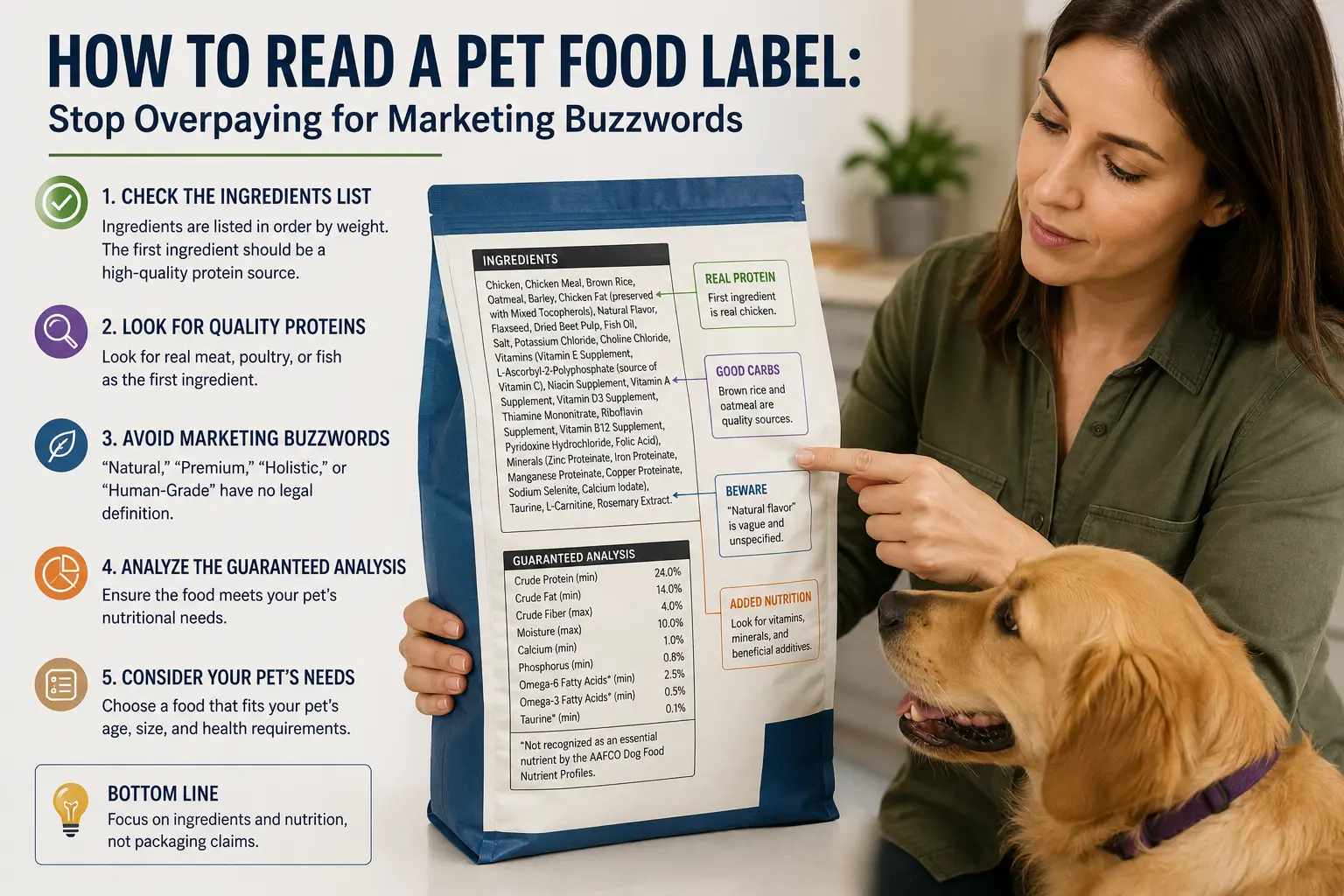
The most useful way to evaluate pet food is not to judge the package by its pictures or marketing language. Instead, learn how to read the parts of the label that provide information about species, life stage, nutritional adequacy, ingredients, guaranteed analysis, calories, and feeding directions.
This guide explains each section in plain language so you can make a more informed decision when comparing dog and cat foods.
Important: This article is for general educational purposes and is not veterinary or nutritional advice. Individual pets can have different nutritional needs because of age, body condition, activity level, allergies, medications, or medical conditions. If your pet has a diagnosed health condition or requires a therapeutic diet, consult your veterinarian before changing food.
Quick Answer: What Should You Look at First?
If you only have a few minutes to evaluate a pet-food package, start with these six areas:
- Species — Is it made for dogs or cats?
- Life stage — Is it appropriate for growth, adult maintenance, or another life stage?
- Nutritional adequacy statement — Is it intended to provide complete and balanced nutrition?
- Feeding directions — How much does the manufacturer recommend feeding?
- Calorie content — How many calories are in a cup, can, pouch, or other familiar unit?
- Ingredient list and guaranteed analysis — What does the product contain and what nutrients are guaranteed?
AAFCO identifies the nutritional adequacy statement as a particularly important part of the label because it helps match a food with a pet’s nutritional requirements.
Why Reading the Label Matters
The front of a pet-food package is designed to attract attention.
It may show:
- Pictures of meat
- Fruits and vegetables
- Happy-looking pets
- Claims such as “premium”
- Statements such as “natural”
- Large percentages such as “95% meat”
- Words such as “holistic”
- Lifestyle claims
These statements may provide useful information, but they should not be the only basis for choosing a food.
AAFCO explains that pet-food labels contain both required information and optional promotional information. The required sections are generally more useful when you are trying to determine what the food actually is and how it should be fed.
The 8 Main Parts of a Pet Food Label
A typical complete pet-food label can include:
- Product and brand name
- Species identification
- Quantity statement
- Guaranteed analysis
- Ingredient list
- Nutritional adequacy statement
- Feeding directions
- Calorie statement
AAFCO identifies these as key elements of pet-food labeling.
Let’s look at each one.
1. Product Name
Start with the product name.
The name can tell you something about how the manufacturer is presenting the product, but do not use the product name alone to determine whether it is appropriate as your pet’s primary diet.
For example, a package might be marketed as:
Chicken Dinner
or
Beef Recipe
or
Chicken & Rice Formula
The wording can describe the product, but you should continue reading the label.
AAFCO regulates how certain product-name claims are used, and its consumer guidance recommends looking beyond the front label when evaluating a pet food.
2. Check the Species
This sounds obvious, but it is one of the first things to verify.
Look for language identifying the intended species, such as:
Dog Food
or
Cat Food
Dogs and cats do not have identical nutritional requirements.
AAFCO specifically notes that pet food should be formulated for the intended species and that cats require certain nutrients that differ from dogs.
Simple rule
Dog food → dog
Cat food → cat
Do not assume that a product is interchangeable simply because both animals may eat similar ingredients.
3. Understand the Life Stage
The next question is:
Who is this food designed for?
Common life-stage categories include:
- Growth
- Maintenance
- Gestation/lactation
- All life stages
Different life stages can have different nutritional requirements.
For example, a growing puppy has different nutritional needs from a mature adult dog.
Similarly, a kitten is not nutritionally identical to an adult cat.
AAFCO explains that different quantities and ratios of nutrients are necessary for different life stages.
Puppy and Kitten Food
Growing animals require diets formulated for growth.
When looking at puppy or kitten food, check whether the nutritional adequacy statement identifies the food as appropriate for growth or another applicable life stage.
Do not assume that an adult-maintenance food is automatically appropriate for a growing animal.
Adult Maintenance Food
Adult-maintenance foods are intended for mature animals that are no longer growing.
If you have a healthy adult dog or cat, an appropriate maintenance food may be suitable as the primary diet.
However, individual health conditions can change what diet is appropriate.
“All Life Stages” Food
You may also see:
“All life stages”
This means the product is formulated to meet nutritional requirements across the life stages covered by the applicable nutritional standard.
It does not necessarily mean that every pet should eat it.
Always consider the individual animal.
4. The Nutritional Adequacy Statement
This is one of the most important parts of the label.
It is often printed in relatively small text on the back or side of the package.
Look for wording indicating that the product provides:
“complete and balanced” nutrition
for a particular species and life stage.
FDA explains that a nutritional adequacy statement containing “complete and balanced” indicates that the product is intended to provide a nutritionally balanced diet as the sole diet for the stated purpose.
AAFCO similarly describes nutritional adequacy as the key mechanism for matching a product to a pet’s nutritional needs.
What Does “Complete and Balanced” Mean?
In simple terms:
Complete
The food contains the nutrients required for the intended nutritional purpose.
Balanced
Those nutrients are provided in appropriate proportions.
AAFCO explains that “complete” and “balanced” are related but distinct concepts and that nutritional adequacy depends on the appropriate nutrient levels and ratios.
Does “AAFCO” Mean the Food Is Approved?
This is a common misunderstanding.
AAFCO does not approve, certify, or endorse individual pet-food products.
AAFCO establishes nutritional standards and model regulations that are used by states and the industry.
AAFCO itself specifically states that there is no such thing as an “AAFCO-approved” pet food.
So if a website says:
“AAFCO approved this brand”
be careful with that wording.
A more accurate question is:
What nutritional adequacy statement does the product carry?
Two Common Ways a Food Can Establish Nutritional Adequacy
AAFCO describes different ways a product may support a complete-and-balanced claim.
One approach is formulation to meet established nutrient profiles.
Another is substantiation through standardized feeding tests.
The exact wording appears in the nutritional adequacy statement on the package.
For consumers, the practical point is:
Read the complete statement rather than relying on a marketing phrase such as “premium” or “veterinarian recommended.”
Treats Are Different From Complete Pet Food
A bag of dog treats may contain a long ingredient list and attractive nutritional claims.
That does not mean it is intended to replace your dog’s regular food.
AAFCO notes that treats and snacks generally are not required to provide complete and balanced nutrition unless they are specifically labeled for such nutritional adequacy.
So check whether the product is:
Food
or
Treat/Snack
before deciding how it fits into your pet’s diet.
5. Ingredient List: How to Read It
The ingredient list can look complicated.
The basic rule is simple:
Ingredients are listed in descending order by weight.
That means the ingredient contributing the greatest weight is generally listed first, followed by the next, and so on.
AAFCO confirms that pet-food ingredients are listed from greatest to least by weight on an “as formulated” basis.
Does the First Ingredient Tell You Which Food Is Best?
Not by itself.
You may see:
Chicken
as the first ingredient.
That tells you chicken is first by weight in the ingredient statement.
It does not by itself tell you:
- Whether the food is nutritionally complete
- Whether your pet needs it
- How many calories the food contains
- Whether it is appropriate for a medical condition
- Whether the food is better than another complete food
The complete formulation matters.
Why Ingredients Near the End Can Still Matter
The last part of an ingredient list often contains smaller quantities of ingredients such as:
- Vitamins
- Minerals
- Nutritional additives
- Preservatives
- Other functional ingredients
AAFCO explains that these minor ingredients can contribute important nutrients even though they appear later in the list.
Therefore:
“It’s near the bottom, so it doesn’t matter.”
is not necessarily correct.
What Are “Chemical-Sounding” Ingredients?
Some pet-food ingredients have names that sound unfamiliar.
That does not automatically mean they are dangerous.
A pet-food formulation may contain specific:
- Vitamins
- Minerals
- Amino acids
- Preservatives
- Stabilizers
- Other permitted ingredients
AAFCO notes that minor ingredients can include vitamins, minerals, preservatives, conditioning agents, emulsifiers, stabilizers, and other functional components.
Instead of judging an ingredient solely because its name sounds unfamiliar, check its purpose and the overall nutritional formulation.
What About Meat By-Products?
“By-product” is a term that is often misunderstood.
It does not automatically mean:
“bad ingredient.”
The nutritional value of an ingredient depends on what it is and how it contributes to the overall formulation.
When evaluating pet food, avoid reducing the entire analysis to one word in the ingredient list.
A complete-and-balanced product is formulated to provide required nutrients through the combination of its ingredients.
6. Guaranteed Analysis
The guaranteed analysis provides percentages for certain nutrients.
Common guaranteed-analysis items include:
- Crude protein
- Crude fat
- Crude fiber
- Moisture
AAFCO explains that pet-food labels generally provide minimum guarantees for crude protein and crude fat and maximum guarantees for crude fiber and moisture, with additional nutrient guarantees possible when applicable.
What Does “Crude Protein” Mean?
Crude protein is an estimate of the amount of protein in the food based on a standard analytical method.
The word “crude” does not mean “poor quality.”
It refers to the analytical measurement method.
This number is useful for comparison, but it does not tell you everything about:
- Protein quality
- Amino-acid profile
- Digestibility
- Overall nutritional adequacy
Therefore, don’t choose food solely because it has the highest protein percentage.
What Does “Crude Fat” Mean?
Crude fat provides information about the amount of fat in the product according to the labeling analysis.
Fat is an important source of energy and provides essential fatty acids.
But more fat is not automatically better.
A dog’s or cat’s appropriate diet depends on the animal’s individual nutritional requirements.
What Does “Crude Fiber” Mean?
Crude fiber is a measure used in the guaranteed analysis to describe a portion of the food’s fiber content.
It should not be interpreted as the complete amount of dietary fiber in the product.
This is another reason why comparing foods using only one guaranteed-analysis number can be misleading.
What Does “Moisture” Mean?
Moisture tells you how much water is present in the food.
This matters particularly when comparing:
Dry food vs. wet food
A canned food may have a much higher moisture percentage than dry kibble.
That can make direct protein or calorie comparisons more complicated.
Why You Should Be Careful Comparing Protein Percentages
Suppose:
Dry Food
Protein:
30%
Wet Food
Protein:
10%
It may look like the dry food has three times as much protein.
But wet food contains much more water.
The better comparison may be on a dry-matter basis when you are comparing nutrient percentages between foods with significantly different moisture levels.
AAFCO explains that guaranteed-analysis values are generally presented on an “as fed” basis and that moisture differences need to be considered when making certain nutritional comparisons.
Dry-Matter Comparison: Basic Example
Suppose a wet food contains:
10% protein
and:
75% moisture
Dry matter:
100 − 75 = 25%
Approximate dry-matter protein:
10 ÷ 25 × 100 = 40%
So the food’s protein concentration on a dry-matter basis would be approximately:
40%
This example demonstrates why a direct comparison of the printed percentages can be misleading.
For accurate nutritional comparisons, use the appropriate calculation and reliable label information.
7. Calorie Content
Calories are one of the most useful pieces of information on a pet-food label.
Look for:
Calorie Content
AAFCO explains that calorie information is expressed in kilocalories per kilogram and also in a more familiar unit such as per cup, can, or biscuit.
This makes it easier to estimate how many calories your pet receives.
Why Calories Matter More Than Package Price
Consider two foods.
Food A
$30 per bag
Food B
$40 per bag
You cannot determine which is cheaper to feed just from these prices.
You need to know:
- Total calories
- Feeding amount
- Package size
- Your pet’s calorie requirements
A more expensive bag can sometimes provide a lower cost per calorie.
Example: Cost Per 100 Calories
Suppose:
Food A
Price = $30
Total calories = 12,000 kcal
Cost per 100 calories:
$30 ÷ 12,000 × 100 = $0.25
Now:
Food B
Price = $36
Total calories = 18,000 kcal
Cost per 100 calories:
$36 ÷ 18,000 × 100 = $0.20
Food B costs more at checkout but less per 100 calories.
This is a much more useful financial comparison.
Why “Low Calories” Doesn’t Automatically Mean Better
A lower-calorie food is not automatically healthier.
AAFCO specifically notes that calorie content should not be the sole factor in choosing a pet food because nutritional needs vary with life stage and condition.
A growing puppy may need a different calorie intake from a sedentary adult dog.
A highly active working dog may have different energy requirements again.
8. Feeding Directions
The feeding table tells you how much the manufacturer recommends feeding.
It may be based on:
- Body weight
- Life stage
- Activity
- Other factors
AAFCO explains that feeding directions for complete and balanced foods should provide information on the amount to feed based on animal weight and life stage.
But remember:
Feeding directions are guidelines.
Your veterinarian can help adjust feeding based on your pet’s:
- Weight
- Body condition
- Activity
- Age
- Health
Why Feeding Directions Affect Your Budget
Suppose:
Food A costs $40 per bag
but your dog needs:
4 cups/day
while:
Food B costs $50 per bag
and your dog needs:
3 cups/day
The cheaper bag may not actually be cheaper per day.
This is why the proper comparison is:
Package cost → calories → daily feeding amount → monthly cost
Calculate Your Monthly Pet-Food Cost
A simple calculation is:
Daily food cost × 30 = estimated monthly cost
For example:
$1.50/day × 30 = $45/month
Annual estimate:
$45 × 12 = $540/year
This can help you include pet food accurately in your household budget.
What Is the “Guaranteed Analysis” Not Telling You?
The guaranteed analysis is useful, but it has limitations.
It does not by itself tell you:
- Whether the food is complete and balanced
- Whether your pet needs that food
- Protein digestibility
- Overall ingredient quality
- Exact amount of every nutrient
- Whether the food is suitable for a medical condition
That’s why you should read the label as a whole.
Marketing Claims: What Should You Be Careful With?
Pet-food packaging may include claims such as:
- Natural
- Premium
- Holistic
- Human-grade
- Grain-free
- High protein
- Limited ingredient
- Digestive support
- Weight management
- Healthy skin
- Healthy coat
These terms should not replace the fundamental label checks.
Start with:
Species → Life stage → Nutritional adequacy → Calories → Feeding directions → Ingredients → Guaranteed analysis
Then consider additional marketing claims.
“Natural” Does Not Mean Automatically Better
“Natural” is a regulated claim with specific requirements in pet-food labeling contexts, but it should not be interpreted as:
“This is automatically the healthiest food.”
The overall formulation still matters.
AAFCO includes “natural” among the descriptive claims addressed in its pet-food labeling guidance.
“Human-Grade” Does Not Mean Human Food
Human-grade is a specific pet-food marketing term with requirements.
AAFCO notes that “human-grade” has specific guidelines and should not simply be interpreted as “people can eat this product.”
Your pet’s nutritional requirements remain the central consideration.
“Grain-Free” Does Not Automatically Mean Better
Grain-free is a formulation characteristic.
It does not automatically mean:
- Higher quality
- More nutritious
- Better digestion
- Better for allergies
If your pet has a suspected food allergy or medical condition, discuss diet selection with your veterinarian.
“High Protein” Does Not Automatically Mean Better
Protein requirements depend on the animal and life stage.
A higher percentage on the guaranteed analysis is not sufficient reason to choose one food over another.
Consider:
- Nutritional adequacy
- Life stage
- Calories
- Overall formulation
- Your pet’s individual needs
“Limited Ingredient” Does Not Mean “Complete”
A limited-ingredient product may contain fewer major ingredients, but that does not automatically tell you whether it is appropriate as a complete diet.
Check the nutritional adequacy statement.
“Veterinarian Recommended” Claims
If a package or advertisement says:
“Veterinarian recommended”
look at the actual wording and context.
A marketing claim does not replace the nutritional adequacy statement.
Also remember that a diet appropriate for one pet may not be appropriate for another.
Dog Food vs. Cat Food Labels
Don’t treat dog and cat food labels as interchangeable.
Cats have nutritional requirements that differ from dogs.
AAFCO specifically notes that cats require nutrients such as taurine and pre-formed vitamin A that dogs do not require in the same way.
Therefore:
Always check the species designation.
What About Veterinary Therapeutic Diets?
Some pet foods are designed for specific medical purposes.
Examples may include diets intended for animals with certain:
- Kidney conditions
- Urinary conditions
- Gastrointestinal conditions
- Weight-management needs
- Other health problems
These diets should be used according to veterinary guidance where appropriate.
Do not assume that a regular grocery-store food with a similar marketing phrase is an equivalent substitute.
How to Read a Pet Food Label in 60 Seconds
If you’re standing in a store and need a quick method, use this sequence:
Step 1 — Species
Dog or cat?
Step 2 — Life stage
Puppy/kitten, adult, or another stage?
Step 3 — Nutritional adequacy
Is it complete and balanced for the intended purpose?
Step 4 — Calories
How many kcal per cup, can, or other unit?
Step 5 — Feeding directions
How much would your pet need each day?
Step 6 — Ingredients
What are the major ingredients and other components?
Step 7 — Guaranteed analysis
What are the protein, fat, fiber, and moisture guarantees?
Step 8 — Cost
What will it actually cost per day or month?
This approach is more useful than choosing a product based on the front of the package.
Pet Food Label Comparison Example
Imagine you’re comparing two adult dog foods.
| Factor | Food A | Food B |
|---|---|---|
| Species | Dog | Dog |
| Life stage | Adult | Adult |
| Complete & balanced | Yes | Yes |
| Calories/cup | 350 | 430 |
| Protein | 24% | 26% |
| Fat | 12% | 15% |
| Price | $35 | $42 |
| Daily amount | 3 cups | 2.5 cups |
| Estimated daily cost | $___ | $___ |
The correct conclusion is not automatically:
“Food B has more protein, so it is better.”
Instead, evaluate the entire picture.
A Simple Pet Food Label Checklist
Before buying a new food, ask:
- Is it for my pet’s species?
- Is the life stage appropriate?
- Does it have an appropriate nutritional adequacy statement?
- Is it intended as a complete diet or only a treat/supplement?
- What is the calorie content?
- What are the feeding directions?
- What are the guaranteed protein and fat levels?
- What is the moisture level?
- Have I reviewed the ingredient list?
- Does the product fit my pet’s health needs?
- Does the daily cost fit my budget?
- Have I discussed major dietary changes with my veterinarian if necessary?
Common Pet Food Label Mistakes
Mistake 1: Choosing the First Ingredient Only
The first ingredient does not tell the entire nutritional story.
Mistake 2: Choosing the Highest Protein
More protein is not automatically better for every pet.
Mistake 3: Comparing Wet and Dry Food Directly
Moisture differences can make printed percentages misleading.
Mistake 4: Ignoring Calories
A lower package price does not necessarily mean a lower feeding cost.
Mistake 5: Ignoring Life Stage
Puppy, kitten, adult, and other life stages can have different requirements.
Mistake 6: Treating Marketing Claims as Nutrition Facts
“Premium,” “natural,” or “grain-free” should not replace the nutritional adequacy check.
Mistake 7: Assuming AAFCO “Approved” Means Certification
AAFCO does not approve or certify individual pet-food products.
How Label Reading Can Save Money
Understanding the label can also improve your pet budget.
Suppose:
Food A = $45/bag
Food B = $55/bag
Food B looks more expensive.
But after checking calories and feeding directions:
Food A = $1.70/day
Food B = $1.40/day
Annual difference:
($1.70 − $1.40) × 365 = $109.50
In this example, the more expensive package actually costs less to feed.
This is why cost per day is more useful than shelf price.
When Should You Ask a Veterinarian Before Changing Food?
Consider speaking with your veterinarian before making a significant diet change if your pet:
- Has kidney disease
- Has diabetes
- Has a diagnosed food allergy
- Has chronic digestive problems
- Has urinary disease
- Is significantly overweight or underweight
- Is pregnant or nursing
- Is a growing puppy or kitten with special needs
- Takes medications that may interact with diet
- Is already eating a therapeutic veterinary diet
If your pet is sick, AAFCO advises owners to seek veterinary care and advice rather than trying to manage the condition through food selection alone.
What If Your Pet Does Not Like the New Food?
Don’t assume that refusing a new food simply means the product is “bad.”
Pets can have individual preferences.
If you are changing foods, a gradual transition may be easier for many animals than an abrupt switch.
If your pet refuses food for an extended period or has other symptoms such as vomiting, diarrhea, lethargy, or weight loss, contact a veterinarian.
Frequently Asked Questions
What is the most important part of a pet-food label?
For determining whether a food is designed to meet nutritional needs, the nutritional adequacy statement is one of the most important sections.
What does complete and balanced mean?
It indicates that the food is intended to provide the necessary nutrients in appropriate amounts and proportions for the stated nutritional purpose.
Does AAFCO approve pet food?
No. AAFCO does not approve, certify, or endorse individual pet-food products.
What does crude protein mean?
It is a standardized measurement of protein content used in the guaranteed analysis. It does not by itself measure overall protein quality or determine whether a food is best for your pet.
Why is moisture important?
Moisture affects how nutrient percentages should be interpreted, particularly when comparing wet and dry foods.
Should I choose the food with the highest protein?
Not necessarily. Nutritional needs depend on species, life stage, health, and other factors.
Is the first ingredient the most important ingredient?
It is important because ingredients are listed by weight, but it is only one part of evaluating the overall formulation.
How do I compare wet and dry pet food?
Consider moisture, calories, feeding amounts, and—when appropriate—dry-matter nutrient comparisons rather than comparing printed percentages alone.
Are treats complete and balanced?
Usually not. AAFCO notes that treats and snacks are generally not intended to provide complete and balanced nutrition unless specifically labeled for that purpose.
How do I calculate the cost of pet food?
Use the package price, total calories, and your pet’s estimated daily feeding amount to calculate an approximate daily and monthly cost.
Is expensive pet food automatically better?
No. Price is only one factor. Evaluate nutritional adequacy, life stage, calories, feeding directions, formulation, and your pet’s individual needs.
Our Pet Food Label Evaluation Method
At PetPolicyFinance.com, we recommend evaluating pet food using seven practical factors:
| Factor | Importance |
|---|---|
| Nutritional adequacy | 25% |
| Species & life-stage suitability | 20% |
| Calorie density & feeding requirements | 15% |
| Guaranteed analysis | 10% |
| Ingredient information | 10% |
| Individual pet tolerance | 10% |
| Cost per day | 10% |
These percentages are our editorial framework, not an official AAFCO or veterinary scoring system.
The purpose is to prevent one attractive feature—such as a high-protein claim or low package price—from dominating the entire decision.
The 30-Second Rule
When evaluating a new pet food, remember:
Don’t start here:
“Does the package look premium?”
Start here:
“Is this the right food for my pet?”
Then check:
Species → Life stage → Nutritional adequacy → Calories → Feeding directions → Ingredients → Guaranteed analysis → Cost
That sequence will give you a much more useful picture of the product.
Final Takeaway
A pet-food label contains much more useful information than the marketing claims on the front of the package.
You don’t need to understand every scientific term to make a better comparison.
Start with the fundamentals:
1. Check the species.
2. Check the life stage.
3. Find the nutritional adequacy statement.
4. Confirm whether the food is complete and balanced for its intended purpose.
5. Check calorie content.
6. Read the feeding directions.
7. Review the ingredient list.
8. Understand the guaranteed analysis.
9. Consider your pet’s individual needs.
10. Calculate the real cost per day.
The goal is not to find a package with the most impressive words.
The goal is to find a food that is appropriate for your pet, nutritionally suitable, practical to feed, and sustainable for your household budget.
And if your pet has a medical condition or needs a therapeutic diet, a veterinarian should be part of the decision.
Sources & Editorial Methodology
This article is based primarily on regulatory and veterinary-information sources rather than brand advertising.
AAFCO — Association of American Feed Control Officials
AAFCO provides detailed consumer guidance on pet-food labels, including:
- Ingredient lists
- Guaranteed analysis
- Nutritional adequacy
- Feeding directions
- Calories
- Life stages
- Treats and supplements
- Label claims
AAFCO — How to Understand a Dog or Cat Food Label
U.S. Food & Drug Administration
The FDA provides information about pet-food regulation and explains how the “complete and balanced” nutritional adequacy statement helps consumers determine whether a product is intended to meet a pet’s nutritional needs.
FDA — Complete and Balanced Pet Food
Editorial Method
This article does not rank specific pet-food brands as universally “best.”
Instead, it provides a repeatable method for comparing products based on label information, nutritional purpose, calorie content, feeding requirements, individual pet needs, and cost.
Pet-food formulas, labels, prices, and regulations can change. Readers should always check the current package label and consult a veterinarian when their pet has specific medical or nutritional needs.
Last Reviewed: August 2026
Author: Harry Mills
