

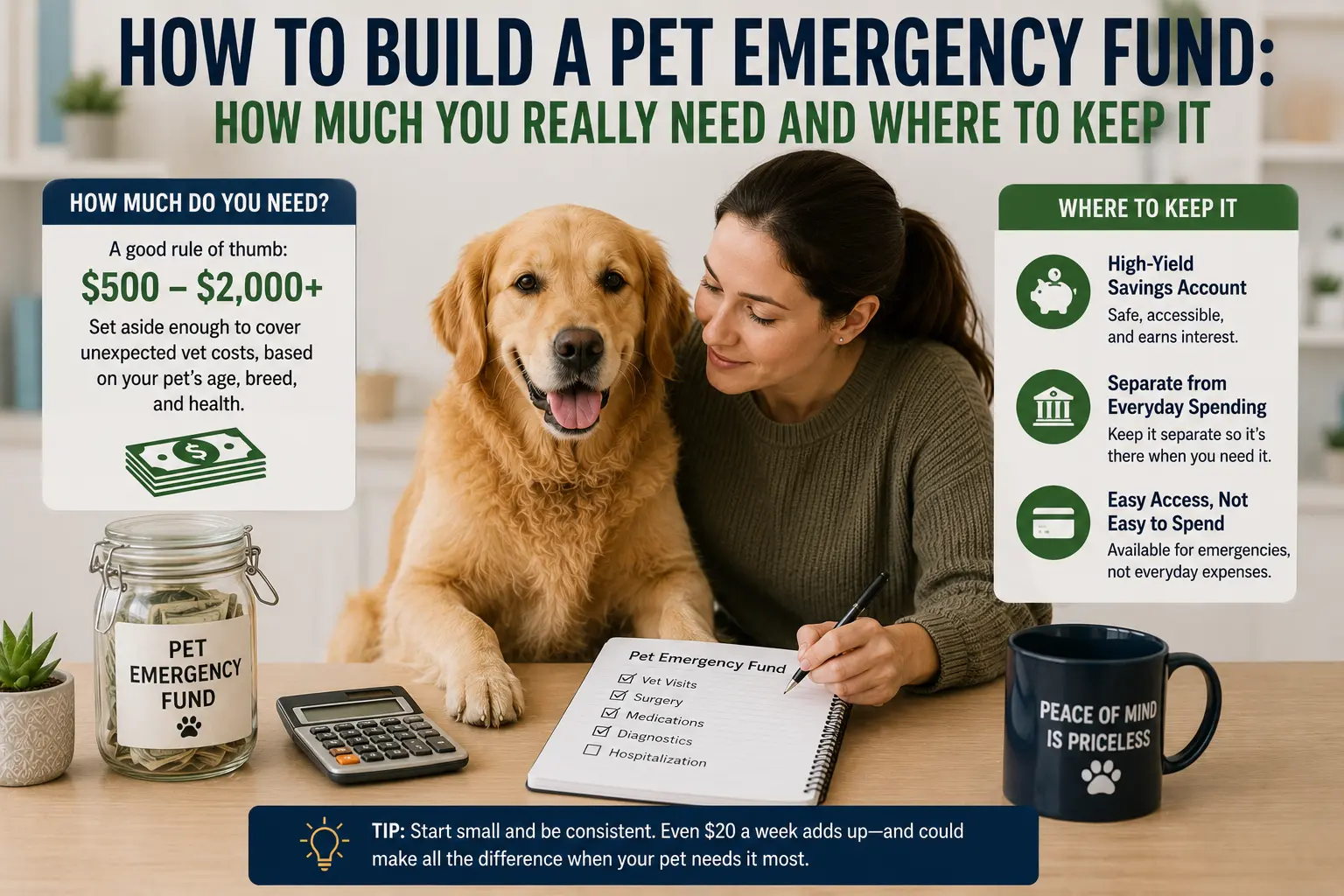
Most pet owners know they should have money set aside for a veterinary emergency. Far fewer actually do it. And when a crisis hits — a broken leg, a swallowed foreign object, a sudden diagnosis of cancer — the gap between “I know I should have saved” and “I have no idea how to pay for this” becomes one of the most stressful moments a pet owner can face.
This guide is here to close that gap. We’re going to walk through exactly how much you need in a pet emergency fund, where the smartest place to keep it is, and how to build it up even if you’re starting from zero. This isn’t vague financial advice — it’s a practical, step-by-step plan built specifically for pet owners.
Why a Pet Emergency Fund Is Non-Negotiable in 2025
Veterinary costs have risen significantly over the past decade. The American Pet Products Association estimates that Americans now spend more than $35 billion per year on veterinary care, a figure that has more than doubled since 2010. Emergency and specialty care, in particular, has surged in price.
To put some real numbers on it:
- Emergency vet visit (exam + diagnostics): $300 – $1,500
- Broken bone (surgery + aftercare): $1,500 – $4,000
- Intestinal blockage surgery: $2,000 – $5,000
- Cancer diagnosis and treatment: $5,000 – $20,000+
- Ruptured cruciate ligament (dogs): $3,000 – $6,000
- Urinary blockage (cats): $1,000 – $3,500
Pet insurance helps, but it isn’t instant — you pay upfront and get reimbursed later, meaning you still need liquidity. Payment plans like CareCredit are useful tools, but they’re not a substitute for savings you actually control.
The cold truth: if you own a pet, a large vet bill isn’t a possibility. It’s an eventual certainty. The only question is whether you’ll be ready for it.
How Much Should You Actually Save?
This is the question everyone asks and almost no one answers directly. Here’s a clear framework:
The Baseline: $1,000 – $2,000 Per Pet
For most households with one or two pets, a minimum emergency fund of $1,000 to $2,000 per pet is a reasonable floor. This covers the majority of common emergencies — digestive issues, infections, minor injuries, and most urgent care visits — without wiping out your finances.
If you have one dog and one cat, aim for $2,000 to $3,000 combined as a starting target.
The Comfort Zone: $3,000 – $5,000
A fund in the $3,000 to $5,000 range handles most non-catastrophic emergencies comfortably, including many surgeries and multi-day hospitalizations. For most pet owners, this is the sweet spot — enough to handle nearly any common emergency without debt.
The Full Safety Net: $5,000+
If you have multiple pets, own a large breed dog (which typically incurs higher medical costs), or have a pet with a known health condition or genetic predispositions (e.g., English Bulldogs, Maine Coons, Dachshunds), a fund of $5,000 or more provides genuine peace of mind and covers most scenarios short of prolonged cancer treatment.
The Honest Answer: Base It on Your Pet’s Risk Profile
The “right” amount depends on several factors specific to your situation:
Your pet’s age: Puppies and kittens are accident-prone. Senior pets (7+ years for most breeds) face significantly higher rates of chronic illness, dental disease, cancer, and organ failure. The older your pet, the larger your fund should be.
Your pet’s breed: Certain breeds carry well-documented health risks. If you own a French Bulldog, a Persian cat, a Great Dane, or a Golden Retriever, you are statistically more likely to face expensive veterinary situations. Research your breed’s common health issues and let that inform your savings target.
Your pet’s current health status: A pet with a known chronic condition (diabetes, epilepsy, heart disease, allergies) will have recurring costs. Those should be factored into your regular budget separately from your emergency fund.
Whether you carry pet insurance: If you have a good pet insurance policy with high reimbursement rates, your emergency fund can be smaller — essentially a deductible buffer. If you don’t have insurance, your fund needs to do more work.
Quick Reference: Savings Targets by Situation
| Situation | Recommended Fund |
|---|---|
| 1 young, healthy small pet + no insurance | $1,500 – $2,500 |
| 1 young, healthy large breed dog + no insurance | $2,500 – $4,000 |
| Multiple pets, mixed ages + no insurance | $4,000 – $6,000 |
| Any pet + good pet insurance policy | $1,000 – $2,000 (deductible buffer) |
| Senior pet (7+ years) + no insurance | $3,000 – $5,000+ |
| High-risk breed (Bulldog, GSD, Maine Coon) | $4,000 – $7,000 |
Where Should You Keep Your Pet Emergency Fund?
Location matters. Your pet emergency fund has two competing requirements: it needs to be accessible quickly (emergencies don’t wait for business days) and it needs to actually grow over time (not just sit idle). Here are the best options, ranked:
1. High-Yield Savings Account (HYSA) — Best Option for Most People
A high-yield savings account at an online bank is the gold standard for emergency funds of any kind, including pet funds. In 2025, the best HYSAs offer annual percentage yields (APYs) in the range of 4.00% to 5.25%, compared to the national average of just 0.45% at traditional banks.
Why it works for pet emergencies:
- Money is FDIC-insured (safe up to $250,000)
- Funds are typically available within 1–2 business days via transfer
- You earn meaningful interest while the money sits idle
- Separate from your checking account, reducing the temptation to spend it
Recommended providers to compare:
- Marcus by Goldman Sachs — consistently competitive rates, no fees
- Ally Bank — excellent user experience, strong mobile app, easy transfers
- SoFi — high APY, no minimum balance, pairs well with direct deposit
- Discover Online Savings — solid rates, well-established brand
Pro tip: Open a dedicated savings account labeled specifically “Pet Emergency Fund.” The naming psychology matters — when it’s visually separate and labeled, people are far less likely to raid it for non-emergencies.
2. Money Market Account (MMA)
A money market account is similar to a high-yield savings account but often comes with check-writing privileges or a debit card, making it slightly more immediately accessible. Interest rates are competitive with HYSAs.
If your emergency vet clinic doesn’t accept bank transfers and you’d need to write a check or pay immediately, a money market account has a practical advantage. Some vets accept card payments at checkout — check with your regular clinic and any emergency hospitals in your area.
3. Cash Management Account (CMA)
Offered by brokerages like Fidelity and Schwab, cash management accounts often offer market-beating interest rates, FDIC insurance through partner banks, and easy ATM access. These are worth considering for pet owners who already use these platforms for investing.
Fidelity Cash Management Account and Schwab Bank High Yield Investor Checking are two strong options that combine accessibility with solid yields.
4. Short-Term CD Ladder (Advanced Strategy)
If your pet is young and healthy and you’re building toward a larger long-term fund, a certificate of deposit (CD) ladder can maximize your interest earnings. You split your savings across multiple CDs with staggered maturity dates (e.g., 3-month, 6-month, 12-month), so a portion is always coming available while the rest earns higher locked-in rates.
This strategy is best as a complement to — not a replacement for — a liquid HYSA. Keep at least $1,000 in a fully liquid account at all times.
What NOT to Do
Don’t keep it in a regular checking account. Interest rates at major banks on checking accounts are often 0.01% APY or less. You’re leaving real money on the table, and the funds are too easily spent.
Don’t keep it in cash at home. It earns nothing, isn’t protected, and creates a risk of it quietly disappearing into everyday expenses.
Don’t invest it in stocks or crypto. Emergency funds need to be stable and liquid. The last thing you need is to discover your pet emergency fund dropped 30% right when you need it most.
Don’t rely on a credit card as your “emergency fund.” Credit cards are tools, not savings. High interest rates can turn a $2,000 vet bill into a $3,000+ debt spiral if you can’t pay it off quickly.
How to Build Your Pet Emergency Fund From Zero
Knowing how much to save is one thing. Actually getting there is another. Here is a step-by-step system that works even on a tight budget.
Step 1: Open a Dedicated Account Today
Before you save a single dollar, open the account. This sounds basic, but it’s the most important step. Friction is the enemy of saving. If the account already exists, all you have to do is move money into it.
Go to Ally, Marcus, or SoFi right now and open a high-yield savings account. It takes about 10 minutes. Name it “Pet Emergency Fund.”
Step 2: Set a Starter Goal, Not a Final Goal
Don’t let the full target number ($3,000, $5,000) paralyze you. Set a starter goal of $500. Research consistently shows that reaching a first milestone dramatically increases the likelihood of continued saving. Once you hit $500, the next $500 feels much more achievable.
Step 3: Automate a Weekly or Monthly Transfer
This is the highest-impact habit you can build. Set up an automatic recurring transfer from your checking account to your pet emergency fund — even if it’s just $25 or $50 per week. Over a year:
- $25/week = $1,300 saved (+ interest)
- $50/week = $2,600 saved (+ interest)
- $100/week = $5,200 saved (+ interest)
Automation removes willpower from the equation. You don’t have to “decide” to save every week — it just happens.
Step 4: Redirect Pet-Related Windfalls
Anytime you save money on pet expenses, redirect the savings directly to the fund:
- Got a coupon for pet food? Move that dollar amount to the fund.
- Switched to a less expensive flea medication? Move the difference.
- Birthday money you hadn’t counted on? Put a portion in the pet fund.
- Tax refund? A portion goes straight in.
These small redirects add up faster than you’d expect.
Step 5: Reduce One Recurring Cost and Redirect It
Look at your current spending on your pet and identify one area where you can make a smarter choice without compromising care:
- Switch to a store-brand pet food that meets the same nutritional standards
- Buy flea/tick prevention in bulk (3-month or 6-month supply)
- Groom your pet at home instead of monthly professional grooming
- Price-compare pet medications (GoodRx works for many pet prescriptions)
Even $20 to $40 per month redirected to your fund adds $240 to $480 per year.
Step 6: Build a Savings Timeline
Use this simple table to estimate how long it will take you to reach your goal based on monthly contributions:
| Monthly Savings | $1,000 Goal | $2,500 Goal | $5,000 Goal |
|---|---|---|---|
| $50/month | 20 months | 50 months | 100 months |
| $100/month | 10 months | 25 months | 50 months |
| $150/month | 7 months | 17 months | 33 months |
| $200/month | 5 months | 13 months | 25 months |
| $300/month | 4 months | 9 months | 17 months |
(Excludes interest earnings, which reduce these timelines slightly)
If the timeline feels too long, look for one-time ways to jump-start the fund — a portion of a bonus, a side gig for a month, selling unused items online.
Pet Emergency Fund vs. Pet Insurance: Do You Need Both?
Yes — ideally, you want both. They serve different functions.
Pet insurance handles the big, catastrophic expenses that can run into thousands of dollars. A good policy reimburses 80–90% of covered costs, which can save you $5,000 to $15,000 on a serious illness or injury.
Your emergency fund handles the gap — deductibles, non-covered treatments, conditions that were pre-existing at enrollment, and expenses before you hit your deductible. It also serves as a bridge while you wait for reimbursement (most insurers take 7–14 days to process claims).
The combination looks like this in practice:
Your dog needs emergency surgery costing $4,000. Your pet insurance covers 80% after a $500 deductible. Your out-of-pocket cost is approximately $1,300 ($500 deductible + 20% of $3,500). Your emergency fund pays the $1,300 upfront. Your insurance reimburses you within 10 days. You replenish your fund over the next few months.
Without the fund, even with great insurance, you’d need to come up with $1,300 immediately at a time of crisis. With both tools in place, it’s manageable.
5 Rules to Protect Your Pet Emergency Fund
Once you’ve built your fund, protect it with these simple rules:
Rule 1 — It’s for emergencies only. A pet emergency fund is not a general pet expense account. Routine vet visits, vaccines, food, toys, and grooming come out of your regular monthly budget. The emergency fund is for unexpected, urgent, or serious medical situations only.
Rule 2 — Replenish it immediately after use. If you tap the fund, restart automatic contributions to bring it back to your target as quickly as possible. Don’t let it sit depleted.
Rule 3 — Review your target annually. As your pet ages, your target should increase. A 2-year-old dog has very different risk than a 10-year-old dog. Reassess your savings target every year at your pet’s annual wellness exam.
Rule 4 — Keep it separate from your human emergency fund. Your personal emergency fund (3–6 months of living expenses) is a different account for different purposes. Mixing them creates confusion and risks leaving you short in both areas.
Rule 5 — Tell your household about it. If you share finances with a partner or family member, make sure they know the account exists, what it’s for, and what the login is. In a real emergency, you may not be the one handling the transaction.
Final Thoughts: The Best Time to Start Was Yesterday
No one wants to think about their pet getting seriously ill or injured. But the families who’ve been through a $4,000 emergency vet visit will tell you, unanimously, that the financial stress makes an already terrible situation dramatically worse.
Building a pet emergency fund is one of the most loving things you can do for an animal in your care. It means that if the worst happens, the only thing you have to think about is getting your pet the help they need — not how you’re going to pay for it.
Start small. Start today. Open the account, set the auto-transfer, and let time and compound interest do the rest.
Your pet is counting on you. And now you have a plan.
This article is for informational purposes only and does not constitute financial advice. Interest rates and account features change frequently — always check current rates directly with your financial institution. For veterinary cost estimates, consult with a licensed veterinarian in your area.
